
Proactive hiring is a strategic approach where recruiting teams engage and nurture candidates before roles are officially approved, leading to a 40–60% faster time-to-fill and a 25% improvement in quality-of-hire compared to reactive hiring. Key benefits include reduced hiring emergencies, enhanced candidate experience, and stronger employer branding. Implementing proactive hiring involves maintaining warm talent pools, continuous outreach, quarterly talent mapping, producing employer-brand content, and establishing year-round referral programs, starting with a focused pilot program within a 90-day timeframe.
Proactive hiring is a forward-looking talent-acquisition approach where recruiting teams identify, engage, and nurture candidates before a role is ever approved. Teams using this model report 40–60% faster time-to-fill and roughly 25% improvement in quality-of-hire compared to purely reactive processes. If your organization is ready to shift, schedule a 30-minute talent-mapping meeting with your top three hiring managers this week — that single conversation is the lowest-effort way to start a 90-day pilot.
Table of Contents
- What is proactive hiring, exactly?
- Reactive vs. proactive hiring: how do they actually differ?
- Key benefits of proactive hiring
- The five core pillars that make proactive hiring work
- How to implement proactive hiring: a 30/60/90 checklist
- Which KPIs tell you if proactive hiring is working?
- Which tools support a proactive hiring program?
- Common pitfalls to avoid when shifting to proactive hiring
- How Cs-recruiters runs proactive hiring: a client example
- Your 90-day pilot plan: next steps for hiring teams
- Key Takeaways
- The part most guides skip
- How Cs-recruiters supports your proactive hiring pilot
- Useful sources
- FAQ
What is proactive hiring, exactly?
Proactive recruiting is the practice of sourcing, engaging, and nurturing candidates — often passive talent who are not actively job-searching — before a vacancy exists. The goal is to have qualified, relationship-warmed candidates ready to move when a role opens, rather than scrambling to build a list from scratch.
A few terms get used interchangeably in this space, so it helps to pin down the distinctions:
- Proactive recruiting — the overall strategy of building candidate relationships ahead of need
- Proactive sourcing — the tactical activity of finding and first-contacting potential candidates
- Talent pipeline — a staged, moving set of candidates at different readiness levels (identified → engaged → qualified → ready to hire)
- Talent pool — a broader collection of names and profiles, not necessarily staged or actively nurtured
- Pipeline building — the ongoing process of moving candidates through those readiness stages
Typical proactive activities include talent mapping, passive outreach on LinkedIn and niche communities, employer-brand content published on social channels, and structured referral programs that run year-round rather than only when a req is open.
Reactive vs. proactive hiring: how do they actually differ?
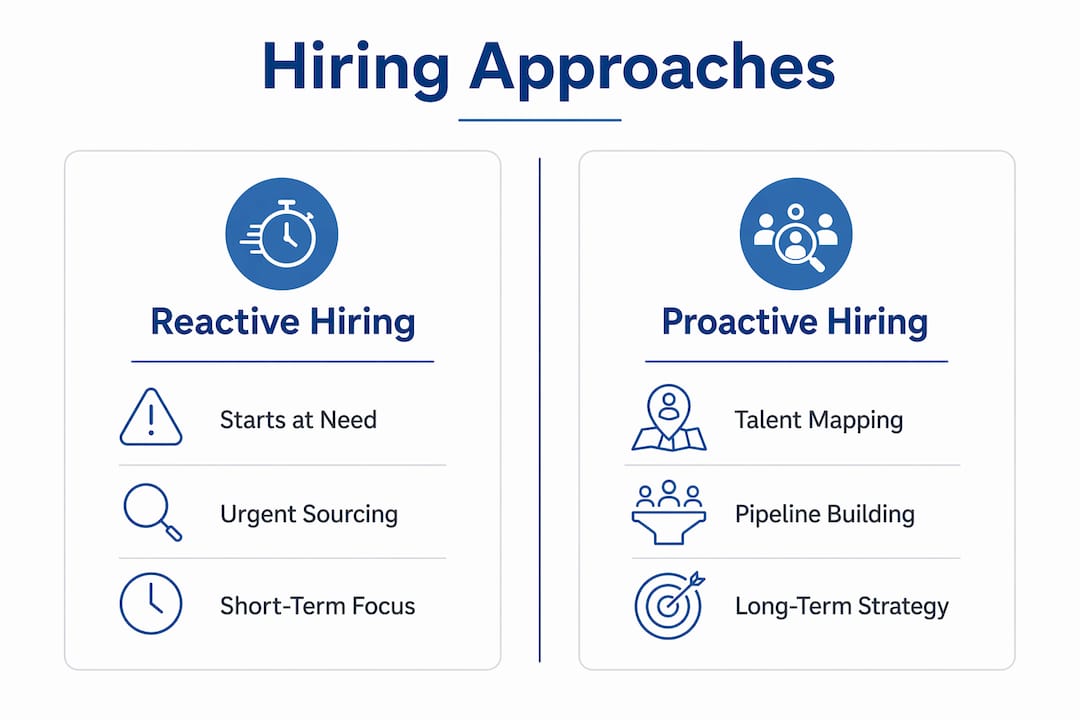
The clearest way to understand the difference is to look at where each approach starts. Reactive recruiting begins after a role is approved: post the job, wait for applicants, screen, and hire under time pressure. Proactive recruiting treats sourcing as a continuous background process, so candidates are already warm when the req arrives.

| Dimension | Reactive hiring | Proactive hiring |
|---|---|---|
| Trigger | Role approved, req opened | Ongoing, independent of open reqs |
| Candidate type | Primarily active job-seekers | Primarily passive candidates |
| Time-to-fill impact | Full sourcing window (15–25 days) consumed | Sourcing window largely eliminated |
| Resource load | Concentrated, high-pressure bursts | Distributed, lower-pressure cadence |
| Candidate relationship | Starts at application | Starts weeks or months earlier |
| Hiring-manager alignment | Reactive, post-req | Planned, pre-req |
When proactive hiring wins:
- Specialized or technical roles where passive candidates dominate the talent market
- Recurring role types (e.g., software engineers, sales reps) with predictable volume
- Planned headcount growth tied to a product launch or expansion
- Senior leadership searches where relationship-building takes months
When reactive hiring still makes sense:
- Unplanned departures that need an immediate backfill
- Roles with abundant active applicants and short skill-ramp times
- One-off positions outside your core hiring cadence
The practical answer for most teams: run both. Proactive pipelines reduce fire drills; reactive processes handle the gaps that pipelines cannot anticipate.
Key benefits of proactive hiring
The business case for proactive talent acquisition is straightforward once you look at where time and money actually go in a typical hiring cycle.
- Faster time-to-fill. Because sourcing typically consumes 15–25 days of the average 44-day time-to-fill, having pre-identified candidates can eliminate that window almost entirely.
- Higher quality-of-hire. Warm pipelines let recruiters assess fit over multiple touchpoints rather than a single rushed interview loop.
- Fewer hiring emergencies. When a key player leaves, a pre-built pipeline means the team is not starting from zero.
- Better candidate experience. Candidates who have been nurtured over time feel valued, not processed — and acceptance rates reflect that.
- Stronger employer brand. Consistent, low-pressure outreach and content positions the company as a desirable employer before candidates are even evaluating options.
- Improved retention. Candidates who know the organization before they join tend to have more realistic expectations and stay longer.
Stat to know: Teams with warm, aligned pipelines report 40–60% faster time-to-fill and roughly 25% improvement in quality-of-hire — two metrics that directly affect both hiring cost and business performance.
The ROI argument is straightforward. Shortening a 44-day fill to 20–25 days reduces the productivity gap on the team, lowers the cost of overtime or contract coverage, and frees recruiters from the high-pressure, high-error conditions that come with emergency hiring.
The five core pillars that make proactive hiring work
Proactive hiring is not a single tactic — it is a set of interlocking practices that, together, keep your pipeline warm. Here is how each pillar operates and where it fits in the cadence.
-
Always-warm talent pools. Segment candidates by function and level, then stage them: Identified (found, not yet contacted) → Engaged (first outreach sent, response received) → Qualified (screened, fit confirmed) → Ready (willing to move within 30–60 days). A talent pipeline implies movement through these stages; a pool without staging is just a list.
-
Continuous passive outreach. For recurring roles, sourcing should run as a background process every week, not only when a req opens. For anticipated one-off needs, intensify outreach 2–3 months before the expected opening.
-
Quarterly talent mapping. Every quarter, sit down with hiring managers to forecast headcount needs, identify critical roles, and map the external talent market. This session is where pipeline priorities get set and sourcing resources get allocated. A structured talent mapping process turns vague “we might need someone” conversations into a sourcing plan with names attached.
-
Employer-brand content. Proactive recruitment treats recruiting like marketing — publishing content on LinkedIn, Glassdoor, and niche communities that passive candidates already follow. The goal is to be known and credible before a candidate is even evaluating a move. Tactics for attracting top talent through content and social channels compound over time in ways that job postings never do.
-
Year-round referral programs. Referral programs that reward introductions year-round — not just hires during active cycles — keep employee networks engaged and surface passive candidates who would never see a job posting. The reward does not have to be large; consistency matters more than the dollar amount.
How to implement proactive hiring: a 30/60/90 checklist
Moving from reactive to proactive does not require a full-team overhaul on day one. A focused pilot on two or three role families is enough to prove the model and build internal buy-in.
Setup (Days 1–30)
- Identify two or three target role families — choose recurring roles or known upcoming needs.
- Audit your current ATS for existing warm candidates who were not hired but are still viable.
- Schedule a talent-mapping session with each relevant hiring manager to define the ideal candidate profile and forecast 90-day headcount needs.
- Define your pipeline stages (Identified → Engaged → Qualified → Ready) and configure them in your ATS or talent CRM.
- Set baseline KPIs — current time-to-fill, cost-per-hire, and sourcing days for the target roles.
Sourcing (Days 31–60)
- Build initial candidate lists using LinkedIn Recruiter, GitHub, professional associations, or niche job boards relevant to the role family.
- Send first-touch outreach — keep it short, specific, and low-pressure. Reference something genuine about the candidate’s background. No job pitch in message one.
- Publish two to three pieces of employer-brand content on LinkedIn or the company blog targeting the candidate personas you are sourcing.
- Activate your referral program — brief the team on the target roles and ask for introductions, not just applicants.
Sample first-touch message cadence:
- Day 1: Personalized intro, no job mention — acknowledge their work or background.
- Day 10: Share a relevant article or company update.
- Day 21: Soft mention of a role or team growth, invite a conversation.
Nurturing and handoff (Days 61–90)
- Move qualified candidates to the “Ready” stage and schedule informal calls with the hiring manager.
- Report pipeline metrics — pipeline conversion rate, sourcing days saved, and number of candidates at each stage.
- Decide: scale, adjust, or pause based on whether the pilot hit its baseline KPI targets.
Pro Tip: Assign a single owner for each role-family pipeline. Shared ownership with no named accountable person is the fastest way to let a pipeline go cold.

Which KPIs tell you if proactive hiring is working?
You cannot improve what you do not measure. These six metrics give you a complete picture of pipeline health and pilot performance.
| KPI | Definition | How to measure | Sample baseline target |
|---|---|---|---|
| Time-to-fill | Days from req open to offer accepted | ATS date fields | Aim to reduce time-to-fill compared to reactive baseline |
| Sourcing days saved | Days eliminated from sourcing phase | Compare sourcing start date vs. req open date | Save significant days per filled role |
| Pipeline conversion rate | Percentage of engaged candidates who reach “Ready” stage | CRM stage tracking | Target modest conversion from Engaged to Ready |
| Quality-of-hire | Performance rating at 90 days plus retention at 12 months | Manager scorecard plus HRIS | Seek improvement in 90-day performance score |
| Cost-per-hire | Total recruiting spend divided by number of hires | Finance plus ATS data | Aim to reduce cost-per-hire compared to reactive baseline |
| Source effectiveness | Hires by channel (referral, LinkedIn, outreach, etc.) | ATS source tracking | Identify top hiring channels and optimize investment |
Report these metrics monthly during the pilot, with a brief weekly sourcing sync for the recruiting team and a biweekly check-in with hiring managers. The monthly readout is where you decide whether to scale or adjust.
Which tools support a proactive hiring program?
Technology does not create a proactive culture — but the right tools reduce manual work enough that recruiters can spend time on relationships instead of spreadsheets.
Core tool categories:
- Talent CRM (e.g., Beamery, Avature, Gem) — manages candidate relationships, tracks pipeline stages, and automates nurture sequences. This is the operational center of a proactive program.
- ATS with pipelining features (e.g., Greenhouse, Lever, Ashby) — stores candidate records and tracks stage movement; some ATSs have basic CRM functionality built in.
- Sourcing and AI sourcing tools (e.g., LinkedIn Recruiter, SeekOut, hireEZ) — surface passive candidates at scale based on skills, experience, and signals like job changes or content activity.
- Automated outreach and sequencing (e.g., Outreach, Salesloft, or CRM-native sequencing) — schedules and personalizes multi-touch nurture messages so recruiters are not manually following up on every thread.
- Analytics dashboards — pull data from ATS and CRM to report on the KPIs in the table above; many ATSs have native reporting, or you can use a BI tool like Tableau or Looker.
Selection checklist — ask these questions before buying:
- Does it integrate with your existing ATS and HRIS without a custom build?
- Can you segment candidates by function, level, and pipeline stage easily?
- Does it support personalized outreach at scale, or only bulk messaging?
- What reporting does it offer out of the box for time-to-fill and pipeline conversion?
- How much recruiter training does it require before it is usable?
When to prototype before buying: If your team is running a first pilot on two or three role families, start with LinkedIn Recruiter plus a shared spreadsheet or your ATS’s existing pipeline view. Prove the model works before investing in a dedicated talent CRM. Once the pilot shows measurable results, the business case for tooling writes itself.
Common pitfalls to avoid when shifting to proactive hiring
Most proactive hiring pilots fail for the same handful of reasons. Knowing them in advance is half the fix.
-
Building a database instead of a pipeline. The goal is not the biggest candidate list but the right candidates at the right readiness stage. A pool of 500 unengaged names is worth less than 30 warm, qualified candidates who know your company.
-
One-off outreach with no follow-up. A single LinkedIn message is not a proactive strategy. Candidates need multiple low-pressure touchpoints before they trust you enough to have a real conversation.
-
No hiring-manager alignment. Recruiters who build pipelines without input from hiring managers often source for the wrong profile. Quarterly talent-mapping sessions fix this before it wastes sourcing hours.
-
Skipping measurement. Without baseline KPIs set at the start of the pilot, there is no way to prove the model worked — or to get budget for the next phase.
-
Poor candidate experience. Generic, high-volume outreach damages your employer brand with the exact people you are trying to attract. Proactive recruiting requires marketing and sales skills — relationship-building, personalization, and patience.
-
Over-automating early. Automation is a force multiplier for a working process, not a substitute for one. If your messaging and segmentation are not right, automation just scales the mistake.
Pro Tip: Set a “pipeline hygiene” rule: any candidate who has not been contacted in 90 days gets re-engaged or removed. Stale pipelines create false confidence and waste recruiter time.
How Cs-recruiters runs proactive hiring: a client example
The following is an anonymized example drawn from Cs-recruiters’s work with a mid-size professional services firm that was consistently taking 50+ days to fill senior consultant roles.
The situation
The client had no talent pipeline for their most critical role family. Every opening triggered a reactive search, and sourcing alone consumed three to four weeks of each cycle.
The approach
- Talent mapping session (Week 1): Cs-recruiters met with the client’s hiring managers to define the ideal candidate profile, identify the five most critical roles to pipeline, and map the external talent market by geography and firm type.
- Pipeline build (Weeks 2–6): Recruiters identified and first-contacted 80 passive candidates across the target profile. Outreach was personalized, role-agnostic, and focused on building familiarity with the client’s brand.
- Nurture cadence (Weeks 6–12): Candidates received a three-touch sequence over 30 days — an intro, a relevant industry insight, and a soft conversation invite. No hard job pitch until the candidate expressed interest.
- Handoff to hiring manager (Week 10): Twelve candidates reached “Ready” stage and were introduced to the hiring manager through informal calls before any req opened.
The results
When two senior consultant roles opened in week 11, the client filled both within 18 days — compared to their previous 50+ day average. Pipeline conversion from Engaged to Ready ran at 22%, within the 15–25% target range.
When to outsource vs. keep in-house:
- Outsource when you lack internal sourcing capacity, need to pipeline a niche skill set quickly, or are running a time-bound pilot with no dedicated recruiter bandwidth.
- Keep in-house when the role family is high-volume and recurring, your team has the tools and training, and hiring-manager relationships are already strong.
For industry-specialized recruiting across professional services, technology, and engineering, Cs-recruiters manages the full pipeline build so internal teams can focus on evaluation and selection.
Your 90-day pilot plan: next steps for hiring teams
A pilot does not need to be complex to be effective. Here is the compact version you can hand to a hiring manager today.
- Week 1: Identify two role families and assign one pipeline owner each.
- Week 2: Run a talent-mapping session with the relevant hiring manager; document the ideal candidate profile.
- Week 3: Set baseline KPIs (current time-to-fill, sourcing days, cost-per-hire).
- Weeks 4–8: Source and first-contact 40–60 candidates per role family; begin nurture sequences.
- Weeks 9–12: Move qualified candidates to “Ready” stage; introduce top candidates to hiring managers.
- Day 90: Report on pipeline conversion, sourcing days saved, and time-to-fill vs. baseline. Decide: scale, adjust, or pause.
Meeting cadence during the pilot:
- Weekly: 15-minute sourcing sync (recruiter + pipeline owner) — review outreach activity and stage movement.
- Biweekly: 30-minute hiring manager check-in — review “Ready” candidates and align on upcoming needs.
- Monthly: KPI readout with HR leadership — pipeline conversion, time-to-fill trend, and cost-per-hire.
Verdict: Scale the pilot if time-to-fill drops by at least 40% and pipeline conversion reaches 15% or above by day 90. Pause and diagnose if neither metric moves — the issue is usually hiring-manager alignment or outreach quality, not the model itself.
Key Takeaways
Proactive hiring consistently outperforms reactive recruiting on time-to-fill, quality-of-hire, and cost-per-hire when pipelines are kept warm, staged, and aligned with hiring-manager input.
| Point | Details |
|---|---|
| Definition | Proactive hiring means sourcing and nurturing candidates before a role opens, not after. |
| Time-to-fill impact | Sourcing consumes 15–25 days of the average 44-day fill; a warm pipeline eliminates that window. |
| Core KPI to watch | Pipeline conversion rate (target: 15–25% from Engaged to Ready) signals whether your pipeline is healthy. |
| Pilot structure | A 90-day pilot on two role families is enough to prove the model and build internal buy-in. |
| Cs-recruiters | Cs-recruiters builds and manages proactive pipelines for professional services, technology, and engineering hiring teams across the U.S. |
The part most guides skip
There is a version of proactive hiring that looks great on paper and fails in practice — and it almost always fails for the same reason: recruiters treat it as a sourcing volume problem instead of a relationship quality problem.
The instinct when building a pipeline is to go wide. Source more candidates, send more messages, build a bigger database. But the value of a proactive pipeline is not in its size. It is in how many candidates at the “Ready” stage actually want to work for your company — and that number is determined entirely by the quality of the relationship you built before the req opened.
The recruiters who do this well think less like sourcers and more like account managers. They remember what a candidate told them three months ago. They send a relevant article without any ask attached. They introduce the hiring manager early, before there is any pressure on either side. That kind of relationship does not scale through automation alone. It scales through discipline: a consistent cadence, a clear segmentation model, and a recruiter who treats every touchpoint as a deposit in a trust account.
The other thing most guides understate is hiring-manager alignment. A pipeline built without the hiring manager’s input on what “great” actually looks like is a pipeline that will stall at the handoff stage every time. The talent-mapping session is not optional — it is the mechanism that keeps sourcing and selection pointed at the same target.
How Cs-recruiters supports your proactive hiring pilot
Cs-recruiters is built for exactly the situation most hiring teams find themselves in: you know proactive hiring works, but you do not have the recruiter bandwidth, the sourcing tools, or the time to build a pipeline from scratch while managing open reqs at the same time.
Cs-recruiters handles the full pipeline build — talent mapping, passive outreach, candidate nurturing, and hiring-manager introductions — so your internal team focuses on evaluation and final selection. The firm specializes in professional services, technology, and engineering roles across the U.S., which means the sourcing is targeted, not generic. For teams that need to move fast on a niche skill set or want to explore contract staffing options to cover a gap while the pipeline matures, Cs-recruiters can staff both tracks simultaneously.
Ready to run a 90-day pilot? Request a talent consultation and Cs-recruiters will map the right role families, set baseline KPIs, and build the first pipeline with you.
Useful sources
- Personio HR Lexicon — What is Proactive Recruiting? — Clean definitional resource covering the distinction between proactive and reactive recruiting.
- Noon.ai Blog — Proactive Recruitment: How to Hire Before Roles Open — Source for the 40–60% time-to-fill and 25% quality-of-hire statistics, plus sourcing-day data.
- Taleva — How to Build a Talent Pipeline — Practical guidance on pipeline staging and the quality-over-volume principle.
- Indeed — Reactive vs. Proactive Recruiting — Side-by-side comparison of both models with use-case guidance.
- CareerArc — What is Proactive Recruiting? — Covers employer-brand content, social channels, and the marketing/sales mindset required.
- RecruitBPM — Proactive Recruitment Strategies — Year-round referral program design and broader strategy overview.
- LocateHire — Build a Talent Pipeline for Your Small Team — Practical pipeline-building guidance for teams with limited sourcing resources.
FAQ
What is proactive hiring in simple terms?
Proactive hiring means identifying and building relationships with potential candidates before a job opening exists, so you have qualified people ready to move when a role opens rather than starting a search from scratch.
What does “proactive” mean in a recruiting context?
In recruiting, proactive means taking initiative before a need becomes urgent — sourcing passive candidates, nurturing relationships, and mapping the talent market on an ongoing basis rather than reacting to an open req.
What are the biggest red flags in a proactive hiring program?
The most common red flags are an unfocused candidate database with no pipeline staging, one-touch outreach with no follow-up cadence, and no baseline KPIs set before the pilot begins. Any one of these will stall a program before it produces results.
What is the 70/30 rule in hiring?
Talent acquisition often emphasizes sourcing passive candidates (those not actively job-searching) more than active applicants. Proactive hiring is the primary mechanism for reaching that passive majority.
How long does it take to see results from proactive hiring?
A well-structured 90-day pilot targeting two or three role families typically shows measurable time-to-fill reductions and pipeline conversion data by the end of the first cycle, giving teams enough evidence to decide whether to scale the model.