
A structured employee selection process — covering role definition, screening, interviewing, and assessments — reduces time-to-hire by 35% and improves retention by 22%, yet 46% of hiring managers skip critical steps. Consistency is the core principle: using standardized rubrics, structured interview questions, and AI-powered tools like ATS platforms and screening tools ensures every candidate is evaluated against the same criteria, reducing legal exposure and bias. Compliance with EEOC, FCRA, and GDPR standards must be maintained throughout, with documented scorecards and job-related questions at every stage.
Employee selection steps are the defined, structured actions employers take to evaluate, screen, and hire the most qualified candidates efficiently and legally. In HR practice, this process is formally called the employee selection process, and it covers everything from role definition to onboarding. 46% of hiring managers admit to skipping critical recruitment steps, which drives up bad hire rates and weakens retention. Organizations that follow a complete, structured workflow reduce time-to-hire by 35% and improve retention by 22%. That gap is significant. Tools like Treegarden AI screening, Wonderlic assessments, and Zoom-based video interviews now make it easier to execute every step with consistency, while compliance with EEOC, FCRA, and GDPR standards keeps your process legally defensible at every stage.
What Are the Essential Employee Selection Steps Before Screening Begins?
Before a single resume lands in your inbox, the foundation of your hiring process must be set. Role definition is the first and most consequential step. You need a clear picture of the job responsibilities, required skills, reporting structure, and measurable success criteria before writing a single word of a job description. Skipping this step produces vague postings that attract the wrong candidates and waste recruiter time.
Job description quality directly affects candidate quality. Job descriptions with inclusive language boost application rates by 58%, and AI-powered tools like Textio and Ongig analyze your postings for biased language and salary benchmarking gaps. A well-structured description sets the evaluation criteria you will use throughout the entire selection process, so the time invested here pays dividends at every subsequent stage.

Posting strategy matters just as much as description quality. Distributing your job across LinkedIn, Indeed, ZipRecruiter, and niche industry boards increases reach and candidate diversity. Cs-recruiters recommends reviewing effective job posting steps before launching any campaign to avoid common distribution mistakes that shrink your talent pipeline.
Before you open a requisition, gather these documents and tools:
- Approved headcount requisition form signed by the hiring manager and finance
- Detailed job description with required skills, preferred skills, and salary band
- Defined success criteria for 30, 60, and 90 days post-hire
- Stakeholder alignment on interview panel members and decision authority
- Job posting accounts on LinkedIn, Indeed, and at least one industry-specific board
- AI writing tools such as Textio or Ongig for inclusive language review
Pro Tip: Get written sign-off from the hiring manager on the success criteria before posting the role. This single document eliminates the most common source of disagreement during final candidate evaluation.
How to Effectively Screen and Shortlist Candidates Step by Step
Screening is where most hiring processes lose consistency. Without a structured approach, different recruiters apply different standards, which creates both legal exposure and poor candidate quality. The goal at this stage is to filter your applicant pool down to the candidates who genuinely meet the role’s minimum requirements, using the same criteria for every applicant.
AI-driven screening tools reduce time-to-hire by over 20% by filtering unqualified applicants before human review. This means your recruiters spend their hours on candidates who actually qualify, rather than reading through hundreds of mismatched resumes. Platforms like Greenhouse, Lever, and Workday all offer automated screening workflows that score applicants against your defined criteria.
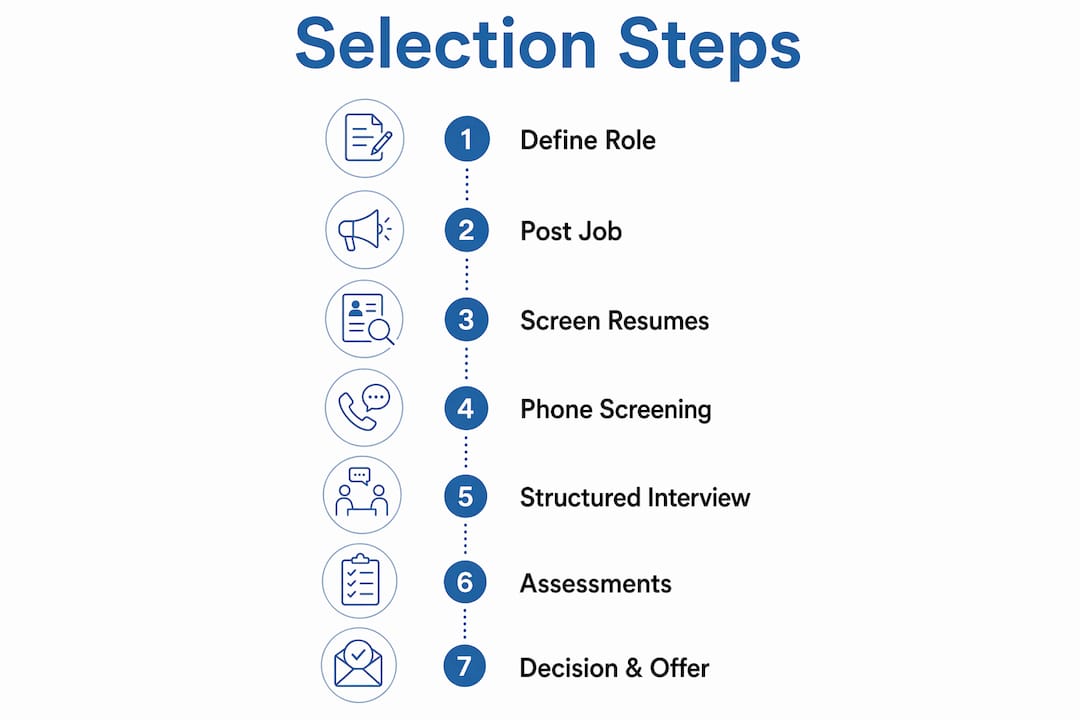
The successive hurdles approach is the industry-standard method for structured screening. Each selection step acts as a gate, and candidates must pass each one before advancing. This protects against discrimination claims by applying consistent evaluation rubrics to every applicant. It also prevents the common mistake of advancing a candidate based on gut feeling when they have not met the stated criteria.
Follow these numbered steps for a consistent screening workflow:
- Define your minimum qualifications in writing before reviewing any applications.
- Use an applicant tracking system (ATS) to apply keyword filters based on required skills.
- Score each resume against a standardized rubric covering experience, education, and role-specific skills.
- Conduct a 15-to-20-minute phone screen with every candidate who passes the resume review.
- Use structured screening questions, the same set for every candidate, to assess communication and basic fit.
- Document your notes and scores in the ATS immediately after each screen.
- Advance only candidates who meet the threshold score to the interview stage.
Pro Tip: Never advance a candidate to interviews based on enthusiasm alone. If they did not meet the screening threshold, revisit your criteria rather than bending the rules. Inconsistent standards are the fastest path to EEOC complaints.
For a deeper look at scoring and ranking candidates at this stage, Cs-recruiters has a practical shortlisting guide for hiring managers worth reviewing before you finalize your rubric.
Best Practices for Conducting Interviews and Assessments
Interviews are the most visible part of the hiring process and also the most prone to bias. Structured interviews using standardized questions produce more reliable candidate evaluations and stronger legal compliance than unstructured conversations. Every interviewer should work from the same question set, score candidates on the same rubric, and submit written feedback before any group discussion takes place.
Scheduling and format decisions affect candidate experience and data quality. Tools like HireVue and Zoom support structured video interviews with built-in scoring features, while platforms like Calendly and GoodTime automate scheduling to reduce time-to-interview. Panel interviews that include both HR and the direct hiring manager improve decision quality because HR and hiring manager collaboration produces better candidate fit assessments than either party evaluating alone.
Skills assessments add an objective layer that interviews cannot replicate. For technical roles, platforms like HackerRank and Codility deliver job-relevant coding challenges. For cognitive ability, Wonderlic assessments provide standardized scores that correlate with on-the-job performance. The key is selecting assessments that directly measure skills required in the role description you defined at the start of the process.
Comparison of common assessment methods:
| Method | Best for | Pros | Cons |
|---|---|---|---|
| Structured behavioral interview | All roles | Consistent, legally defensible | Requires trained interviewers |
| Panel interview | Senior or cross-functional roles | Multiple perspectives, reduces individual bias | Time-intensive to coordinate |
| Skills assessment (HackerRank, Wonderlic) | Technical and analytical roles | Objective, measurable data | Can feel impersonal to candidates |
| Situational judgment test | Customer-facing and management roles | Predicts real-world decision-making | Requires role-specific design |
| Work sample or case study | Creative, consulting, or strategic roles | Directly mirrors job tasks | High candidate time investment |
Key interview compliance requirements to document:
- Use only job-related questions approved by legal or HR
- Avoid any questions touching on age, religion, national origin, disability, or family status
- Store all interview scorecards and notes for a minimum of one year
- Obtain written consent before recording any video interview
What to Do After Interviews: Decisions and Pre-Employment Checks
Post-interview decision-making is where structured processes pay off most clearly. Consolidate all interviewer scorecards before holding a debrief meeting. This prevents the loudest voice in the room from overriding the data. Each interviewer should submit their scores independently, and the debrief should focus on reconciling differences rather than reaching consensus through social pressure.
Setting 30/60/90-day performance goals during the final selection stage improves onboarding clarity and long-term retention. Defining what success looks like at 30, 60, and 90 days gives both the hiring manager and the new employee a shared framework from day one. Without this, early turnover spikes because expectations were never made explicit.
Follow these steps to move from decision to offer:
- Rank finalists using the consolidated scorecard data, not recency or personal preference.
- Confirm the selected candidate meets all minimum qualifications documented at the start of the process.
- Initiate background and reference checks through a compliant vendor. Pre-employment checks must comply with FCRA in the U.S. and GDPR in the EU, including written consent and proper disclosure.
- Benchmark the offer against current market data using tools like Levels.fyi, Radford, or Mercer.
- Extend a verbal offer before sending written documentation to gauge acceptance likelihood.
- Send the formal written offer with a clear response deadline.
- Communicate a timeline to all other finalists and close out their candidacies professionally.
Keeping candidates engaged during the background check period is a detail many hiring managers overlook. 75% of employees say their job acceptance decision depends heavily on candidate experience quality. A single check-in message during a week-long background check can meaningfully reduce offer withdrawal rates.
How to Ensure Successful Onboarding After Selection
Onboarding is not a post-hire administrative task. It is the final and most retention-critical step in the employee selection process. Effective onboarding that starts before day one leads to 60% higher employee engagement, which translates directly into faster productivity ramp-up and lower early turnover.
Pre-boarding, the period between offer acceptance and the first day, is where most organizations lose momentum. Send paperwork, system access requests, and introductory training modules before the employee arrives. Assign a peer mentor from the team so the new hire has a named contact before they walk through the door. Integrated HR portals like Workday, BambooHR, and Rippling make pre-boarding workflows easy to automate and track.
Connect onboarding milestones directly to the 30/60/90-day success criteria you defined before the role was posted. This closes the loop on the entire selection process and gives managers a structured way to evaluate early performance. When new hires see that the goals discussed during interviews match what they are measured against in their first quarter, trust in the organization increases significantly.
Onboarding essentials checklist:
- Pre-boarding packet sent within 24 hours of offer acceptance
- System access and equipment ordered before the start date
- First-week schedule shared in advance with meeting invites sent
- Assigned peer mentor or onboarding buddy from the immediate team
- 30/60/90-day goal document reviewed with the manager on day one
- HR portal access for benefits enrollment, payroll setup, and policy acknowledgment
- Scheduled check-ins at the 30-day and 60-day marks to assess progress
Key Takeaways
A structured employee selection process, executed from role definition through onboarding, is the single most reliable way to reduce bad hires, cut time-to-fill, and improve retention.
| Point | Details |
|---|---|
| Define the role before posting | Document success criteria and required skills before writing the job description. |
| Use the successive hurdles method | Require candidates to pass each step before advancing to maintain consistency and legal compliance. |
| Standardize interviews and assessments | Apply the same questions and scoring rubrics to every candidate to reduce bias and improve data quality. |
| Comply with FCRA and GDPR | Obtain written consent and follow disclosure requirements before running any background check. |
| Start onboarding before day one | Pre-boarding engagement drives 60% higher engagement and reduces early turnover. |
Why Structured Selection Steps Matter More than Most Hiring Managers Realize
Most hiring managers treat the selection process as a checklist they move through as fast as possible. That instinct is understandable. Roles sit open, teams are stretched, and pressure to fill seats is real. But in my experience working with employers across industries, the organizations that rush through selection steps pay for it in turnover costs, team disruption, and legal exposure that far exceeds the cost of a few extra days in the process.
The step that gets skipped most often is also the one with the highest downstream impact: defining success criteria before the role is posted. When you cannot articulate what a successful hire looks like at 90 days, you are essentially asking your interview panel to evaluate candidates against an invisible standard. That produces inconsistent decisions and sets new hires up to fail.
Technology tools like AI screening platforms and structured interview software have made it easier than ever to run a consistent process without adding significant recruiter time. The organizations that use these tools well are not just faster. They are making better decisions with better data. The ones that skip steps and rely on gut feel are cycling through the same roles every 18 months.
The other underrated factor is documentation. Keeping records of your selection criteria, interview scores, and decision rationale is not just a legal protection. It is a feedback loop. When you can look back at why you hired someone and compare it to their actual performance, you learn what your process is getting right and where it needs adjustment. You cannot improve what you do not measure.
— Bradford
How Cs-Recruiters Helps You Hire Faster and Smarter
Cs-recruiters specializes in connecting employers with qualified professionals through a hiring process that is fast, honest, and built around your industry. Whether you need contract staffing solutions for short-term capacity or a direct hire placement for a permanent role, Cs-recruiters brings industry-specific recruiting expertise that shortens your time-to-fill without cutting corners on candidate quality. The team handles sourcing, screening, and shortlisting so your hiring managers spend their time evaluating finalists, not sorting through unqualified applicants. If you are ready to put a structured, effective selection process to work, submit a talent request and a Cs-recruiters specialist will reach out within one business day.
FAQ
What Are the Core Employee Selection Steps in Order?
The core steps are role definition, job posting, resume screening, phone or video pre-screening, structured interviews, skills assessments, background and reference checks, offer extension, and onboarding. Following each step in sequence using consistent criteria reduces bad hires and improves retention.
How Does the Successive Hurdles Approach Work in Hiring?
The successive hurdles approach requires candidates to meet the criteria at each selection step before advancing to the next. This method keeps evaluation consistent, protects against discrimination claims, and ensures only qualified candidates reach the final interview stage.
What Legal Requirements Apply to Pre-Employment Background Checks?
In the U.S., background checks must comply with the FCRA, which requires written disclosure and candidate consent before any check is run. Employers operating in the EU must also follow GDPR opt-in requirements. Failure to comply exposes organizations to significant legal liability.
How Much Does Skipping Selection Steps Actually Cost?
Organizations that skip critical recruitment steps face higher bad hire rates, increased turnover, and longer time-to-fill on repeat openings. Structured workflows reduce time-to-hire by 35% and improve retention by 22%, making the cost of skipping steps measurable and avoidable.
When Should Onboarding Begin in the Selection Process?
Onboarding should begin before the employee’s first day. Pre-boarding activities including paperwork, system access, and introductory training modules drive 60% higher employee engagement and accelerate productivity ramp-up compared to onboarding that starts on day one.