
Resume screening is the initial evaluation process that helps employers identify candidates meeting the minimum qualifications for a position. It typically involves a two-pass system: a quick binary check to eliminate unqualified applicants, followed by a deeper review of remaining resumes based on a structured rubric. Common challenges include reliance on potentially misleading AI-generated resumes, unconscious bias, and the risk of overlooking qualified candidates with non-traditional backgrounds. Best practices for effective screening include defining clear criteria, using blind screening to reduce bias, and supplementing resumes with skills assessments.
In this article
Resume screening is the process of evaluating job applications to quickly identify candidates who meet the minimum qualifications for an open position. It is the first filter in most hiring workflows, sitting between the job posting and the interview stage. Recruiters use it to reduce a large applicant pool to a manageable shortlist. The process can be manual, automated with an applicant tracking system (ATS), or a combination of both. Understanding how resume screening works matters whether you are hiring or applying, because the same criteria that help employers find talent can also cause qualified candidates to be overlooked.
Resume Screening vs. CV Screening
Same job, different document. In the US you screen resumes — one to two pages, tailored to the role. CV screening is the norm in the UK, Europe, and academia, where the document runs longer and lists everything. The process in this guide works for both: set criteria first, score against them, and document the cut.
What Is Resume Screening and How Does It Work?
Resume screening is a structured review of submitted applications against a predefined set of job requirements. The goal is not to find the perfect candidate at this stage. The goal is to remove applications that clearly do not meet the role’s core criteria, so recruiters can focus time on the most promising candidates.
The most effective method is the two-pass system. The first pass takes 10–15 seconds per resume and answers one binary question: does this candidate meet the must-have criteria? Must-haves typically include minimum years of experience, required certifications, specific technical skills, and geographic availability. Any resume that fails this check is removed from the pool.

The second pass is a deeper review. Recruiters score remaining resumes against a rubric that weighs nice-to-have qualifications, career progression, accomplishments, and role-specific keywords. This scoring step separates a good shortlist from a weak one.
Here is how a structured screening process typically unfolds:
- Define criteria before reviewing. List must-have and nice-to-have qualifications before opening a single resume. This prevents criteria from shifting mid-review.
- Run the binary pass. Eliminate resumes that miss any must-have requirement. Do not score these; simply remove them.
- Score the remaining pool. Use a rubric with weighted categories: relevant experience, skills match, accomplishments, and presentation quality.
- Flag for follow-up. Mark borderline candidates for a quick phone screen rather than a hard rejection.
- Document decisions. Record why each candidate passed or failed. This protects against bias claims and improves future screening criteria.
Manual screening at scale is time-consuming. Reviewing 250 applications manually takes an average of 23 hours per hire. That figure explains why most mid-to-large employers now use ATS platforms to handle initial keyword filtering before human review begins.
Pro Tip: Build your screening rubric directly from the job description. Every must-have criterion should map to a specific line in the posting. If you cannot trace a criterion back to the job description, remove it from the rubric.
What Are the Main Challenges with Traditional Resume Screening?
The core problem with resume screening is a confidence gap. Only 33% of employers are very confident that resumes accurately reflect candidate skills. Yet 66% still rely on resume screening as the primary first step in hiring. That gap between confidence and practice is where most screening failures happen.
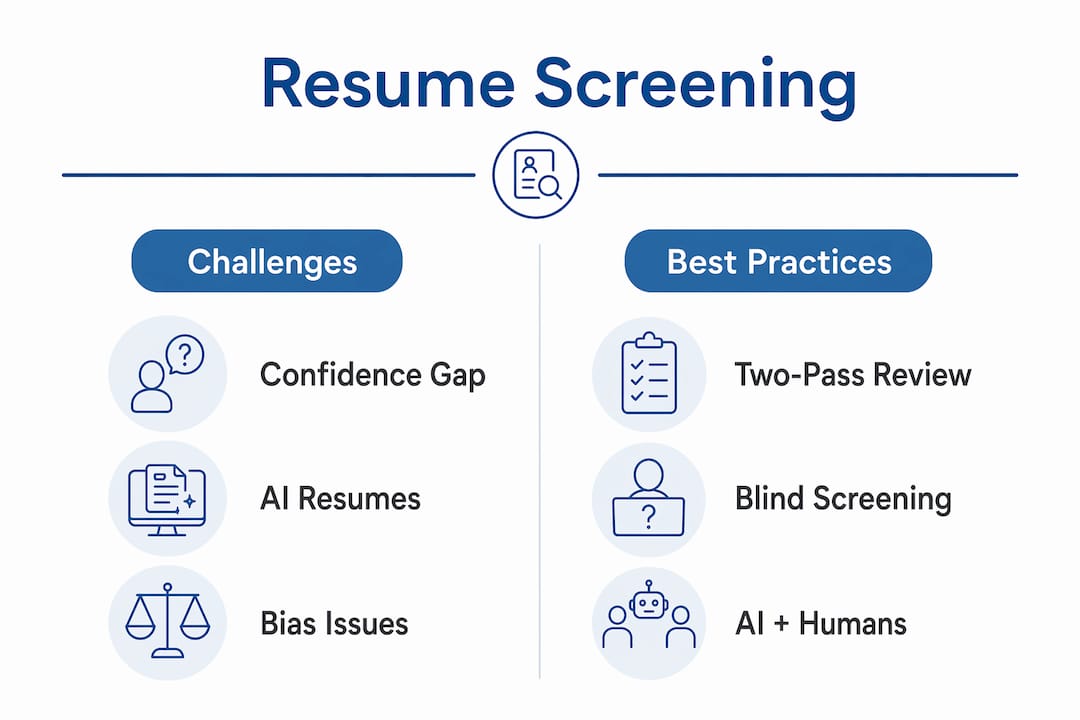
AI-generated resumes have made this worse. 92% of recruiting leaders report that AI-generated resumes are now common in their applicant pools, and half describe them as very common. When a resume is written by an AI tool trained to match job descriptions, it can score well on keyword filters without reflecting the candidate’s actual capabilities.
The deeper structural problem is that resumes function as marketing documents. Keyword optimization rewards candidates who understand how ATS systems work, not necessarily those who are most qualified. An ATS scores pattern recognition, not performance.
The human side of screening carries its own risks:
- Decision fatigue. Recruiters who review dozens of resumes in a single session become less objective over time. Qualified candidates reviewed later in a batch are more likely to be overlooked.
- Keyword bias. Screening too heavily on job titles and keywords causes recruiters to miss candidates with transferable skills or non-traditional career paths.
- Demographic filtering. Names, graduation years, and school names can trigger unconscious bias in manual review, reducing diversity in the shortlist.
- Over-reliance on format. Candidates who use non-standard resume formats, such as functional or skills-based layouts, may score poorly in ATS systems even when their qualifications are strong.
“The structural flaw in AI screening is that it scores based on pattern recognition of marketing documents, leading to misleading results.” — Hirevire
Career changers and candidates from non-traditional backgrounds face the steepest disadvantage. Their resumes often lack the exact job titles or industry-specific keywords that automated systems are trained to recognize. The screening process filters them out before a human ever sees their application.
What Are the Best Practices for Effective Resume Screening?
Effective resume screening requires a combination of clear criteria, structured process, and human judgment. No single method solves every problem, but the following practices reduce error and improve the quality of your shortlist.
Define criteria in two tiers. Separate must-have qualifications from nice-to-have ones before screening begins. Must-haves are non-negotiable: a software engineer role may require proficiency in Python; a licensed nursing position requires current state licensure. Nice-to-haves are weighted bonuses, not filters.
Use blind screening where possible. Removing names, addresses, graduation years, and photos from resumes before review reduces the impact of unconscious bias. Several ATS platforms support blind review modes natively. This practice is especially valuable when building diverse talent pipelines.
Combine AI tools with human judgment. AI screening tools can process 250 resumes in under 30 minutes, compared to 8–10 hours for manual review. That speed advantage is real. The risk is over-relying on keyword matching at the expense of candidate potential. Use AI to handle the binary pass, then apply human judgment to the scored shortlist.
Supplement resumes with assessments. Skills-based assessments are considered more reliable predictors of candidate success than resumes by talent acquisition leaders. A short work sample, coding test, or writing exercise added after the initial screen gives you direct evidence of capability, not just a formatted claim.
Calibrate your rubric regularly. Compare the screening scores of candidates who were hired against their 90-day performance reviews. If high-scoring resumes are not producing high-performing hires, your rubric needs adjustment.
| Screening method | Speed | Bias risk | Accuracy |
|---|---|---|---|
| Manual review only | Slow | High | Moderate |
| ATS keyword filtering | Fast | Moderate | Low to moderate |
| Two-pass with rubric | Moderate | Low | High |
| Rubric plus assessment | Moderate | Low | Highest |
Pro Tip: Cap your manual screening sessions at 30 resumes before taking a break. Decision fatigue sets in quickly, and the candidates reviewed in the final third of a long session receive less consistent evaluation than those reviewed first.
How Does Resume Screening Affect Job Seekers?
Resume screening is the first and most common reason qualified candidates never hear back from an employer. Understanding how it works gives you a direct advantage in how you present your application.
Recruiters look for three things in the first pass: clarity, keyword relevance, and evidence of accomplishment. A resume that buries its most relevant experience in dense paragraphs will fail the 10–15 second binary check even if the candidate is well qualified. Format and structure are not cosmetic choices. They are functional ones.
Common mistakes that lead to rejection during screening include:
- Missing keywords from the job description. ATS systems match your resume against the posting. If the posting says “project management” and your resume says “program oversight,” the system may not connect them.
- Listing responsibilities instead of accomplishments. “Managed a team” tells a recruiter nothing. “Led a team of six that reduced time-to-fill by 30%” gives them a measurable outcome.
- Using a non-ATS-friendly format. Tables, graphics, headers in text boxes, and unusual fonts can break how an ATS parses your resume. Plain text formatting passes through cleanly.
- Applying without tailoring. A generic resume sent to 50 jobs will underperform a tailored resume sent to 10. Matching your language to each job description improves your keyword score.
The risk of over-optimizing with AI tools is real. A resume that reads as AI-generated can raise red flags with experienced recruiters, particularly when the language is generic and the accomplishments are vague. Honest, specific representation of your experience outperforms a polished but hollow document. You can upload your resume directly to Careerscape to get matched with employers who are actively hiring in your field.
Pro Tip: Read the job description three times before writing a single word. On the first read, note the must-have requirements. On the second, identify the language patterns the employer uses. On the third, map your actual experience to those patterns. Your resume should reflect their vocabulary, not just your own.
For job seekers navigating a competitive market, understanding job hunting strategies that go beyond resume submission can also improve your chances of reaching the interview stage.
Key Takeaways
Effective resume screening requires structured criteria, a two-pass review process, and skills-based assessments to move beyond keyword matching and identify genuinely qualified candidates.
| Point | Details |
|---|---|
| Two-pass system works best | Run a binary must-have check first, then score remaining resumes with a weighted rubric. |
| AI resumes complicate screening | 92% of recruiting leaders report AI-generated resumes in their pools, reducing keyword reliability. |
| Decision fatigue is a real risk | Cap manual screening sessions at 30 resumes to maintain consistent evaluation quality. |
| Assessments outperform resumes | Skills-based tests predict candidate success more reliably than resume content alone. |
| Job seekers must tailor applications | Matching resume language to each job description improves ATS keyword scores and pass rates. |
The Resume Screening Problem No One Talks About Enough
Resume screening has a fundamental design flaw that the industry keeps patching rather than fixing. The entire system assumes a resume is an accurate representation of a candidate. It is not. It is a self-reported marketing document, and we have built an enormous amount of hiring infrastructure on top of that assumption.
I have seen this play out repeatedly. A candidate with a polished, keyword-rich resume sails through screening and then struggles in the role. A career changer with a non-linear background gets filtered out by an ATS before a human ever reads their application. The screening process optimized for efficiency, and in doing so, it optimized away from accuracy.
The AI-generated resume problem makes this worse, but it did not create it. The problem existed long before AI writing tools became widely available. What AI did was accelerate the signal corruption. When keyword optimization becomes the primary skill being tested, screening stops measuring candidate capability and starts measuring candidate gaming ability.
The fix is not to abandon resume screening. It is to treat the resume as one data point among several. Asynchronous video responses, work samples, and short assessments each add a dimension that a resume cannot provide. The employers I have seen build the strongest hiring pipelines are the ones who use resume screening to narrow the pool, then use other methods to actually evaluate the candidates in it. That shift from document review to candidate evaluation is where hiring quality improves.
— Bradford
How Careerscape Approaches Candidate Screening
Careerscape takes the burden of resume screening off your team by combining structured screening processes with industry-specific expertise. Rather than relying on keyword filters alone, Careerscape’ recruiters apply role-specific criteria and direct candidate conversations to build shortlists that reflect actual capability. Whether you need contract staffing solutions for immediate headcount or industry-specialized recruiting for niche technical roles, Careerscape matches qualified professionals to your open positions with speed and accuracy. The result is a shortlist you can trust, not just a stack of keyword-matched documents. Connect with Careerscape to reduce your time-to-fill and improve the quality of every hire.
FAQ
What Is the Purpose of Resume Screening in Hiring?
Resume screening filters a large applicant pool down to a manageable shortlist of candidates who meet the minimum qualifications for a role. It saves recruiter time and focuses interview resources on the most relevant candidates.
How Long Does Resume Screening Take?
Manual screening of 250 applications takes an average of 23 hours per hire. AI-assisted screening tools can process the same volume in under 30 minutes, though human review of the scored shortlist is still recommended.
What Do Recruiters Look for When Screening Resumes?
Recruiters check for must-have qualifications first, including required skills, certifications, and experience levels. They then score remaining resumes on accomplishments, career progression, and keyword relevance to the job description.
Why Do Qualified Candidates Get Rejected During Resume Screening?
Qualified candidates are often rejected because their resumes lack the exact keywords used in the job posting, use non-ATS-friendly formatting, or list responsibilities rather than measurable accomplishments. Tailoring each resume to the specific job description reduces this risk.
Are Skills Assessments Better than Resume Screening?
Talent acquisition leaders rank skills-based assessments as more reliable predictors of candidate success than resumes. Assessments work best as a supplement to resume screening, not a replacement, adding direct evidence of capability to the shortlist process.
Recommended
- How to Shortlist Applicants: A Hiring Manager’s Guide
- Job Hunting Strategies 2026: Win the Hidden Market
- What is recruiting? The employer’s guide to modern hiring
- Steps to Effective Job Posting for Recruiters in 2026