
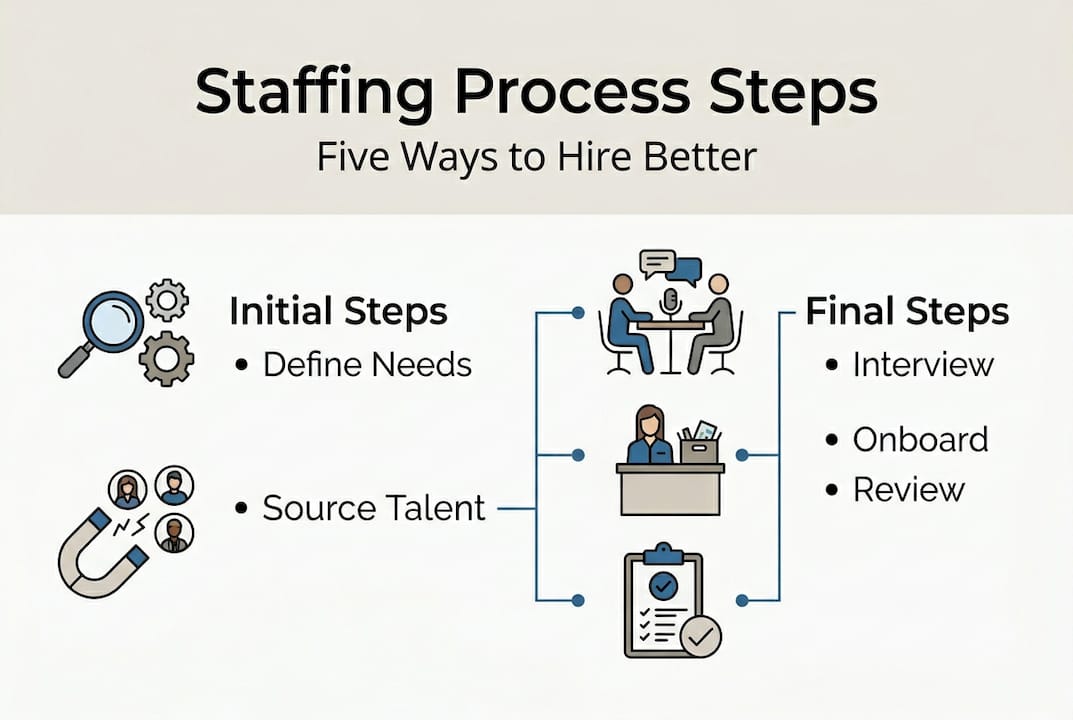
A structured staffing process is essential for small to medium-sized businesses to minimize hiring delays and turnover. Key steps include clearly defining staffing needs, utilizing multiple sourcing methods, implementing a consistent selection process, prioritizing effective onboarding, and regularly refining the staffing approach. By following these steps, businesses can enhance hiring efficiency, reduce costs, and improve employee retention.
For small to medium-sized businesses, a vague or inconsistent staffing process is one of the most expensive problems you can have. Slow hiring leads to lost productivity. Poor candidate selection drives up turnover. And when your team lacks a clear roadmap, every open role becomes a scramble. The good news is that fixing this doesn’t require an overhaul of your entire HR function. A structured, step-by-step approach to staffing gives you a repeatable system that saves time, reduces cost-per-hire, and puts better people in seats faster. This guide walks through each stage of that process with practical tools you can apply immediately.
Table of Contents
- Clarifying staffing needs and job requirements
- Sourcing and attracting the right candidates
- Screening, interviewing, and selecting candidates
- Final onboarding and continuous improvement
- Why overengineering the staffing process holds SMBs back
- Streamline staffing with expert support
- Frequently asked questions
Key Takeaways
| Point | Details |
|---|---|
| Clarify needs early | Defining your staffing requirements at the start minimizes confusion and speeds hiring. |
| Use multiple sourcing methods | Combining job boards, referrals, and talent pools finds better candidates faster. |
| Keep selection structured | A consistent screening and interviewing approach improves fairness and results. |
| Prioritize onboarding | Smooth onboarding maximizes new hire engagement and boosts early retention. |
| Continuously improve | Regularly review and refine your staffing process for ongoing efficiency gains. |
Clarifying staffing needs and job requirements
Every effective staffing process starts in the same place: a clear picture of what you actually need. This sounds obvious, but many SMBs skip this step or rush through it, resulting in job postings that attract the wrong applicants and interviews that go nowhere.
Start by connecting open roles to your business goals. If you’re scaling a customer service team ahead of a product launch, the skills required look very different than if you’re backfilling a mid-level operations role. Involve department heads and direct managers early. Their input shapes not just the job description, but the success criteria for the hire.
Here’s a sample breakdown of how staffing requirements can differ by role type:
| Role type | Core skills needed | Experience level | Priority timeline |
|---|---|---|---|
| Customer support | Communication, CRM tools | Entry to mid | 2 to 4 weeks |
| Operations coordinator | Project management, logistics | Mid-level | 4 to 6 weeks |
| Technical specialist | Domain expertise, certifications | Senior | 6 to 10 weeks |
| Sales representative | Prospecting, CRM, persuasion | Entry to senior | 3 to 5 weeks |
Once you’ve aligned with stakeholders, review and update your job descriptions. Outdated postings are a common source of hiring delays and mismatched expectations. Accurate job descriptions reduce hiring delays and turnover by setting clear expectations from the start. Look at job title examples in your industry to ensure your language matches what candidates are actually searching for.
Key elements to include in every job description:
- Required skills versus preferred skills (keep them separate)
- Performance expectations for the first 30, 60, and 90 days
- Reporting structure and team context
- Compensation range to filter for realistic applicants
- Growth opportunities to attract motivated candidates
Pro Tip: Tie your hiring timeline to specific business milestones. If a product launch is scheduled for Q3, work backward from that date to set your time-to-fill target. This keeps hiring decisions grounded in operational reality rather than reactive urgency.
Sourcing and attracting the right candidates
With job requirements clearly defined, the next challenge is finding the right people. Sourcing is where many SMBs either overspend or underperform, relying on a single channel and hoping for the best.

The most effective sourcing strategies combine multiple approaches. Here’s how the main options compare:
| Sourcing method | Speed | Cost | Candidate quality | Best for |
|---|---|---|---|---|
| Job boards | Fast | Low to medium | Variable | High-volume roles |
| Employee referrals | Medium | Low | High | Culture-fit roles |
| Staffing agencies | Fast | Medium to high | High | Specialized or urgent roles |
| Passive talent pipelines | Slow to build | Low | Very high | Long-term planning |
| Social/professional networks | Medium | Low | Medium to high | Mid to senior roles |
Both active sourcing and passive talent pipelines boost applicant quality when used together. Active sourcing fills immediate gaps. Passive pipelines reduce your time-to-fill for future roles by keeping warm candidates engaged before a position even opens.
Here’s a practical sequence for launching a multi-channel sourcing campaign:
- Post the role on two to three relevant job boards based on your industry and role type.
- Notify your internal team and launch an employee referral request with clear incentives.
- Search your existing candidate database for previously screened applicants who weren’t selected but remain a strong fit.
- Activate your professional network on LinkedIn or through industry-specific channels relevant to the role.
- Engage a staffing partner if the role is specialized or the timeline is tight.
Pro Tip: Write job ads with your must-have criteria in the first three lines. Candidates scan, they don’t read. If your key requirements aren’t visible immediately, you’ll attract a flood of unqualified applicants and miss the ones who are actually a match.
Screening, interviewing, and selecting candidates
Once candidates are sourced, the selection process needs to be both efficient and consistent. This is where many hiring managers lose time or introduce bias without realizing it.
Start with structured screening criteria before a single resume is reviewed. This keeps your evaluation objective and speeds up shortlisting. Effective screening criteria to apply immediately:
- Minimum qualifications check: Does the candidate meet the non-negotiable requirements listed in the job description?
- Relevant experience filter: Does their background align with the core responsibilities of the role?
- Compensation alignment: Is their stated expectation within your defined range?
- Availability and timeline: Can they start within your required window?
- Red flag review: Are there unexplained gaps, frequent short tenures, or inconsistencies in their application?
Structured interviews improve selection quality and reduce bias by ensuring every candidate is evaluated on the same criteria. Use a scorecard with weighted categories so hiring decisions are based on data, not gut feeling.
A four-step interviewing flow that works well for SMBs:
- Phone screen (15 to 20 minutes): Confirm basics, assess communication, and verify interest.
- Structured first interview (45 to 60 minutes): Use the same question set for all candidates. Cover competencies, situational responses, and role-specific scenarios.
- Skills or work sample assessment: Where applicable, ask candidates to complete a short task relevant to the role.
- Final interview with decision-maker: Confirm cultural fit, discuss expectations, and answer candidate questions.
Consistency is your friend. The same set of questions for all candidates supports fairness and gives you a reliable basis for comparison when it’s time to make a decision.
Once you’ve selected your top candidate, move quickly. Delays between the final interview and the offer are one of the leading causes of candidate drop-off. Strong candidates have options. Pair your offer with clear next steps, including what to expect during onboarding best practices so the transition feels seamless from day one.
Final onboarding and continuous improvement
Selecting the right candidate is only part of the job. How you bring them into the organization determines whether that hire sticks. Effective onboarding increases retention rates significantly, yet many SMBs treat it as an afterthought.
Statistic callout: Organizations with a structured onboarding program report new hire retention rates up to 82% higher and productivity improvements of over 70% compared to those without a formal process.
A practical onboarding checklist for new staff:
- Send a welcome email and first-day agenda before the start date
- Prepare workstation, system access, and tools in advance
- Schedule introductions with key team members in the first week
- Assign a buddy or mentor for the first 30 days
- Conduct a structured 30-day check-in to address questions and concerns
- Set clear 60 and 90-day performance goals with measurable outcomes
- Gather feedback from the new hire about their onboarding experience
That last point matters more than most HR teams realize. New hire feedback reveals gaps in your process that you can’t see from the inside. Build a simple survey or structured conversation into your 30-day check-in and use the responses to refine your approach.
To optimize your onboarding workflow, track metrics like time-to-productivity, 90-day retention rate, and new hire satisfaction scores. These numbers tell you whether your staffing process is actually working or just moving people through the motions. Continuous improvement means reviewing your process after every hire cycle, not just when something goes wrong.
Why overengineering the staffing process holds SMBs back
Here’s a perspective that doesn’t get shared enough: more steps in your staffing process do not automatically mean better hires. In fact, for most SMBs, adding layers of approval, extra interview rounds, and elaborate assessment tools often slows hiring down without improving outcomes.
When a process becomes too rigid, hiring managers disengage. Candidates drop out. And the roles that needed to be filled two weeks ago are still open a month later. The hiring process best practices that actually work for smaller organizations tend to be lean, clear, and adaptable.
The smarter approach is to pilot your process, measure what matters, and adjust. Run three to five hiring cycles with your current framework, then review your time-to-fill, offer acceptance rate, and 90-day retention data. Let the numbers tell you where the friction is. Remove one barrier at a time. A staffing process that’s 80% structured and 20% flexible will outperform a rigid, overcomplicated system every time.
Streamline staffing with expert support
Putting a structured staffing process in place is achievable, but executing it consistently while managing everything else on your plate is a different challenge entirely.
Careerscape works with SMBs to implement, scale, and refine every stage of the staffing process. Whether you need industry staffing expertise for a specialized role, contract staffing services to handle a short-term gap, or project teams support for a defined initiative, Careerscape brings the speed and honesty your hiring deserves. Connect with our team to schedule a consultation and start building a staffing process that actually works for your business.
Frequently asked questions
What are the key steps in the staffing process?
The main steps include defining job needs, sourcing candidates, screening applicants, conducting interviews, and onboarding new hires. A clear overview of staffing steps helps teams stay consistent and reduce time-to-fill across every hiring cycle.
How can small businesses make staffing more efficient?
Clarifying needs upfront, using structured interviews, and working with specialized recruiting partners can significantly speed up and improve results. Industry-specialized recruiters help SMBs avoid common bottlenecks and fill roles with better-fit candidates.
What is the most common mistake in staffing?
Skipping a clear needs assessment often leads to poor hires and wasted time. Defining job requirements before sourcing begins is the single most impactful step you can take to improve hiring quality.
Why is onboarding important in the staffing process?
Effective onboarding boosts employee engagement and retention right from the start. Strong onboarding programs reduce early turnover and help new hires reach full productivity faster.
What tools help with staffing process steps?
Applicant tracking systems and structured interview guides streamline hiring workflows and reduce manual effort. Workflow optimization tools give HR teams visibility into every stage of the process so nothing falls through the cracks.
Recommended
- Staffing & Recruiting by Job Title — 48 Roles | Careerscape
- Hire Talent — Staffing & Recruiting Services | Careerscape
- Shift-Based Staffing Solutions | Careerscape
- Careerscape | National Staffing & Recruiting Agency