
Temporary staffing involves hiring workers for short-term periods through staffing agencies, which manage payroll and compliance, allowing employers to swiftly access skilled labor without long-term commitments. This approach offers flexibility, cost savings, and rapid filling of positions, with many employers reporting temporary staff as equally or more productive than permanent hires. However, it also entails shared legal responsibilities between the agency and the client company, necessitating careful management of workplace safety and compliance to mitigate risks.
The U.S. staffing industry is larger than most employers realize. In 2024, ~11M workers were employed through staffing firms, with roughly 2.2 million temporary and contract workers placed every week. Yet many hiring managers still treat temporary staffing as a last resort rather than a strategic tool. This guide breaks down what temporary staffing actually involves, how it benefits your organization, what legal responsibilities come with it, and how to make it work effectively. Whether you’re managing seasonal demand spikes or filling a critical gap, understanding temporary staffing can change how you think about workforce planning.
Table of Contents
- Understanding temporary staffing
- Benefits and challenges of hiring temporary staff
- Legal responsibilities and risk management
- How to maximize temporary staffing success
- What most employers get wrong with temporary staffing
- Explore expert temporary staffing solutions
- Frequently asked questions
Key Takeaways
| Point | Details |
|---|---|
| Scale and impact | Temporary staffing supports millions of jobs weekly across major industries in the United States. |
| High productivity | Most employers report temporary staff are equally or more productive than permanent hires. |
| Legal clarity | Employers share some liability, but agencies handle payroll and compliance, reducing legal risk. |
| Conversion potential | A significant portion of temporary workers receive opportunities for permanent employment. |
| Strategic advantage | Temporary staffing offers a cost-effective, flexible solution for fluctuating workforce needs. |
Understanding temporary staffing
Temporary staffing refers to the practice of hiring workers for a defined, short-term period, typically through a staffing agency that acts as the employer of record. The agency recruits, screens, and places workers with client companies, handling payroll, taxes, and benefits on the worker’s behalf. The client company directs the day-to-day work. This arrangement gives employers fast access to skilled labor without the long-term commitment of a permanent hire.
The scope of this industry is significant. Staffing firms employ workers across three major sectors: 36% industrial, 24% office-clerical, and 21% professional roles. That distribution reflects just how broadly temporary staffing is used, from warehouse operations and manufacturing to accounting, IT, and healthcare support.
Here’s a quick breakdown of the most common temporary staffing arrangements:
- Short-term assignments: Days to a few weeks, often for project support or seasonal demand
- Long-term temporary roles: Several months, used when a company needs sustained capacity without a permanent headcount
- Temp-to-hire: A trial period that can convert to a permanent offer based on performance
- Contract staffing: Professionals hired for a specific scope of work, often in technical or specialized fields
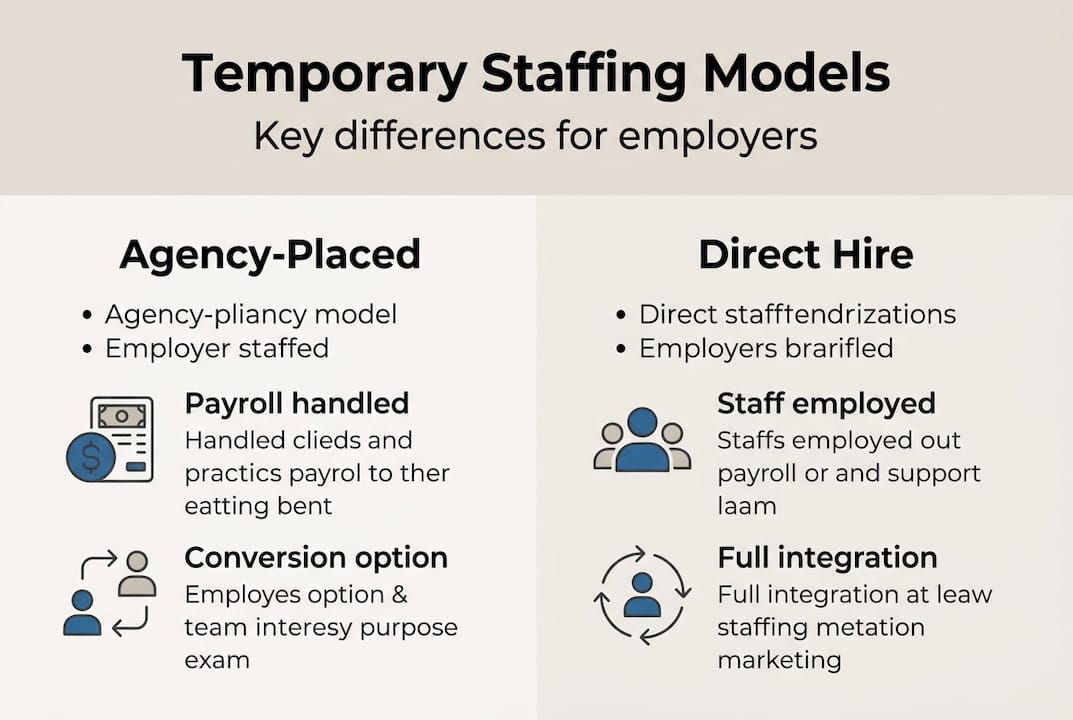
The key distinction between agency-placed temps and direct hires is employment status. With agency placements, the staffing firm remains the legal employer. With direct hires, your company takes on full employer responsibilities from day one. This difference has significant implications for cost, compliance, and flexibility.
| Arrangement | Employment of record | Payroll handled by | Conversion option |
|---|---|---|---|
| Agency temporary | Staffing agency | Agency | Yes (temp-to-hire) |
| Direct hire | Client company | Client company | N/A |
| Contract staffing | Agency or worker | Agency or self | Sometimes |
Pro Tip: Partnering with a staffing agency for temporary staffing services reduces your HR team’s administrative workload significantly. Agencies manage onboarding paperwork, compliance checks, and payroll processing, freeing your team to focus on managing performance and output.
Understanding these structures helps you choose the right model for your specific workforce need, whether that’s covering a leave of absence, ramping up for a busy quarter, or testing a candidate before committing to a permanent offer.
Benefits and challenges of hiring temporary staff
With the basics clear, it’s time to consider why employers choose temporary staffing and the obstacles they might face.

The productivity argument for temporary staffing is stronger than many assume. 73% of clients rate temporary staff as equally or more productive than their permanent counterparts. That’s not a marginal finding. It reflects the reality that well-vetted temporary workers are motivated, experienced, and often bring cross-industry exposure that adds immediate value.
Here are the core benefits employers consistently report:
- Workforce flexibility: Scale your team up or down based on actual demand, not projections
- Reduced cost-per-hire: Agencies absorb recruiting, screening, and onboarding costs
- Speed: Time-to-fill is dramatically shorter when a vetted talent pipeline already exists
- Temp-to-hire potential: 35% of temporary workers receive permanent job offers, making temporary placements a low-risk audition process
- Specialized skills on demand: Access professionals with niche expertise for short-term projects without long-term salary commitments
It’s also worth noting that Fortune 500 companies rely on temporary workers for roughly 15% of their total workforce. That figure signals that temporary staffing is not a workaround. It’s a deliberate workforce strategy used at the highest levels.
Of course, challenges exist. The most common ones include:
- Culture fit gaps: Temporary workers may not align with team norms if they aren’t properly integrated
- Productivity risk: Poor agency vetting can result in placements that require more supervision than expected
- Knowledge transfer: Short-term workers may leave before institutional knowledge is fully shared
| Factor | Temporary staff | Permanent staff |
|---|---|---|
| Cost-per-hire | Lower (agency absorbs) | Higher (internal recruiting) |
| Flexibility | High | Low |
| Productivity | Comparable (73% client-rated) | Consistent but slower to ramp |
| Turnover cost | Minimal | Significant |
| Conversion option | Yes (temp-to-hire) | N/A |
For employers managing project-based work, project-based staffing offers a structured way to bring in talent for defined deliverables. Similarly, contract staffing solutions are well-suited for technical roles where specialized expertise is needed for a fixed duration.
Legal responsibilities and risk management
Beyond operational advantages, employers must understand the legal and risk implications of temporary staffing.
When you bring on a temporary worker through a staffing agency, you enter what’s known as a joint employment relationship. This means both the agency and the client company share certain legal responsibilities. Understanding where those lines fall is critical to avoiding costly compliance errors.
Here’s how legal responsibility is typically divided:
- Agency responsibilities: Payroll taxes, unemployment insurance, I-9 verification, workers’ compensation coverage, and benefits administration
- Client company responsibilities: Day-to-day supervision, workplace safety conditions, and ensuring non-discriminatory treatment
- Shared responsibilities: OSHA workplace safety compliance and EEO (Equal Employment Opportunity) obligations
The joint employment framework means that if a temporary worker is injured on your site, you can be held liable for unsafe conditions even though the agency is the employer of record. This is why maintaining OSHA-compliant workplaces matters regardless of employment status.
“Employers who use temporary workers are still responsible for providing a safe work environment. OSHA’s general duty clause applies to all workers on site, including those employed by a staffing agency.”
On the positive side, temporary staffing carries significantly less legal risk than misclassifying workers as independent contractors. Agencies handle the compliance infrastructure, which reduces your exposure to payroll tax disputes, benefits eligibility claims, and labor law violations.
Key risk management practices include:
- Document the scope of supervision: Clearly define who directs the temp worker’s daily tasks
- Conduct safety orientations: Treat temps like any other worker when it comes to site-specific safety training
- Review agency contracts carefully: Ensure indemnification clauses protect your organization in the event of a dispute
- Avoid co-employment pitfalls: Don’t provide temps with the same benefits as permanent staff without legal guidance
For employers in specialized fields, working with industry-specialized staffing partners who understand your sector’s compliance requirements adds another layer of protection.
How to maximize temporary staffing success
Once legal risks are managed, the next step is making sure temporary staffing delivers maximum value.
Success with temporary staffing is not accidental. It follows a repeatable process. Effective agency vetting is directly tied to higher satisfaction and productivity outcomes. The employers who get the most from temporary staffing are the ones who treat it as a managed program, not a reactive fix.
Here’s a step-by-step framework for maximizing results:
- Define your workforce need clearly. Before contacting any agency, document the role, required skills, expected duration, and performance benchmarks. Vague job briefs lead to poor placements.
- Select a vetted staffing partner. Evaluate agencies on their screening process, industry specialization, time-to-fill track record, and client references. Not all agencies operate at the same standard.
- Onboard temps with intention. Provide the same site orientation, safety training, and team introductions you would for a permanent hire. First-day experience directly affects early productivity.
- Set clear expectations from day one. Share performance standards, communication norms, and reporting structures in writing. Ambiguity is the most common cause of performance issues.
- Collect feedback regularly. Check in with both the temporary worker and your internal team during the first two weeks. Address issues early before they affect output.
- Track conversion candidates. Monitor which temporary workers demonstrate the skills, attitude, and culture fit that would make them strong permanent hires.
Pro Tip: Build a preferred vendor list of two to three staffing agencies you’ve already vetted. When demand spikes, you won’t waste time evaluating new partners. Your staffing and recruiting services relationship should be proactive, not reactive.
Integrating temporary workers into your team culture also matters. Introduce them to key contacts, include them in relevant team meetings, and give them access to the tools they need. Temps who feel included perform better and are more likely to accept a permanent offer if one is extended.
Tracking metrics like productivity output, time-to-productivity, and temp-to-perm conversion rate gives you data to refine your approach over time. You can’t improve what you don’t measure, and temporary staffing services work best when treated as a measurable workforce strategy.
What most employers get wrong with temporary staffing
The most common mistake is treating temporary staffing as a purely transactional exercise. An employer identifies a gap, calls an agency, and expects a ready-to-go worker to show up and perform. When it doesn’t work out, the agency gets the blame. But the data tells a more nuanced story.
High productivity outcomes are real, but they depend on more than just agency quality. Onboarding, integration, and clear expectations are equally responsible for whether a temporary placement succeeds. A well-vetted worker placed into a disorganized environment will underperform. That’s not a staffing failure. It’s a management failure.
The contrarian insight here is that temporary staffing rewards employers who invest upfront. The employers who skip onboarding, skip feedback loops, and skip tracking conversion rates are the ones who report disappointing results. The ones who treat temps like valued contributors, with clear roles and real accountability, consistently report strong performance and successful permanent conversions.
Tracking your temp-to-perm conversion rate is one of the most underused tools in workforce planning. It tells you which agencies are sending the right candidates, which roles are best suited for temp-to-hire, and where your onboarding process needs work. Start measuring it.
Explore expert temporary staffing solutions
If you’re managing fluctuating workforce demands, temporary staffing is one of the most effective tools available. But results depend on having the right partner.
Careerscape specializes in connecting employers with qualified professionals across industries, with speed and precision that reduces your time-to-fill and cost-per-hire. Whether you need temporary staffing services for a seasonal surge, contract staffing for a technical project, or project-based staffing for a defined deliverable, Careerscape has the talent pipeline and industry knowledge to deliver. Reach out today to discuss your workforce needs and find the staffing solution that fits your timeline and budget.
Frequently asked questions
How long can temporary staff be employed?
Temporary staffing arrangements are flexible and driven by employer needs, ranging from a few days to several months depending on the role and agency agreement.
What legal obligations do employers have for temporary workers?
Under joint employment rules, employers share OSHA safety and EEO liability with the staffing agency, while the agency typically handles payroll taxes, unemployment insurance, and I-9 compliance.
Are temporary staff less productive than permanent staff?
73% of clients rate temporary workers as equally or more productive than permanent staff, making productivity concerns largely unfounded when agency vetting is done properly.
Can temporary workers become permanent employees?
Yes. 35% of temporary workers receive permanent job offers, and many employers use temp-to-hire strategies specifically to evaluate candidates before committing to a full-time role.
What industries use temporary staffing most?
Industrial, office-clerical, and professional sectors are the top users, accounting for 36%, 24%, and 21% of all temporary staffing placements respectively.
Recommended
- Temporary Staffing Services | Careerscape
- Contract Staffing Solutions | Careerscape
- Project-Based Staffing & Teams | Careerscape
- Shift-Based Staffing Solutions | Careerscape