
A written 30/60/90 onboarding plan with assigned owners for each task is crucial for ensuring new hires thrive from their first day, as it enhances retention and productivity. Key steps include sending a preboarding welcome email, confirming IT access, assigning a buddy, scheduling a manager's first 1:1, and distributing the onboarding plan. Organizations that effectively implement these practices can significantly improve the onboarding experience and reduce disengagement.
In this article
Before your new hire’s first day arrives, one action determines whether they thrive or struggle: a written 30/60/90 onboarding plan with owners assigned to every task. Without it, the most talented candidate you placed can still disengage within weeks.
Here is what your hiring team should execute immediately after offer acceptance:
- Send a preboarding welcome email (Owner: Hiring Manager) — a brief, personal note within 24 hours of offer acceptance that confirms the start date, introduces the team, and sets expectations for Day 1.
- Confirm IT access and equipment provisioning (Owner: IT) — submit the new-hire ticket to IT no later than two weeks before the start date so credentials, hardware, and software licenses are ready on Day 1.
- Assign a buddy (Owner: HR or Hiring Manager) — identify and brief a peer buddy before Day 1 so the new hire has a named contact for informal questions from the moment they walk in.
- Schedule the manager’s first 1:1 (Owner: Hiring Manager) — block a 30-minute check-in for the end of Day 1 before the new hire starts, not after they arrive.
- Distribute the written onboarding plan (Owner: HR) — share the 30/60/90 document with the new hire, their manager, IT, and the buddy so every stakeholder knows what is expected and when.
These five steps take less than two hours of combined effort. Skipping any one of them is the most common reason a strong hire has a weak first week.
Key Takeaways
A structured, owner-assigned onboarding plan covering all Four C’s is the single most reliable way to improve 90-day retention and time-to-productivity for every new hire.
| Point | Details |
|---|---|
| Start before Day 1 | Preboarding tasks (welcome email, IT provisioning, buddy assignment) must be completed before the new hire arrives. |
| Use the Four C’s framework | Design onboarding around Compliance, Clarification, Culture, and Connection to reach SHRM’s Level 3 (Proactive). |
| Assign owners to every task | An owner-task matrix covering HR, hiring manager, IT, and buddy prevents accountability gaps that derail new hires. |
| Extend onboarding to 90 days minimum | BambooHR recommends at least 90 days, with many organizations extending through the first year for complex roles. |
| Careerscape supports the full cycle | Careerscape places contract staff, project teams, and HR coordinators to fill onboarding capacity gaps and accelerate time-to-productivity. |
What are the Four C’s of onboarding, and how mature is your program?
The Four C’s framework, developed by SHRM, gives HR teams a structured lens for designing onboarding programs that go beyond paperwork. Each “C” represents a distinct dimension of the new-hire experience, and a program that addresses all four consistently is operating at the highest level of maturity.
Compliance covers the legal and administrative foundation: employment eligibility verification, tax forms, policy acknowledgments, and mandatory training. Clarification ensures the new hire understands their role, performance expectations, and how their work connects to team goals. Culture immerses the employee in the organization’s values, norms, and unwritten rules. Connection builds the relationships — with peers, managers, and the broader organization — that drive engagement and retention.
The three onboarding maturity levels
SHRM organizes onboarding programs into three levels that describe how thoroughly an organization addresses the Four C’s:
- Level 1 (Passive): Onboarding is primarily compliance-focused. New hires complete paperwork, attend a generic orientation, and are largely left to figure out the rest. There is no written plan, no assigned buddy, and manager involvement is minimal after Day 1.
- Level 2 (High Potential): The program addresses Compliance and Clarification well and makes some effort toward Culture and Connection. A written plan may exist but is inconsistently applied. Manager check-ins happen but are not scheduled in advance.
- Level 3 (Proactive): All four C’s are deliberately designed into the experience. There is a written plan with milestones, assigned owners, a buddy system, scheduled stakeholder check-ins, and feedback loops that improve the program over time.
Only about 20% of organizations reach Level 3 (Proactive). That gap represents a real competitive advantage for employers willing to invest in the structure.
Quick diagnostic: which level is your program?
Answer these three questions honestly:
- Does every new hire receive a written onboarding plan with named milestones before Day 1? If no, you are at Level 1.
- Does the hiring manager have a scheduled 1:1 with the new hire at 30, 60, and 90 days? If no, you are at Level 2 at best.
- Do you collect new-hire feedback at 30 and 90 days and use it to update the program? If no, you have not yet reached Level 3.
Most organizations that believe they are at Level 2 are actually operating closer to Level 1 for remote hires, where the informal cultural signals that mask a weak program simply do not exist.
How do you prepare for a new hire before Day 1?
Preboarding — the period between offer acceptance and the first day — is where first impressions are set and where most onboarding programs lose ground before they even begin. SHRM recommends preboarding activities including welcome messages, materials to review, and buddy introductions specifically because they reduce first-day anxiety and improve early integration.
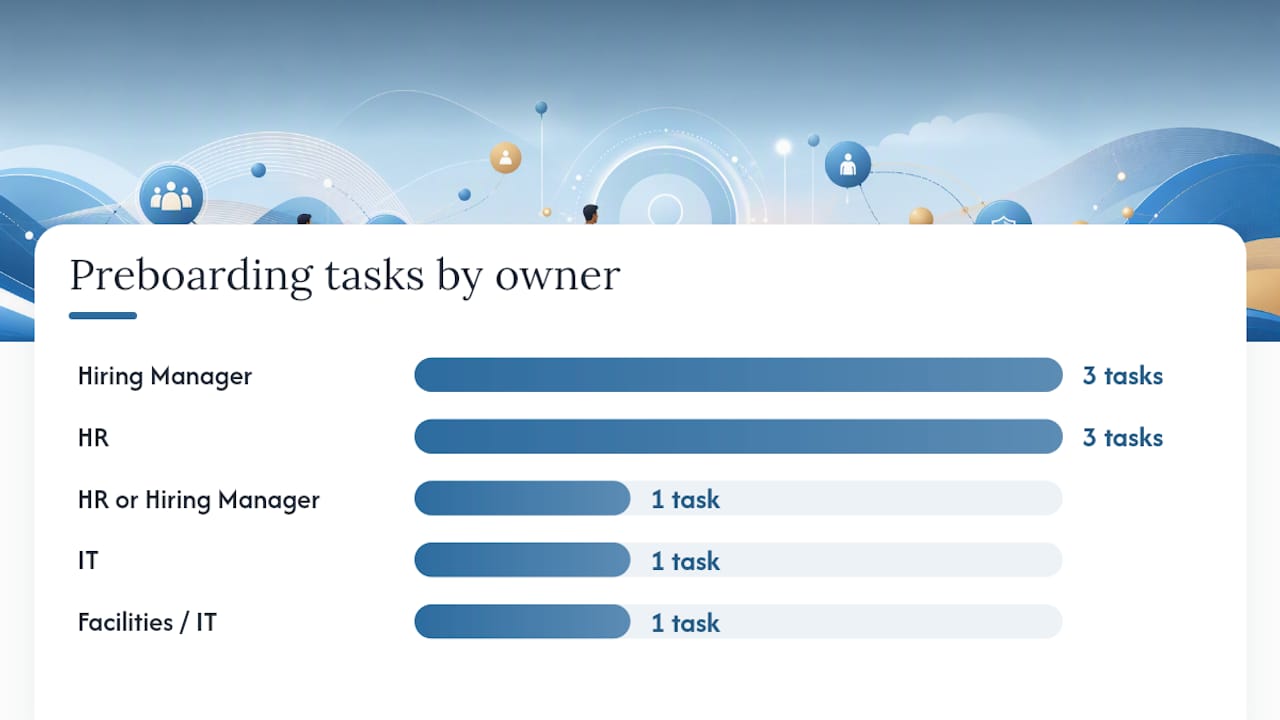
Preboarding checklist by owner
The tasks below should be completed before the new hire’s start date. Each item has a clear owner so nothing falls through the cracks.
| Task | Owner | Timing |
|---|---|---|
| Send personalized welcome email with start-date logistics | Hiring Manager | Within 24 hours of offer acceptance |
| Initiate background check and reference verification | HR | Day of offer acceptance |
| Collect and process new-hire paperwork (offer letter, I-9, W-4) | HR | Week 1 after offer acceptance |
| Submit IT provisioning ticket (hardware, software, credentials) | IT | No later than 2 weeks before start date |
| Share digital employee handbook and policy documents | HR | 1 week before start date |
| Send team introduction email or short team bio document | Hiring Manager | 3–5 days before start date |
| Brief and confirm buddy assignment | HR or Hiring Manager | 1 week before start date |
| Confirm workstation setup (desk, badge, parking, building access) | Facilities / IT | 2 days before start date |
| Schedule Day-1 agenda and first manager 1:1 | Hiring Manager | 1 week before start date |
Pro Tip: If your organization uses a professional headshot for the employee directory or team communications, arrange the photo session for the first week. Sending the new hire a resource like tips for professional headshots as part of the welcome email is a small gesture that signals you have thought about their experience beyond the paperwork.
A practical Day-1 agenda
Day 1 should balance compliance requirements with genuine human connection. Overloading the morning with policy presentations is one of the most common mistakes hiring managers make. A better structure:
- 8:30 AM — Welcome and workspace orientation (Buddy leads): Walk the new hire to their desk, introduce them to immediate team members, show them the kitchen, restrooms, and any shared spaces. Keep it informal and unhurried.
- 9:00 AM — HR compliance session (HR leads): Complete any remaining I-9 verification, benefits enrollment overview, and policy acknowledgment signatures. Aim to finish within 90 minutes.
- 10:30 AM — IT setup (IT or Buddy assists): Log into systems, confirm email access, set up two-factor authentication, and verify all software licenses are active.
- 12:00 PM — Team lunch or informal introduction (Hiring Manager leads): A casual lunch with the immediate team. No agenda, no presentations.
- 1:30 PM — Role orientation (Hiring Manager leads): Walk through the 30/60/90 plan, clarify the first week’s priorities, and answer questions about the role.
- 4:00 PM — End-of-day check-in (Hiring Manager): A 20-minute 1:1 to ask how the day went, address any concerns, and confirm tomorrow’s schedule.
The end-of-day check-in is the single most underused tool in Day-1 onboarding. It takes 20 minutes and signals to the new hire that their manager is present and invested.
What should the first week and 30/60/90 plan look like?
BambooHR recommends that onboarding span at least 90 days and often extend through the first year to improve retention and engagement. The first week sets the pace for everything that follows, and the 30/60/90 plan gives both the manager and the new hire a shared map of what success looks like at each milestone.
First-week priorities
The first week is not the time for deep technical training. It is the time for role clarity, relationship-building, and a few early wins that build confidence. Managers should focus on three things:
- Role clarity: By the end of Week 1, the new hire should be able to articulate their top three priorities for the first 30 days in their own words. If they cannot, the clarification work is not done.
- Relationship-building: Schedule brief introductory meetings (15–20 minutes each) with five to seven key stakeholders the new hire will work with regularly. These are not briefings — they are conversations.
- Quick wins: Identify one or two low-stakes tasks the new hire can complete and deliver in Week 1. Early visible contribution accelerates confidence and team trust.
30/60/90 milestone template
SHRM recommends a written onboarding plan with stakeholder check-ins and milestones at 30, 60, and 90 days — and up to one year for complex roles. The template below gives managers a ready-to-use structure.
| Milestone | Focus Area | Deliverables | Manager Check-In |
|---|---|---|---|
| Day 30 | Compliance and orientation complete; role clarity established | All paperwork done; 30-day goal set; buddy relationship active | 30-minute 1:1 to review goals and address early friction |
| Day 60 | Role-specific skill development; early performance indicators | First project or deliverable completed; training modules finished | 45-minute 1:1 to review progress, adjust goals if needed |
| Day 90 | Independent contribution; team integration | 90-day review completed; development plan drafted; onboarding feedback submitted | Formal 90-day review with documented outcomes |
Sample meeting agendas for each checkpoint
30-day check-in agenda (30 minutes):
- How is the role matching your expectations so far? (5 min)
- Review the 30-day goals: what is on track, what needs adjustment? (10 min)
- Are there any tools, access, or resources you are still missing? (5 min)
- What questions do you have about the team or the organization? (5 min)
- Confirm priorities for the next 30 days. (5 min)
60-day check-in agenda (45 minutes):
- Review progress on the first deliverable or project. (10 min)
- Discuss training completion and any skill gaps identified. (10 min)
- Calibrate performance expectations: are the 90-day goals realistic? (10 min)
- Check in on relationships with key stakeholders. (10 min)
- Confirm next steps and any support needed. (5 min)
90-day review agenda (60 minutes):
- Formal review of 90-day deliverables against goals. (15 min)
- Strengths observed and areas for development. (15 min)
- Draft a 6-month development plan together. (15 min)
- Collect onboarding feedback: what worked, what did not? (10 min)
- Confirm transition from onboarding to standard performance management. (5 min)
Milestone checklist for managers:
- [ ] All compliance paperwork verified complete by Day 30
- [ ] Buddy relationship confirmed active at Day 14 check-in
- [ ] Core training modules completed by Day 30
- [ ] First deliverable reviewed and documented by Day 60
- [ ] 90-day review scheduled at least two weeks in advance
- [ ] Onboarding feedback collected and submitted to HR by Day 90
- [ ] Development plan drafted and shared with HR by Day 90
Who owns what? A clear accountability matrix for onboarding
Onboarding fails most often not because of missing resources but because of missing ownership. When every stakeholder assumes someone else handled the IT ticket or the buddy briefing, the new hire pays the price. AIHR emphasizes assigning owners for each task in a timed new-hire checklist precisely because ambiguous accountability is the leading cause of onboarding gaps.
Owner-task matrix
Escalation steps and SLAs
When something is late, the escalation path should be defined before Day 1, not discovered after a problem surfaces.
- IT access or equipment not ready by Day 1: IT notifies HR and the hiring manager no later than 48 hours before the start date. The hiring manager decides whether to delay the start date or provide a temporary workaround (loaner device, temporary credentials).
- Paperwork incomplete at Day 7: HR flags to the hiring manager and legal/compliance. I-9 must be completed within three business days of the start date under federal law — this is not a flexible deadline.
- Buddy has not connected with the new hire by Day 3: HR follows up with the buddy and, if needed, assigns an interim contact from the team.
- 30-day check-in not scheduled by Day 20: HR sends an automated reminder to the hiring manager and escalates to the department head if not resolved within 48 hours.
Communicating ownership to the new hire
The new hire should receive a one-page “who to contact for what” document on Day 1. It should list the name, role, and contact information for their HR contact, their buddy, their IT support contact, and their manager. Ambiguity about who to ask is a silent source of early disengagement — new hires who do not know where to turn for help often do not ask at all.
How do buddy and mentoring programs deliver real connection?
The Connection C is the most frequently underfunded dimension of onboarding. Organizations invest in compliance systems and training platforms but assign buddies informally, without a brief, a structure, or a defined time commitment. The result is a buddy relationship that fades by Week 2. SHRM’s guidance on new employee onboarding notes that buddies answer everyday practical questions and help new hires navigate cultural norms — a function no orientation deck can replicate.

Buddy vs. mentor: different roles, different scope
A buddy is a peer-level colleague who helps the new hire navigate the practical realities of the workplace in the first 30–90 days: where to find things, how the team communicates, what the unwritten norms are. The buddy relationship is informal, low-stakes, and time-bounded.
A mentor is typically a more senior colleague or leader who supports the new hire’s longer-term professional development. Mentoring relationships can last from a few months to a year or more and involve career guidance, skill development, and organizational navigation at a strategic level.
Both roles are valuable. Conflating them — asking one person to do both — usually means neither is done well.
Buddy touchpoint schedule
- Day 1: Meet the new hire at the entrance or their desk. Walk them through the physical or virtual workspace. Have lunch together if possible.
- Day 3: Check in informally (10 minutes) to ask what questions have come up and whether there are any gaps in access or resources.
- Week 2: A 20-minute conversation focused on team dynamics: who the key collaborators are, how decisions get made, and any cultural norms the new hire should know.
- Week 4: A closing check-in to assess whether the buddy relationship should continue informally or whether the new hire is ready to navigate independently.
Sample buddy agreement
Before the new hire starts, the buddy should receive a brief written agreement that sets clear expectations:
- Time commitment: Approximately 2–3 hours per week for the first two weeks, tapering to 1 hour per week through Day 30.
- Scope: Answer practical questions about the workplace, team, and culture. Do not provide performance feedback or act as a manager.
- Escalation: If the new hire raises a concern about their role, compensation, or a workplace issue, the buddy directs them to HR or the hiring manager and notifies HR that the conversation occurred.
- Confidentiality: Conversations between the buddy and the new hire are informal and not reported to the manager unless a safety or compliance concern arises.
Pro Tip: Select buddies who have been with the organization for at least one year and who have demonstrated cultural alignment — not just technical competence. A buddy who is disengaged themselves will transmit that disengagement to the new hire within the first week.
What metrics and tools should you use to track onboarding progress?
Onboarding metrics give HR and hiring managers the data they need to catch problems early and improve the program over time. You cannot improve what you do not measure — and most organizations measure only compliance completion, missing the engagement and productivity signals that predict 90-day retention.
Essential onboarding metrics
- Paperwork completion rate by Day 3: The percentage of new hires who have completed all required compliance documents within three business days. This is a baseline metric, not a success indicator.
- IT/credential readiness on Day 1: Whether the new hire had full system access on their first day. Any rate below 100% indicates a process gap in IT provisioning.
- Milestone completion rate: The percentage of new hires who complete their 30, 60, and 90-day check-ins on schedule. Low rates signal manager disengagement.
- New-hire NPS (Net Promoter Score): A single-question survey at Day 30 and Day 90 asking how likely the new hire is to recommend the organization as a place to work. This is one of the fastest ways to surface early engagement problems.
- Time-to-productivity: A manager-assessed rating of when the new hire reached independent contribution. Tracked across cohorts, this reveals whether onboarding investments are shortening the ramp time.
- 90-day retention rate: The percentage of new hires still employed at Day 90. This is the lagging indicator that all other metrics are trying to predict.
Technology tools and what to automate
HR technology can handle the administrative layer of onboarding efficiently, freeing managers to focus on the relationship work that technology cannot replicate.
Automate with HRIS/HR tech platforms (Workday, BambooHR, ADP Workforce Now):
- New-hire paperwork collection and e-signature
- Compliance deadline reminders
- Milestone check-in scheduling and tracking
- Training module assignments and completion tracking
Automate with IT ticketing systems (ServiceNow, Jira Service Management):
- Equipment provisioning requests
- Software license assignments
- Access credential setup and verification
Keep human:
- The Day-1 welcome and workspace orientation
- Manager 1:1 check-ins at 30, 60, and 90 days
- Buddy touchpoints
- Culture and values conversations
The practical implication: use your HRIS to track completion rates and send reminders, but never replace the manager’s 30-day check-in with an automated survey. The survey supplements the conversation; it does not substitute for it.
What templates and checklists does every onboarding program need?
A well-run onboarding program runs on templates that any hiring manager can pick up and use without reinventing the process for each new hire. ADP recommends standardizing onboarding items including Form I-9, W-4, payroll setup, equipment provisioning, and manager introductions and notes that digital onboarding reduces paperwork friction and improves tracking across the board.
New-hire paperwork checklist
Federal employment forms:
- Form I-9 (Employment Eligibility Verification) — must be completed within three business days of start date
- Form W-4 (Employee’s Withholding Certificate)
- Direct deposit authorization form
- Emergency contact form
State-specific forms (varies by state):
- State income tax withholding form
- State new-hire reporting form (required in all 50 states within specific timeframes)
- Paid leave or disability insurance enrollment (where applicable)
Policy acknowledgments:
- Employee handbook acknowledgment
- Code of conduct and ethics policy
- Confidentiality and non-disclosure agreement (where applicable)
- IT acceptable use policy
- Anti-harassment and discrimination policy
Benefits enrollment:
- Health, dental, and vision insurance elections
- 401(k) or retirement plan enrollment
- FSA/HSA enrollment (if offered)
- Life and disability insurance elections
IT and security checklist for remote hires
Remote onboarding requires a more deliberate IT checklist because there is no IT desk to walk to on Day 1.
- [ ] Laptop or desktop shipped and confirmed delivered at least two days before start date
- [ ] VPN access configured and tested before Day 1
- [ ] Email account active and accessible before Day 1
- [ ] Two-factor authentication enrolled on Day 1
- [ ] All role-specific software licenses assigned and accessible
- [ ] Video conferencing platform (Zoom, Microsoft Teams, or Google Meet) tested
- [ ] IT support contact information shared with the new hire before Day 1
- [ ] Security awareness training assigned in the LMS by Day 3
Pro Tip: *For remote hires, schedule a 15-minute IT orientation call on the morning of Day 1 before any other meetings. Discovering a VPN issue or a missing software license mid-orientation is disruptive and signals poor preparation.
Manager script: Day-1 and first-week check-ins
Managers who are strong performers are not always strong onboarders. A short script gives them a reliable structure without making the conversation feel scripted.
Day-1 end-of-day check-in (20 minutes):
- “How did today go? What surprised you, positively or negatively?”
- “Do you have everything you need to get started tomorrow — access, tools, a clear first task?”
- “Is there anything I can clarify about the role or the team before we wrap up?”
Day-5 end-of-week check-in (30 minutes):
- “What has been clearer than you expected? What is still fuzzy?”
- “Have you connected with [buddy name] and the key stakeholders we identified?”
- “What is your top priority for next week, and what would make it easier?”
These prompts are not scripts to read verbatim. They are anchors that keep the conversation focused on the new hire’s experience rather than drifting into task updates.
How do you scale onboarding from Level 1 to Level 3?
Most organizations know their onboarding program needs work. The harder question is where to start and how to sequence the investments so each improvement builds on the last. A structured audit followed by a prioritized roadmap is the most reliable path from Passive to Proactive.
Mini audit: data points to collect first
Before building a roadmap, collect these five data points from your last 10–20 new hires:
- Time-to-complete onboarding: How many days did it take for each new hire to complete all compliance paperwork and core training? Anything beyond Day 14 for compliance and Day 30 for core training indicates a process gap.
- Buddy assignment rate: What percentage of new hires were assigned a buddy before Day 1? If the answer is below 80%, the buddy program is aspirational, not operational.
- Core training completion by Day 30: What percentage of new hires completed their assigned training modules within the first 30 days? Low rates often reflect poor LMS assignment, not poor motivation.
- Manager check-in completion rate: Did the hiring manager complete a scheduled 1:1 at 30, 60, and 90 days for each new hire? This is frequently the weakest metric in organizations that believe they have a structured program.
- 90-day retention rate: What percentage of new hires placed in the last 12 months were still employed at Day 90?
Prioritized roadmap to Level 3
Near-term (0–90 days): fix the foundation
- Create or update a standard new-hire checklist with owners and deadlines (use the AIHR framework as a starting point).
- Implement a preboarding email sequence triggered by offer acceptance.
- Train hiring managers on the Day-1 agenda and the 30/60/90 check-in structure.
- Assign a buddy to every new hire before Day 1.
Mid-term (90 days–6 months): build the structure
- Integrate the onboarding checklist into your HRIS so completion is tracked automatically.
- Launch a new-hire NPS survey at Day 30 and Day 90.
- Develop role-specific onboarding tracks for your highest-volume positions.
- Create a manager onboarding enablement guide that covers the Four C’s and the check-in scripts.
Long-term (6–12 months): reach Level 3
- Build a feedback loop: review new-hire NPS data quarterly and update the program based on findings.
- Extend onboarding through Month 12 for complex or senior roles, with quarterly development check-ins.
- Integrate onboarding milestones with your performance management system so the 90-day review feeds directly into the annual review cycle.
- Measure time-to-productivity by role and use the data to refine the 30/60/90 templates.
Multi-state scaling and legal compliance
Multi-state employers face an additional layer of complexity. SixFifty recommends combining a standard core onboarding process with state-specific supplements for tax withholding, leave laws, and new-hire reporting requirements. Every state has its own new-hire reporting timeline and its own required tax forms — California, New York, and Texas each have distinct requirements that differ from the federal baseline.
The practical approach: build a core onboarding checklist that applies to all hires, then create state-specific addendum documents that HR appends based on the new hire’s work location. Review these addenda annually, as state leave laws in particular change frequently.
Pro Tip: When hiring in a new state for the first time, consult employment counsel before the new hire’s start date. State-specific requirements for paid leave, non-compete enforceability, and final paycheck timing can create compliance exposure if the core onboarding checklist is applied without modification.
What onboarding mistakes derail new hires, and how do you fix them fast?
Even well-designed onboarding programs break down at the execution level. The warning signs are usually visible within the first 72 hours, and most of them have a fix that takes less than a day to implement.
Top red flags and immediate fixes
-
No workstation or system credentials on Day 1 (Owner: IT, escalated by HR)
Immediate fix: Provide a loaner device and temporary credentials within two hours. IT notifies the hiring manager of the delay and commits to a resolution timeline. The hiring manager acknowledges the issue directly with the new hire and reframes the day’s agenda. -
No manager check-in at the end of Day 1 (Owner: Hiring Manager)
Immediate fix: If the manager missed the Day-1 check-in, they schedule a 20-minute call for the morning of Day 2 and send a brief message that evening acknowledging the gap. One missed check-in is recoverable. A pattern of missed check-ins is not. -
No buddy assigned or buddy has not made contact by Day 3 (Owner: HR)
Immediate fix: HR assigns an interim buddy from the team within 24 hours and briefs them on the basic touchpoint schedule. The original buddy assignment is reviewed — if the assigned buddy is unavailable or disengaged, replace them rather than waiting for the relationship to self-correct. -
Orientation overloaded with policy presentations (Owner: HR and Hiring Manager)
Immediate fix: Move non-urgent policy acknowledgments to a self-paced digital module due by Day 5. Reserve live orientation time for culture, team introductions, and role clarity. The new hire can read the employee handbook; they cannot replicate a genuine team lunch from a PDF. -
30-day check-in not scheduled by Day 20 (Owner: Hiring Manager, tracked by HR)
Immediate fix: HR sends a reminder to the hiring manager and offers to schedule the meeting on their behalf. If the manager declines or does not respond within 48 hours, HR escalates to the department head.
Longer-term mitigation tactics
The fixes above address symptoms. The underlying cause in most cases is that hiring managers have not been trained on what onboarding requires of them. A one-hour manager onboarding workshop, delivered as part of new manager orientation and refreshed annually, eliminates the majority of execution failures. The workshop should cover the Four C’s, the 30/60/90 check-in structure, and the escalation path for common problems.
A second structural fix: build onboarding completion into manager performance metrics. When managers are measured on whether their new hires complete onboarding milestones on schedule, completion rates rise. When onboarding is treated as an HR responsibility with no manager accountability, it stays at Level 1.
Why preboarding and manager enablement are the two highest-leverage investments
Most onboarding conversations focus on what happens after Day 1. The evidence points in a different direction: the decisions made between offer acceptance and the first morning determine whether the new hire arrives confident or anxious, prepared or confused. Preboarding is not a courtesy — it is a retention tool.
The same logic applies to manager enablement. A well-designed onboarding program delivered by an unprepared manager produces Level-1 outcomes regardless of the templates in the HRIS. Managers who understand the Four C’s, who have a check-in script, and who know the escalation path when something goes wrong are the single most reliable predictor of a successful 90-day outcome. HR can build the infrastructure, but the manager is the one who makes it real for the new hire.
The organizations that reach Level 3 onboarding are not the ones with the most sophisticated HR technology. They are the ones where every hiring manager treats the first 90 days as their most important management responsibility for that hire — and where HR has given them the tools to do it well.
Careerscape helps you place and onboard the right people, faster
Placing the right candidate is only half the equation. The other half is making sure they are set up to succeed from Day 1. Careerscape’s staffing and recruiting services are built for hiring managers who need qualified professionals placed quickly and onboarded effectively across administrative, customer service, IT, and leadership roles.
Here is where Careerscape adds direct value to your onboarding process:
- Contract staffing: When you need a skilled professional to fill a gap while a permanent hire ramps up, Careerscape places contract staff who are ready to contribute from Day 1 with minimal onboarding overhead.
- Project-based staffing: For short-term initiatives where a full onboarding cycle is not practical, Careerscape builds project teams with the role clarity and stakeholder alignment already established.
- HR coordinator placements: If your onboarding program needs a dedicated owner, Careerscape sources HR coordinators who specialize in new-hire experience, HRIS management, and compliance tracking.
Every placement comes with Careerscape’s commitment to fast, honest recruiting backed by industry expertise. To request a staffing consultation or discuss your onboarding capacity needs, submit a request here.
The following resources provide deeper reading on onboarding best practices, compliance requirements, and program design. Each is referenced in this article and is worth bookmarking for your HR team.
FAQ
What is the most important step when starting a new hire’s onboarding?
The single most important step is distributing a written 30/60/90 onboarding plan with named owners before Day 1. Without it, accountability gaps in IT provisioning, compliance paperwork, and manager check-ins are almost inevitable.
How long should onboarding last for a new employee?
BambooHR recommends onboarding last at least 90 days, with many organizations extending the process through the first year for complex or senior roles to improve retention and long-term engagement.
What are the Four C’s of onboarding?
The Four C’s, defined by SHRM, are Compliance, Clarification, Culture, and Connection.
What should a Day-1 agenda include for a new hire?
A Day-1 agenda should cover a workspace orientation led by the buddy, an HR compliance session for I-9 and policy acknowledgments, IT setup, a team lunch or informal introduction, a role orientation with the hiring manager, and a brief end-of-day manager check-in.
How does Careerscape support the onboarding process for employers?
Careerscape places contract staff, project-based teams, and HR coordinators who can fill onboarding capacity gaps, manage compliance tracking, and support new-hire integration from Day 1. Hiring managers can request a staffing consultation to discuss their specific onboarding and placement needs.