
Data-driven recruiting replaces gut-feel hiring decisions with analytics, metrics, and predictive modeling across the full talent acquisition lifecycle, helping organizations reduce time-to-hire by up to 30% and cost-per-hire by up to 40%. The approach improves candidate fit, reduces unconscious bias, and enables defensible hiring decisions, while human judgment remains an essential complement to the data. Successful implementation requires defining clear KPIs upfront, integrating HR tech systems to eliminate data silos, and building recruiter data literacy — since collecting data is only valuable when teams can translate it into actionable decisions.
Most hiring decisions still involve a level of gut feeling that no one wants to admit out loud. A resume looks polished, an interview goes well, and a manager says “I have a good feeling about this one.” But gut feelings don’t scale, and they don’t explain a bad hire that cost the company three times the position’s annual salary. What is data-driven recruiting? It’s the practice of replacing that guesswork with measurable, repeatable analytics across every stage of the hiring lifecycle. This guide breaks down how it works, what it delivers, and how you can put it to work.
Table of Contents
- Key takeaways
- What is data-driven recruiting?
- Benefits of data-driven hiring
- Common challenges in implementation
- How to implement data recruiting
- My take on data as a recruiting habit
- How Cs-recruiters supports data-driven hiring
- FAQ
Key Takeaways
| Point | Details |
|---|---|
| Data replaces guesswork | Data-driven recruiting uses analytics across the full hiring cycle to support smarter, faster decisions. |
| Measurable efficiency gains | Leading firms reduce time-to-hire by up to 30% and cost-per-hire by up to 40% with data-driven methods. |
| Tech integration is critical | Disjointed HR tools block data flow; unified systems are the foundation of any effective data strategy. |
| Human judgment still matters | Data supports decision-making but does not replace it. The two work best together. |
| Start with clear KPIs | Define measurable hiring goals before building any analytics process or technology stack. |
What Is Data-Driven Recruiting?
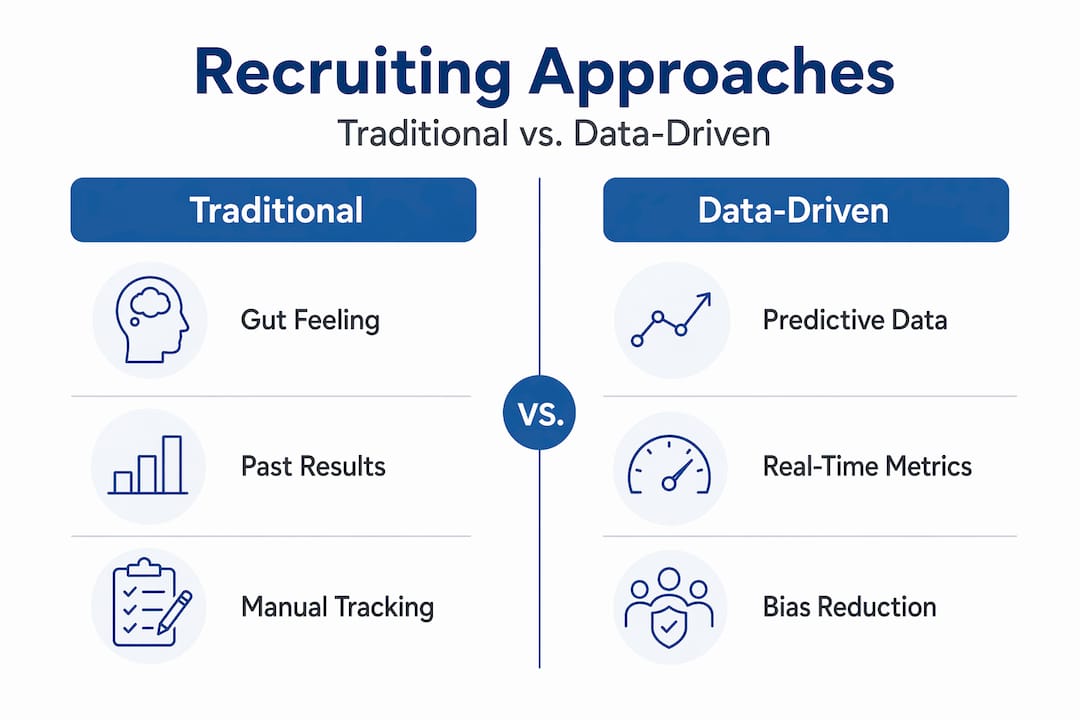
Data-driven recruiting is the use of analytics, metrics, and predictive modeling to guide hiring decisions at every stage of the talent acquisition process. Instead of relying on a recruiter’s instinct or a manager’s first impression, data-based hiring decisions draw on concrete evidence collected from multiple sources throughout the hiring funnel.
Traditional recruiting typically works like this: a hiring manager approves a job description, a recruiter posts it, resumes come in, someone screens them manually, and interviews happen. The process is largely subjective. Candidate selection depends heavily on who wrote the job description, who reviewed the resume, and how the interview felt in the room.
Data-driven talent acquisition changes that dynamic entirely. It introduces structure at each decision point. Here’s what the core elements typically include:
- Data collection: Candidate performance metrics, sourcing channel effectiveness, time-to-fill per role, application completion rates, and structured interview scores
- Analytics and reporting: Real-time dashboards that surface patterns across applicant pools and recruiter performance
- Predictive modeling: Using historical hire data to forecast which candidates are most likely to succeed in a given role
- AI-assisted screening: Tools that score applications against role requirements based on pre-set, validated criteria
- Continuous feedback loops: Post-hire data including 90-day performance reviews and retention rates fed back into sourcing and screening models
What separates this from traditional recruiting is the shift from retrospective to predictive analysis. Rather than asking “What happened in our last hiring cycle?” a data-driven team asks “Which candidates hired through channel X in Q3 performed best at 12 months?” That is a fundamentally different question. And it produces fundamentally better answers.
Human judgment doesn’t disappear in this model. Data enhances human decision-making and reduces unconscious bias rather than replacing the recruiter entirely. Think of it as giving your hiring team better instruments. The pilot still flies the plane.
Benefits of Data-Driven Hiring
The case for data analytics in recruitment isn’t theoretical. The numbers are concrete, and the operational advantages are significant.
- Faster hiring: Firms reduce time-to-hire by 30% and cost-per-hire by up to 40% when they shift from intuition-based to analytics-supported recruiting.
- Better candidate fit: Structured interview scorecards and validated assessments produce candidates who match role requirements more precisely, which directly improves retention rates.
- Reduced bias: Data recruitment strategies create more consistent evaluation criteria across all candidates, which supports more diverse hiring outcomes and reduces the influence of individual preferences.
- Defensible decisions: When a hiring decision is challenged, documented metrics and scoring criteria provide clear justification. Subjective impressions do not.
- Bottleneck identification: Tracking recruiting metrics reveals exactly where candidates drop off or where the process slows down, so you can fix the right thing.
- Strategic alignment: Data connects hiring volume and timeline to business goals, making talent acquisition a planning function rather than a reactive one.
The most underappreciated benefit is what happens after the hire. When you track 90-day performance, manager satisfaction ratings, and voluntary turnover by source channel, you begin to understand which sourcing approaches actually produce your best employees. That insight is worth more than any single placement. It reshapes your entire recruiting model over time, which is the real payoff of committing to data-driven talent acquisition.
Common Challenges in Implementation

Knowing the benefits is one thing. Getting there is another. Most organizations that struggle with data-driven recruiting hit the same obstacles, and understanding them upfront saves significant time and frustration.
Technology fragmentation is the most common barrier. 81% of organizations report that disjointed HR tech systems prevent them from achieving their recruiting goals. When your applicant tracking system doesn’t talk to your assessment platform, and neither connects to your onboarding tool, you end up with data scattered across systems that no one can synthesize.
The insight gap is the second major problem. 61% of organizations say providing useful people data is a top priority, but only 33% actually succeed in producing insights that change hiring decisions. Collecting data is not the same as using it. Many teams generate reports but lack the infrastructure or the skills to translate numbers into decisions.
Data quality compounds both problems. Only 42% of organizations report that their people data is highly accurate. If the underlying data is inconsistent or incomplete, any analysis built on it will lead you in the wrong direction.
Three additional pitfalls are worth calling out:
- Treating data review as a quarterly exercise rather than a continuous operational habit
- Over-indexing on metrics and losing sight of candidate experience
- Failing to upskill recruiters in basic data literacy, which leaves analytical tools underused
Pro Tip: Before investing in new analytics software, audit your existing HR tech stack to identify where data is getting lost between systems. A unified data flow matters more than any single tool.
How to Implement Data Recruiting
Getting data-driven recruiting off the ground requires a sequence of decisions, not just a software purchase. Here’s a practical framework for organizations at any stage of maturity.
-
Define your hiring KPIs first. Decide which metrics matter most for your organization: time-to-fill, cost-per-hire, offer acceptance rate, quality-of-hire at 90 days, or sourcing channel ROI. You can’t improve what you don’t measure.
-
Integrate your HR technology. Your ATS, candidate relationship management tool, and assessment platform need to share data. Mature data-driven recruiting depends on interoperability between these systems to avoid manual data rework that introduces errors and delays.
-
Implement structured assessments. Standardized screening questions, structured interview scorecards, and validated skills assessments create consistent data points across all candidates for a given role. This is the raw material your analytics need.
-
Leverage predictive analytics. Once you have 12 to 18 months of hiring data, you can begin using predictive modeling to forecast candidate success based on historical patterns. Predictive analytics reduces time-to-fill by 30% and shifts the recruiter’s role from reactive screener to proactive decision architect.
-
Train your recruiting team. Data literacy is now a core recruiting competency. Hiring managers and recruiters need to read dashboards, interpret trend lines, and ask the right questions of the data in front of them.
-
Review metrics continuously, not quarterly. Successful data-driven recruiting requires integration into daily operations rather than periodic audits. Set up weekly metric reviews for active roles and monthly reviews for sourcing channel performance.
-
Communicate findings clearly. Clear communication of data goals across hiring teams builds trust and alignment. When recruiters understand why you are tracking a metric, they engage with the process instead of working around it.
The table below shows which metrics to prioritize at each hiring stage.
| Hiring stage | Key metric to track | Why it matters |
|---|---|---|
| Sourcing | Channel effectiveness ratio | Shows which sources produce qualified applicants |
| Screening | Application-to-interview rate | Flags misaligned job descriptions or screening criteria |
| Interviewing | Structured scorecard correlation | Connects interview scores to post-hire performance |
| Offer | Offer acceptance rate | Reveals compensation or process friction |
| Post-hire | 90-day retention by source | Identifies which hiring channels produce lasting employees |
Pro Tip: When optimizing job postings with data, track application volume and quality by job board channel separately. Most teams average these together and miss the fact that one platform delivers 80% of their best hires.
My Take on Data as a Recruiting Habit
I’ve spent years watching organizations invest in analytics tools and then use them the same way they used spreadsheets before: to justify decisions already made. That’s the wrong model, and it’s surprisingly common.
What I’ve learned is that data-driven recruiting only works when it’s treated as a continuous operational habit, not a reporting exercise. The teams that actually improve their hiring outcomes are the ones reviewing metrics every week, not every quarter. They ask “Why did our offer acceptance rate drop this month?” the same week it drops. Not six weeks later when the trend is already cemented.
I’ve also found that the human judgment piece gets misunderstood in both directions. Some recruiters fear that data will replace their expertise. Others swing too far the other way and trust a score blindly. The sweet spot is using data to sharpen your judgment, not to substitute for it. An algorithm can surface a strong candidate. It cannot read the room in a values conversation.
The shift I find most significant is what data does to the recruiter’s role itself. The best recruiters I’ve worked with don’t just source candidates anymore. They architect hiring decisions. They understand how applicant screening connects to downstream retention. They design processes with measurement built in from the start. That’s a fundamentally more sophisticated skill set than “find good people and hope for the best.”
My advice: don’t wait until you have a perfect tech stack to start. Pick two metrics, track them consistently for 90 days, and act on what you find. That discipline, practiced daily, does more for your hiring than any software implementation.
— Chris
How Cs-Recruiters Supports Data-Driven Hiring
Cs-recruiters, operating as Careerscape, builds its recruiting practice around the same principles this article outlines: measurable outcomes, transparent processes, and industry expertise that cuts time-to-fill without sacrificing quality. If you’re ready to put data-driven talent acquisition into practice but need support, Careerscape offers contract staffing solutions that give you flexible access to qualified professionals without the overhead of a full-time hire, which is particularly useful when testing a new role or filling a skills gap quickly.
For organizations taking on defined projects, project-based staffing teams deliver pre-screened talent aligned to specific deliverables and timelines. And if you want to see how Careerscape’s employer portal gives you direct access to recruiting analytics and candidate pipelines, it’s worth exploring. Careerscape connects qualified professionals with companies ready to hire, fast and honestly. That’s not a tagline. It’s the operating standard.
Find talent now and see how a data-informed recruiting partner makes a measurable difference.
FAQ
What Is Data-Driven Recruiting in Simple Terms?
Data-driven recruiting is the practice of using measurable analytics and structured assessment data to guide hiring decisions, replacing or supplementing gut-feel judgment with evidence at every stage of the process.
What Metrics Matter Most in Data-Driven Hiring?
The most impactful metrics include time-to-fill, cost-per-hire, sourcing channel effectiveness, offer acceptance rate, and quality-of-hire measured at 90 days post-placement.
Does Data-Driven Recruiting Eliminate Human Judgment?
No. Data enhances human decision-making rather than replacing it. Recruiters and hiring managers still make final calls, but those calls are informed by structured data rather than impression alone.
How Long Does It Take to Implement Data Recruiting?
Basic implementation, covering KPI definition, ATS data audits, and structured interview scorecards, can be done in 60 to 90 days. Predictive modeling typically requires 12 to 18 months of consistent data collection before it produces reliable forecasts.
What Is the Biggest Barrier to Data-Driven Talent Acquisition?
Technology fragmentation is the leading obstacle. 81% of organizations report that disjointed HR tech systems prevent them from using recruiting data effectively. Unifying your tools is the most important first step.
Recommended
- What is recruiting? The employer’s guide to modern hiring
- Job Posting Optimization: A 2026 Recruiter’s Guide
- What Is Technical Recruiting? A Complete Guide for Employers
- Types of recruitment agencies: A smarter hiring guide