
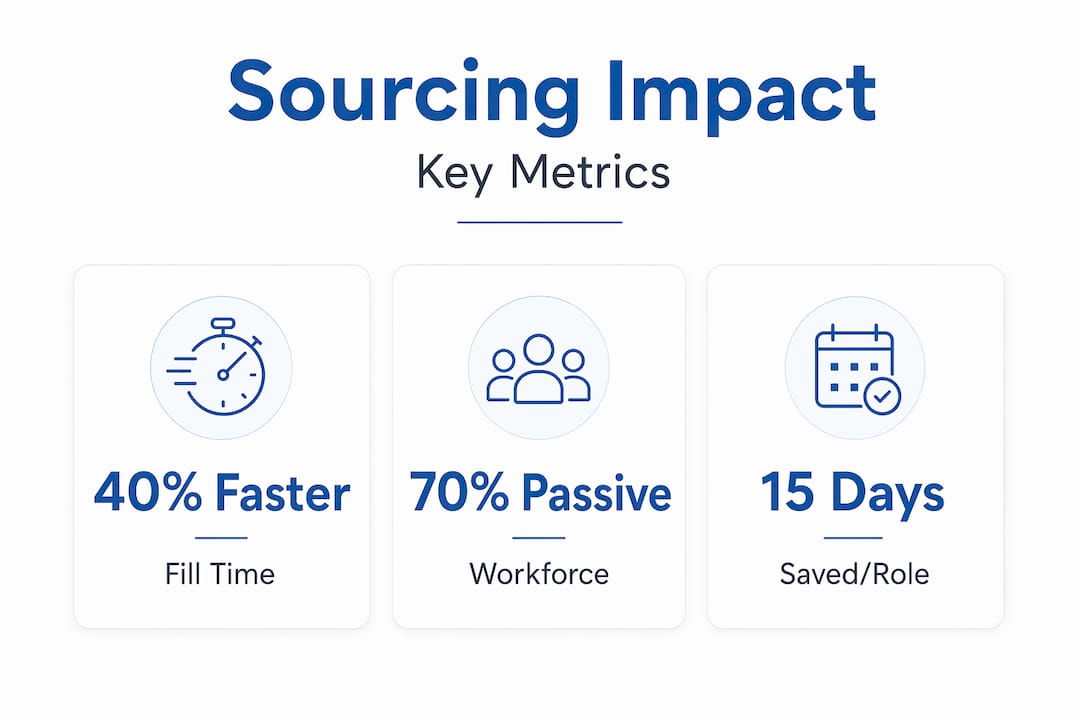
Candidate sourcing is a proactive recruiting discipline where teams identify and engage potential hires before roles are posted, rather than waiting for inbound applications. With 70% of the global workforce classified as passive candidates — and 87% open to new opportunities when approached thoughtfully — targeted outreach to non-active job seekers represents the largest and often highest-quality talent pool available. Organizations with dedicated sourcing functions fill roles 40% faster than those relying solely on inbound applications, making sourcing one of the highest-leverage investments in talent acquisition.
In this article
Most hiring teams wait for candidates to come to them. They post a job, review applications, and hope the right person shows up. Candidate sourcing flips that model entirely. Understanding what is candidate sourcing means recognizing it as a proactive discipline: recruiters go out and find talent before a position is even posted. This guide covers the candidate sourcing definition in full, walks through the most effective sourcing techniques, explains how to engage passive talent, and outlines the measurable benefits that make sourcing one of the highest-leverage activities in modern talent acquisition.
Key Takeaways
| Point | Details |
|---|---|
| Sourcing is proactive, not reactive | Candidate sourcing begins before candidates apply, targeting talent through outbound research and engagement. |
| Passive talent dominates the market | 70% of the global workforce is passive, yet 87% are open to opportunities when approached correctly. |
| Sourcing differs from recruiting | Sourcing covers early funnel discovery only; recruiting handles the full lifecycle through offer and onboarding. |
| Quality shortlists beat large pipelines | Focused, vetted shortlists lead to faster decisions and stronger hiring outcomes than high-volume outreach. |
| ATS/CRM integration prevents pipeline loss | Connecting sourcing tools directly to your applicant tracking system reduces dropped contacts and stalled candidates. |
What Is Candidate Sourcing, Exactly?
The candidate sourcing definition, at its core, is the proactive process of identifying, researching, and engaging potential candidates before they apply for open roles. According to Klearskill, sourcing focuses on outbound engagement, distinct from inbound functions like employer branding or job board advertising.
Many HR professionals conflate sourcing with recruiting or headhunting. They are related but not interchangeable. The table below clarifies the distinctions:
| Function | Scope | Primary goal |
|---|---|---|
| Candidate sourcing | Early funnel: identify and engage | Build a pool of qualified, contactable talent |
| Recruiting | Full lifecycle: screening to onboarding | Move candidates from interest to hire |
| Headhunting | Executive and specialist search | Fill specific senior roles through direct approach |
Sourcing is distinct from recruiting in that it focuses only on early funnel discovery and initial engagement, while recruiting handles everything from screening to offer acceptance. You can read a deeper breakdown of how these roles intersect in this employer’s guide to recruiting.
The practical implication is significant. Organizations with dedicated sourcing teams fill roles 40% faster than those relying solely on inbound applications, with sourced hires filling 15 days faster than the 44-day industry average. When sourcing operates as a distinct function, it creates a pre-qualified talent pool that recruiting teams can move through quickly and confidently.
Pro Tip: If your recruiters are spending most of their time generating candidate leads rather than conducting interviews and managing offers, consider separating sourcing into its own dedicated function. The efficiency gains are measurable and consistent.
Passive Candidate Sourcing: The Largest Talent Pool You’re Not Using
Understanding what is a passive candidate is foundational to any sourcing strategy. A passive candidate is a professional who is currently employed and not actively looking for a new role. What is passive candidate sourcing, then? It is the practice of identifying and engaging those individuals through targeted, outbound research rather than waiting for them to raise their hand.

The numbers make a strong case for this approach. 70% of the global workforce is classified as passive at any given moment, and 87% of them are open to new opportunities when approached thoughtfully. This is not a marginal talent pool. It is the dominant one.
Why passive candidates often represent higher quality hires comes down to selection bias. Active job seekers include everyone on the market, including those displaced involuntarily or struggling in current roles. Passive candidates are, by definition, performing well enough to stay employed. Approaching them requires a different posture: one of relevance, respect, and specificity.
The challenges in passive candidate sourcing are real, however:
- Passive candidates are not monitoring job boards, so standard postings do not reach them.
- They require a compelling reason to engage, not just a role description.
- Response rates drop sharply when outreach feels generic or irrelevant.
- Their availability windows are unpredictable, requiring long-term relationship management.
Modern sourcing increasingly uses behavioral signals like network growth, content engagement, and tenure trajectories to identify candidates who are statistically more likely to be open to a move. This is a meaningful upgrade from traditional keyword searches, which often surface candidates based on job title alone.
The most valuable passive candidates are not the full 70% labeled as passive but a smaller subset likely to respond within a 90-day window, identified through predictive behavioral models. Knowing who to prioritize is as important as knowing where to look.
Pro Tip: Before reaching out to a passive candidate, review their recent LinkedIn activity, published content, and tenure at their current employer. These signals tell you whether someone is likely to be open before you write a single word of outreach.
The Candidate Sourcing Process, Step by Step
Knowing how to source candidates systematically separates teams that consistently deliver quality hires from those scrambling to fill roles at the last minute. The sourcing funnel has six distinct stages, each with its own focus and tools.
-
Define the role profile. Work with the hiring manager to establish must-have versus nice-to-have skills, performance benchmarks, and compensation range. Vague role definitions produce unfocused sourcing. This conversation is not optional.
-
Map the talent market. Research where qualified candidates are concentrated: which companies, industries, geographies, and professional communities. This step often reveals competitor talent clusters that are highly relevant to your search.
-
Identify target candidates. Use Boolean search strings on LinkedIn Recruiter, GitHub, professional association databases, and your internal ATS to surface named, contactable individuals. Enterprise ATS platforms with résumé parsing and filtering help categorize candidates into talent pools based on role, location, skills, and engagement status.
-
Qualify against role criteria. Review each profile against the defined benchmarks before reaching out. Sending outreach to unqualified candidates wastes everyone’s time and damages your employer brand.
-
Conduct personalized outreach. LinkedIn’s average InMail acceptance rate is 18% across industries, but personalized messages with at least three role-specific details push that rate to 26%. Reference something specific: a project they led, a skill that matches the role, or a shared industry connection. Generic volume blasting is not sourcing. It is spam.
-
Hand qualified candidates to recruiting. Once a candidate expresses interest and clears basic qualification, transfer them to the recruiting pipeline with full context documented. Integrating sourcing workflows with ATS/CRM systems reduces pipeline leakage caused by manual data entry and stalled candidate engagement. This handover step is where many organizations lose candidates due to poor documentation and tool disconnects.
The Veridata Insights case study on research recruitment for a business consulting firm illustrates this approach well, showing how structured, personalized engagement outperformed volume-based sourcing in both response rate and final hire quality.
Common Pitfalls and Best Practices for Candidate Sourcing
Even experienced teams fall into predictable sourcing traps. Recognizing them is the first step to building a sourcing function that consistently performs.
The most common mistakes include:
- Relying solely on keyword searches. Keyword or job-title searches alone often miss top talent. A candidate may have the right skills without using the exact terminology your search string targets. Behavioral analytics offer a richer picture of candidate readiness.
- Building oversized pipelines. Quantity feels productive. It rarely is. Focused shortlists of vetted candidates enable hiring managers to make faster, more confident decisions and reduce the number of interview cycles required.
- Failing to document sourcing insights. Knowledge gained during a search, about talent density in specific companies, compensation benchmarks, or candidate objections, should persist beyond the individual role. Teams that capture and share these insights compound their sourcing effectiveness over time.
- Treating outreach as a numbers game. Volume outreach erodes your employer brand. A candidate who receives a poorly targeted message remembers it, and so do the colleagues they mention it to.
The best practices for candidate sourcing center on role clarity, personalization, and measurement. You cannot improve what you do not measure. Track metrics like outreach response rate, time from first contact to pipeline entry, source-of-hire breakdown, and shortlist-to-offer ratio. These numbers reveal where your process is strong and where it is leaking value.
Pro Tip: Set up a shared sourcing insights document for each search. Include candidate objections, compensation data points, and market observations. The next recruiter who works a similar role will close it 30% faster because of that institutional knowledge.
Passive sourcing insights should persist beyond individual roles to compound value over time. This is one of the most underused practices in sourcing, and one of the most impactful.
Benefits of Candidate Sourcing for Hiring Outcomes
The benefits of candidate sourcing extend beyond filling roles faster. Strategic sourcing contributes to workforce planning, succession readiness, and cost-per-hire reduction. The data below summarizes the most significant performance gains:
| Benefit | Metric or outcome |
|---|---|
| Faster time-to-fill | Sourced hires fill 15 days faster than the 44-day industry average |
| Higher response rates | Personalized outreach achieves 26% InMail acceptance vs. 18% for generic messages |
| Better hire quality | Vetted shortlists lead to fewer interview cycles and stronger stakeholder confidence |
| Reduced hiring uncertainty | Always-on sourcing reduces last-minute scrambles and reactive hiring costs |
| Succession planning support | Pre-built talent pipelines provide immediate candidates when critical roles open |
Recruitment teams with continuous sourcing practices reduce last-minute hiring scrambles and improve shortlist quality significantly. When leadership asks how quickly a key role can be filled, a team with an active sourcing pipeline has a very different answer than one starting from zero.
The long-term case for why candidate sourcing is important is also tied to workforce planning. Pre-built pipelines for recurring roles, critical functions, and succession targets mean your organization is never caught flat-footed when a key person exits. That kind of hiring readiness has real financial value, even when no role is currently open.
My Honest Take on Sourcing’s Place in Talent Acquisition
I’ve worked closely with recruiting teams across industries, and one pattern stands out: sourcing is consistently the function that gets under-resourced and underestimated until a search goes badly wrong.
Organizations often treat sourcing as something recruiters do in their spare time, between interviews and offer calls. That’s a structural mistake. Sourcing requires focused attention, market research, and relationship-building over time. When it’s crammed into the margins of a recruiter’s day, you get volume outreach, weak shortlists, and extended time-to-fill.
What I’ve seen work: teams that treat sourcing as a distinct, measured discipline with its own KPIs and dedicated ownership. They build talent pipelines not just for open roles but for roles they anticipate opening. They track outreach response rates and refine their messaging based on what actually converts. They share knowledge across searches instead of starting from scratch each time.
The passive candidate piece is where I see the most confusion. Many teams assume that reaching out to passive talent is simply a matter of volume: send enough InMails and some will respond. That logic fails. The candidates most worth targeting have options. They respond to relevance, specificity, and a recruiter who clearly understands their work. A well-researched, targeted approach to passive candidate engagement will outperform a high-volume spray every single time.
Sourcing, done well, is a competitive advantage. It is how organizations consistently hire people their competitors cannot find.
— Chris
How Careerscape Can Strengthen Your Sourcing Strategy
Careerscape, is built on the premise that quality hiring requires more than waiting for candidates to appear. The firm’s sourcing capabilities span contract staffing, direct hire placements, and project-based staffing across industries where finding qualified candidates requires a proactive and targeted approach.
Careerscape’s industry-specialized recruiters maintain active talent pipelines and access passive candidates through structured outreach, not job board dependency. For employers tired of reactive hiring cycles, this means shorter time-to-fill, better shortlist quality, and a partner who brings market intelligence to every search. Explore industry-specific recruiting expertise or take the first step toward building a stronger talent pipeline with Careerscape’s hiring solutions.
FAQ
What Is Candidate Sourcing in Recruitment?
Candidate sourcing is the proactive process of identifying and engaging potential candidates before they apply for a role. It focuses on outbound talent discovery, particularly targeting passive candidates who are not actively job searching.
What Is a Passive Candidate?
A passive candidate is a professional who is currently employed and not actively seeking a new role. They represent approximately 70% of the global workforce but can be engaged through targeted, personalized outreach.
How Is Sourcing Different from Recruiting?
Sourcing covers only the early stages of talent acquisition, specifically identification and initial engagement. Recruiting encompasses the full hiring lifecycle, from screening and interviews through to offer acceptance and onboarding.
How Do You Measure Sourcing Success?
Key metrics include outreach response rate, time from first contact to pipeline entry, source-of-hire breakdown, and shortlist-to-offer ratio. Tracking these numbers over time allows teams to identify and fix weak points in the sourcing process.
Why Is Candidate Sourcing Important for Employers?
Sourcing reduces time-to-fill, improves hire quality, and builds talent pipelines that support succession planning. Organizations with dedicated sourcing functions fill roles an average of 15 days faster than those relying on inbound applications alone.
Recommended
- What is recruiting? The employer’s guide to modern hiring
- Job Posting Optimization: A 2026 Recruiter’s Guide
- What Is Technical Recruiting? A Complete Guide for Employers