
Technical recruiting is a specialized process focused on sourcing and hiring candidates with deep expertise in technology roles, such as software engineering and data science. Many organizations struggle with common pitfalls like lengthy hiring processes and shallow vetting, leading to high rates of bad hires. Implementing proactive, data-driven methods and involving technical experts throughout the recruiting process can significantly enhance hiring outcomes, ultimately treating technical recruiting as a strategic advantage that boosts overall business performance.
In this article
Technical recruiting is the specialized process of sourcing, evaluating, and hiring people for engineering, data, and other deeply technical roles — run by recruiters who can hold their own in a conversation about the stack they hire for. It differs from general recruiting in one decisive way: the candidates are almost all passive, and they judge your company by the technical fluency of the first person who contacts them.
It is also one of the most misunderstood functions in modern hiring. Many companies apply the same volume-based process they use for general roles to software engineers, data scientists, and cloud architects, and then wonder why bad-hire rates hit 25-30%. The stakes are high. A wrong hire in a senior engineering role can cost well above the person’s annual salary when you factor in lost productivity, team disruption, and the cost to restart the search. This guide breaks down what technical recruiting actually is, how it works step by step, where most organizations go wrong, and what a stronger process looks like in practice.
Key Takeaways
| Point | Details |
|---|---|
| Technical recruiting defined | It focuses on sourcing, vetting, and hiring specialized tech professionals using tailored processes. |
| Common pitfalls | Lengthy or shallow processes cause ghosting and bad hires, especially in tech roles. |
| Modern best practices | Proactive, data-driven, and engineer-involved recruiting delivers the best results. |
| Strategic value | Treating technical recruiting as a core strategy boosts business performance. |
Defining Technical Recruiting
Technical recruiting is a specialized discipline focused on identifying, attracting, and placing candidates in roles that require deep expertise in areas like software engineering, IT infrastructure, data science, cybersecurity, machine learning, or DevOps. It is not simply general recruiting with a few added questions about coding languages. The entire process, from how you write the job description to how you evaluate a candidate’s skills, has to be redesigned around the technical nature of the role.
Here is what makes technical recruiting categorically different from traditional HR-led recruiting:
- Role complexity: Technical roles often require a precise combination of programming languages, frameworks, platforms, and domain knowledge that general recruiters may not know how to assess or even recognize.
- Candidate behavior: Tech candidates, especially senior engineers and niche specialists, are often passive. They are not browsing job boards. They need to be found and convinced.
- Skill validation: You cannot rely on a resume alone. Technical competency must be verified through practical assessments, portfolio reviews, or live coding exercises.
- Market speed: High-demand tech candidates frequently receive multiple offers within days. Slow processes lose top talent.
- Communication style: Technical candidates respond poorly to generic outreach. Messaging needs to speak directly to the role’s technical challenges and growth opportunities.
Traditional HR screening models tend to rely on keyword matching in applicant tracking systems and phone screens focused on soft skills. This approach fails to assess technical depth and frequently filters out qualified engineers whose resumes do not match exact keyword patterns, or it passes through candidates who look good on paper but cannot perform in practice.
“The greatest risk in technical hiring is not failing to find candidates. It is failing to accurately evaluate the ones you do find.”
The impact of using a non-technical recruiting process for technical roles is measurable and significant. Organizations report longer time-to-fill rates, higher rates of early attrition among new hires, and significant friction between HR teams and engineering leaders who do not trust the candidates being presented. Investing in purpose-built IT recruiting processes is not optional for tech companies. It is a foundational requirement for building teams that can actually deliver.
Understanding this distinction is the first step toward building a hiring function that works. Once you see technical recruiting as its own discipline rather than a subset of general HR, the path to improvement becomes much clearer.
Core Processes and Methods in Technical Recruiting
Now that you know what technical recruiting is, let’s look at the actual steps and how they’re different from traditional approaches. The workflow in technical recruiting follows a sequence, but each stage has unique requirements that separate it from standard hiring processes.
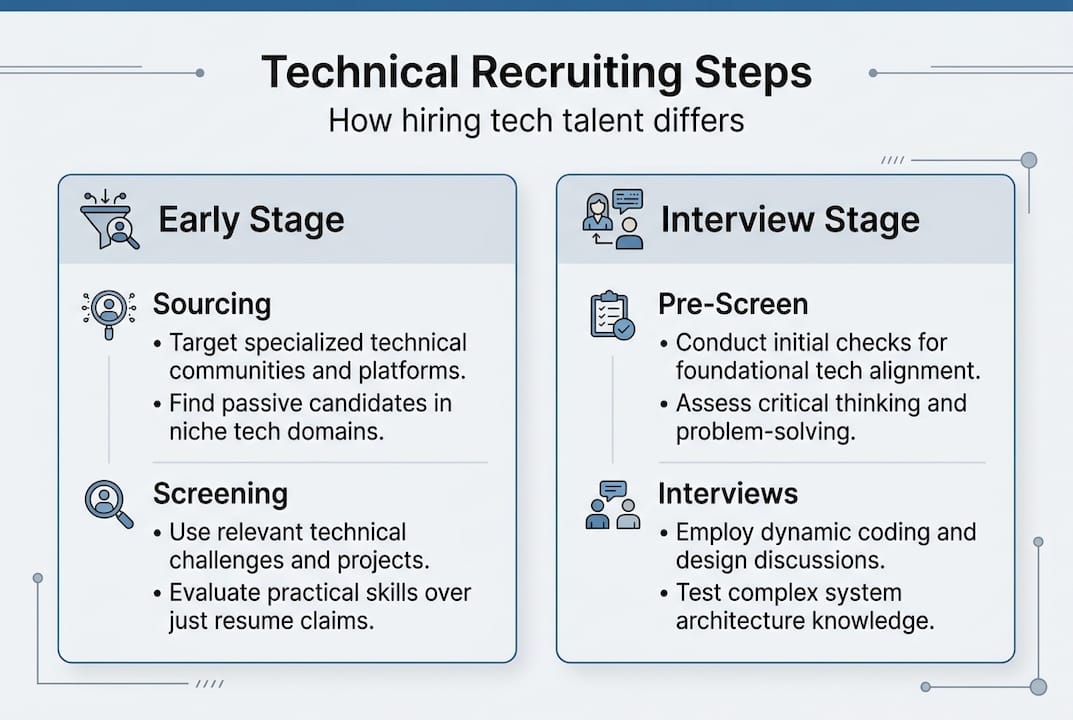
1. Technical sourcing
Sourcing in technical recruiting goes far beyond posting a job on LinkedIn or Indeed. Because niche deep tech roles require specialized sourcing, recruiters need to know where highly skilled engineers actually spend their time. That includes GitHub repositories, Stack Overflow profiles, open-source contribution histories, and niche communities on platforms like Discord or Slack. Boolean search strings must be constructed using technical terminology, not just job titles, to surface the right candidates from passive pools.
2. Resume screening with technical literacy
A technical recruiter reads a resume differently than a general HR screener does. They can distinguish between candidates who have worked with a specific cloud architecture versus those who simply list cloud experience as a bullet point. They understand the difference between a candidate who has used a framework superficially and one who has built production systems with it.

3. Technical pre-screening
Before a candidate ever meets the hiring manager, technical recruiting involves a screening layer specifically designed to validate foundational skills. This might include a short take-home coding challenge, a timed online assessment, a GitHub portfolio review, or a brief technical phone screen conducted by either a technical recruiter or a participating engineer. Software engineering screening at this stage reduces the number of unqualified candidates who advance, saving significant time for your internal teams.
4. Structured technical interviews
This stage typically involves at least one engineer from the team and focuses on applied problem-solving. Interviewers assess how candidates think through technical challenges, not just whether they know the right answer. Behavioral and situational questions are combined with technical ones to evaluate both skill and culture fit.
5. Offer and close
Closing a technical candidate requires a different approach than closing a general hire. Engineers often weigh factors like the technology stack they will work with, the team’s engineering culture, opportunities for skill development, and remote work flexibility alongside compensation. Recruiters need to understand and address these motivators directly. Partnering with specialized staffing solutions providers who understand tech candidate motivations can significantly improve offer acceptance rates.
Pro Tip: Involve your hiring manager early and continuously. When engineers meet hiring managers before the final interview stage, and when those managers clearly articulate the team’s technical challenges and mission, candidates move faster and accept offers at higher rates. Alignment between recruiter and hiring manager is one of the single strongest predictors of successful tech placements.
What Does the Technical Interview Process Look Like?
Most technical hiring funnels run four to five stages over two to four weeks. The names vary; the shape rarely does:
- Recruiter screen (20–30 minutes): motivation, compensation range, logistics, and a credibility check in both directions.
- Technical phone screen (45–60 minutes): a hiring-team engineer probes real project depth, not trivia.
- Coding assessment or take-home: a timed exercise or a scoped take-home. Respect the candidate’s time — anything beyond three or four hours costs you finalists.
- Panel or onsite loop: system design, code review, and team conversations across two to four sessions, ideally in one day.
- Debrief and decision: structured scorecards, one decision meeting, and an offer within 48–72 hours of the final round. Passive candidates rarely wait longer.
Compensation belongs at the start of this funnel, not the end. Anchor the range in the recruiter screen and confirm it before the panel. Our salary guide data helps calibrate ranges before a search opens.
Pitfalls and Challenges Unique to Technical Recruiting
While the steps seem direct, several unique challenges trip up even experienced hiring leaders. Knowing what these pitfalls are and why they occur gives you a real advantage in building a more resilient process.
| Pitfall | Root cause | Impact on hiring |
|---|---|---|
| Slow interview process | Too many rounds, poor scheduling | Top candidates accept competing offers |
| Shallow technical vetting | HR-only screening | High rate of mis-hires and early attrition |
| Chasing “purple squirrels” | Unrealistic job requirements | Roles stay open for months |
| Niche sourcing failures | Limited sourcing channels | Weak or thin candidate pipelines |
| Poor candidate communication | No feedback, delayed responses | Ghosting and damaged employer brand |
| Role misalignment | Hiring manager not involved | Wrong candidates advanced |
Let’s go deeper on a few of these. Lengthy processes cause candidate ghosting, and the data backs this up repeatedly. When a senior engineer submits an application or completes a coding assessment and then hears nothing for two weeks, they have already moved on. Tech talent at the senior and specialist level is not waiting around. They receive recruiter outreach regularly, and a slow process signals organizational dysfunction, not just poor scheduling.
“Purple squirrel” hunting is its own category of problem. A purple squirrel is a candidate who perfectly matches every requirement on a job description: a decade of experience in a specific niche framework, certifications in three cloud platforms, a background in a particular industry, and the communication skills of a senior product manager. These candidates almost never exist in the volume organizations expect. When companies refuse to prioritize requirements and treat every item on a job description as non-negotiable, roles stay vacant for quarters at a time while perfectly qualified candidates are passed over.
Misunderstanding technical requirements is costly in a different way. When a recruiter or HR team lacks the technical background to understand what a role actually demands, they miscommunicate that role to candidates. This results in candidates advancing through the process only to discover the job is nothing like what they expected, which wastes everyone’s time and accelerates attrition after hire.
You can also review your available recruiting by job title to better understand how role-specific requirements shape the recruiting approach needed for each position.
Pro Tip: Build a clear, fast communication cadence into your recruiting process. Set expectations with candidates about timelines at every stage. Even a brief message confirming receipt of an assessment or setting a date for next steps dramatically reduces ghosting and keeps top candidates engaged.
Best Practices and the Future of Technical Recruiting
To overcome these pitfalls, follow proven strategies and get ahead of emerging trends. The shift from reactive to proactive technical recruiting is not just about adding tools. It reflects a fundamental change in how organizations treat talent acquisition.
The contrast between outdated and modern approaches is stark:
| Dimension | Traditional approach | Modern technical recruiting |
|---|---|---|
| Sourcing strategy | Inbound job boards | Proactive outreach on technical platforms |
| Screening method | HR keyword review | Technical assessments with engineer input |
| Interview panel | HR and one hiring manager | Cross-functional team with engineers |
| Data use | Gut-feel decisions | Metrics-driven: time-to-fill, offer acceptance, retention |
| AI use | Minimal or absent | AI-assisted sourcing with human review and override |
| Process speed | Weeks between stages | 48 to 72-hour turnaround at each stage |
| Candidate communication | Inconsistent, reactive | Proactive, structured, and transparent |
The shift to data-driven, engineer-involved processes is now considered a baseline expectation for competitive tech employers, not a differentiator. AI tools can accelerate sourcing by scanning technical profiles at scale, flagging candidates whose GitHub activity matches the skill profile you need, and personalizing outreach at volume. But AI still requires human oversight. An algorithm can surface candidates who look like a match on paper, but it cannot assess how someone communicates under pressure, evaluates their strategic thinking, or determines whether their values align with your engineering culture.
Here is what your organization should be doing right now to improve technical recruiting outcomes:
- Partner with engineers: Include at least one engineer in every stage of the hiring process beyond the final interview, including job description review and candidate assessment design.
- Prioritize your requirements: Work with hiring managers to separate “must-have” from “nice-to-have” skills before the search begins. This alone can dramatically expand your candidate pool.
- Set and measure KPIs: Track time-to-fill, cost-per-hire, offer acceptance rate, and 90-day retention for technical roles separately from general hires. You cannot improve what you do not measure.
- Speed up your feedback loops: Commit to a maximum of three business days between each stage of your process, and communicate that timeline to every candidate.
- Use specialized recruiting partners: For niche or high-volume technical hiring, working with recruiters who specialize in your specific sector dramatically improves both speed and quality of hire.
- Invest in employer brand: Engineers talk to each other. Your reputation in the technical community directly affects who applies, who accepts, and who refers others to your company.
Our Take: Why Technical Recruiting Is a Strategic Advantage, Not a Burden
Most companies treat technical recruiting as a response to an open requisition. A role opens, a request goes to HR or an agency, and the clock starts. This reactive posture is exactly why so many tech organizations remain perpetually understaffed or overpay to backfill roles quickly.
At Careerscape, we have seen firsthand what happens when companies flip this model. Organizations that build talent pipelines before roles open, that involve engineers in shaping their own hiring criteria, and that treat our tech hiring expertise as a strategic resource rather than a transactional service consistently close roles faster, retain talent longer, and report stronger team performance.
The real signs you are falling behind are not always obvious. Talent pipelines that stall without warning, top candidates who disappear after the first interview, and growing tension between HR and engineering leadership are all symptoms of a recruiting function that has not kept pace with the complexity of technical hiring. The fix is not more job postings. It is a more intelligent, collaborative, and specialized approach to building technical teams. Companies that get this right gain a genuine competitive advantage: faster time-to-market, stronger product outcomes, and a culture where engineers want to stay.
Get Support for Your Technical Recruiting Journey
Technical recruiting is a specialized discipline, and getting it right requires more than good intentions. It takes recruiters who understand the roles, the market, and the pace of the tech industry. Whether you are looking to fill a single senior engineering position or build out an entire product team, working with a staffing partner who has proven expertise in the technical space makes a measurable difference.
Careerscape works with tech employers across direct-hire, contract, and project-based engagements. You can see how sector expertise matters for companies in software, IT, data, and beyond. If you need flexible capacity without a long-term commitment, you can also explore technical contract staffing to get skilled professionals on the ground fast. Reach out today to discuss your hiring goals and get a recruiting partner who speaks your language.
Frequently Asked Questions
What Does a Technical Recruiter Do?
A technical recruiter specializes in finding, vetting, and placing candidates with specialized tech skills like IT, software engineering, or data science. Unlike general recruiters, they understand technical depth requirements and use methods like coding assessments and engineer-led interviews to validate real competency before presenting candidates.
Why Is Technical Recruiting Harder than Other Types of Recruiting?
Technical recruiting demands deep knowledge to assess candidates, moves fast, and involves complex roles that generic methods often miss. Volume-based recruiting consistently produces high bad-hire rates in tech because it prioritizes quantity of candidates over the specialized evaluation needed to confirm actual technical fit.
How Do You Improve Technical Recruiting Outcomes?
Use proactive, data-driven processes, involve engineers in hiring, streamline steps, and avoid slow or shallow vetting. Lengthy methods cause ghosting among top candidates, so reducing time between stages and improving communication cadence are among the highest-impact changes you can make.
What Are “Purple Squirrels” in Technical Recruiting?
A “purple squirrel” is a candidate with a perfect but extremely rare mix of skills, often slowing the hiring process by setting an impossible standard. “Purple squirrel” hunting delays hiring and causes organizations to overlook strong candidates who meet 80 to 90 percent of the requirements and could grow into the role.
Does AI Replace Technical Recruiters?
AI helps with sourcing and screening but still needs human oversight for best results. AI aids but needs human oversight because algorithms cannot evaluate communication style, cultural alignment, or strategic thinking in the nuanced ways that skilled technical recruiters and engineering teams can.
Recommended
- Technology & IT Recruiters in 29 U.S. Markets | Careerscape
- Industry-Specialized Recruiting | Careerscape
- Austin, Texas Staffing & Recruiting Agency
- Job Seekers — Upload Your Resume & Get Matched | Careerscape