
Recruiting has evolved into a strategic discipline that focuses on building long-term talent pipelines rather than merely filling vacancies quickly. Key benchmarks indicate that the median time to fill a position is 44 to 45 days, with hiring costs averaging $1,200 for non-executive roles and over $10,600 for executive positions. Modern recruitment emphasizes skills over traditional qualifications, utilizes data-driven and AI-assisted methods, and requires a proactive approach to create resilient hiring strategies that enhance organizational growth and reduce turnover.
In this article
Filling a job opening sounds straightforward until you see the numbers. The median time to fill a role in the US sits at 44 to 45 days, the average cost per hire runs $1,200 for non-executive positions and more than $10,600 for executive roles, and the typical job posting attracts 73 to 74 applicants. For most employers, those figures are bigger than expected. Recruiting is not a simple administrative task. It is a strategic discipline that, when done well, builds competitive advantage and, when done poorly, drains resources, delays growth, and elevates turnover. This guide breaks down exactly what modern recruiting involves and what you can do to improve your outcomes.
Key Takeaways
| Point | Details |
|---|---|
| Recruiting is strategic | Modern recruiting is about building long-term talent pipelines, not just filling jobs fast. |
| Benchmarks matter | Knowing current industry standards for time, cost, and applicant volume helps you evaluate and improve your hiring process. |
| Skills-first wins | Prioritizing skills over pedigree and embracing smart tech tools yields better hires in 2026. |
| Adapt for resilience | A successful recruiting strategy balances internal development with seeking external innovation. |
| Expert help available | Partnering with specialists can dramatically boost recruiting outcomes for hard-to-fill or critical roles. |
What Is Recruiting? Definitions, Scope, and Core Objectives
Recruiting, in its most straightforward form, is the process of identifying, attracting, evaluating, and hiring qualified candidates to fill organizational roles. But that definition undersells the scope. Modern recruiting involves every interaction a candidate has with your organization before their first day on the job, and it extends into onboarding to make sure new hires are set up for long-term success.
The phases of a complete recruiting process include:
- Sourcing: Identifying and attracting potential candidates through job boards, employee referrals, social media, recruiting firms, and talent pipelines.
- Screening: Reviewing applications, conducting initial phone screens, and using structured assessments to evaluate candidate fit.
- Engagement: Building relationships with candidates throughout the process to keep top talent interested and informed.
- Selection: Running structured interviews, using scorecards to evaluate candidates objectively, and making data-supported decisions.
- Offer and negotiation: Extending competitive, tailored offers and navigating acceptance to close top candidates.
- Onboarding: Integrating new hires into culture, processes, and teams to accelerate productivity and reduce early attrition.
Many employers treat recruiting as a reactive exercise: a vacancy appears, a job gets posted, and resumes get collected. That model is increasingly outdated. As SHRM research underscores, recruiting has evolved from transactional role-filling to strategic talent architecture, where skills take priority over degrees, AI augments decision-making, and organizations balance internal stability with external innovation to build resilient workforces.
“The organizations winning the talent competition in 2026 are not the ones posting the most jobs. They are the ones with the most intentional strategic talent acquisition systems in place.”
Understanding recruitment outsourcing basics is one practical starting point for employers who want to accelerate this transition without overloading internal HR teams. Whether you manage recruiting in-house or partner with a specialized firm, the strategic principles remain consistent.
The Recruiting Process: From Job Posting to New Hire Success
Knowing each stage of the recruiting process gives you a framework to measure performance, identify bottlenecks, and set realistic expectations for hiring managers across your organization. Here is a step-by-step breakdown of how a well-run recruiting process unfolds.
- Identifying the need: A role becomes open through turnover, business growth, or a new strategic initiative. HR aligns with hiring managers to define the position’s requirements, compensation range, and success criteria before any outreach begins.
- Sourcing candidates: Recruiters activate multiple channels, including job boards, professional networks, internal referrals, and direct outreach to passive candidates. The goal is building a diverse, qualified applicant pool efficiently.
- Screening applicants: With an average of 73 to 74 applicants per role, screening tools and structured phone interviews are essential for narrowing the field without introducing bias.
- Selection and interviews: Finalists move through structured interviews using standardized scorecards so evaluations stay objective and comparable across candidates.
- Offer stage: Competitive, personalized offers are extended. Industry benchmarks show offer acceptance rates averaging 75 to 84%, meaning roughly one in four to five offers gets declined. Understanding why requires tracking and analyzing your own data.
- Onboarding: A structured onboarding program reduces time-to-productivity and early turnover. Recruiting does not end at the offer letter; it ends when a new hire is fully contributing.
Recruiting Benchmarks at a Glance
| Metric | Benchmark (2025/2026 US) |
|---|---|
| Median time to fill | 44 to 45 days |
| Cost per hire (non-executive) | $1,200 |
| Cost per hire (executive) | $10,625 |
| Average applicants per role | 73 to 74 |
| Offer acceptance rate | 75 to 84% |
| Recruiter productivity | ~55 hires per month |
These figures vary by industry, role level, and geography. If your numbers fall outside these ranges, that is meaningful data. Executive recruiting benchmarks differ substantially from entry-level hiring, and tracking them separately gives a clearer picture of where your process is performing and where it is losing time or money. Applying data-driven recruitment practices means using these benchmarks not as targets to hit once, but as ongoing indicators to monitor and improve.
How Recruiting Has Changed: Skills-First, Data-Driven, and AI-Powered
Recruiting in 2026 looks markedly different from even five years ago. 63% of organizations now prioritize critical talent sourcing strategies, and the shift toward skills-first, data-driven hiring is no longer optional for employers who want to stay competitive. Understanding what has changed, and why, helps you make smarter decisions about your own process.

Old vs. New Recruiting Philosophy
| Traditional approach | Modern approach |
|---|---|
| Resume-focused (degree, job title) | Skills-focused (demonstrated abilities) |
| Post and wait | Proactive pipeline building |
| Gut-feeling interviews | Structured scorecards and assessments |
| Manual screening | AI-assisted resume parsing and matching |
| Reactive to vacancies | Predictive workforce planning |
| Single-channel sourcing | Multi-channel, data-informed sourcing |
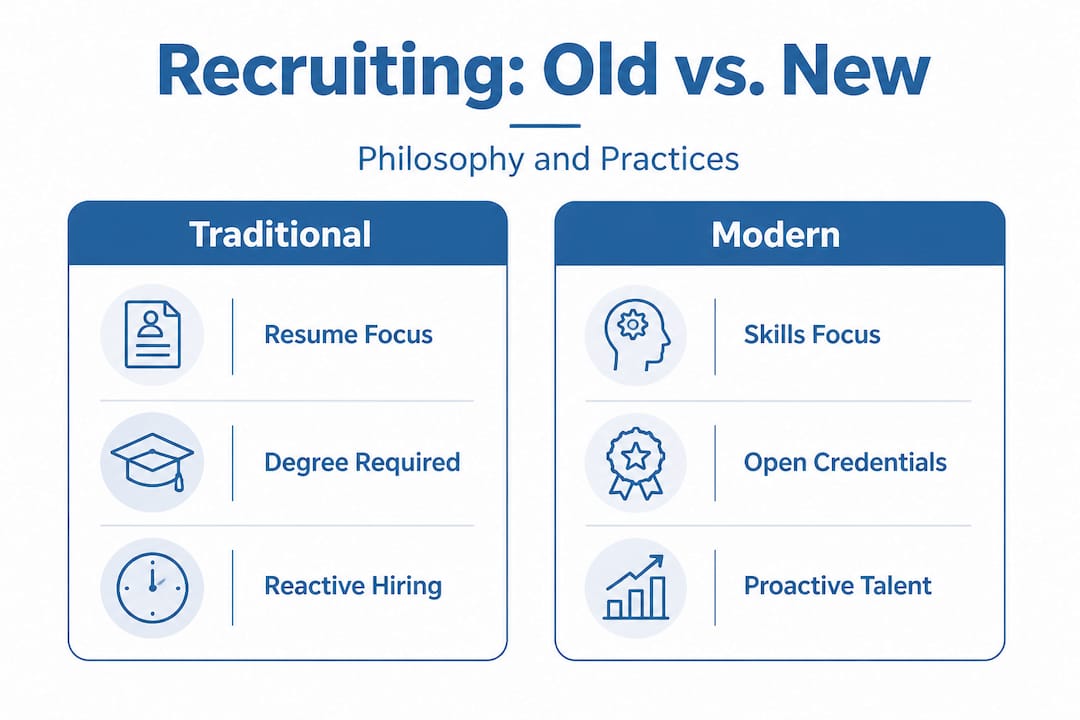
The practical implications of these shifts are significant. A traditional employer who requires a bachelor’s degree for roles that do not truly need one will disqualify large portions of qualified candidates. By contrast, a skills-first employer evaluates whether a candidate can do the job, using work samples, competency assessments, and structured behavioral interviews instead.
AI tools now assist with resume parsing, candidate ranking, initial chatbot screening, and even interview scheduling. When used correctly, these tools reduce time-to-fill and minimize unconscious bias. When deployed carelessly, they can replicate bias at scale or create a cold candidate experience that drives top talent away.
Common pitfalls when adopting these new approaches include:
- Over-relying on AI without human oversight. Algorithms optimize for patterns in historical data, which can reinforce past hiring biases if not regularly audited.
- Focusing on technology without improving process. A faster process that is still poorly structured will produce faster poor results.
- Ignoring candidate experience. Modern candidates evaluate employers during the recruiting process. Slow communication, unclear expectations, or impersonal interviews will cost you offers.
Technology recruiting trends move especially fast in the tech sector, but the underlying principles of skills-based, structured hiring apply across industries. Organizations using analytics in hiring to track source quality, conversion rates, and candidate drop-off points can iterate quickly and improve outcomes quarter over quarter.
Pro Tip: Audit your job descriptions annually. Remove degree requirements from roles where skills and experience matter more. You will expand your candidate pool and often improve both quality and diversity of applicants.
Practical Tips: Building a Resilient Recruiting Strategy in 2026
Strategy without execution is theory. Here is a practical framework for building a recruiting operation that holds up under pressure, scales with growth, and adapts to market shifts.
-
Define success criteria before you source. Every role should have a clearly articulated success profile: the specific skills, behaviors, and outcomes that define a great hire. This prevents scope creep and keeps interviewers aligned.
-
Balance internal mobility with external search. Internal candidates often have faster ramp times, lower cost-per-hire, and stronger cultural alignment. Before opening an external search, audit whether internal talent can fill or grow into the role. This is a core principle in SHRM’s talent architecture framework, which emphasizes balancing internal stability with external innovation.
-
Diversify your sourcing channels. Relying on a single job board limits your reach and concentrates risk. Build a sourcing mix that includes employee referrals, professional associations, social recruiting, college partnerships, and direct outreach to passive candidates.
-
Standardize your interview process. Use structured interview scorecards with consistent questions tied to the success criteria you defined in step one. This reduces interviewer bias and makes it easier to compare candidates objectively.
-
Set SLAs for each recruiting stage. Service-level agreements (SLAs) create accountability. For example: hiring manager feedback within 48 hours of an interview, offer letters sent within 24 hours of a verbal agreement. Time-to-fill often bloats not in sourcing but in internal delays.
-
Measure what matters. Track time-to-fill, cost-per-hire, source-of-hire quality, offer acceptance rate, and 90-day retention by hiring cohort. If you do not measure it, you cannot improve it.
-
Create a warm candidate experience. Regular communication, clear timelines, and respectful feedback signals to candidates that your organization is a professional, trustworthy employer. This directly impacts offer acceptance rates and employer brand.
Pro Tip: Review your offer decline reasons every quarter. If candidates are citing competing offers or unclear compensation, that data should feed directly into your compensation benchmarking and offer strategy. Silence from declined candidates is not neutral; it is a missed feedback opportunity.
Employers working with HR-specific recruiting guidance from specialized partners often find that implementing even three or four of these practices produces measurable improvements in time-to-fill and new hire retention within the first two quarters.
Why Real Recruiting Success Means More than Filling Roles
Here is an uncomfortable observation from years of working across industries: most employers measure recruiting success by whether the seat got filled. Offer accepted, position closed, done. That is a dangerously narrow lens.
The cost of a mis-hire typically runs one to three times the annual salary for that role when you factor in lost productivity, training costs, team disruption, and the cost of starting the recruiting process again. The organizations that understand this do not treat every vacancy as an emergency to be resolved as quickly as possible. They treat it as a decision point with long-term consequences.
Reactive hiring, which is filling roles only when they become vacant, consistently produces worse outcomes than proactive talent pipelining. Building warm relationships with candidates before you need them, mapping critical roles to succession plans, and monitoring workforce trends allows you to hire from a position of strength rather than desperation. Desperation hires are the most expensive kind.
There is also the question of what you are hiring for. Technical skills fade. Technology changes. The candidates who deliver the most long-term value tend to be those who demonstrate adaptability, intellectual curiosity, and cultural alignment alongside their core competencies. Structured behavioral interviews and skills assessments surface these qualities far more reliably than resume screening alone.
The shift from vacancy-centric to workforce-resilience thinking is not just philosophical. It produces measurable outcomes: higher retention, faster time-to-productivity for new hires, stronger internal pipelines, and a recruiting function that acts as a competitive advantage rather than a back-office cost center. Organizations that invest in strategic industry recruiting with this mindset consistently outperform those that treat hiring as a transactional necessity.
The most experienced recruiting professionals we work with describe their role not as filling jobs, but as building the team that will build the company. That reframe changes every decision in the process, from where you source to how you onboard.
Simplify Recruiting with Careerscape’s Specialized Solutions
Putting these strategies into practice requires expertise, technology, and a deep understanding of the talent market in your industry. Careerscape specializes in exactly that. Whether your organization needs industry-specialized recruiting for niche roles, flexible contract staffing to manage project-based demand, or dedicated IT and tech recruiting to compete in one of the tightest talent markets in the country, Careerscape’s team combines market intelligence with a straightforward, honest process. Hiring should be fast, efficient, and backed by people who genuinely understand your field. Careerscape is built to make that a reality for every employer we work with.
Frequently Asked Questions
What Is the Difference Between Recruiting and Talent Acquisition?
Recruiting focuses on filling current open roles, while talent acquisition is a long-term strategy for building your organization’s future workforce and evolving toward strategic talent architecture. Both are essential, but they operate on different time horizons.
What Is the Typical Time to Fill a Job in the US in 2026?
The median time to fill a job in the US is 44 to 45 days, though this varies significantly by industry and role level.
How Can Employers Improve Offer Acceptance Rates?
Improving transparency around compensation, communicating frequently throughout the process, and tailoring offers to individual candidate priorities are the most reliable ways to close more offers. Reviewing your decline reasons quarterly gives you the data to act on.
What Is a “Skills-First” Recruiting Strategy?
A skills-first strategy evaluates candidates on their demonstrated abilities rather than credentials like degrees or previous job titles, following the skills over degrees movement growing across US employers.
What Is the Average Cost per Hire?
For US employers, the median cost per hire is $1,200 for non-executive roles and $10,625 for executive positions, making every hiring decision a significant financial investment worth getting right.
Recommended
- Industry-Specialized Recruiting | Careerscape
- Technology & IT Recruiters in 29 U.S. Markets | Careerscape