
The 2026 talent market is characterized by significant disparities, with some roles like software development experiencing up to nine times applicant growth, while others, such as registered nursing, face acute shortages. Employers must view the talent market as a comprehensive ecosystem encompassing recruitment, development, retention, and analytics to make informed hiring decisions. Leveraging AI tools and market intelligence is essential for navigating this segmented landscape, enabling organizations to optimize hiring strategies, enhance internal mobility, and improve retention rates.
In this article
The 2026 talent market is not a level playing field. Up to 9x applicant growth has flooded some roles like software development, while licensed positions such as registered nurses see only 49 job postings per 100 employed workers. That gap is jarring, and it explains why so many hiring managers feel like they are operating blind. Understanding the talent market as a full system, not just a pile of resumes, is what separates employers who consistently hire well from those who are always scrambling.
Key Takeaways
| Point | Details |
|---|---|
| Talent market scope | The talent market spans recruiting, development, retention, and analytics, not just hiring new candidates. |
| AI and intelligence | Leveraging AI tools and market analysis quickly connects employers to the right talent and informs competitive hiring. |
| 2026 market split | Some roles face high applicant volumes while others are in critical shortage—strategy must follow data, not assumptions. |
| Hybrid sourcing wins | Blending internal talent platforms with selective external recruiting delivers best results in most markets. |
| Retention matters | Keeping and upskilling your workforce is as crucial as finding new talent for long-term success. |
Defining the Talent Market: Beyond Job Boards
Most employers think of the talent market as a list of candidates on a job board. That framing is far too narrow, and it leads to reactive hiring decisions. The talent market is actually a broader ecosystem of platforms, solutions, and processes for acquiring, developing, retaining, and analyzing talent. It includes everything from how you source candidates to how you develop existing staff, track retention rates, and use workforce analytics to plan ahead.
There are four core segments of the talent market that every employer should understand:
- Acquisition: This covers recruitment strategies, applicant tracking systems, candidate assessments, and sourcing channels. It is what most people picture when they think of hiring, but it is only one piece of the whole.
- Development: Once someone is hired, the market doesn’t stop influencing them. Development includes training programs, upskilling initiatives, mentorship, and career pathing that keep employees growing and engaged.
- Retention: This segment tracks why people stay and why they leave. Metrics like retention rate, time-in-role, and flight risk scores all feed into a clearer picture of your workforce health.
- Analytics: Data collection and interpretation across all three prior segments gives employers the intelligence to make smarter, faster, and more defensible decisions.
The table below summarizes these four segments with real-world examples of where each shows up in your organization:
| Market segment | Key activities | Example platforms/processes |
|---|---|---|
| Acquisition | Sourcing, screening, assessing candidates | ATS software, job boards, structured interview scorecards |
| Development | Training, upskilling, mentorship programs | LMS platforms, internal coaching, skills academies |
| Retention | Monitoring engagement, tracking turnover | Exit interview analysis, stay surveys, flight risk models |
| Analytics | Workforce data collection and interpretation | Labor market dashboards, predictive analytics tools |
When you see the talent market as this full ecosystem, your hiring strategy gets sharper. You stop treating every open role as an isolated event and start thinking about talent as an ongoing investment with multiple touchpoints.
How the Talent Market Works: Platforms and Intelligence
Understanding the structure is one thing. Seeing how it operates in real time is where the practical value comes in. Today’s talent market runs on two parallel systems: internal talent marketplaces and external talent market intelligence. Both are increasingly powered by AI, and both matter to employers regardless of company size.

An AI-driven internal talent marketplace matches employees’ skills, interests, and career goals to internal opportunities like open roles, short-term projects, stretch assignments, or mentorships. The goal is to promote internal mobility and reduce unnecessary external hiring. For employers, this translates directly to lower cost-per-hire and higher retention rates, since employees who see clear growth paths within your organization are far less likely to leave.
Mechanically, these platforms collect workforce data, analyze skills fit, and recommend matches using algorithms that would take a human recruiter days to replicate. They surface employees who are ready for a next step before a vacancy forces your hand. This proactive approach to talent movement is one of the clearest markers of a mature employer strategy.
On the external side, talent market intelligence involves collecting and analyzing real-time data on salaries, candidate availability, competitor hiring activity, skill shortages, and emerging trends. For roles where the candidate pool is thinning, this data tells you how to adjust your compensation benchmarks, where to source, and how aggressively to move in your recruitment process. Waiting for anecdotal signals is no longer reliable.
For employers hiring technology roles, technology recruiter insights can help you understand where demand is outpacing supply and how to position your roles competitively. Similarly, accessing passive candidate strategies gives you a way to reach candidates who aren’t actively looking but may be the strongest fit.
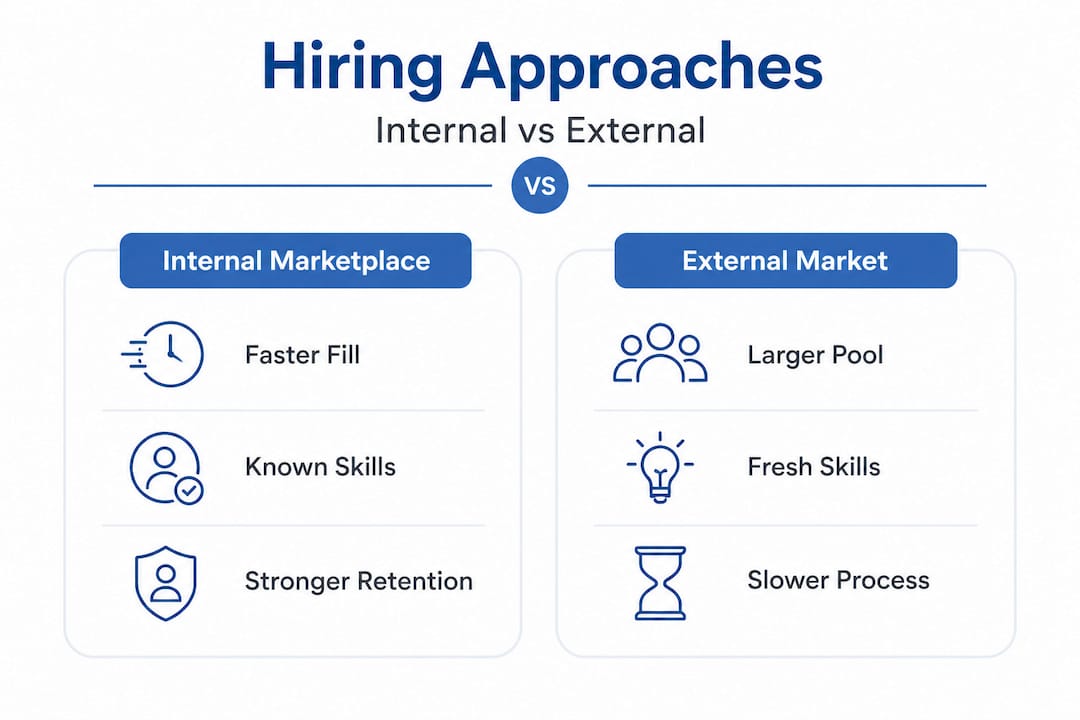
Here is a side-by-side comparison to help you see where each type of marketplace fits into your strategy:
| Factor | Internal talent marketplace | External talent acquisition |
|---|---|---|
| Speed to fill | Faster (existing employee knowledge) | Slower (sourcing, screening cycle) |
| Cost-per-hire | Lower | Higher |
| Cultural fit | Stronger (known quantity) | Variable |
| Innovation potential | Limited (same perspectives) | Higher (fresh skills, new ideas) |
| Best used for | Mobility, retention, known skill needs | Specialized roles, growth, new capabilities |
Pro Tip: Set up a skills inventory inside your internal marketplace before an urgent role opens. When you already know which employees have adjacent skills or expressed interest in a new area, you can fill roles faster and cut external sourcing costs significantly.
2026 Trends: Talent Market Splits, Skills Focus, and Retention Pressure
The 2026 talent market is not difficult because there are too few candidates or too many. It is difficult because it is segmented, and a one-size strategy fails in a segmented environment. What works for filling a software developer role will not work for hiring a licensed nurse, and the data backs this up clearly.
According to recruiting benchmark data, up to 9x applicant growth has hit certain high-volume roles over the past three years, particularly in tech. Meanwhile, licensed healthcare roles face acute shortages with only 49 job postings per 100 employed workers in some nursing categories. Experience requirements in tech have also tightened, with roles requiring five or more years rising from 37% to 42% of postings. That means your screening criteria need to reflect the specific market for each role, not a generic template.
“Employers who treat every open role the same way are leaving real hiring efficiency on the table. The split market of 2026 demands precision by role, location, and skill set.”
Here are the key trends reshaping how smart employers operate this year:
- Market segmentation by role: Applicant volume and candidate quality vary dramatically. Track fill rates and time-to-fill by specific job category, not just overall averages.
- Skills-based hiring: Employers are shifting away from degree requirements and toward demonstrated competencies. This widens your candidate pool in tight markets and improves long-term fit.
- AI-driven skills intelligence: AI skills intelligence use rose 22% year over year, reflecting how rapidly employers are adopting data tools to identify skill gaps before they become vacancies.
- Precision targeting over volume: Mass-posting jobs to every board is losing effectiveness. Employers are focusing spend on the channels that produce qualified, role-specific candidates.
- Full-funnel visibility: With 89% of recruiters rating their hiring funnel as average or worse, the gap between what employers see and what’s actually happening in the market is a major risk.
- Retention as a market signal: Talent retention pressure, measured as the vacancy-to-employment ratio in local market-occupation segments, predicts talent outflows and reduces firm investment when it rises unchecked. Tracking this metric by department or location tells you where the pressure is building before you start losing people.
For a deeper look at how these trends play out across different sectors, reviewing industry-specific trends gives employers a sharper sense of what to expect in their particular hiring environment. And for organizations that want to act on these signals strategically, workforce advisory resources offer a structured approach to planning.
The practical takeaway here is that 2026 rewards employers who segment their strategy. You need one playbook for roles with abundant applicants and a completely different one for hard-to-fill positions. Applying the same process to both wastes time, budget, and recruiter bandwidth.
Navigating the Market: Strategies for Hiring Success
Knowing the trends is useful. Knowing what to do about them is what moves the needle. The good news is that the strategies that work in a split market are not complicated. They require discipline, data access, and a willingness to blend internal and external approaches based on the specific role.
Here is a practical framework for navigating the 2026 talent market:
-
Audit your internal talent first. Before posting externally, run a skills match inside your organization. An internal marketplace is faster, cheaper, and produces stronger cultural fit than external hiring for most roles. It also signals to your current workforce that growth is possible without leaving.
-
Segment your open roles by market conditions. Use your analytics tools to identify which roles sit in a flooded market and which face shortages. For flooded roles, tighten your screening criteria and invest in a better candidate experience to stand out. For scarce roles, move faster, widen your sourcing geography, and adjust your compensation benchmarks using real-time intelligence data.
-
Apply market intelligence to your sourcing decisions. Employers using intelligence for hiring see a 42% improvement in hiring accuracy, and skills-based hiring significantly reduces mismatch. Tools that surface salary benchmarks, competitor job posting activity, and regional skill availability are no longer optional. They are what allow you to recruit with precision rather than guesswork.
-
Build a hybrid sourcing model. For most employers, the best approach combines internal mobility with targeted external recruiting. Internal is faster and cost-effective for known skill sets. External is necessary when you need new capabilities, geographic expansion, or roles that simply don’t exist inside your current workforce.
-
Close skill gaps with targeted upskilling. When your internal market can’t produce an exact match, upskilling a near-match candidate is often faster and cheaper than a full external search. This approach also strengthens retention because the employee sees tangible investment in their career.
-
Partner with recruiting experts who have access to market data. When your internal capacity runs short, having access to specialized recruiting partners who carry real-time labor data is a significant advantage. If you need to find talent quickly in a specific market, a partner with regional intelligence shortens your time-to-fill considerably.
Pro Tip: Use workforce insights from flash polls and labor market data to benchmark your offer competitiveness before you post a role. Knowing whether your salary range is at, above, or below market before you start saves you from losing finalists at the offer stage.
Perspective: Why Talent Market Mastery Separates Top Employers
Most employers approach hiring as a recurring problem to solve rather than a system to understand. A role opens, a search launches, and the process repeats. That transactional mindset works fine in a stable, uniform market. But 2026’s split market has made it a liability.
The employers who consistently outperform their peers in talent acquisition share one trait: they treat the talent market as an ecosystem to navigate, not a queue to manage. They invest in the analytics infrastructure to understand what is happening in their specific labor markets. They run internal mobility programs before they post externally. And they adjust their strategies by role and by quarter, not by gut feeling.
Consider what leading organizations are already doing. Research shows that 42.6% of top employers are actively investing in upskilling as a core market strategy, not just a retention perk. That number reflects a fundamental shift in how industry leaders are thinking about workforce supply. When external talent is scarce or expensive, building capability internally becomes a competitive weapon.
The conventional approach, treating all open roles with the same process, is not just inefficient. It is actively harmful in a segmented market because it burns recruiter time on roles where the problem is screening volume and wastes budget on roles where the real challenge is sourcing reach. Separating those two problems requires market awareness that most employers haven’t built yet.
The brands that are winning right now are not necessarily the biggest. They are the most informed. They know their vacancy-to-employment ratio in key occupations. They know which sourcing channels produce qualified candidates for specific roles. And they use that intelligence to make decisions faster than competitors who are still relying on historical patterns. For a concrete look at what this looks like in a high-demand sector, see IT market examples to understand how leading technology employers are adapting their strategies in real time.
The mindset shift is this: the talent market is not something that happens to you. It is something you can learn to read, anticipate, and respond to with intention. Employers who make that shift don’t just fill roles faster. They build workforces that are more resilient, more aligned, and far less expensive to maintain over time.
Connect with the Right Talent Market Experts
Applying everything covered here takes more than intent. It takes the right partners with access to real-time market data and industry-specialized recruiting expertise. Careerscape works across multiple industries to connect employers with qualified professionals using a process that is fast, honest, and built around how hiring actually works in your sector. Whether you need contract staffing solutions to handle fluctuating workloads or consistent staff recruiting by role across your organization, Careerscape brings the market intelligence and candidate relationships that reduce time-to-fill and improve hiring outcomes. The talent market is complex. Your approach to it doesn’t have to be.
Frequently Asked Questions
What Is the Difference Between a Talent Market and a Talent Marketplace?
A talent market is the broader ecosystem covering acquisition, development, retention, and analytics, while a talent marketplace is an AI-driven internal platform that matches current employees to opportunities within the organization.
How Does Talent Market Intelligence Help Employers?
Real-time data on salaries, availability, and skill gaps allows employers to make faster, more accurate hiring decisions rather than relying on lagging indicators or outdated benchmarks.
Why Are Some Jobs Easy to Fill and Others Almost Impossible in 2026?
The 2026 market is split: up to 9x applicant growth in some roles like software development, while licensed roles such as nursing face severe candidate shortages that extend vacancy periods significantly.
What Hiring Strategy Works Best in the Current Talent Market?
A hybrid approach that combines internal mobility for speed and cost efficiency with external sourcing for new skills and innovation delivers the strongest results for most employers navigating 2026 conditions.
Recommended
- Talent Community & Passive Candidate Access | Careerscape
- Find Talent
- Technology & IT Recruiters in 29 U.S. Markets | Careerscape
- Hire Talent — Staffing & Recruiting Services | Careerscape