
Poorly written job postings are quietly costing you qualified candidates every day. Job posting optimization is no longer a nice-to-have. It’s the difference between a high-volume pipeline of relevant applicants and a trickle of mismatched resumes that drain your time-to-fill. 60% of candidates abandon postings when pay is vague, roles are unclear, or application forms are too long. This guide walks through exactly what to fix, how to structure your postings for both AI-driven search and real human decision-making, and how to measure what’s working.
Table of Contents
- Key takeaways
- Job posting optimization: what to know before you write
- How to craft an optimized job posting
- Technical and AI-driven visibility tactics
- Common mistakes that tank posting performance
- Measuring outcomes and iterating
- My take on where job posting optimization is heading
- How Cs-recruiters supports your hiring strategy
- FAQ
Key Takeaways
| Point | Details |
|---|---|
| Salary transparency drives applies | Including salary info increases application rates by up to 31% and is now legally required in many states. |
| Scannability converts browsers to applicants | Candidates spend only 3 to 5 minutes deciding to apply, so clear structure is a direct driver of conversion. |
| Freshness signals affect search ranking | Updating postings every 30 days resets algorithmic ranking signals on job sites and Google for Jobs. |
| AI optimization requires clean data | ATS data hygiene and structured metadata directly affect how AI recommender systems surface your postings. |
| Explicit instructions filter better applicants | Clear application steps reduce low-effort applies by 24%, improving overall recruiter efficiency. |
Job Posting Optimization: What to Know Before You Write
Before you type a single word of a job posting, there are three things you need to have locked down. Skip this prep work, and even a well-written post will underperform.
Know how candidates are actually searching. In 2026, job seekers are not just browsing job boards. They’re using AI-powered search tools, voice queries, and mobile apps to find roles. That means the words you use in your title and description need to match the language candidates actually search, not the internal language your organization uses. A posting titled “Revenue Growth Associate” will lose to “Sales Manager” every single time on search volume alone.

Establish your performance baseline before you post. Pull your ATS data and identify your current click-through rate, apply rate, and qualified candidate ratio for similar roles. You can’t improve what you don’t measure, and without baseline numbers, any changes you make are guesswork. Clean, structured ATS data is also now critical for AI visibility. Recruiters must optimize career sites and postings with clean metadata so that AI recommendation engines can surface them correctly.
Here’s a quick checklist of what to gather before writing:
- Confirmed job title that matches common search terms
- Salary range (a specific number or tight band, not “competitive”)
- List of 5 to 7 must-have qualifications, separated from nice-to-haves
- Target time-to-fill and cost-per-hire benchmarks
- Historical performance data from similar past postings
Define success metrics up front. The KPIs you track will vary by role level and urgency, but every posting should be measured against at least these four:
| Metric | What it tells you |
|---|---|
| Click-through rate (CTR) | Whether your title and preview text are compelling |
| Apply rate | Whether the posting content converts interest to action |
| Qualified candidate ratio | Whether you’re attracting the right people, not just anyone |
| Time-to-fill | Whether the full posting and sourcing process is efficient |
Pro Tip: Run a keyword check on your proposed job title using Google Trends or a free SEO tool before posting. If the search volume is low, adjust the title. This one step can double organic visibility without changing anything else.
How to Craft an Optimized Job Posting
The structure of your posting matters just as much as the words in it. Candidates spend only 3 to 5 minutes deciding whether to apply. That means your posting has to communicate role clarity, compensation, and fit signals almost immediately.
Follow this sequence when building each posting:
-
Write a search-aligned job title. Keep it to 3 to 5 words. Use the title candidates search, not the one on your org chart. Avoid modifiers like “Rockstar,” “Ninja,” or “Guru.” These reduce searchability and deter serious applicants.
-
Open with a tight summary (3 to 4 sentences). Cover what the role does, who it serves, and what success looks like in the first 90 days. This is the section most AI systems use for matching, so make every sentence count.
-
Structure responsibilities with outcomes, not tasks. Instead of “Responsible for managing client accounts,” write “Manage a portfolio of 15 to 20 mid-market accounts, owning renewal rates above 90%.” Using numeric specifics like dollar values and percentage targets improves AI signal and helps candidates self-assess faster. This approach also dramatically reduces unqualified applies.
-
Separate required from preferred qualifications. List no more than 5 to 6 hard requirements. Add a “nice to have” section for everything else. Research shows that many candidates, particularly women and underrepresented groups, will not apply unless they meet close to 100% of listed requirements. Tighter required lists produce broader, more diverse pools.
-
List salary and benefits in plain, searchable language. Including salary info increases application rates by up to 31% and is increasingly a legal requirement. Format benefits as individual lines (“Fully remote,” “401(k) with 4% match,” “18 days PTO”) rather than a dense paragraph.
-
Add a “You’ll thrive here if” section. This signals cultural fit without being vague. It tells the right candidates they belong and prompts the wrong ones to self-select out, which saves everyone time.
-
Write explicit application instructions. Tell candidates exactly what to submit, what format, and what to expect next. Clear next steps reduce low-effort applications by 24%. This alone improves the signal-to-noise ratio significantly.
-
Add a short video when possible. Job listings with video get 34% more applications and candidates engage 316% longer with the content. A 60-second hiring manager intro outperforms any amount of copy.
Pro Tip: After you draft the posting, read it from the candidate’s perspective and ask: “Would someone who doesn’t work here know exactly what this role involves, what it pays, and how to apply?” If the answer is no on any point, revise before publishing.
Here’s a quick format comparison to illustrate the difference structure makes:
| Element | Weak version | Optimized version |
|---|---|---|
| Job title | Revenue Growth Associate | Inside Sales Manager |
| Responsibilities | Manage client relationships | Manage 15 to 20 accounts, targeting 90% renewal rate |
| Salary | Competitive compensation | $75,000 to $90,000 base plus commission |
| Application step | Apply via portal | Submit resume and one-page cover letter by May 30 |
Technical and AI-Driven Visibility Tactics
Effective recruitment strategies today require more than compelling copy. They require technical precision. Recruitment SEO now includes generative engine optimization, or GEO, which means aligning your ATS and career site data with AI recommendation systems that surface jobs in tools like ChatGPT, Perplexity, and Google’s AI Overviews.
Here is where most recruiters lose technical ground:
- ATS data hygiene. Duplicate postings, expired listings, and missing location fields confuse AI crawlers and suppress ranking. Audit your ATS regularly and remove or merge duplicate records.
- Freshness signals. Refreshing postings every 30 days or sooner resets algorithmic ranking signals on job sites and Google for Jobs. Even minor edits to benefits language or the job summary qualify as a refresh.
- Inclusive language to avoid AI bias filtering. AI bias mitigation requires removing overstrict degree requirements and using diverse phrasing. Postings that require a “bachelor’s degree or equivalent experience” consistently outperform those requiring a degree alone, both in diversity outcomes and in total qualified applicant volume.
- Mobile optimization. 58% of job seekers use mobile to search for jobs, and 25% abandon applications that are not mobile-friendly. If your application portal requires uploading documents on mobile, you’re losing a quarter of your interested candidates before they even start.
Pro Tip: Test your job posting URL on a mobile device before it goes live. Check load time, form functionality, and whether the salary and title are visible without scrolling. If any of these fail, fix the posting page, not just the posting.
For a broader look at types of job postings and which formats work best for different role types, Cs-recruiters has a detailed breakdown worth reviewing before you finalize your approach.
Common Mistakes That Tank Posting Performance
Even recruiters with strong writing skills make these errors regularly. Recognizing them is the first step to fixing them.
- Overloaded requirements. Listing 12 to 15 bullet points of requirements, many of which are preferences, deters qualified candidates and signals poor role definition. Trim ruthlessly.
- Missing or vague pay information. “Salary commensurate with experience” communicates nothing and drives abandonment. Candidates will scroll past your posting to find one that shows the number.
- Creative internal job titles. Posting a role as “Customer Happiness Champion” instead of “Customer Success Manager” dramatically reduces search visibility. Map your internal titles to searchable market-standard equivalents.
- No performance tracking. Posting and walking away is the most common and most costly mistake. Without weekly monitoring of CTR and apply rate, you won’t catch a failing post until time-to-fill has already ballooned.
- Ignoring inclusion best practices. Language that defaults to masculine pronouns, jargon tied to specific academic institutions, or phrases like “digital native” can inadvertently filter out strong candidates.
“Job description quality is very or extremely influential in the decision to apply for 52% of job seekers.” — Indeed
That number should change how seriously you treat every word in your posting.
Measuring Outcomes and Iterating
Publishing an optimized posting is not the finish line. It’s the starting point for a measurement loop that keeps your job ad performance improving over time.
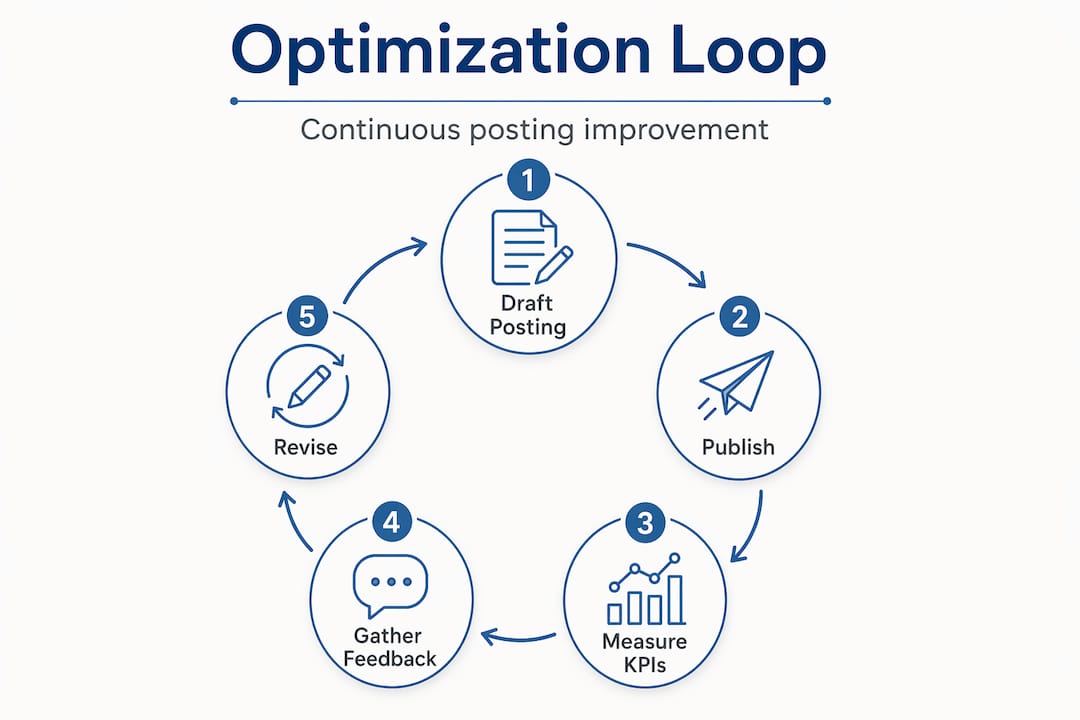
Track these metrics weekly for each active posting:
| KPI | Healthy benchmark | Action if below benchmark |
|---|---|---|
| Click-through rate | 3% to 5% on job boards | Revise title and first two lines |
| Apply rate | 15% to 25% of clicks | Simplify application process or improve clarity |
| Qualified candidate ratio | 40% or higher of applies | Tighten requirements section |
| Time-to-fill | Role-dependent, track vs. historical average | Broaden sourcing or refresh posting |
A/B testing is one of the most underused tools in job posting optimization. Test one variable at a time: the title, the benefits order, the salary placement, or the application instructions. Run each version for at least one week before drawing conclusions. Most ATS platforms and job boards support split testing or allow you to compare performance across posting versions.
Candidate feedback is another data source recruiters rarely tap. A short exit survey sent to applicants who dropped off can surface friction points your metrics alone won’t reveal.
Pro Tip: Schedule a calendar reminder every 28 days to refresh each active posting. Update at least three fields, even if the role hasn’t changed. This resets freshness signals and maintains ranking without requiring a full rewrite.
My Take on Where Job Posting Optimization Is Heading
I’ve worked across enough hiring cycles to say this clearly: the organizations still treating job postings as administrative tasks rather than marketing assets are going to fall further behind, and quickly. The shift toward AI-driven job discovery is not a future trend. It’s already the reality for a growing share of candidates.
What I’ve seen consistently is that the recruiters who get the best results aren’t necessarily the ones with the biggest budgets or the fanciest tools. They’re the ones who treat every posting as a two-way communication. They ask, “What does this candidate need to know to say yes?” rather than “What does this role require?”
The uncomfortable truth I’ve learned is that most job postings are written for compliance and approval workflows, not for candidates. They go through five rounds of internal review and come out sanitized, vague, and formatted for a desktop ATS built in 2014. None of that serves the person reading it at 7pm on their phone.
The recruiters winning right now are building postings that work for AI crawlers and human beings at the same time. Clean structure, specific outcomes, honest pay ranges, and a clear “here’s what to do next.” It’s not complicated. The gap between knowing this and actually doing it consistently is where most teams lose ground.
The next frontier is real-time posting personalization and skills-based matching that bypasses degree requirements entirely. Teams that are already practicing skills-first recruiting will adapt faster. Everyone else will spend 2027 catching up.
— Bradford
How Cs-Recruiters Supports Your Hiring Strategy
When job posting optimization improves your pipeline but the volume or complexity of hiring still outpaces your internal capacity, that’s where Cs-recruiters adds the most value. Careerscape specializes in connecting qualified professionals with companies ready to hire, across industries and role types, with a recruiting process built for speed and accuracy.
Whether you need contract staffing solutions to scale quickly on a specific project or are looking for direct hire services to fill permanent roles with precision, Cs-recruiters brings both the industry knowledge and candidate networks to complement your optimized job postings. The firm’s industry-specialized recruiting covers technology, finance, healthcare, and more, with recruiters who understand the specific talent landscape for each sector.
Explore how Cs-recruiters can support your next hire at Hire Talent.
FAQ
What Is Job Posting Optimization?
Job posting optimization is the process of improving a job listing’s title, content, structure, and technical metadata to increase visibility in search and convert more qualified candidates to applicants.
How Does Salary Transparency Affect Job Posting Performance?
Including a specific salary range increases application rates by up to 31% and reduces candidate dropout caused by pay ambiguity, which affects 60% of job seekers who abandon unclear postings.
How Often Should You Update a Job Posting?
Refresh active postings every 30 days or sooner. Updating even minor content fields resets freshness signals that affect search ranking on job boards and Google for Jobs.
What Makes a Job Posting Mobile-Friendly?
A mobile-friendly posting loads quickly, displays salary and title without scrolling, and allows candidates to complete the full application from a phone without requiring document uploads or complex form navigation.
How Do You Reduce Unqualified Applications?
Limit required qualifications to 5 or 6 hard criteria, add explicit application instructions, and include a “you’ll thrive here if” section. This combination filters for fit and reduces low-effort applies by up to 24%.
Recommended
- What is recruiting? The employer’s guide to modern hiring
- 7 types of job postings every employer should know
- Staffing best practices to boost recruitment and culture