
A talent pool is a database of pre-qualified internal and external candidates organized by skills, readiness, and role fit — distinct from a talent pipeline, which focuses on nurturing candidates for specific near-term openings. Effective talent pools require active management through deliberate segmentation, regular candidate engagement, and periodic data audits to prevent records from going stale. Organizations that align pool-building with hiring forecasts and skills gap analysis gain a significant competitive advantage by reducing time-to-hire and enabling proactive workforce planning rather than reactive scrambling when vacancies arise.
In this article
Most HR teams treat a talent pool like a filing cabinet: candidates go in after a hiring round, and nobody opens the drawer until the next vacancy appears. That framing costs organizations weeks of time-to-hire, inflated cost-per-hire, and missed opportunities to engage qualified professionals before competitors do. Understanding what is a talent pool, and what it demands in practice, is one of the highest-leverage moves an HR team can make for long-term workforce planning.
Key Takeaways
| Point | Details |
|---|---|
| Talent pool definition | A talent pool is a database of pre-qualified internal and external candidates organized by skills, readiness, and role fit. |
| Pools vs. pipelines | Talent pools provide breadth across many future roles; talent pipelines are focused on nurturing candidates for specific, near-term openings. |
| Active management required | Without regular engagement and data updates, talent pools become stale and fail to deliver speed when roles open. |
| Segmentation drives efficiency | Organizing candidates by skills, level, and readiness reduces manual filtering and speeds up recruiter workflows. |
| Strategic alignment matters | Pools built around hiring forecasts and skills gap analysis support proactive workforce planning, not just reactive filling. |
What Is a Talent Pool, Exactly?
A talent pool is a database of job candidates who have the potential to meet organizational needs, whether immediately or at some point in the future. That database captures more than a resume. It stores skills assessments, preferred roles, cultural fit indicators, career aspirations, and readiness-to-move signals. When a role opens, the pool becomes a shortlist waiting to be activated.
The candidate composition in a talent pool is broader than most HR professionals initially expect. A well-built pool typically includes:
- Internal employees with advancement potential who have been identified through performance reviews or development programs
- Previous applicants who were strong candidates but were not selected due to timing or a narrow opening
- Passive candidates discovered through LinkedIn sourcing, industry events, or recruiter outreach
- Alumni and boomerang employees who left on good terms and may be open to returning
- Referrals from current employees and trusted professional networks
- Career site visitors who expressed interest but did not formally apply
Internal and external candidates both belong in a well-organized pool. Ignoring internal candidates is a frequent blind spot. High performers who feel overlooked for advancement often become turnover risks, and the cost of replacing them consistently exceeds that of developing them. Keeping them visible inside the pool supports both succession planning and retention.
Common sources for expanding an external pool include staffing agency partners, alumni networks from universities, former contractor relationships, and passive candidate campaigns on professional networks. The goal is not volume. It is a pool where every record is accurate, current, and genuinely relevant to the organization’s hiring direction.
Talent Pool vs. Talent Pipeline
These two terms get used interchangeably, and that confusion creates real operational problems. They are related but not the same thing, and treating them as if they are will slow down your hiring.
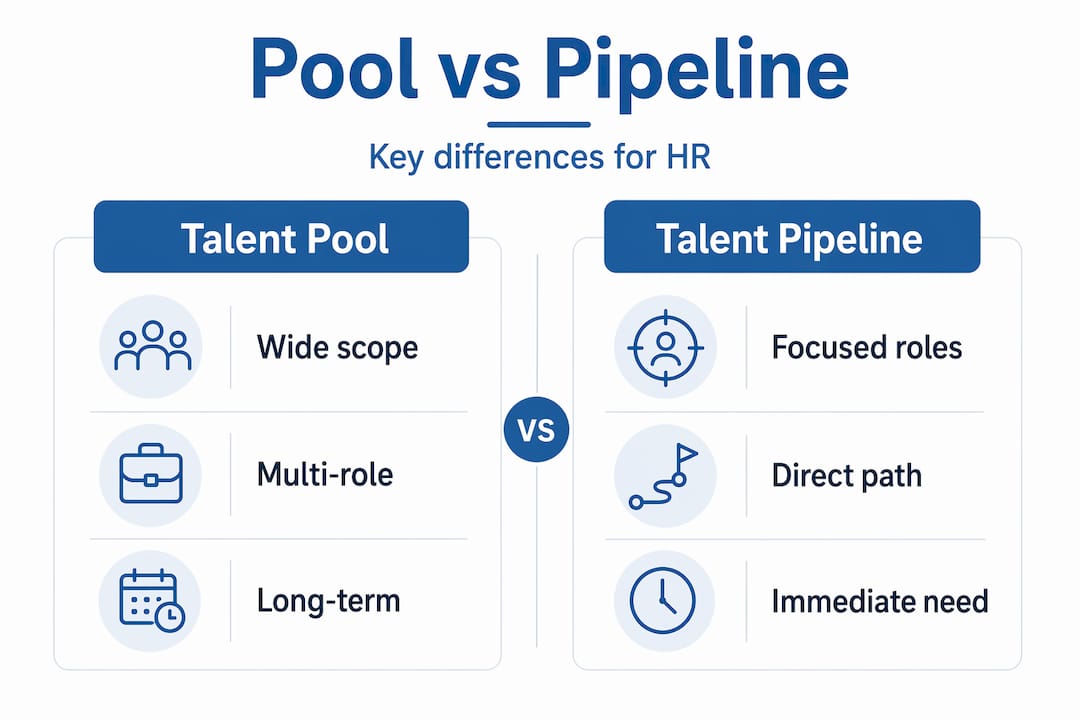
| Characteristic | Talent pool | Talent pipeline |
|---|---|---|
| Scope | Broad, multi-role, long-horizon | Narrow, role-specific, near-term |
| Candidate readiness | Ranges from passive interest to active | Actively nurtured, high-intent |
| Primary purpose | Future talent availability | Immediate or upcoming role coverage |
| Engagement intensity | Periodic, relationship-based | Frequent, structured touchpoints |
| Time to activate | Longer (requires re-engagement) | Shorter (candidates are primed) |
Think of the talent pool as the ocean and the talent pipeline as a focused current moving toward a specific port. Pools provide breadth, pipelines depth, and both are necessary for a functioning talent acquisition strategy. Organizations that only build pipelines find themselves scrambling when a new role type emerges. Organizations that only maintain pools lack the depth and candidate readiness to hire fast when a critical position opens.

Understanding this distinction enables HR teams to move faster and more effectively when vacancies arise, because they know exactly which part of their talent infrastructure to activate.
Pro Tip: When briefing hiring managers on candidate availability, specify whether you are drawing from the pool or the pipeline. It sets realistic expectations on speed and candidate readiness before the search even begins.
Talent Pool Management: Building and Maintaining It
Building a pool once and walking away is the most common failure mode in talent pool strategy. Talent pool management is an ongoing practice of building, organizing, and maintaining candidate databases so they remain useful when roles open.
Here is a practical framework for building and sustaining a high-value pool:
-
Align pool-building with hiring forecasts. Start by mapping the roles and skill sets your organization is most likely to need over the next 12 to 24 months. Aligning pool-building with corporate goals and anticipated hiring identifies skills gaps early and prevents reactive scrambling when budgets open.
-
Segment candidates deliberately. A single undifferentiated list of names is not a talent pool. It is a contact list. Segment pools by skills, career level, and readiness to improve recruiter efficiency and the speed of candidate matching. Useful segmentation variables include job family, location, availability timeline, and specific technical skills.
-
Build a regular engagement cadence. Passive candidates in your pool are not waiting by the phone. Quarterly touchpoints through newsletters, invitations to webinars, or brief personal outreach keep the relationship warm. Regular relationship building improves candidate readiness and reinforces your employer brand even before a role exists.
-
Use a talent management system, not a spreadsheet. Small organizations may start with spreadsheets, but they break down quickly as pools grow. Applicant tracking systems with candidate relationship management modules, or dedicated talent CRM tools, allow recruiters to tag candidates, track engagement history, and surface the right people quickly. Careerscape works with organizations across HR talent management to select and use the right tools for their size and structure.
-
Audit and refresh the pool regularly. Data decays faster than most HR teams realize. Candidates change roles, relocate, or shift career interests. A pool where 30% of contact information is outdated delivers significantly less value than one that is audited every six months. Set a recurring calendar item to validate records and re-engage contacts who have gone quiet.
Pro Tip: Assign pool ownership to a specific recruiter or HR business partner by segment. When nobody owns a segment, nobody maintains it. Clear accountability is what separates a working talent pool from a neglected database.
The Benefits of a Talent Pool for Workforce Planning
The strategic value of talent pools extends well beyond faster hiring, though that is the benefit most organizations notice first. Talent pools reduce time-to-hire, improve workforce planning accuracy, and increase organizational responsiveness to skill gaps and business shifts.
Here is where the measurable benefits concentrate:
- Reduced time-to-hire. When a role opens, a pool of pre-qualified candidates eliminates the cold-sourcing phase. Recruiters move directly to outreach and screening rather than starting from zero, compressing the hiring cycle materially.
- Lower cost-per-hire. Less time spent on job board advertising and external agency fees translates directly into reduced recruiting spend per role. Organizations with mature talent pools often report a meaningful shift in sourcing channel mix toward internal and direct sources.
- Better workforce planning. Including both active and passive candidates is crucial for long-term talent availability, especially for distributed or global teams. Visibility into what talent exists lets HR leaders model future scenarios more accurately.
- Stronger employer brand. Candidates who receive periodic, thoughtful communication from an employer develop a positive perception long before they are ready to move. This matters because most top performers are passively open to new opportunities, not actively searching.
- Diversity and inclusion support. Proactively sourcing and engaging candidates from underrepresented groups widens the diversity of the pool over time. This is more effective than trying to broaden diversity at the point of an open role, when time pressure often defaults hiring managers toward familiar sources.
- Succession planning readiness. Internal talent pools identify high-potential employees before a critical role opens, giving HR time to develop those individuals intentionally rather than reacting to a sudden vacancy.
Talent pools are not just a sourcing tactic. They represent a shift from reactive hiring to a proactive talent strategy, which is where organizations with strong workforce planning capabilities operate.
How to Start Building a Talent Pool
If your organization does not have a functioning talent pool today, the starting point is simpler than it appears. You do not need a full-scale talent CRM on day one. You need a clear source strategy and a consistent outreach habit.
-
Audit your existing candidate data. Your ATS likely contains hundreds of past applicants who were not hired but were qualified. That is your first pool segment, and it costs nothing to activate. Review applications from the past two to three years and tag candidates who met the core criteria.
-
Define your sourcing channels. Engagement strategies warm candidates to be receptive when contacted for opportunities. Identify where your target candidate profiles are active, whether that is LinkedIn, niche professional communities, industry associations, or university alumni networks.
-
Set up a basic CRM or tagging system. Even a structured spreadsheet with consistent fields works as a starting point. The priority is capturing skills, role fit, engagement history, and readiness signals in a format recruiters can actually filter and use.
-
Create a light engagement sequence. A quarterly email with relevant industry content or a brief personal note from a recruiter is enough to keep the pool warm. The goal is to stay in the candidate’s awareness without being transactional. Consistent outreach without a job attached signals that your organization values relationships, not just transactions.
-
Integrate with hiring manager workflows. Pool candidates should be visible to hiring managers before a role is formally posted. When a manager flags an upcoming need, the recruiter should be pulling from the pool first. This is where talent pool strategy produces the fastest time-to-hire reductions. Careerscape offers staffing best practices guidance for organizations building this kind of integrated approach.
My Take on What Organizations Get Wrong About Talent Pools
I have seen organizations invest real effort in building talent pools only to abandon them six months later because “nobody in the pool was interested when we called.” The diagnosis is almost always the same: they built the pool and then did nothing with it.
A talent pool is not a storage container. It is a relationship infrastructure. The organizations I have watched succeed with talent pools treat them the way a good salesperson treats a prospect list: regular touchpoints, genuine value offered between asks, and a clear record of every interaction. When a role opens, they are not cold-calling strangers. They are following up on an ongoing conversation.
The other pattern I see consistently is the failure to get executive buy-in for pool maintenance as an ongoing activity. Building the pool gets funded because it looks like a project. Maintaining it gets cut because it looks like overhead. That is the wrong frame. Without regular engagement and updates, talent pools become outdated and fail when organizations need them most, often during a growth phase or sudden attrition event when time pressure is highest.
Cross-team collaboration matters here too. The best talent pools I have encountered are fed by more than just recruiting. Marketing contributes employer brand content. Department heads flag internal high-potentials. Finance provides headcount forecasts. When pool management becomes a shared organizational practice rather than a recruiting-only initiative, the quality and freshness of the pool improve substantially. That is the mindset shift worth pursuing.
— Chris
How Careerscape Helps You Activate Your Talent Strategy
Building and maintaining a talent pool takes time, tools, and expertise that many HR teams are still developing. Careerscape specializes in exactly this kind of work. Whether you need to fill roles quickly through contract staffing solutions, staff a project with a curated team through project-based staffing, or make a permanent hire through direct hire services, Careerscape operates with pre-built access to qualified candidate pools across industries. The firm’s talent community and passive candidate access means your next hire may already be in a pool that is actively maintained and ready to engage. Fast, honest, and backed by people who know your industry.
FAQ
What Is a Talent Pool in Recruiting?
A talent pool is a database of pre-qualified candidates, both internal and external, organized by skills, role fit, and availability for current or future hiring needs. It allows organizations to move faster when roles open by drawing on relationships built before a vacancy exists.
How Is a Talent Pool Different from a Talent Pipeline?
A talent pool is a broad collection of candidates across many potential roles, while a talent pipeline is a focused group of candidates being actively nurtured for a specific upcoming opening. Pools provide breadth; pipelines provide depth and immediacy.
Why Does a Talent Pool Matter for Workforce Planning?
Talent pools support workforce planning by giving HR leaders visibility into available skills before a role is officially open, enabling skills gap analysis, succession planning, and faster response to sudden hiring needs.
How Do You Build a Talent Pool from Scratch?
Start by auditing existing applicant tracking data for previously qualified candidates, define sourcing channels for each key role type, implement basic candidate relationship management, and establish a regular outreach cadence to keep candidates engaged over time.
How Often Should a Talent Pool Be Updated?
At minimum, talent pools should be audited every six months to validate contact information, update candidate status, and re-engage contacts who have gone quiet. Organizations with high hiring velocity may benefit from quarterly reviews to keep the pool responsive and accurate.
Recommended
- What is the talent market? A guide for smarter hiring
- Staffing best practices to boost recruitment and culture
- Talent Community & Passive Candidate Access | Careerscape