
Talent mobility is a strategic workforce approach that moves employees across roles, teams, and geographies — encompassing both internal transfers and external programs like alumni rehiring — to build skills, fill capability gaps, and retain top performers. Organizations with structured mobility programs benefit from faster ramp-up times, lower recruiting costs, stronger leadership pipelines, and improved retention, with 64% of HR professionals confirming significant business impact. Successful implementation requires a skills inventory, transparent internal processes, learning investment to bridge skill gaps, and clear governance — with the biggest execution risk being the 63% of organizations that recognize mobility's value but fail to fund the upskilling infrastructure that makes it work.
Talent mobility is defined as the intentional, strategic movement of employees across roles, teams, functions, and geographies to develop skills, fill capability gaps, and retain top performers. Unlike reactive transfers or ad hoc promotions, talent mobility is a deliberate workforce strategy that serves both the organization’s operational needs and the employee’s career trajectory. Research from SHL and Sapia.ai confirms that organizations with structured mobility programs outperform peers on retention, leadership pipeline depth, and cost-per-hire. For HR professionals and organizational leaders, understanding this concept is the first step toward building a workforce that adapts faster than the market demands.
What Is Talent Mobility and How Does It Differ from Internal Mobility?
Talent mobility and internal mobility are related but not identical. Internal mobility covers moves within a single employer, including lateral transfers, promotions, and project rotations. Talent mobility is the broader concept. It includes those internal moves plus external-facing programs such as alumni rehiring networks, inter-company talent sharing arrangements, and structured returnship programs.
The distinction matters for strategic planning. An organization that only tracks internal transfers is measuring one dimension of a larger system. A full talent mobility strategy accounts for how talent flows in and out of the organization, not just across departments.
| Dimension | Internal mobility | Talent mobility |
|---|---|---|
| Scope | Moves within one employer | Internal moves plus external programs |
| Examples | Promotions, lateral transfers, rotations | Alumni rehiring, inter-company sharing, returnships |
| Strategic focus | Retention and development | Workforce agility and capability building |
| Program governance | HR-managed transfers | Cross-functional policy and L&D integration |
Consider a professional services firm that rehires former consultants after they gain outside experience. That alumni rehiring program is a talent mobility initiative, not an internal mobility one. Cs-recruiters works with organizations building exactly these kinds of external talent pipelines to extend their reach beyond the internal org chart.
What Are the Key Benefits of Talent Mobility for Organizations?
The business case for talent mobility is grounded in measurable outcomes, not theory. Internal hires ramp up 30% faster and cost 30% less to recruit than external hires. That combination of speed and cost reduction directly improves time-to-fill and cost-per-hire, two metrics every HR leader tracks.

The retention impact is equally significant. According to SHL’s 2025 State of Talent Mobility report, 64% of HR professionals confirm that talent mobility significantly improves business outcomes and retention rates. Employees who see a clear path forward inside the organization are less likely to look outside it. That directly reduces voluntary turnover and the associated replacement costs.
Key benefits HR leaders consistently report include:
- Stronger leadership pipeline: Mobility exposes high-potential employees to diverse functions, accelerating readiness for senior roles without relying entirely on external executive searches.
- Faster skill gap closure: Moving an employee with adjacent skills into a critical role is faster than recruiting externally and waiting for onboarding to complete.
- Higher employee engagement: Employees who experience career growth through mobility report higher job satisfaction, which correlates with lower absenteeism and higher productivity.
- Reduced recruiting costs: Filling roles internally eliminates agency fees, job board spend, and extended time-to-fill cycles.
- Organizational agility: Teams that can redeploy talent quickly respond faster to market shifts, product pivots, and client demands.
One critical nuance: the benefits only materialize when organizations invest in the learning infrastructure to support moves. Only 37% of organizations currently invest in upskilling and reskilling to support mobility programs. That gap between recognizing mobility’s value and funding the learning bridge is where most programs stall. The link between retention and mobility is well established, but it requires deliberate investment to activate.
How to Implement an Effective Talent Mobility Strategy
A talent mobility strategy does not happen by announcing an open-door policy for internal transfers. Structured programs require skills mapping, transparent internal application processes, L&D support, and governance frameworks that define eligibility, timelines, and decision rights.
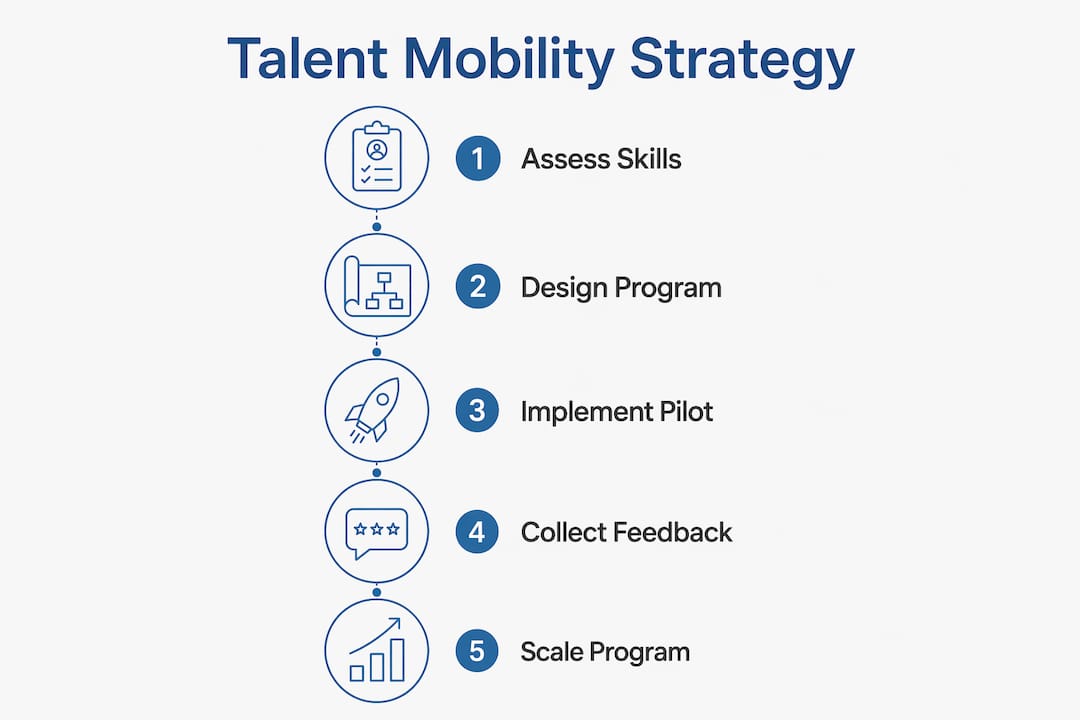
Here is a practical implementation sequence:
- Build a skills inventory. Map current employee skills against future capability needs. Tools like Workday Skills Cloud, SAP SuccessFactors, and Eightfold AI provide skills data infrastructure. Without reliable skills data, mobility decisions default to gut instinct and manager relationships, which introduces bias and misses hidden talent.
- Design transparent internal application processes. Employees need to know how to express interest in new roles, what criteria govern selection, and how their current manager will be involved. Opacity kills participation. Publish the process, set timelines, and communicate outcomes clearly.
- Create learning bridges. Identify the skill gaps between an employee’s current profile and the target role, then fund the training to close them before or immediately after the move. This is where the 37% upskilling investment gap becomes a direct program risk.
- Establish governance and fairness standards. Define who approves mobility moves, how conflicts between releasing and receiving managers are resolved, and how performance during transitions is evaluated. Without governance, mobility becomes a favor economy rather than a merit-based system.
- Address manager resistance directly. Managers sometimes resist mobility because their performance metrics reward headcount retention, not talent deployment. Changing this requires updating manager scorecards to include talent development as a measurable outcome, not just a soft expectation.
- Measure and iterate. Track mobility rate, time-to-productivity for internal moves, retention rates of mobile employees versus non-mobile peers, and internal fill rate by department. You cannot improve what you do not measure.
Pro Tip: Before launching a mobility program, audit your skills data quality. If your HRIS contains job titles but not actual skill profiles, your first investment should be a skills taxonomy project, not a mobility portal. Accurate data is the foundation every other element depends on.
For organizations operating across multiple locations, international staffing considerations add complexity around tax, compliance, and work authorization that require dedicated policy structures separate from domestic mobility governance.
What Are Common Challenges and Pitfalls in Talent Mobility Programs?
Most talent mobility programs underperform not because the concept is flawed, but because execution gaps undermine the strategy. Understanding where programs break down helps HR leaders build more durable frameworks from the start.
The most common failure points include:
- Underinvestment in upskilling. Mobility without learning support creates mismatched placements. Employees moved into roles without adequate preparation underperform, which discourages future participation from both managers and employees.
- Poor skills data quality. High-performing mobility requires well-maintained skills data and a learning bridge to close gaps before and after moves. Organizations relying on outdated job descriptions cannot accurately match employees to opportunities.
- Misalignment with workforce planning. Mobility programs that operate independently of strategic workforce planning fill today’s vacancies without building tomorrow’s capabilities. The two functions must share data and planning cycles.
- Confusing mobility with relocation logistics. For global programs, separating mobility strategy from relocation logistics is critical. Organizations that treat international moves as purely administrative underinvest in compliance, tax policy, and employee experience, which creates legal risk and high attrition among relocated employees.
- Lack of executive sponsorship. Programs managed entirely within HR without C-suite visibility rarely receive the budget or organizational authority needed to override manager resistance or fund learning infrastructure.
Pro Tip: Run a pilot mobility cohort of 10 to 15 employees before scaling. A controlled pilot surfaces governance gaps, manager resistance patterns, and skills data deficiencies at a scale you can fix without disrupting the broader organization.
Only 25% of roles globally are currently filled with internal talent, while 33% of leaders still prioritize external recruitment over internal development. Those numbers represent a significant missed opportunity, and they signal that most organizations have not yet built the systems needed to make internal mobility the default choice.
How Does Talent Mobility Intersect with Global Workforce and Remote Work Trends?
Global talent mobility extends the concept beyond domestic role changes to include international assignments, cross-border remote work arrangements, and structured global rotation programs. The strategic stakes are higher, and so are the compliance requirements.
Seventy percent of organizations now recognize global mobility as a strategic priority for developing, attracting, and retaining talent. That represents a fundamental shift from treating international moves as administrative logistics to treating them as a talent development lever. The KPMG 2024 Global Mobility Benchmarking Survey confirms this shift is accelerating, with HR functions taking greater ownership of global mobility strategy from legacy relocation vendors.
Remote work has added a new dimension to workforce mobility. 67% of organizations now have formal policies governing international remote work arrangements, reflecting the reality that employees increasingly work across borders without physically relocating. This creates both opportunity and risk: organizations can access global talent pools more easily, but they must manage permanent establishment risk, payroll tax exposure, and data privacy compliance across jurisdictions.
| Mobility type | Primary driver | Key compliance consideration |
|---|---|---|
| Domestic role transfer | Skill gap, career development | Internal policy, manager approval |
| International assignment | Leadership development, market expansion | Tax, immigration, social security |
| Cross-border remote work | Talent access, employee preference | Permanent establishment, payroll tax |
| Alumni rehiring | Capability gap, speed to productivity | Onboarding, benefits reinstatement |
Organizations that integrate global and domestic mobility into a single workforce planning framework gain a significant advantage. They can deploy talent where it is needed most, whether that means moving a finance analyst from Chicago to Singapore or rotating a product manager from one business unit to another. Cs-recruiters supports organizations navigating cross-border talent movement with specialized recruiting expertise across 29 U.S. markets and international placements.
Key Takeaways
Talent mobility delivers measurable retention, cost, and agility benefits only when organizations invest equally in skills data, learning infrastructure, and governance frameworks.
| Point | Details |
|---|---|
| Core definition | Talent mobility is the strategic movement of employees across roles, functions, and geographies to build capability and retain talent. |
| Retention impact | 64% of HR professionals confirm mobility significantly improves retention, but only 37% fund the upskilling needed to support it. |
| Cost advantage | Internal hires ramp up 30% faster and cost 30% less to recruit than external candidates. |
| Implementation priority | Build a skills inventory and transparent application process before launching any mobility program. |
| Global complexity | Separating mobility strategy from relocation logistics is critical for scalable, compliant international programs. |
Why the Manager Mindset Is the Real Bottleneck
After working closely with HR teams across industries, the pattern I see most consistently is this: organizations invest in mobility portals, skills platforms, and internal job boards, then wonder why participation rates stay flat. The technology is rarely the problem. The manager is.
Most managers are evaluated on their team’s output, not on how many people they develop and release to other parts of the organization. That incentive structure makes talent hoarding rational behavior, not a character flaw. Until organizations update manager performance criteria to reward talent development and deployment, mobility programs will always fight an uphill battle against the org chart.
The organizations that get this right treat their workforce as a deployable set of capabilities rather than a collection of fixed roles. That framing changes everything. A manager who sees their job as developing talent for the organization, not just for their team, becomes a mobility enabler rather than a blocker. Building that culture requires explicit leadership modeling, updated performance frameworks, and consistent executive messaging over time. It does not happen from a policy memo.
The future of talent management belongs to organizations that can move skills faster than competitors can recruit them. That is not a prediction. It is already happening in sectors like technology, financial services, and life sciences, where internal talent marketplaces are replacing traditional succession planning as the primary tool for filling critical roles.
— Chris
How Cs-Recruiters Supports Your Talent Mobility Strategy
Building a talent mobility program often surfaces capability gaps that cannot be filled through internal moves alone. Cs-recruiters provides contract staffing solutions and project-based staffing designed to place qualified professionals quickly when internal talent is not available or ready. With industry-specialized recruiting expertise across sectors including technology, HR, and professional services, Cs-recruiters helps organizations fill critical roles while their internal mobility programs scale. Whether you need to backfill a role vacated by an internal move or bring in specialized skills for a defined project, Cs-recruiters connects you with the right talent fast.
FAQ
What Is the Talent Mobility Definition in HR?
Talent mobility in HR is the strategic, intentional movement of employees across roles, teams, functions, or geographies to develop skills, fill capability gaps, and improve retention. It encompasses both internal moves and external-facing programs like alumni rehiring.
How Does Talent Mobility Improve Employee Retention?
Employees who experience career growth through internal moves are less likely to seek opportunities externally. SHL research shows 64% of HR professionals confirm that mobility programs significantly improve retention outcomes.
What Is the Difference Between Talent Mobility and Workforce Mobility?
Talent mobility focuses on the strategic development and deployment of individual employees across roles and functions. Workforce mobility is a broader term that often includes physical relocation, remote work policies, and labor market movement at a population level.
How Do You Measure the Success of a Talent Mobility Program?
Key metrics include internal fill rate, time-to-productivity for internal hires, retention rates of mobile versus non-mobile employees, and the percentage of leadership roles filled internally. Tracking these over time reveals whether the program is building capability or simply moving people laterally without development impact.
What Is Global Mobility in the Context of Talent Strategy?
Global mobility refers to the movement of employees across international borders through assignments, rotations, or cross-border remote work. KPMG’s 2024 benchmarking survey found 70% of organizations now treat global mobility as a strategic talent priority, not just a relocation function.
Recommended
- What is the talent market? A guide for smarter hiring
- Talent Community & Passive Candidate Access | Careerscape
- Why Talent Retention Matters for Business Performance