
Ethical hiring — defined as fair, unbiased, and merit-based recruitment — delivers measurable business results, with inclusive companies reporting 28% higher revenue, 30% better profit margins, and up to 40% lower employee turnover. Reducing bias requires structural changes such as anonymized applications, structured interview scorecards, and diverse panels, while AI tools carry significant risk if trained on flawed historical data or used without human oversight. Sustainable implementation demands alignment between CHRO and CIO roles, ongoing recruiter training, and regular audits of hiring funnel data to ensure consistency and compliance.
In this article
Ethical hiring is recruiting candidates through fair, unbiased, and transparent processes that prioritize merit and genuine inclusivity. This practice, formally recognized in HR as equitable recruitment, goes well beyond legal compliance. It shapes workforce quality, retention rates, and financial performance in measurable ways. Companies that apply ethical hiring practices report up to 40% lower turnover among employees with disabilities, and those leading in inclusive hiring show 28% higher revenue versus peers. For hiring managers and CHROs evaluating why ethical hiring deserves a permanent place in their talent strategy, the data is clear and the case is strong.
What Are the Primary Benefits of Ethical Hiring for Businesses?
Ethical hiring produces outcomes that show up directly on the balance sheet. The financial case is no longer theoretical. Companies leading in inclusive and ethical recruitment show 28% higher revenue and 30% better profit margins compared to industry peers. That gap reflects the compounding effect of better talent decisions made consistently over time.
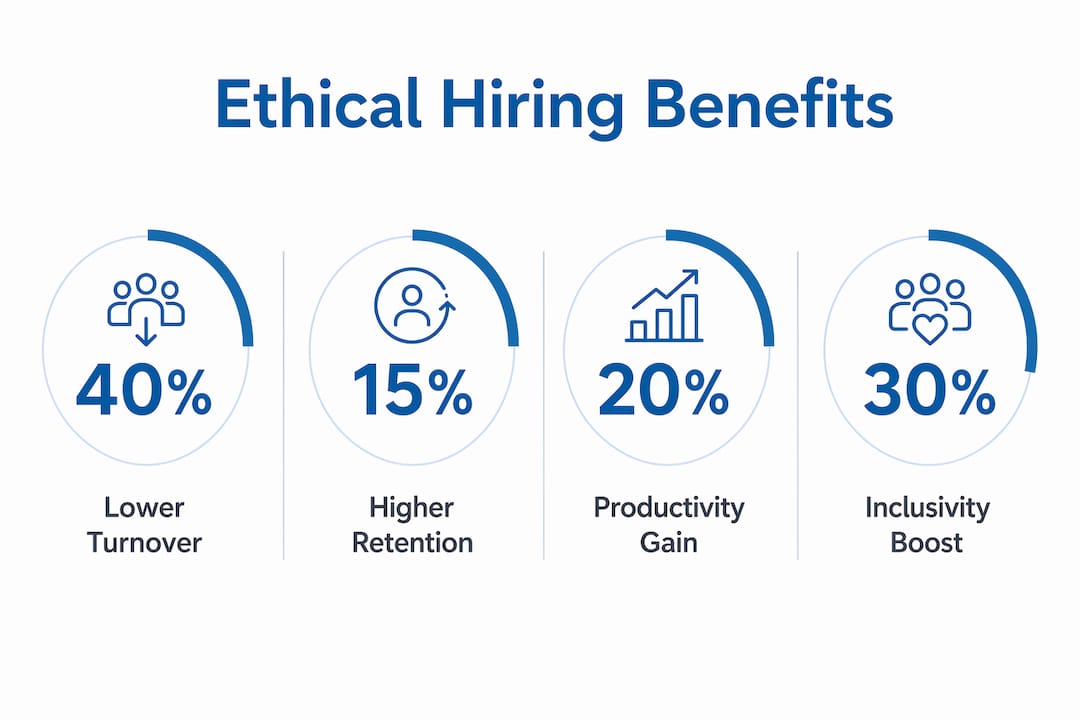
Retention is the most immediate benefit most employers notice. Inclusive hiring practices result in up to 40% lower turnover and 15% higher retention among employees with disabilities. Lower turnover means lower cost-per-hire, reduced onboarding cycles, and stronger institutional knowledge within teams.

Productivity gains are equally significant. When CHRO and CIO roles align to deploy AI tools within an ethical framework, the results are striking. CHRO-CIO partnerships that align AI with ethical hiring drive 14.7x higher recruitment productivity and cut hiring time by 30%. That is not a marginal improvement. It represents a structural shift in how fast and how well organizations fill critical roles.
Beyond the numbers, ethical hiring builds employer brand equity. Candidates talk. A transparent, respectful hiring process generates positive word-of-mouth that reduces time-to-fill on future roles. It also reduces legal exposure. Companies with documented, consistent hiring criteria are far better positioned when facing equal employment opportunity audits or discrimination claims.
Key benefits at a glance:
- Retention: Up to 40% lower turnover and 15% higher retention in inclusive workplaces
- Revenue: 28% higher revenue among inclusive hiring leaders
- Profit margins: 30% better margins versus non-inclusive peers
- Productivity: 14.7x recruitment productivity gains from ethical AI and CHRO-CIO alignment
- Legal risk: Documented ethical processes reduce exposure to discrimination claims
- Employer brand: Transparent hiring improves candidate experience and referral rates
How Does Ethical Hiring Reduce Bias and Improve Fairness?
Bias in hiring is rarely intentional. It is structural. Recruiters make faster judgments when applications include names, schools, or zip codes that trigger unconscious associations. The fix is process design, not willpower.
Anonymizing applications by removing names and schools is one of the most direct ways to minimize unconscious bias in early screening. This approach forces evaluators to focus on skills, experience, and demonstrated outcomes rather than demographic signals. Several large employers, including those in financial services and legal sectors, have adopted blind resume screening as a standard first-round practice.
Diverse interview panels address a different layer of the problem. Diverse interview panels reduce single-interviewer bias and promote fair candidate evaluation. A panel that includes people from different functions, backgrounds, and seniority levels is far less likely to converge on a single cultural preference or unconscious preference pattern.
Here is a practical four-step process for reducing bias in your hiring pipeline:
- Anonymize early-stage applications. Remove names, photos, graduation years, and school names before screening resumes.
- Use structured interview scorecards. Define evaluation criteria before interviews begin and score each candidate against the same rubric.
- Assemble diverse interview panels. Include at least one panel member from outside the direct hiring team.
- Audit AI tools before deployment. Verify that any AI screening tool excludes subjective inputs like tone analysis or facial expression scoring.
Pro Tip: Run a quarterly audit of your structured interview scorecards. Compare scores across demographic groups to identify patterns that may signal residual bias in your evaluation criteria.
Consistency is the underlying principle. Every candidate deserves the same questions, the same scoring criteria, and the same timeline. When processes vary by interviewer or role, bias fills the gaps.
What Are the Ethical Risks of AI in Modern Hiring?
AI in recruitment is not inherently fair. It is only as fair as the data it was trained on and the oversight built around it. AI recruiting tools can perpetuate bias if trained on flawed historical data, creating discrimination risks that are harder to detect than human bias because they are embedded in code rather than behavior.
The risks are specific and worth naming:
- Training data bias: If historical hiring data favored certain demographics, AI models will replicate and amplify those preferences.
- Subjective input analysis: Tools that analyze facial expressions, voice tone, or word choice introduce high-risk, unvalidated criteria into decisions.
- Opacity: Candidates and regulators increasingly expect explanations for hiring decisions. Black-box AI systems cannot provide them.
- Accountability gaps: When AI makes a recommendation and a recruiter accepts it without review, accountability disappears.
“Hiring efficiency driven by AI risks embedding systemic discrimination if ethical frameworks and transparency are not proactively implemented.” — Ethical AI Principles in Hiring
The regulatory environment is tightening. Explainability of AI hiring decisions is increasingly necessary due to new employment laws and ethical expectations as of 2026. In practice, this means your AI vendor must be able to explain, in plain language, why a candidate was ranked or screened out. If they cannot, that tool carries compliance risk.
Human-in-the-loop design keeps recruiters accountable and is vital to prevent bias when using AI in hiring. The recruiter must remain the decision-maker. AI should surface candidates and flag patterns, not replace human judgment on final selections.
For small and mid-size employers evaluating AI screening tools, understanding how applicant screening works at a technical level is the first step toward responsible adoption.
How Can Employers Implement Ethical Hiring Practices Effectively?
Implementation is where most ethical hiring commitments stall. Policies get written, training gets scheduled once, and then the day-to-day pressure of filling roles takes over. Sustainable ethical hiring requires structural changes, not annual workshops.
Align CHRO and CIO roles around shared hiring goals. Strong CHRO-CIO partnerships that align technical and people strategy create faster, fairer, and future-ready hiring processes. The CHRO defines the ethical standards. The CIO selects and governs the technology. When those roles operate in silos, AI tools get deployed without ethical guardrails.
Adopt structured, transparent interviewing. Every role should have a defined competency framework before the job posts. Interviewers score candidates against that framework using a structured scorecard. Scores are documented and retained. This creates an auditable record and reduces the influence of gut-feel decisions.
Train recruiters and hiring managers on ethical AI use. Training should cover what AI tools can and cannot assess, how to recognize bias in recommendations, and when to override an AI-generated ranking. This is not a one-time onboarding item. It belongs in annual compliance training.
Conduct regular ethical audits. Review your hiring funnel data quarterly. Look at offer rates, interview-to-offer ratios, and time-to-fill broken down by demographic group. Disparities in those numbers are signals worth investigating.
Pro Tip: Use candidate feedback surveys at the end of every hiring process, regardless of outcome. Candidates who were not selected often provide the most honest feedback about where your process feels unfair or unclear.
| Practice | Without Ethical Framework | With Ethical Framework |
|---|---|---|
| Resume screening | Subjective, name-influenced | Anonymized, criteria-based |
| Interviewing | Unstructured, variable | Structured scorecards, consistent |
| AI use | Unaudited, opaque | Audited, explainable, human-reviewed |
| Outcome tracking | Ad hoc | Regular demographic audits |
For employers building staffing best practices into their hiring culture, the comparison above shows exactly where the process gaps tend to appear.
Key Takeaways
Ethical hiring is the most direct path to lower turnover, stronger financial performance, and a defensible, legally sound recruitment process.
| Point | Details |
|---|---|
| Retention and revenue gains | Inclusive hiring leaders report 40% lower turnover and 28% higher revenue versus peers. |
| Bias reduction requires process design | Anonymized applications and diverse panels reduce bias more reliably than awareness training alone. |
| AI carries real ethical risk | AI tools trained on flawed data replicate discrimination; human-in-the-loop oversight is non-negotiable. |
| CHRO-CIO alignment drives results | Coordinated technical and people strategy produces 14.7x higher recruitment productivity. |
| Audits sustain ethical standards | Quarterly funnel reviews and candidate feedback surveys catch drift before it becomes a liability. |
Why Ethical Hiring Is an Organizational Character Test
I have worked with enough hiring teams to know that most organizations believe they hire fairly. Very few have actually tested that belief against their own data.
The uncomfortable pattern I see repeatedly is this: inclusion gets treated as a policy to activate when it is convenient and quietly deprioritize when hiring pressure spikes. That is not ethical hiring. That is ethical hiring as a performance. Inclusion anchored solely in strategic or financial motivations tends to be fragile. The organizations that sustain it are the ones that treat it as a character trait, not a KPI.
The financial case for ethical hiring is real and worth citing. But I would argue the more durable reason to commit to it is simpler: the kind of organization you build through your hiring decisions is the organization you become. Candidates who experience a fair, transparent process tell others. Employees hired on merit stay longer and perform better because they were selected for the right reasons. The culture compounds.
What I find most telling is the gap between companies that audit their hiring data and those that do not. The ones that measure offer rates, interview-to-offer ratios, and retention by demographic group are the ones that catch problems early. You cannot improve what you do not measure. Ethical hiring is not a values statement. It is a discipline.
— Chris
How Careerscape Supports Ethical, Merit-Based Hiring
Careerscape was built on the principle that hiring should be fast, honest, and backed by people who understand your industry. Every engagement, from contract staffing to direct hire placements, is structured around merit-based screening and transparent candidate evaluation. Careerscape works with employers who want to build diverse, high-performing teams without sacrificing speed or quality. If you are ready to put ethical recruitment strategies into practice with a partner who holds those standards at every stage, find the talent your organization needs through a process you can stand behind.
FAQ
What Is Ethical Hiring in Simple Terms?
Ethical hiring is the practice of recruiting candidates through fair, consistent, and transparent processes based on merit and qualifications. It excludes bias based on race, gender, age, or other protected characteristics.
What Are the Measurable Benefits of Ethical Hiring?
Companies with inclusive hiring practices report up to 40% lower turnover, 15% higher retention among employees with disabilities, and 28% higher revenue versus non-inclusive peers.
How Does AI Create Ethical Risks in Recruitment?
AI tools trained on biased historical data can replicate and amplify discrimination in screening decisions. Explainability and human-in-the-loop oversight are required to manage that risk responsibly.
How Do Diverse Interview Panels Improve Hiring Fairness?
Diverse panels reduce the influence of single-interviewer bias by bringing multiple perspectives to candidate evaluation, producing more consistent and defensible hiring decisions.
How Can Employers Start Implementing Ethical Hiring Practices?
Start by anonymizing early-stage applications, adopting structured interview scorecards, auditing any AI tools in use, and reviewing hiring funnel data quarterly by demographic group to identify disparities.
Recommended
- 9 Proven Ways to Attract Top Talent in 2026
- Job Hunting Strategies 2026: Win the Hidden Market
- Steps to Effective Job Posting for Recruiters in 2026