
Remote hiring — the process of sourcing, screening, interviewing, and onboarding candidates entirely through digital platforms — delivers measurable advantages over traditional recruitment, including a 33% reduction in time-to-hire, up to 35% greater candidate diversity, and 60–80% lower cost-per-hire. A structured seven-step process (role definition, targeted sourcing, asynchronous screening, structured video interviews, paid test projects, digital offer signing, and formal 30-day onboarding) is key to achieving these outcomes. Employers must also proactively address challenges around time zone overlap, multi-jurisdiction payroll compliance, and cultural integration to scale remote hiring successfully.
Remote hiring is defined as the end-to-end process of sourcing, screening, interviewing, and onboarding candidates entirely through digital platforms, with no requirement for physical presence at any stage. Unlike traditional recruitment, this model uses tools like Zoom, Greenhouse, Workday, and HireVue to replace every in-person touchpoint. The advantages of remote hiring are measurable: organizations that adopt structured remote recruitment reduce time-to-hire by 33%, cutting average fill times from 42 days to 28. That compression matters because unfilled roles cost revenue and strain existing teams. For HR professionals ready to move beyond local talent pools, remote hiring is the most direct path to a faster, more diverse, and more scalable workforce.
What Benefits Does Remote Hiring Provide to Organizations?
Remote hiring transforms recruitment from a geographic constraint into a strategic advantage for growth. The benefits are not theoretical. They show up in measurable outcomes across time-to-fill, cost-per-hire, and workforce diversity.

The most cited advantage is speed. A 33% reduction in time-to-hire means roles get filled faster, onboarding starts sooner, and productivity gaps close earlier. That is not a marginal gain. It is a structural improvement in how quickly your organization can respond to headcount needs.
Diversity is the second major win. Organizations using remote hiring increase candidate diversity by 35%. Removing geography as a filter means you stop defaulting to the same local talent pool and start evaluating candidates based on skills and fit.
The financial case is equally strong:
- Cost savings: Remote hiring can reduce costs by 60%–80% compared to Western-based hires. Cost savings should be treated as a secondary benefit, not the primary goal. The real prize is access to superior talent.
- Productivity parity: Remote hires reach 98% of office-based productivity after six months. That near-parity removes the most common objection to distributed teams.
- Faster ramp-up: Remote hires get up to speed 12% faster than office hires, averaging 45 days versus 51. Structured digital onboarding drives that result.
- Global talent access: You can recruit from any market, not just the metro area surrounding your office. That expands your candidate pipeline and improves the quality of your shortlist.
“Companies ignoring remote hiring risk losing top talent and slowing growth compared to competitors adopting borderless models.” — Staffing Industry Analysts
The advantages of remote work extend beyond the employee experience. For employers, the real payoff is a talent pipeline that is faster, broader, and more cost-effective than anything a single-city search can produce. If you want to attract top talent in 2026, remote hiring is not optional. It is the baseline expectation for competitive organizations.
How Does the Remote Hiring Process Work Step by Step?
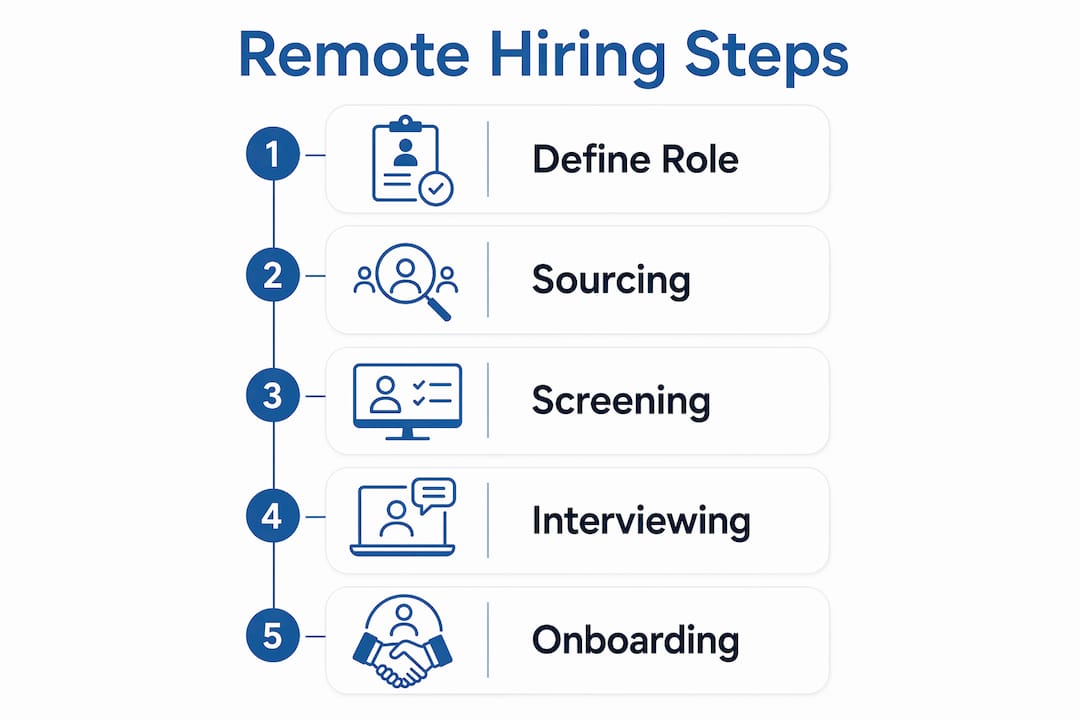
A 7-step remote hiring process is the most effective framework for reducing attrition and improving hire quality. Each step serves a specific function. Skipping any one of them increases the risk of a bad hire or a failed onboarding.
-
Define the role by outcomes, not tasks. Write a job description that specifies what success looks like at 30, 60, and 90 days. Vague task lists attract the wrong candidates and make evaluation harder.
-
Source through the right channels. Use niche job boards like We Work Remotely or Remote.co, employee referrals, and specialized recruiting firms for remote roles. Generic job boards produce high volume but low signal.
-
Screen with asynchronous written tests. Before any live interview, send candidates a short written assessment. This tests communication clarity, the single most important skill for remote work. Candidates who cannot write clearly will struggle in distributed teams.
-
Conduct structured video interviews. Use platforms like Zoom or HireVue with a standardized scorecard. Behavioral questions tied to specific competencies produce more consistent and defensible hiring decisions than unstructured conversations.
-
Assign a paid test project. Give finalists a short, compensated task that mirrors actual work. This is the most reliable predictor of on-the-job performance and signals respect for the candidate’s time.
-
Issue a clear written offer with digital signing. Use tools like DocuSign or PandaDoc to formalize the offer. Ambiguity in offer letters creates friction and erodes trust before day one.
-
Execute a structured 30-day onboarding plan. Assign a buddy, schedule regular check-ins, and document all processes in a shared knowledge base like Notion or Confluence. Onboarding is where retention is won or lost.
Pro Tip: Build your remote hiring process as a repeatable system, not a one-off effort. Document each step, assign ownership, and review outcomes after every hire cycle. You cannot improve what you do not measure.
What Challenges Must Employers Address in Remote Hiring?
Remote hiring introduces operational and cultural complexity that traditional recruitment does not. Employers who treat it as simply “regular hiring done over video” consistently run into avoidable problems.
Time zone management is the most common operational failure. Savvy remote recruiters prioritize 3–8 hours of business overlap to maintain collaboration without burning out team members with unsustainable schedules. Hiring across too many time zones without a clear overlap policy creates coordination bottlenecks that erode team cohesion.
Legal and compliance complexity is the second major challenge. Remote-first companies proactively manage local compliance including tax obligations, payroll regulations, and local labor laws. Ignoring these details does not make them go away. It creates administrative backlogs and exposes the organization to legal risk.
Key challenges to address before your first remote hire:
- Payroll and tax compliance: Understand whether you need an Employer of Record (EOR) service like Deel or Remote to legally employ workers in other states or countries.
- Cultural integration: Remote teams do not build culture passively. Schedule regular virtual touchpoints, team rituals, and informal communication channels using tools like Slack or Microsoft Teams.
- Technology infrastructure: Every remote hire needs a defined tech stack from day one. Delays in provisioning equipment or access create frustration and slow productivity.
- Treating hiring as a system: Managing remote hiring as an integrated system with aligned HR, Finance, Legal, and Procurement teams prevents operational chaos and supports smooth scaling.
Pro Tip: Before posting your first remote role, align your HR, Legal, and Finance teams on jurisdiction, classification, and payroll. Discovering compliance gaps after a hire is made is far more costly than addressing them upfront.
Remote Hiring vs. Traditional on-Site Recruitment: How Do They Compare?
The differences between remote and traditional hiring are not just logistical. They affect outcomes across speed, cost, diversity, and retention. The table below captures the most decision-relevant comparisons.
| Factor | Remote Hiring | Traditional On-Site Hiring |
|---|---|---|
| Time-to-hire | ~28 days average | ~42 days average |
| Candidate pool | Global, borderless | Local or regional only |
| Cost-per-hire | 60%–80% lower possible | Higher due to office and relocation costs |
| Diversity | Up to 35% improvement | Limited by local demographics |
| Productivity at 6 months | 98% of office baseline | Office baseline |
| Ramp-up time | ~45 days | ~51 days |
| Onboarding complexity | Higher; requires structured digital process | Lower; in-person support available |
| Compliance burden | Higher; multi-jurisdiction risk | Lower; single-location rules |
The productivity data is the most persuasive argument for remote hiring skeptics. Remote hires reach near-parity with office workers within six months. The ramp-up is actually faster. The cost and diversity advantages are significant. The trade-off is operational complexity, specifically in onboarding and compliance. Organizations that invest in structured processes and the right technology infrastructure consistently outperform those that do not.
For employers evaluating the remote work hiring process for the first time, the data supports a clear conclusion. The advantages of remote hiring outweigh the challenges when the process is built correctly from the start. Exploring scalable team extension models can also help organizations expand capacity without the full overhead of permanent headcount.
Key Takeaways
Remote hiring is the most effective way to reduce time-to-hire, expand candidate diversity, and access global talent when supported by a structured, system-based process.
| Point | Details |
|---|---|
| Speed advantage | Remote hiring cuts average time-to-hire from 42 to 28 days, a 33% improvement. |
| Diversity gains | Structured remote recruitment increases candidate diversity by up to 35%. |
| Productivity parity | Remote hires reach 98% of office-based productivity within six months. |
| Process discipline | A 7-step remote hiring process reduces attrition and improves hire quality. |
| Compliance planning | Aligning HR, Legal, and Finance before hiring prevents costly compliance failures. |
The Mistake Most Employers Make with Remote Hiring
After working with dozens of organizations building out distributed teams, the pattern is consistent. Companies treat remote hiring as a technology problem. They buy the right ATS, set up Zoom interviews, and assume the process will follow. It does not.
The real challenge is structural. Remote hiring works best when it is treated as a strategic transformation, not a tactical adjustment. That means aligning HR, Legal, and Finance before the first job post goes live. It means writing job descriptions around outcomes, not job duties. It means filtering for written communication ability as a non-negotiable competency, because candidates who cannot communicate clearly in writing will struggle in any distributed environment.
The time zone issue is also consistently underestimated. I have seen teams hire across eight time zones with no overlap policy and wonder why collaboration breaks down. The 3–8 hour overlap rule is not a preference. It is a structural requirement for functional remote teams.
The organizations that get remote hiring right treat onboarding as the most critical phase of the entire process. A strong hire with a weak onboarding experience becomes a retention risk within 90 days. Build the ramp-up plan before you post the role, not after the offer is accepted.
Long-term success in remote hiring depends on predictable scaling and superior talent access. Cost savings are a byproduct. Focus on building a process that consistently produces great hires, and the financial results will follow.
— Bradford
How Cs-Recruiters Supports Your Remote Hiring Strategy
Cs-recruiters (Careerscape) is built for exactly this kind of hiring. Whether you need to fill a single specialized role or scale a distributed team across multiple markets, Careerscape brings industry-specific expertise and a structured process to every search. The firm’s contract staffing solutions give employers the flexibility to bring on remote talent quickly without long-term commitment risk. For project-specific needs, Careerscape’s project-based staffing teams provide pre-vetted professionals ready to contribute from day one. If your organization is ready to build a remote talent pipeline that is fast, honest, and backed by people who understand your industry, find talent through Cs-recruiters today.
FAQ
What Is Remote Hiring in Simple Terms?
Remote hiring is the process of recruiting, interviewing, and onboarding employees entirely through digital tools, with no in-person meetings required at any stage. It allows employers to hire from any location, not just their local market.
Is Remote Hiring Effective Compared to Traditional Recruiting?
Remote hiring reduces time-to-hire by 33% and increases candidate diversity by 35%, while remote hires reach 98% of office-based productivity within six months. The data consistently supports its effectiveness when a structured process is in place.
What Are the Biggest Challenges of Remote Hiring?
The top challenges are time zone management, multi-jurisdiction legal compliance, and cultural integration. Employers who align HR, Legal, and Finance teams early and maintain 3–8 hours of daily team overlap avoid the most common operational failures.
What Skills Should Employers Prioritize in Remote Candidates?
Written communication is the top skill filter for remote hiring success. Candidates who communicate clearly in writing perform better in distributed environments where asynchronous collaboration is the norm.
How Many Steps Does a Successful Remote Hiring Process Require?
A proven remote hiring process follows seven steps: role definition, sourcing, written screening, structured video interviews, paid test projects, written offer with digital signing, and a structured 30-day onboarding plan.
Recommended
- What is recruiting? The employer’s guide to modern hiring
- 9 Proven Ways to Attract Top Talent in 2026
- Job Hunting Strategies 2026: Win the Hidden Market
- Job Posting Optimization: A 2026 Recruiter’s Guide