
Headhunting is a proactive, research-driven recruitment method that targets passive, senior, or highly specialized candidates who are not actively job searching — unlike traditional recruiting, which responds to applicant demand. The process involves confidential candidate mapping, personalized outreach, and rigorous assessment (including psychometric testing), typically through a retained engagement costing 20–38% of first-year compensation. For critical leadership and niche technical roles, headhunting reduces vacancy time, improves candidate quality, and accesses talent pools that standard hiring methods cannot reach.
In this article
Headhunting is the practice of directly approaching high-performing people who are not applying to jobs — usually senior, passive, or scarce-skill candidates — and recruiting them for a specific role. Unlike post-and-wait recruiting, the headhunter builds a target list and goes to the candidate first. Unlike posting a job and waiting for applications, headhunting starts with a predefined target list and moves through confidential, research-led outreach. CEO departures rose 9% globally to 202 in 2024, and that surge in executive turnover has pushed demand for headhunting services to new highs. For HR professionals and hiring managers filling critical leadership or niche technical roles, understanding how executive search works is no longer optional. It is a core competency in modern talent acquisition.
What Is Headhunting and How Does It Differ from Standard Recruiting?
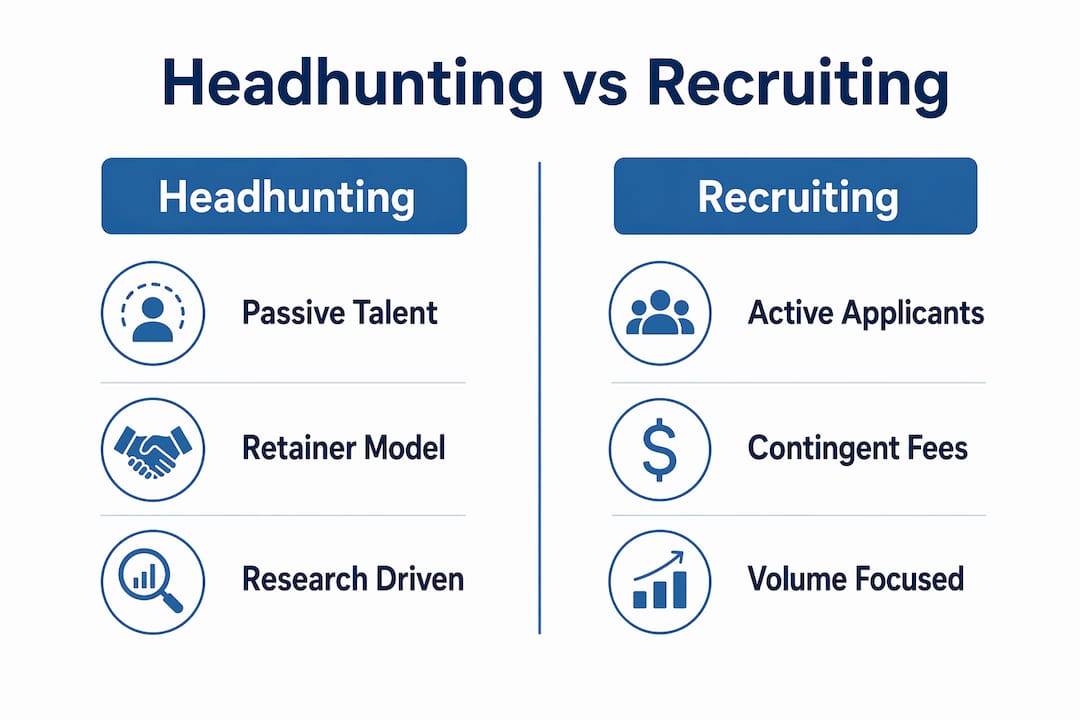
Headhunting is the formal practice of executive search: a retained, research-driven process in which external specialists proactively contact passive, senior candidates and exit the engagement once placement is complete. The headhunting definition separates it clearly from general recruiting. Standard recruiting responds to demand by posting roles and managing inbound applicants. Headhunting creates demand by identifying the right person before they ever raise their hand.
The distinction matters most at the senior and specialized level. A VP of Engineering, a Chief Revenue Officer, or a niche data scientist with domain expertise in regulated industries is rarely browsing job boards. These professionals are employed, performing well, and not looking. Reaching them requires a different approach entirely. Headhunting firms build candidate maps from scratch, using industry databases, professional networks like LinkedIn, and proprietary research to identify who holds the right role at a competitor or adjacent organization.

For employers, this means the value of headhunting is not just in filling a seat. It is in accessing a talent pool that self-managed hiring simply cannot reach. To understand how modern recruiting compares across methods, the foundational difference is always sourcing strategy: reactive versus proactive.
How Does Headhunting Work in Practice?
The headhunting process follows a structured sequence that prioritizes confidentiality, precision, and candidate quality at every stage. Here is how a retained executive search engagement typically unfolds:
- Client intake and confidential briefing. The search firm meets with the hiring organization to define the role, success profile, compensation range, and cultural requirements. The more specific this brief, the stronger the shortlist.
- Candidate mapping and research. The firm builds a named list of qualified individuals across target companies and sectors. This structured approach includes multiple assessment phases and psychometric tests, not just credential matching.
- Discreet outreach. Headhunters contact candidates directly and confidentially, often through personal networks or direct messaging. The pitch is tailored to the individual, not broadcast to the market.
- Vetting and structured assessment. Qualified candidates go through interviews, reference checks, and in many cases psychometric evaluations. A retained engagement typically includes rigorous multi-stage evaluation including confidential references, which is not standard in contingent recruiting.
- Shortlist presentation. The client receives a curated shortlist, typically three to five candidates, with detailed profiles and the firm’s assessment of each.
- Offer negotiation and closure. The headhunter brokers the final offer, managing expectations on both sides to protect the placement.
Fee structures separate headhunting from contingent recruiting in a meaningful way. Headhunting firms operate on a retainer model for intensive, research-led searches, meaning the client pays a portion of the fee upfront regardless of outcome. Fees typically range from 20 to 38% of first-year compensation, reflecting the depth of service involved. That fee range signals the level of commitment required from both parties.
Pro Tip: Before signing a retainer, ask the search firm for a sample candidate map from a comparable prior engagement. It tells you immediately whether their research depth matches your expectations.
Headhunting vs Recruiting: Which Approach Fits Your Hiring Need?
The choice between headhunting and traditional recruiting is not about which method is better. It is about which method fits the role, the timeline, and the talent pool you need to access.
| Factor | Headhunting | Traditional recruiting |
|---|---|---|
| Candidate pool | Passive, senior, or specialized professionals | Active job seekers across experience levels |
| Sourcing method | Proactive, research-led outreach | Job postings, applications, referrals |
| Fee model | Retained (paid upfront) | Contingent (paid on placement) |
| Time to shortlist | Weeks for qualified candidates | Variable, often longer for senior roles |
| Assessment depth | Psychometric testing, confidential references | Standard interviews and background checks |
| Best use case | C-suite, VP, niche technical roles | High-volume, mid-level, or entry-level hiring |
The table above shows that neither method dominates across all scenarios. Where headhunting wins decisively is in reducing vacancy duration for senior roles. Approximately 40% of senior positions take an extended period to fill without headhunting, and vacancy costs at the executive level compound quickly.
Key distinctions HR professionals should factor into their decision:
- Employer branding: Headhunting protects confidentiality when replacing an incumbent or entering a new market. Posting a role publicly signals your intentions to competitors.
- Candidate experience: Passive candidates expect a personalized, high-touch approach. A generic application process will lose them before the first conversation.
- Internal capacity: If your talent acquisition team lacks the network or time to run a senior search, contingent or retained headhunting fills that gap without adding headcount.
The commercial terms differ too. Contingency recruiting commonly bills 15–25% of first-year salary and only on a completed hire, while headhunting for executive and hard-to-fill roles is usually retained — billed in stages, with the firm working a defined shortlist whether or not the first candidate signs. Expect a retained search to run 8–14 weeks for a senior role; contingency can move faster but competes on speed rather than depth.
What Are the Benefits of Headhunting for Critical Hires?
The strategic advantages of headhunting are measurable, not theoretical. For roles where the wrong hire costs more than the search fee, the math favors a specialized approach.
- Cost reduction through direct outreach. Optimizing recruitment budgets toward direct outreach and headhunting can reduce cost-per-hire by up to 30%. That figure reflects fewer wasted job board spends, shorter vacancy periods, and lower attrition from better-fit placements.
- Access to passive talent. The most qualified professionals in any field are rarely available through job boards. Headhunting is the only reliable method to reach them.
- Faster, higher-quality shortlists. For senior or specialized roles, headhunting firms regularly deliver shortlists within weeks, compared to self-managed searches that can exceed 90 days. Every day a senior role sits vacant carries a real cost to productivity, revenue, and team morale.
- Improved cultural fit. Because headhunters conduct in-depth vetting beyond credentials, including behavioral interviews and psychometric assessments, the candidates presented align more closely with the organization’s culture and leadership expectations.
- Talent pipeline development. A well-run executive search builds a map of the talent market that stays useful beyond the immediate hire. Organizations that work with industry-specialized search firms gain ongoing intelligence about who is moving, who is available, and where the market is heading.
“Retainer models ensure search firms commit extensive resources early, leading to higher candidate quality and confidentiality.” — Klearskill
That commitment from the search firm translates directly into a more thorough process for the employer. When a firm is retained, they are not splitting attention across multiple contingent searches. Your role gets dedicated research time.
How to Implement Headhunting Strategies Effectively
Engaging a headhunting firm produces the best results when the employer brings the same level of preparation to the process that the search firm does. Vague briefs produce weak shortlists. Here is how to get the most from a headhunting engagement:
Define the success profile before the search begins. Go beyond the job description. Identify the specific outcomes the hire must achieve in the first 12 months, the leadership behaviors the role requires, and the compensation range you can realistically offer. The more precise your brief, the faster the firm can build a targeted candidate map.
Select a firm with genuine industry specialization. A generalist recruiter and a specialized headhunting firm are not interchangeable for senior roles. Look for firms with documented placements in your sector, not just a broad network. Careerscape, for example, structures its executive search practice around industry-specific knowledge, which shortens research time and improves candidate relevance.
Understand what you are paying for with a retainer. The upfront fee is not a risk. It is what funds the research phase. Retainer models ensure the firm commits extensive resources early, which produces higher candidate quality and confidentiality than a contingent arrangement.
Collaborate actively during the search. Provide rapid feedback on candidate profiles. Slow response times from the client side are one of the most common reasons searches stall. Treat the headhunter as an extension of your talent acquisition team, not a vendor you check in with monthly.
Track the right metrics. Monitor time-to-fill, cost-per-hire, and 12-month retention rate for every headhunted placement. These three numbers tell you whether the search firm is delivering value beyond the initial placement. If retention rates for headhunted hires are not outperforming your standard recruiting results, the vetting process needs review.
Common pitfalls to avoid:
- Providing an incomplete or shifting role brief mid-search
- Setting compensation expectations below market rate for the target candidate pool
- Treating the headhunter as a transactional vendor rather than a strategic partner
- Neglecting candidate experience during the assessment process, which damages employer brand with passive talent
Pro Tip: Ask your search firm to include a B2B recruitment case study or comparable placement example before the engagement starts. Firms with documented results in your industry, like Veridata Insights, demonstrate the kind of specialized track record that reduces search risk.
Key Takeaways
Headhunting delivers measurable hiring advantages for senior and specialized roles when employers engage the right firm with a precise brief and active collaboration throughout the search process.
| Point | Details |
|---|---|
| Headhunting definition | Proactive, research-led recruitment targeting passive, senior, or specialized candidates not actively job seeking. |
| Retainer fee model | Fees of 20 to 38% of first-year compensation fund dedicated research and deeper candidate vetting. |
| Speed advantage | Headhunting firms deliver shortlists in weeks; self-managed senior searches often exceed 90 days. |
| Cost-per-hire reduction | Direct outreach and headhunting can reduce cost-per-hire by up to 30% compared to reactive sourcing. |
| Effective implementation | Define a precise success profile, select an industry-specialized firm, and track retention rate post-placement. |
Why Headhunting Is Becoming a Leadership Function, Not Just a Hiring Tactic
I have watched headhunting shift from a transactional service to something closer to organizational consulting over the past several years. The firms doing the most interesting work are not just filling seats. They are helping leadership teams think about succession, culture fit at the executive level, and what kind of leader the organization actually needs versus what the job description says.
The headhunting industry is evolving toward what some are calling “leadership architecture,” combining executive search with cultural and organizational consulting. BrisCann Young’s pivot to this model is one of the clearest signals that credential matching alone is no longer sufficient. The organizations that get the most from headhunting are the ones that treat it as a strategic input, not a last resort when internal recruiting stalls.
AI is changing the research phase significantly. Headhunting firms are integrating AI to accelerate data-driven candidate mapping while keeping the relationship-building side firmly human-led. That balance matters. A passive candidate at the VP level will not respond to an automated outreach sequence. They respond to a well-researched, personalized conversation from someone who clearly understands their career trajectory.
The employers who get the most from headhunting are the ones who show up as genuine partners in the process. They share context, give fast feedback, and trust the firm’s market intelligence. You cannot outsource the judgment calls, but you can build a search partnership that makes those calls much better informed.
— Chris
Find the Right Talent with Careerscape
Careerscape builds hiring programs around one principle: the right hire comes from knowing your industry, not just your job description. Whether you need direct hire staffing for a specialized permanent role or a broader talent sourcing strategy across multiple functions, Careerscape brings the industry knowledge and proactive outreach methods that headhunting demands. Explore Careerscape’ industry-specialized recruiting services to see how targeted search can reduce your time-to-fill and improve the quality of every critical hire. Fast, honest, and backed by people who understand your market.
FAQ
What Is the Headhunting Definition in Simple Terms?
Headhunting is the proactive recruitment of passive candidates, typically for senior or specialized roles, using research-led outreach rather than job postings. The process is usually managed by an external executive search firm on a retained basis.
How Does Headhunting Work Differently from Contingent Recruiting?
Headhunting uses a retainer fee model and begins with a predefined candidate map, while contingent recruiting is paid only on placement and relies on active applicants. The retained model funds deeper vetting, including psychometric testing and confidential references not standard in contingent searches.
What Does a Headhunter Do That an Internal Recruiter Cannot?
A headhunter proactively contacts passive, senior candidates through personal networks and proprietary research, accessing talent that never applies through standard channels. Internal recruiters typically manage active applicant flow and lack the external market access a specialized search firm provides.
How Much Do Headhunter Services Cost?
Headhunters typically charge 20 to 38% of the placed candidate’s first-year compensation, depending on search complexity and fee model. Retainer-based searches require an upfront payment, while contingent arrangements are paid only after a successful placement.
Is Headhunting Effective for Reducing Time-to-Fill?
Yes. For senior or specialized roles, headhunting firms regularly deliver qualified shortlists within weeks, while self-managed searches for the same roles can exceed 90 days. The speed advantage directly reduces vacancy costs and productivity loss at the leadership level.
Recommended
- What is recruiting? The employer’s guide to modern hiring
- How to Shortlist Applicants: A Hiring Manager’s Guide
- What Is Technical Recruiting? A Complete Guide for Employers