
Temp-to-hire is a staffing model where a worker is placed temporarily through an agency — which handles payroll, taxes, and compliance — with a structured 3-9 month evaluation period before the employer decides whether to convert them to permanent status. The model reduces mis-hire risk by providing real-world performance data that interviews cannot replicate, while deferring benefits and payroll costs until conversion is confirmed. It sits between direct hire (immediate permanent placement) and pure temporary staffing, making it best suited for mid-level roles where cultural fit and on-the-job performance need validation before a long-term commitment.
Temp-to-hire is defined as a staffing arrangement where a worker is placed in a role on a temporary basis, with the explicit option for the employer to convert that worker to permanent status after a structured trial period. Also referred to as contract-to-hire in many staffing contexts, this employment model gives hiring managers a real-world evaluation window before making a long-term commitment. Cs-recruiters works with employers daily who use this model to reduce mis-hires, control cost-per-hire, and build stronger permanent teams. Understanding how the process works, and where it outperforms direct hire, is the foundation of smarter workforce planning.
What Is Temp-to-Hire and How Is It Defined?
Temp-to-hire is an employment model where a staffing agency places a candidate with a client company for a defined trial period, after which the employer decides whether to offer permanent employment. The arrangement is distinct from pure temporary staffing because both parties enter the relationship with conversion to permanent status as the intended outcome. This is also what separates it from what is contract-to-hire in the broader staffing market, though the two terms are used interchangeably across most industries.
The temp-to-hire definition centers on three elements: a temporary placement, a structured evaluation period, and a conditional offer of permanent employment. Employers evaluate skills and cultural fit in real work conditions before committing to a permanent hire. That real-world filter is something no resume or interview process can replicate.

During the trial period, the staffing agency functions as the Employer of Record. The agency handles payroll, benefits administration, and tax compliance on behalf of the worker. This structure keeps the employer’s legal exposure low while the evaluation is underway.
How Does Temp-to-Hire Work Step by Step for Employers?
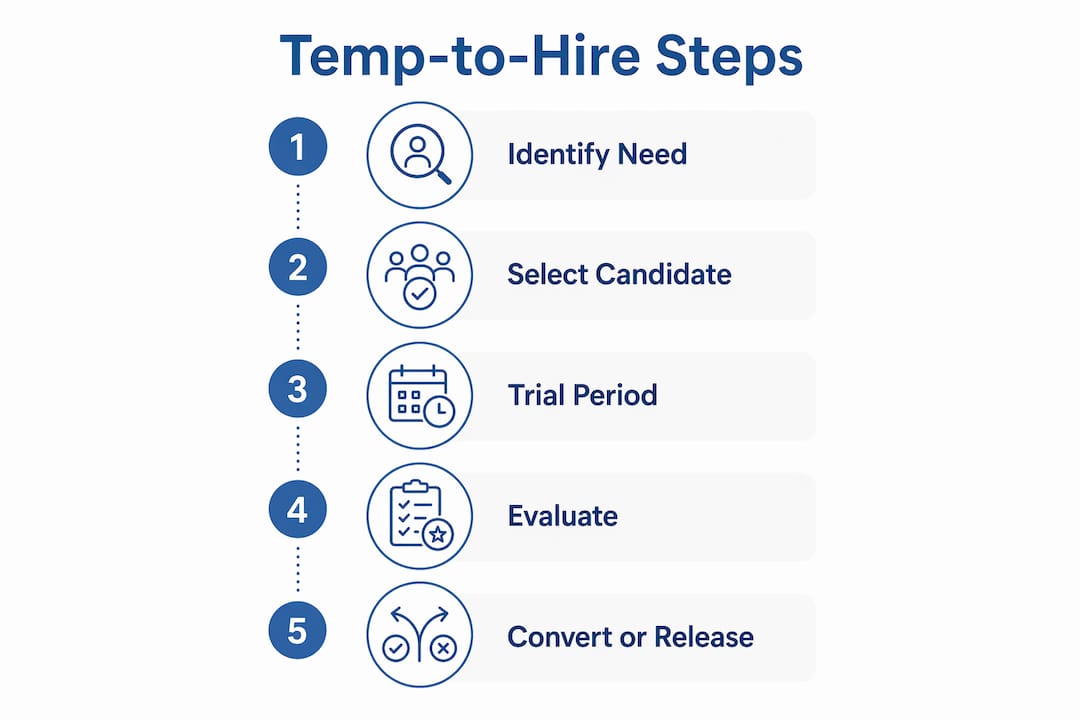
The temp-to-hire staffing process follows a clear sequence. Understanding each phase helps employers set expectations, avoid administrative errors, and make confident conversion decisions.
-
Define the role and partner with a staffing agency. The employer provides a detailed job description, compensation range, and evaluation criteria to the staffing agency. Cs-recruiters, for example, uses this intake to source candidates who match both technical requirements and team culture.
-
Agency sources, screens, and places the candidate. The staffing agency conducts initial interviews, background checks, and skills assessments. The employer may conduct a final interview, but the agency manages the offer and onboarding paperwork.
-
Trial period begins. The standard trial period runs 3 to 6 months, with some specialized technical roles extending up to 9 months for adequate assessment. During this window, the worker is on the agency’s payroll, not the employer’s.
-
Employer evaluates performance, reliability, and cultural fit. This is the core of the temp-to-hire employment model. Hiring managers should use structured scorecards, regular check-ins, and defined performance benchmarks to document their assessment objectively.
-
Employer makes a conversion decision. At or before the end of the trial period, the employer decides whether to extend a permanent offer. If the decision is yes, the worker transitions off the agency’s payroll and onto the employer’s. If the decision is no, the staffing agency places the worker elsewhere or ends the assignment without any hiring obligation on the employer’s part.
-
Conversion fee is paid. When a permanent offer is accepted, the employer typically pays a conversion fee to the agency for the placement. This fee is usually negotiated upfront and should be factored into total cost-per-hire calculations.
Pro Tip: Negotiate the conversion fee structure before the trial period begins. Many agencies offer a sliding scale where the fee decreases the longer the temp period runs, rewarding employers who take a full evaluation window.
A critical administrative point: payroll taxes and insurance remain the agency’s responsibility throughout the temp phase. Employers who mistakenly assume they must manage these obligations create unnecessary compliance risk. The agency issues the W-2, withholds federal and state taxes, and pays the employer’s portion of payroll taxes until conversion is complete.
What Are the Benefits of Temp-to-Hire for Employers?
The benefits of temp-to-hire are most visible when compared against the cost of a failed direct hire. The average cost of replacing a salaried employee is substantial, and a temp-to-hire arrangement reduces that risk before it materializes.
-
Real-world performance data. Interviews reveal potential. A 90-day trial period reveals actual output, work habits, and team dynamics. Employers gain performance data that no structured interview scorecard can fully capture.
-
Reduced upfront financial commitment. Benefits and payroll taxes are deferred until permanent hire is confirmed. This lowers the employer’s cost-per-hire during the evaluation window and protects the budget if the placement does not convert.
-
Workforce flexibility. The temp-to-hire model provides less long-term commitment than direct hire, which is especially valuable when business conditions are shifting or headcount approval is pending. Employers can keep a skilled worker productive while the permanent role is formally approved.
-
Access to pre-vetted talent pipelines. Staffing agencies maintain active candidate networks that most internal recruiting teams cannot replicate. Cs-recruiters’ contract staffing solutions give employers access to qualified professionals who are ready to contribute from day one.
-
Cultural fit validation. Resumes and references describe a candidate’s past. A trial period shows how that candidate operates within your specific team, management style, and organizational culture. This is the factor most often cited in retention failures, and temp-to-hire addresses it directly.
Pro Tip: Assign a dedicated internal mentor or point of contact to every temp-to-hire placement. Workers who receive structured onboarding and regular feedback during the trial period convert to permanent employees at significantly higher rates.
How Does Temp-to-Hire Compare to Direct Hire and Temporary Staffing?
The temp-to-hire vs direct hire comparison comes down to risk tolerance, timeline, and role complexity. Each model serves a different hiring scenario, and choosing the wrong one increases both time-to-fill and cost-per-hire.
Direct hire places a candidate directly onto the employer’s payroll as a permanent employee from day one. The employer assumes full financial and legal responsibility immediately. This model works well for senior leadership roles, highly specialized positions with limited candidate pools, or situations where speed to full productivity is critical.
Temporary staffing places workers for a fixed project or seasonal period with no expectation of permanent conversion. The employer gains short-term capacity without any long-term obligation. This model fits project-based work, seasonal demand spikes, or coverage for employee leave.
Temp-to-hire sits between these two models. It provides the flexibility of temporary staffing with a built-in pathway to permanent employment. The strategic value is mutual: both the employer and the candidate evaluate fit before committing.
| Factor | Temp-to-hire | Direct hire | Temporary staffing |
|---|---|---|---|
| Employer of Record during placement | Staffing agency | Employer | Staffing agency |
| Permanent hire intent | Yes, conditional | Yes, immediate | No |
| Trial period | 3 to 9 months | None | Duration of project |
| Conversion fee | Yes | No | No |
| Employer payroll tax during placement | No | Yes | No |
| Best use case | Cultural fit evaluation, mid-level roles | Senior or specialized roles | Project work, seasonal demand |
Employers comparing direct hire staffing against temp-to-hire should weigh the cost of a mis-hire against the cost of the conversion fee. For most mid-level professional roles, the trial period pays for itself by filtering out poor fits before they reach permanent status.
Common Pitfalls and Best Practices for Successful Temp-to-Hire Hiring
The temp-to-hire employment model delivers strong results when managed correctly. These are the most common failure points and how to avoid them.
-
Failing to define the Employer of Record clearly. Confusing the agency’s legal employer role with the client’s supervisory role creates payroll errors, tax filing mistakes, and potential legal liability. Document the division of responsibilities in writing before the placement begins.
-
Setting vague evaluation criteria. A trial period without defined benchmarks becomes a subjective exercise. Use structured scorecards that measure output quality, attendance, collaboration, and role-specific KPIs at 30, 60, and 90-day intervals.
-
Delaying the conversion decision. Extending the trial period without a clear reason signals indecision to the candidate and risks losing them to a competing offer. Set a firm decision date at the outset and communicate it to both the agency and the worker.
-
Overlooking cultural fit in favor of technical skills. Temp-to-hire is best suited for roles where cultural alignment and real-world performance matter as much as technical credentials. Hiring managers who focus only on task completion miss the broader picture.
-
Neglecting to negotiate conversion fees upfront. The conversion fee is a known cost in every temp-to-hire arrangement. Employers who treat it as a surprise at conversion time create budget friction and strain the agency relationship. Review the contract staffing guide from Cs-recruiters for a breakdown of how these fees are typically structured.
-
Failing to communicate the arrangement to the candidate. Workers who understand the temp-to-hire structure from day one are more engaged and more likely to perform at a level that earns a permanent offer. Transparency about the evaluation criteria and timeline is a retention tool, not just an HR formality.
Key Takeaways
Temp-to-hire is the most effective hiring model for employers who need to validate real-world performance and cultural fit before committing to a permanent placement.
| Point | Details |
|---|---|
| Core definition | Temp-to-hire places a worker temporarily with a structured option to convert to permanent status after evaluation. |
| Trial period length | Standard trial periods run 3 to 6 months; technical roles may extend to 9 months. |
| Agency handles compliance | The staffing agency manages payroll taxes, benefits, and W-2s during the entire temp phase. |
| Conversion fee is expected | Employers pay a conversion fee to the agency upon permanent hire; negotiate this rate before placement begins. |
| Best use case | Temp-to-hire outperforms direct hire when cultural fit and on-the-job performance are the primary hiring criteria. |
Why Temp-to-Hire Deserves More Strategic Attention than It Gets
Most hiring managers treat temp-to-hire as a fallback option, something to use when they are not sure about a candidate or when headcount approval is slow. That framing undersells what the model actually does. In my experience working with employers across professional services, accounting, and legal sectors, the placements that convert most successfully are the ones where the employer entered the trial period with a clear evaluation framework, not just a vague sense of “let’s see how it goes.”
The real power of this model is not the trial period itself. It is the discipline it forces on the hiring process. When you know you have 90 days to make a data-backed decision, you pay attention differently. You document performance. You check in with the team. You measure output against the role’s actual requirements. That rigor is what most direct hire processes lack entirely, and it is why temp-to-hire placements often produce stronger long-term retention rates than traditional hiring.
The one area where I see employers consistently underperform is cultural fit evaluation. Technical skills are easy to assess in a trial period. Whether someone’s communication style, work pace, and values align with the team is harder to measure without a structured approach. Employers who build that assessment into their 30-60-90 day check-ins, rather than relying on gut feel at the end, convert better candidates and lose fewer placements to last-minute hesitation.
For roles where the cost of a mis-hire is high and the candidate pool is competitive, temp-to-hire is not a compromise. It is the smarter path to a permanent placement that actually sticks.
— Bradford
How Cs-Recruiters Supports Your Temp-to-Hire Hiring Needs
Cs-recruiters manages the full temp-to-hire staffing process so your team can focus on evaluating fit rather than managing compliance. From sourcing pre-vetted candidates to handling payroll, tax withholding, and Employer of Record responsibilities during the trial period, Cs-recruiters reduces the administrative burden that slows most temp-to-hire programs down. The firm’s contract staffing solutions are built for employers who need qualified professionals placed quickly, with a clear pathway to permanent conversion. Whether you are filling a single mid-level role or building a talent pipeline across multiple departments, Cs-recruiters brings the industry knowledge and candidate network to make the placement count. Request a staffing consultation to get started.
FAQ
What Is the Temp-to-Hire Definition in Simple Terms?
Temp-to-hire is a staffing arrangement where a worker is placed in a role temporarily, with the employer having the option to offer permanent employment after a defined trial period, typically 3 to 6 months.
Who Pays Payroll Taxes During a Temp-to-Hire Arrangement?
The staffing agency pays payroll taxes, withholds federal and state income taxes, and issues the W-2 during the temp phase. The employer assumes these obligations only after the worker converts to permanent status.
What Happens if the Employer Decides Not to Convert the Temp Worker?
If the employer declines to make a permanent offer, there is no hiring obligation. The staffing agency typically places the worker in a new assignment or ends the contract, as outlined in the original placement agreement.
How Is Temp-to-Hire Different from Contract-to-Hire?
Temp-to-hire and contract-to-hire describe the same core model: a temporary placement with a conditional path to permanent employment. The terminology varies by industry and agency, but the structure, responsibilities, and conversion process are functionally identical.
When Should an Employer Choose Temp-to-Hire over Direct Hire?
Temp-to-hire is the stronger choice when cultural fit, team dynamics, or real-world performance are difficult to assess through interviews alone. For roles where fit matters most, the trial period reduces mis-hire risk more effectively than any pre-hire screening process.
Recommended
- Contract-to-hire: Benefits, comparisons, and expert insights
- Contract staffing: A practical guide for employers
- Contract Staffing Solutions | Careerscape
- Temporary Staffing Services | Careerscape