
AI is increasingly used in recruitment for high-volume, rules-based tasks like resume screening, interview scheduling, and candidate communications, with 69% of companies adopting it in some form but only 18% deploying it at meaningful scale. Research shows AI delivers measurable efficiency gains (reducing time-to-hire) and modest improvements in candidate experience, with scheduling automation being the most widely scaled application. However, significant challenges remain around algorithmic bias, lack of transparency in AI decision-making, and poor integration with existing systems, meaning human judgment remains essential for complex hiring decisions.
In this article
The role of AI in recruitment is the application of machine learning, large language models (LLMs), and automation to reduce administrative burden, improve screening accuracy, and support recruiter decision-making across the hiring lifecycle. According to ICIMS, 69% of companies now use AI in talent acquisition in some form, yet only 18% deploy it broadly across hiring workflows. That gap tells the real story: adoption is widespread, but meaningful, scaled integration remains the exception. IBM’s 2026 guidance confirms AI is most effective for high-volume, rules-based tasks, not as a replacement for human judgment. Understanding where AI adds genuine value, and where it falls short, is the foundation for any HR team serious about improving time-to-fill and cost-per-hire.
What Is the Role of AI in Recruitment Today?
AI in talent acquisition functions primarily as an efficiency and decision-support layer, not a decision-maker. The technology handles the tasks that consume recruiter time without requiring nuanced human judgment: parsing thousands of resumes, scheduling interviews, sending candidate status updates, and flagging applications that meet predefined criteria.
IBM’s 2026 analysis identifies improved hiring efficiency as the primary measurable benefit, with AI reducing time-to-hire by automating screening and administrative tasks that previously required hours of manual work per requisition. A survey of 423 HR professionals published in F1000Research found β = 0.61 for efficiency gains from AI deployment, a statistically significant result that validates what many recruiting teams already observe in practice.

What makes this shift meaningful is not just speed. AI-generated job descriptions, structured interview question sets, and candidate ranking algorithms reduce the inconsistency that plagues high-volume hiring. When every applicant is evaluated against the same criteria, the quality of the shortlist improves. That directly affects downstream metrics like offer acceptance rates and 90-day retention.
The modern recruiting workflow described at Careerscape reflects this model: technology handles the volume, and experienced recruiters focus on the decisions that require industry knowledge and relationship judgment. Understanding modern hiring practices helps contextualize where AI fits and where it does not.
How Does AI Improve Efficiency and Candidate Experience?
AI reduces friction at two points in the hiring process: the recruiter’s workload and the candidate’s experience. Both matter for time-to-fill and employer brand.
On the recruiter side, the efficiency gains are concrete:
- Resume screening and ranking cuts manual review time significantly on high-volume roles, allowing recruiters to focus on qualified candidates rather than sorting applications.
- Interview scheduling automation eliminates the back-and-forth that typically adds two to five days to time-to-hire on coordinator-heavy teams.
- Automated follow-up communications keep candidates informed without requiring recruiter intervention, reducing drop-off rates during the process.
- LLM-generated evaluation notes create structured summaries of candidate interviews, supporting consistency in how evaluators interpret and compare applicants.
On the candidate side, chatbots and automated status updates address the single most common complaint in hiring: lack of communication. Candidates who receive timely updates are measurably more likely to complete the process and accept offers.
Pro Tip: Before deploying any AI screening tool, audit your existing job descriptions for clarity and specificity. AI matching algorithms perform only as well as the criteria they are given. Vague job descriptions produce vague shortlists.
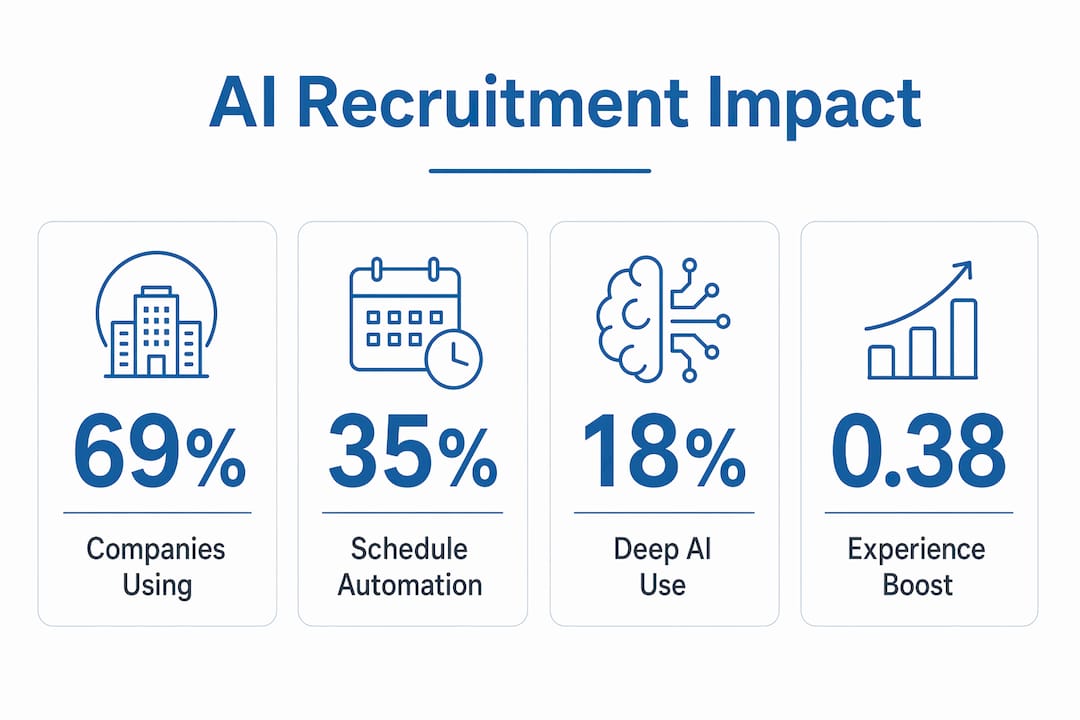
The F1000Research survey also found β = 0.38 for candidate experience improvement from AI deployment, a meaningful but smaller effect than efficiency gains. This suggests AI improves candidate experience as a secondary benefit of faster, more consistent communication, not as a primary design outcome.
What Are the Main AI Recruitment Tools and Their Practical Uses?
The artificial intelligence recruitment tools currently in use span several functional categories. Each addresses a different stage of the hiring funnel.
| Tool Category | Primary Function | Deployment Stage |
|---|---|---|
| Resume parsers and rankers | Extract structured data from applications and score against job criteria | Application review |
| LLM-generated evaluations | Produce interview question sets, candidate summaries, and evaluation narratives | Screening and interview |
| Scheduling automation bots | Coordinate interview times across calendars without human coordination | Interview scheduling |
| Chatbots and candidate messaging | Deliver status updates, answer FAQs, and collect pre-screening responses | Throughout the process |
| Agentic AI integrations | Autonomously execute multi-step tasks across platforms with minimal human input | Emerging / pilot stage |
Scheduling automation leads actual deployment at scale. The State of AI Recruiting 2026 report from Recruiting Tech Reviews found that scheduling automation reaches more than 50% requisition coverage at 35% of companies surveyed, making it the most broadly scaled AI category in recruiting today. Everything else, including resume ranking and LLM-generated evaluations, still operates primarily in pilot or partial-use mode.
LLMs represent the most consequential and least understood category. Research published in Frontiers in Artificial Intelligence found that LLMs shape evaluators’ framing of candidates, not just the outputs they produce. When an LLM generates a candidate summary, it influences how the human reviewer interprets the underlying information. That is a significant accountability consideration, not just a technical feature.
Platforms like LocateHire combine candidate communication automation with scheduling features, representing the integrated approach that delivers the most measurable ROI. The key distinction between tools that deliver value and those that do not is integration depth, which is covered in the adoption section below.
Which Tools Do Teams Actually Use?
Names help more than categories. Conversational agents like Paradox handle screening questions and interview scheduling in high-volume hiring. HireVue and similar platforms run structured video assessments. Eightfold and SeekOut sit in the talent-intelligence lane — sourcing, matching, and internal mobility. The big ATS platforms (Workday, Greenhouse, iCIMS) now ship AI features inside the systems teams already run, and LinkedIn Recruiter’s AI search has become the default first stop for sourcing. General assistants — ChatGPT, Claude, Gemini — show up most in job-description drafting and outreach personalization.
The pattern across all of them: AI compresses the top of the funnel. The judgment calls — final interviews, offers, culture reads — stay human, and the vendors themselves say so.
What Are the Challenges and Limitations of AI in Recruitment?
The impact of AI on hiring is not uniformly positive. Three categories of limitation consistently appear in 2026 research: bias, transparency, and scaling gaps.
Bias and fairness. AI systems trained on historical hiring data replicate the patterns in that data. The F1000Research study notes that bias mitigation impact is modest at best, and AI can amplify historical biases when training data reflects past discriminatory patterns. Resume parsers that learn from previous hires at a company will favor candidates who resemble those hires, which may exclude qualified candidates from underrepresented groups.
Transparency and trust. When a recruiter cannot explain why an AI ranked one candidate above another, the decision becomes difficult to defend. This is not just an ethical concern. It is a legal exposure. Without explainability built into the tool, governance becomes reactive rather than proactive.
Scaling gaps. Only 38% of talent acquisition teams have any single AI category running at meaningful scale. Most organizations are running pilots or partial deployments that deliver inconsistent results. The ICIMS data reinforces this: 58% of HR leaders report being unclear about the difference between AI and basic automation, which means many teams cannot accurately assess what they are actually deploying.
Additional limitations include:
- Siloed AI tools that do not integrate with existing ATS platforms, creating data fragmentation and duplicate work.
- Poor data quality feeding AI models, which produces unreliable candidate rankings and screening outputs.
- Over-automation of sensitive decision points, such as final-round candidate selection, where human judgment is both legally and ethically required.
Pro Tip: Run a bias audit on your AI screening tool’s output quarterly. Compare the demographic profile of AI-shortlisted candidates against your applicant pool. If the shortlist is systematically narrower than the pool, your model needs recalibration.
What Compliance and Ethical Obligations Apply to AI in Hiring?
Compliance is not optional for organizations using AI in hiring decisions. The regulatory environment has moved faster than most HR teams realize.
-
Understand the EU AI Act classification. The EU AI Act classifies AI hiring tools as high-risk systems under Annex III. This triggers mandatory human oversight, transparency documentation, and conformity assessments before deployment. Financial penalties for non-compliance are substantial. Even organizations outside the EU are affected if they hire EU-based candidates.
-
Apply the OECD responsible AI framework. The OECD’s 2026 guidance outlines five principles for trustworthy AI: safety, fairness, transparency, robustness, and accountability. These are not aspirational. They are the operational design criteria your AI governance framework should be built around.
-
Build human-in-the-loop checkpoints. Every consequential hiring decision, including shortlisting, interview selection, and offer approval, requires a human reviewer who can explain and defend the outcome. AI-generated outputs, including LLM candidate summaries, must be treated as inputs to human judgment, not as final determinations.
-
Document AI decision logic. Maintain records of which AI tools are used at each stage, what criteria they apply, and how outputs are reviewed. This documentation is required under the EU AI Act and is good practice regardless of jurisdiction.
-
Conduct regular audits. Compliance is not a one-time checklist. Audit AI outputs for disparate impact, review model performance against hiring outcomes, and update governance documentation as tools evolve.
The Frontiers in Artificial Intelligence research reinforces why this matters: LLM-produced artifacts become part of the hiring record and shape accountability. If those artifacts are not reviewed and documented, they create legal exposure without the organization even recognizing it.
How Can HR Teams Successfully Integrate AI into Their Workflows?
Effective AI adoption in recruiting requires a structured approach. The organizations that realize measurable ROI share several operational practices.
Prioritize integrated platforms over point solutions. Siloed AI tools that do not connect to your ATS create integration failures that reduce efficiency and undermine data quality. A scheduling bot that does not sync with your ATS creates manual reconciliation work that erases the time savings. Choose platforms that connect natively with your existing stack.
Validate ATS integration before full deployment. Test AI tools against a subset of requisitions before scaling. Measure time-to-fill, shortlist quality, and candidate drop-off rates during the pilot. If the numbers do not improve, the tool is not ready for broader use.
Invest in data governance. AI systems require good data to produce reliable outputs. Audit your candidate database for completeness and accuracy before deploying AI screening tools. Garbage in, garbage out applies directly to candidate ranking algorithms.
Keep human judgment central. IBM’s guidance is explicit: over-automation harms candidate interactions and reduces the quality of nuanced decisions. Use AI to handle volume and consistency, and reserve recruiter time for relationship-building, offer negotiation, and final selection.
Use AI to improve shortlisting, not replace it. The guide to shortlisting applicants at Careerscape outlines how structured criteria and consistent evaluation frameworks work alongside AI tools to produce better candidate slates. AI accelerates the process; the recruiter validates the output.
The future of AI in recruitment belongs to organizations that treat it as an augmentation tool, not a replacement strategy. Teams that combine AI-driven efficiency with experienced recruiter judgment consistently outperform those that automate without oversight.
Key Takeaways
AI in recruitment delivers measurable efficiency gains when deployed on high-volume, rules-based tasks, but requires human oversight, integrated platforms, and rigorous data governance to produce reliable, compliant outcomes.
| Point | Details |
|---|---|
| Adoption is wide but shallow | 69% of companies use AI in hiring, yet only 18% deploy it broadly across workflows. |
| Efficiency gains are real and measurable | A survey of 423 HR professionals found a β = 0.61 efficiency improvement from AI deployment. |
| Scheduling automation leads at scale | Only 35% of companies run scheduling automation at meaningful scale; other AI categories lag further behind. |
| Compliance is mandatory, not optional | The EU AI Act classifies hiring AI as high-risk, requiring human oversight and documentation before deployment. |
| Data quality determines AI quality | Poor data governance is a more common barrier to AI ROI than tool capability. |
Where I Stand on AI and Recruiter Judgment
I have watched organizations deploy AI in their hiring processes with genuine enthusiasm, and I have watched the same organizations quietly walk back those deployments two quarters later. The pattern is consistent. The tool was real. The integration was not.
The most common mistake I see is treating AI adoption as a technology decision rather than an operational one. A resume parser is only as useful as the job description it is matching against. A scheduling bot only saves time if it connects cleanly to your ATS and calendar system. When those conditions are not met, the tool creates work instead of eliminating it.
What I find more concerning is the tendency to over-automate at sensitive decision points. Shortlisting is one thing. But I have seen teams use AI-generated candidate summaries as the primary basis for interview decisions, with no human review of the underlying application. That is not efficiency. That is abdication. The LLM is shaping how the evaluator thinks about the candidate, and nobody is checking the framing.
The organizations getting this right treat AI the way a good analyst treats a model: as a starting point for judgment, not a substitute for it. They validate outputs, audit for bias, and keep experienced recruiters in the loop on every decision that matters. That is not a limitation of AI. That is how you use it responsibly.
The future of AI in recruiting is not fully automated hiring. It is faster, more consistent hiring where recruiters spend their time on the work that actually requires them.
— Chris
How Careerscape Uses AI to Support Smarter Hiring
Careerscape combines AI-enhanced sourcing and screening with experienced industry recruiters to deliver faster, more accurate candidate matches. The firm’s contract staffing solutions apply structured screening criteria and automated candidate communication to reduce time-to-fill without sacrificing candidate quality. For organizations looking to scale hiring quickly or fill specialized roles, Careerscape also offers direct hire staffing services backed by industry-specific recruiter expertise. If your team is navigating AI adoption in talent acquisition and needs a staffing partner who understands both the technology and the human side of hiring, Careerscape is built for exactly that.
FAQ
What Is the Primary Role of AI in Recruitment?
AI in recruitment automates high-volume, rules-based tasks such as resume screening, interview scheduling, and candidate communications, while supporting recruiter decision-making through structured data and evaluation tools. It is a decision-support layer, not a decision-maker.
Does AI in Hiring Reduce Bias?
AI can reduce certain forms of inconsistency in screening, but research shows bias mitigation impact is modest and AI can amplify historical biases when trained on past hiring data. Regular audits and human oversight are required to manage this risk.
What AI Recruitment Tools Are Most Widely Deployed?
Scheduling automation is the most broadly scaled AI category in recruiting, with 35% of companies running it at meaningful scale according to Recruiting Tech Reviews. Resume parsers and LLM-generated evaluations are more commonly in pilot or partial-use stages.
Is AI in Hiring Subject to Legal Compliance Requirements?
The EU AI Act classifies AI hiring tools as high-risk systems, requiring human oversight, transparency documentation, and conformity assessments before deployment. Organizations hiring EU-based candidates are subject to these obligations regardless of where they are headquartered.
How Many Companies Currently Use AI in Talent Acquisition?
According to ICIMS, 69% of companies use AI in talent acquisition in some form as of 2026, but only 18% deploy it broadly across their hiring workflows, indicating a significant gap between adoption and scaled integration.
Recommended
- What is recruiting? The employer’s guide to modern hiring
- Job Posting Optimization: A 2026 Recruiter’s Guide
- Types of recruitment agencies: A smarter hiring guide