
Talent mapping is a proactive market intelligence discipline that identifies and tracks named external candidates for critical roles over a 6-to-18-month horizon, producing structured outputs like compensation benchmarks, skills supply views, and tiered candidate pipelines — not merely a static list of prospects. The process requires assessing internal workforce gaps before researching external markets, maintaining continuous map updates, and focusing on a narrow set of 5-10 high-priority roles to remain actionable. Organizations that practice continuous talent mapping report 38% shorter time-to-fill on critical roles and gain strategic advantages in succession planning, proactive compensation benchmarking, and stronger alignment between HR and business leadership.
In this article
Talent mapping is one of the most misunderstood practices in workforce planning. Many HR professionals treat it as a recruiting shortcut or a static spreadsheet of candidates. In reality, talent mapping is a proactive market intelligence discipline: it researches and documents external talent markets for specific roles over a 6-to-18-month horizon, producing a structured view of named individuals, target companies, compensation benchmarks, and skills supply. Done right, it transforms how organizations connect business strategy to hiring execution and answers a question most HR teams never get ahead of: who are we going to hire before we need to hire them?
Key Takeaways
| Point | Details |
|---|---|
| Talent mapping is proactive intelligence | It identifies named candidates and market trends before a role opens, not after. |
| Living maps outperform static lists | Maps must be refreshed continuously to remain actionable; stale data leads to missed hires. |
| Focus beats breadth | Covering 5-10 critical roles produces more results than building a broad, unmanageable map. |
| Internal assessment comes first | Skills inventories and performance data must precede external market research to prioritize build vs. buy decisions. |
| Benefits are measurable | Organizations using continuous talent mapping report 38% shorter time-to-fill on critical roles. |
What Talent Mapping Actually Is (and What It Isn’t)
Talent mapping, sometimes called competitive talent intelligence or proactive sourcing, is the structured practice of identifying, researching, and tracking external talent pools for roles that are critical to your organization’s future. According to Klearskill, the three core inputs are workforce plans, market intelligence from platforms like LinkedIn and Glassdoor, and passive candidate conversations. The outputs go well beyond a list of names: they include compensation summaries, skills supply views, target company catalogs, and warm contacts already familiar with your employer brand.
This is where many teams lose the thread. Talent mapping is not the same as what is talent management, workforce planning, or traditional recruitment. Each plays a distinct role.
| Practice | Time Horizon | Focus | Primary Output |
|---|---|---|---|
| Workforce planning | 2-5 years | Business-level headcount and structure | Staffing models, budget projections |
| Talent mapping | 6-18 months | Market intelligence for specific roles | Named targets, compensation benchmarks |
| Traditional recruitment | Immediate | Fill open requisitions | Hired candidates |
| Talent management | Ongoing | Internal development and retention | Career paths, succession plans |
Workforce planning without talent mapping is a wish list. Talent mapping without workforce planning is research without a customer. They are designed to work together, and organizations that treat them as the same function consistently underperform on both.
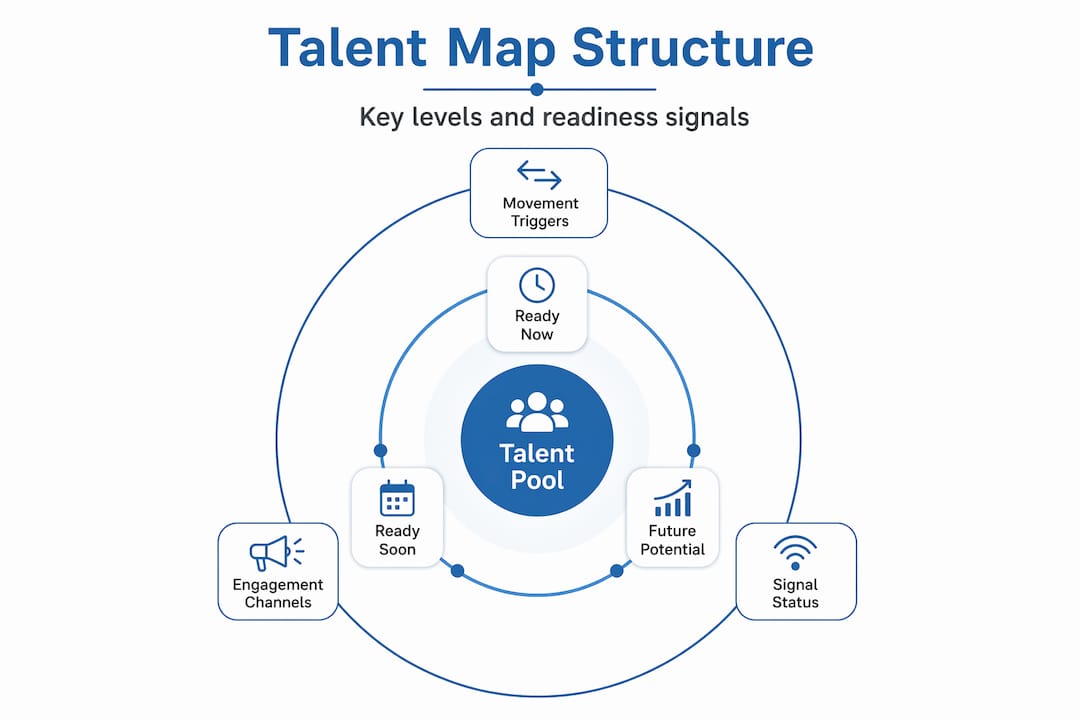
A real talent map names individuals with readiness signals, indicating likely movement triggers and the right engagement approach for each person. That specificity is what makes it directly usable the moment a requisition opens, rather than forcing a team to start research from scratch under deadline pressure.
The Talent Mapping Process, Step by Step
A well-executed talent mapping process follows a clear sequence. Indeed’s five-step framework emphasizes connecting talent maps to hiring processes and ongoing review cycles. Here is how to put that into practice:
-
Identify critical roles and required skills. Start with roles that directly affect operations, revenue, or leadership continuity. Tie each role to a specific business objective. This prevents scope creep and grounds your map in strategic priority.
-
Assess your current internal workforce. Before mapping externally, conduct a skills inventory and review performance data. Internal capability assessments must precede external market mapping to prioritize development versus acquisition thoughtfully.
-
Identify gaps between current state and future needs. Compare what you have today against the skills and capacity your business strategy demands over the next one to two years. Document whether each gap is better addressed through upskilling, internal mobility, or external hiring.
-
Research external talent markets. Build a target company list of 20 to 40 organizations per role where your ideal candidates are likely to work. Use LinkedIn, industry associations, compensation surveys, and direct conversations with passive candidates to build your intelligence base.
-
Build and categorize a candidate pipeline. Living talent maps segmented by readiness tiers such as engaged, warm, cold, and aspirational outperform static lists by enabling targeted engagement and faster hiring. Assign each named candidate to a tier and document their likely movement triggers.
-
Maintain a refresh cadence. A talent map is not a project. It is an ongoing process. Continuous refresh and integrated systems ownership are key success factors for sustaining map value over time. Set quarterly reviews at minimum, with monthly updates for high-priority roles.
Pro Tip: Start your talent mapping effort with one critical role before expanding. Starting with a single role creates a manageable, repeatable process that ties naturally to workforce planning and development loops — and it builds internal credibility for the practice.
Understanding the talent market dynamics for each role you map will sharpen your intelligence significantly. Knowing where talent clusters, which companies are losing headcount, and what compensation is moving in real time turns your map from a list into a decision-making tool.

Talent Mapping vs. Candidate Mapping
The two get used interchangeably, but the scope differs. Candidate mapping is the recruiter’s exercise: charting who holds the target role at competitor companies — names, titles, reporting lines — so outreach is ready the day a search opens. Talent mapping is the wider organizational discipline: mapping internal capabilities and external market supply against where the business is heading. Candidate mapping feeds a single search; talent mapping feeds workforce planning. If a vendor pitches you “talent mapping” and delivers a spreadsheet of competitor org charts, you bought candidate mapping.
Benefits of Talent Mapping for HR and Organizational Leaders
The most direct benefit is speed. Organizations that maintain continuous talent maps experience 38% shorter time-to-fill on critical roles compared to those that do not. When you already know who the best candidates are and have a warm relationship with several of them, the hiring process shortens from months to weeks.
Beyond speed, the benefits of talent mapping include:
- Succession planning support. Mapping identifies external successors for leadership roles before a vacancy creates a crisis. Combined with internal succession planning, it gives you both a build and buy option for every critical seat.
- Proactive skill gap management. By comparing internal capability data against external supply, you can decide whether to train existing employees or recruit externally before the gap becomes urgent.
- Improved candidate quality. Candidates who have been nurtured through a pipeline over months arrive at the interview stage with context about your organization. That familiarity improves both the candidate experience and offer acceptance rates.
- Compensation and retention intelligence. External market data from your mapping process reveals what competitors are paying. This allows HR leaders to adjust compensation bands proactively rather than reactively when key employees start receiving outside offers.
- Stronger alignment between HR and business leadership. When HR can demonstrate a named pipeline of candidates for the company’s five most critical roles, the conversation shifts from “we’re working on it” to “here’s what we have and here’s our timeline.” That shift in credibility changes how HR is perceived at the leadership level.
OysterHR notes that talent mapping connects business priorities to workforce and succession planning by reviewing internal skills, forecasting needs, and evaluating external talent to build a pipeline over time. Organizations that do this well reduce reliance on reactive hiring, which consistently produces higher cost-per-hire and lower quality outcomes.
Common Pitfalls and How to Avoid Them
Most talent mapping efforts fail not because the concept is wrong, but because execution misses a few critical details. Here are the mistakes worth knowing before you start:
- Mapping too broadly. Focused scope on 5-10 critical roles and 20 to 40 target companies per role yields results. Larger maps become unmanageable due to outreach, verification, and pipeline warming constraints. More names do not mean more hires.
- Treating it as a one-time project. A talent map completed in Q1 and untouched until Q4 has already decayed. People change jobs, get promoted, or leave the market entirely. Stale data is worse than no data because it creates false confidence.
- Skipping the internal assessment. External mapping without an internal skills inventory leads to hiring roles you could have developed internally. That wastes budget and misses a retention opportunity.
- Confusing it with ATS reports. Your applicant tracking system captures candidates who applied to you. Talent mapping captures the people who never will unless you reach out first. These are fundamentally different populations, and the highest-value candidates are almost always in the second group.
- Building maps that don’t connect to action. Without careful scope and segmentation, talent maps become informational but not actionable due to resource bottlenecks in candidate outreach and pipeline warming. Every entry in your map should have a next action assigned.
Pro Tip: Assign a CRM owner for your talent map data and define a refresh rhythm before you start building. Integrated workflows and defined refresh cycles are consistently underestimated success factors for sustaining map value over time.
Using Talent Mapping to Strengthen Workforce and Development Strategy
Once you have a functioning talent map, the data serves multiple strategic functions beyond filling open roles. Here is how HR leaders and organizational executives can apply the intelligence:
- Internal succession planning. Your map reveals not just external successors but also exposes gaps in your internal bench. If no internal candidate is within 12 months of readiness for a critical role, that is a development planning trigger.
- Career path alignment. External market data shows what skills the next generation of talent in a given function holds. You can use that information to shape learning and development programs that keep internal employees competitive and engaged.
- Compensation strategy. Real-time market intelligence from your mapping activity tells you where your offers stand relative to competitors. Adjusting bands before turnover spikes is far less expensive than responding after top performers leave.
- Strategic hiring decisions. When a business unit wants to expand into a new market or capability, talent mapping tells you whether the external supply of relevant skills is sufficient, scarce, or concentrated in specific geographies or companies. That intelligence shapes the business case, not just the hiring plan.
- Performance management integration. Combining internal performance data with external supply intelligence helps you prioritize retention investment. If a high-performer holds a skill set that is scarce in the external market, they deserve differentiated retention attention.
Connecting talent mapping data to your broader staffing best practices creates a feedback loop where each hire, each promotion, and each departure sharpens your understanding of both your workforce and the market around it.
My Perspective on Talent Mapping’s Real Value
I’ve watched organizations invest significant time and money in talent mapping programs that produced beautiful spreadsheets and absolutely no hires. The failure was almost never in the research. It was in treating the map as the destination rather than the tool.
The teams that use talent mapping most effectively are the ones who treat it like a sales pipeline, not a research report. They know who is in each stage, what the next touch point is, and who owns the relationship. They also stay ruthlessly focused on critical roles. I’ve seen HR leaders try to map every position in their organization and collapse under the weight of it within three months.
What I’ve learned is that the real value of talent mapping isn’t in the data. It’s in the conversations that happen when HR walks into a leadership meeting and says, “We have three qualified, warm candidates for the VP of Engineering role if we need to move in the next 90 days.” That sentence changes everything about how the business thinks of HR. It moves the function from reactive support to strategic partner, which is where it belongs.
The integration challenge is real, but it’s manageable. Start small, stay focused, and build the discipline of continuous refresh before you scale the scope.
— Chris
How Careerscape Supports Your Talent Mapping Strategy
Talent mapping gives you the intelligence. Careerscape gives you the execution capacity to act on it. Careerscape is a staffing and recruiting firm built to make hiring fast, honest, and backed by people who understand your industry. Whether you need contract staffing solutions to fill short-term skill gaps identified through your mapping process, or project-based staffing for expansion initiatives informed by market data, Careerscape’s teams bring the market intelligence and candidate relationships to move quickly.
Careerscape’s technology and IT recruiters operate across 29 U.S. markets with deep knowledge of local talent supply, compensation benchmarks, and competitor hiring activity. That same intelligence directly complements the proactive hiring strategies your talent mapping work is designed to support. If your organization is ready to act on your workforce planning data, connect with Careerscape to discuss tailored workforce solutions built around your priorities.
FAQ
What Is Talent Mapping in Simple Terms?
Talent mapping is the practice of proactively researching and tracking external candidates for critical roles before those positions open. It produces a structured pipeline of named individuals organized by readiness, compensation data, and skills intelligence.
How Does Talent Mapping Differ from Recruiting?
Traditional recruiting is reactive: it starts when a role opens. Talent mapping is proactive, building candidate relationships and market intelligence over 6 to 18 months so hiring moves faster when the need arises.
How Often Should a Talent Map Be Updated?
A talent map should be refreshed at minimum quarterly, with monthly updates for the highest-priority roles. Static maps decay rapidly as candidates change jobs, compensation shifts, and business priorities evolve.
How Many Roles Should a Talent Map Cover?
Research points to 5 to 10 critical roles as the right scope for most organizations. Covering more than that dilutes the depth and actionability of each individual map segment.
What Tools Are Used in the Talent Mapping Process?
Most teams use LinkedIn Recruiter, Glassdoor, and their ATS as primary data sources, supplemented by direct candidate conversations. CRM platforms are increasingly used to manage pipeline stages, readiness tiers, and outreach cadences across named candidates.