
Predictive hiring utilizes data analytics and machine learning to identify candidates likely to succeed in specific roles, significantly improving hiring efficiency and accuracy. Organizations employing this method experience reduced time-to-hire (from 35–45 days to 10–14 days), lower costs-per-hire (by 30–50%), and decreased first-year turnover (by 25–39%). To implement predictive hiring effectively, companies must gather historical data, define success metrics, maintain human oversight in decision-making, and continuously feed performance data back into the model for ongoing improvement.
In this article
Predictive hiring is the use of data analytics and machine learning to forecast which candidates will succeed in a role before a hiring decision is made. It replaces gut-feel selection with a structured, evidence-based process that analyzes historical hiring data, assessment results, and on-the-job performance records. Organizations using this approach report 40–70% reductions in time-to-hire, cutting average hiring timelines from 35–45 days down to 10–14 days. For hiring managers under pressure to fill roles faster and smarter, understanding predictive hiring is no longer optional. It is the foundation of a modern, high-performance talent acquisition strategy.

What Is Predictive Hiring and How Does It Work?
Predictive hiring is a data-driven recruitment method that uses statistical modeling and machine learning to score candidates on their likelihood of succeeding in a specific role. The industry also refers to this approach as predictive analytics in recruitment, a term rooted in industrial-organizational (I-O) psychology and workforce science. The process follows a clear sequence, and each step builds on the last.
-
Data collection. The model ingests inputs from multiple sources: resumes, structured assessment scores, cognitive ability test results, past performance ratings, and retention records. The richer the historical dataset, the more accurate the model becomes.
-
Success profile creation. Analysts identify the traits, skills, and behaviors that top performers in a given role share. This profile becomes the benchmark against which all candidates are measured.
-
Model training and validation. A machine learning algorithm trains on historical hiring and performance data. It learns which candidate attributes correlate with strong 90-day ramp times, 12-month retention rates, and high performance review scores.
-
Candidate scoring. Each applicant receives a predictive fit score based on how closely their profile matches the success benchmark. Hiring managers use this score to prioritize interviews and focus attention on the strongest candidates.
-
Continuous feedback loops. After each hire, real-world performance data feeds back into the model. Predictive models improve accuracy with every hiring cycle, creating a compounding advantage over time.
Pro Tip: Define your success metrics before you build the model. Clear outcome targets, such as 90-day ramp speed or 12-month retention rate, produce far more accurate predictions than starting with data and working backward.
What Are the Key Benefits of Predictive Hiring for Employers?
The measurable gains from predictive analytics in recruitment are well-documented, and they affect every major hiring metric that matters to your bottom line.
-
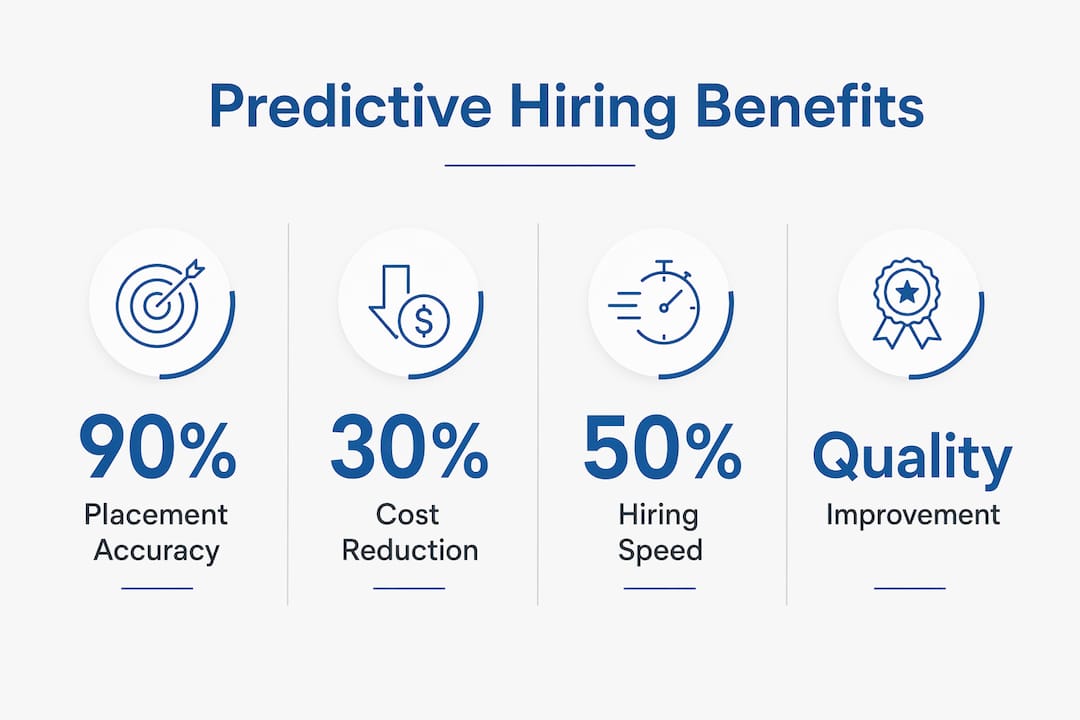
Reduced time-to-hire. Organizations report time-to-hire dropping from an average of 35–45 days to just 10–14 days. Faster hiring means fewer lost candidates and less productivity drag from open roles.
-
Lower cost-per-hire. Predictive hiring reduces cost-per-hire by 30–50%, bringing the average down from roughly $4,700 to between $1,500 and $2,500 per hire. That savings compounds quickly across high-volume hiring programs.
-
Significantly lower first-year turnover. Companies using predictive methods report 25–39% lower first-year turnover compared to traditional hiring. Turnover is one of the most expensive problems in talent acquisition, so this reduction alone often justifies the investment.
-
Faster productivity ramp. Employees hired through predictive processes reach productivity benchmarks 40% faster and score 20–30% higher on performance reviews than those hired through traditional methods.
-
Higher hiring accuracy. Traditional hiring methods achieve roughly 60% accuracy in candidate placement. Predictive hiring raises that accuracy to 85–90%, a difference that shows up directly in team performance and retention rates.
-
Reduced bias. Structured scoring models evaluate candidates against objective criteria rather than subjective impressions. This produces more consistent decisions and supports fairer hiring practices across demographic groups.
The combination of speed, cost savings, and quality improvement makes predictive hiring one of the highest-return investments available in modern talent acquisition. Pairing these methods with strong talent attraction strategies amplifies results further.
How Valid and Reliable Are Predictive Hiring Methods?
The scientific foundation of predictive hiring rests on criterion-related validity, which is the statistical correlation between an assessment score and actual future job performance. This correlation is expressed as a coefficient ®, where a higher value indicates stronger predictive power. Criterion-related validity is the gold standard for evaluating whether any selection tool actually predicts what it claims to predict.
Not all predictive tools are equal. Research consistently shows that structured interviews, general mental ability (GMA) tests, and work samples achieve validity coefficients around r = .5, which is considered strong in selection science. Unstructured interviews and resume reviews, by contrast, show much weaker correlations with job performance.
| Selection method | Validity ® | Practical implication |
|---|---|---|
| General mental ability (GMA) test | ~.5 | Strong predictor of learning speed and performance |
| Structured interview | ~.5 | Consistent questions yield consistent, comparable data |
| Work sample test | ~.5 | Direct measure of job-relevant skills |
| Unstructured interview | ~.2 | High variability, low predictive accuracy |
| Resume review alone | ~.1 | Weakest predictor of actual job success |
Professional standards from the Society for Industrial-Organizational Psychology (SIOP) and the American Psychological Association (APA) require that any selection tool demonstrate empirical validity before deployment. Many vendors market “predictive” tools without publishing validity data. Hiring managers should ask for criterion-related validity studies specific to their industry and role type before adopting any platform.
Pro Tip: Ask any assessment vendor for a technical manual that includes criterion-related validity coefficients. If they cannot provide one, the tool’s predictive claims are unverified.
What Does Predictive Hiring Look Like in Practice?
Concrete examples make the concept less abstract. A sales team scores structured interview answers against the traits of its current top performers and weights those criteria in the next search. A warehouse operator uses a short work-style assessment that its own two-year data shows correlates with 90-day retention, and screens on it before interviews. A software team replaces resume filtering with a scored take-home exercise because its history shows the exercise predicts pass rates in the panel far better than years of experience. And retention models flag which roles lose people fastest, so recruiting starts before the resignation letter arrives.
The common thread: each starts from the company’s own outcome data, not a vendor’s generic model — and each still ends with a human decision.
What Are Best Practices to Implement Predictive Hiring Effectively?
Implementing predictive hiring successfully requires more than purchasing a platform. The process demands careful preparation, clear goals, and ongoing governance.
-
Gather your own historical data first. The model needs your organization’s hiring and performance records to calibrate accurately. An 8–12 week baseline data collection period is standard before reliable predictions can be made. Skipping this step produces generic predictions that do not reflect your specific workforce context.
-
Define success metrics upfront. Decide what “successful hire” means before building the model. Common benchmarks include 90-day ramp time, 12-month retention, and first-year performance review scores. Clear outcome definitions produce more accurate and relevant predictions than starting with data and working backward.
-
Keep humans in the decision loop. Algorithm scores should inform decisions, not replace them. Prohibiting automatic candidate rejections based solely on a score reduces legal risk and catches edge cases the model may miss. Document every human override so the model can learn from those decisions too.
-
Build fairness guardrails into the process. Audit your model regularly for disparate impact across protected groups. Establish written policies on how scores are used, and train hiring managers on the limits of algorithmic recommendations.
-
Feed performance data back continuously. The model’s accuracy grows with every hiring cycle. Structured feedback loops, where new hire performance data returns to the model, are what separate a static screening tool from a true predictive system.
Hiring managers who want to apply these principles to candidate shortlisting will find practical frameworks in Careerscape’ applicant shortlisting guide. The guide covers how to use scoring criteria to rank candidates before the interview stage.
Key Takeaways
Predictive hiring raises placement accuracy from 60% to 85–90% by replacing subjective judgment with validated, data-driven scoring models calibrated to your organization’s own performance outcomes.
| Point | Details |
|---|---|
| Core definition | Predictive hiring uses machine learning and historical data to score candidates on likely job success. |
| Speed and cost gains | Time-to-hire drops to 10–14 days and cost-per-hire falls 30–50% compared to traditional methods. |
| Turnover reduction | First-year employee turnover decreases by 25–39% when predictive methods replace gut-feel selection. |
| Validity matters | Only tools with criterion-related validity coefficients near r = .5 deliver reliable predictive accuracy. |
| Human oversight is required | Prohibit auto-rejections and document overrides to reduce bias and improve model learning over time. |
Why I Think Most Employers Adopt Predictive Hiring Backward
After years of watching hiring decisions play out across dozens of industries, I have noticed a consistent pattern. Most employers buy a predictive hiring platform first and define their success metrics second. That sequence produces mediocre results and fuels skepticism about whether the approach works at all.
The real power of predictive analytics in recruitment comes from organizational specificity. A model trained on your top performers, your retention data, and your performance benchmarks will outperform any generic industry model. The talent market has outpaced what human recruiters can process manually, and algorithmic support is now necessary. But the algorithm is only as good as the data and goals you feed it.
My honest view is that predictive hiring is not a replacement for experienced recruiters. It is a force multiplier. The best outcomes I have seen come from teams that combine structured assessment scores with recruiter judgment, not from teams that hand the decision entirely to the model. Transparency matters too. Candidates and hiring managers both need to understand why a score was generated, not just what it says.
The future of this field belongs to organizations that treat predictive models as living systems, not one-time implementations. Feed them, audit them, and challenge them regularly. That discipline is what separates employers who see lasting gains from those who run a pilot and walk away disappointed.
— Bradford
How Careerscape Applies Data-Driven Hiring for Employers
Careerscape builds every search on the principle that hiring should be fast, honest, and grounded in real industry knowledge. The firm applies data-driven candidate evaluation across its professional services staffing and contract staffing practices, using structured screening criteria and performance benchmarks to match qualified professionals with employers who are ready to hire. Whether you need direct placement or flexible staffing, Careerscape brings the analytical rigor of predictive hiring to every engagement. Hiring managers who want faster placements and stronger retention outcomes can request talent directly and connect with a recruiter who understands their industry.
FAQ
What Is Predictive Hiring in Simple Terms?
Predictive hiring is the use of data, assessments, and machine learning to forecast which job candidates are most likely to succeed before you make a hiring decision. It replaces subjective judgment with scored, evidence-based candidate evaluation.
How Accurate Is Predictive Hiring Compared to Traditional Methods?
Traditional hiring methods achieve roughly 60% placement accuracy, while predictive hiring raises that figure to 85–90%. The improvement comes from validated assessment tools and models trained on real organizational performance data.
How Long Does It Take to Implement Predictive Hiring?
Most organizations require an 8–12 week baseline data collection period to calibrate a predictive model to their specific workforce context before it can generate reliable candidate scores.
What Selection Tools Have the Strongest Predictive Validity?
General mental ability tests, structured interviews, and work sample tests each achieve validity coefficients around r = .5, making them the strongest predictors of job performance according to I-O psychology research.
Does Predictive Hiring Eliminate Bias in Recruitment?
Predictive hiring reduces bias by applying consistent, objective scoring criteria, but it does not eliminate bias automatically. Models trained on biased historical data can reproduce those patterns, which is why regular fairness audits and human oversight are required.