
An effective intake meeting for hiring teams should last 30 to 45 minutes and conclude with a signed brief, draft scorecard, and a scheduled calibration review. Preparation is key, requiring detailed job descriptions and sample profiles to guide focused discussions, while a structured agenda ensures clear outcomes on role context, candidate criteria, and decision-making processes. Confirming agreements within 24 hours solidifies the groundwork for sourcing candidates and minimizes delays.
- An effective intake meeting should be completed within 30 to 45 minutes, resulting in a signed brief, draft scorecard, and a calibration review scheduled immediately.
- Preparation, including sending detailed job descriptions, sample profiles, and templates in advance, is crucial for a focused and efficient discussion.
- Structuring the agenda into time blocks ensures clear outcomes such as role context, profile criteria, scorecard draft, process details, and calibration booking, often extending for complex roles.
- Asking targeted questions eliminates key risks, including clarifying the role’s purpose, success criteria, candidate requirements, decision-making chain, and past red flags.
- Confirming the brief and calibration slot within 24 hours prevents delays and creates a clear, defendable groundwork for sourcing and decision-making.
In this article
Run the intake meeting in 30 to 45 minutes and leave with three artifacts: a signed one-page brief, a draft scorecard, and a booked calibration review. Copy this into your next calendar invite: “30 to 45 minutes; arrive with the job description and sample profiles; leave with a signed one-page brief, draft scorecard, and a calibration slot.” Everything below builds out that structure step by step.
What an intake meeting is and why it matters
An intake meeting is the alignment conversation recruiters hold with a hiring manager before sourcing begins. It exists to settle three things: what the role actually needs to accomplish, how candidates will be evaluated, and what the process and cadence will look like from screen to offer. Skip it, and you end up sourcing against assumptions instead of agreements.
The EEOC’s guidance on employment tests and selection procedures notes that interviews and other selection tools should be job-related and consistent with business necessity, with structured formats and standardized scoring supporting objective decisions. An intake meeting is where that structure gets built, before a single résumé is reviewed.
The meeting typically covers:
- The business reason the role exists and what success looks like in the first 90 days
- The must-have versus nice-to-have qualifications, ranked rather than listed flat
- Who makes the final call, who else weighs in, and what the interview stages will be
Benefits of running a structured intake
A structured intake produces shortlists that match what the hiring manager actually wants, which cuts down on the back-and-forth that stalls a search. When criteria are agreed up front, recruiters stop guessing at seniority level or must-have skills, and hiring managers stop rejecting candidates for reasons nobody wrote down.
There is also a compliance dimension. The Uniform Guidelines Q&A explains that consistent, job-related selection procedures reduce disparate impact risk and make hiring decisions easier to defend. An intake meeting that produces a written brief and scorecard gives you exactly that paper trail.
Across 3,511 intake calls in one recruiting corpus, the mean length was 35.3 minutes, which means a 30-minute agenda is a reasonable budget but one that commonly runs a bit long, particularly on unfamiliar or senior roles.
Structured intake also delivers:
- Fewer reworked shortlists because criteria are agreed before sourcing starts
- Predictable timelines, since process and cadence are set in the same meeting
- Stronger stakeholder buy-in, because the hiring manager helped write the criteria
How to prepare: pre-reads, attendees, and technical setup
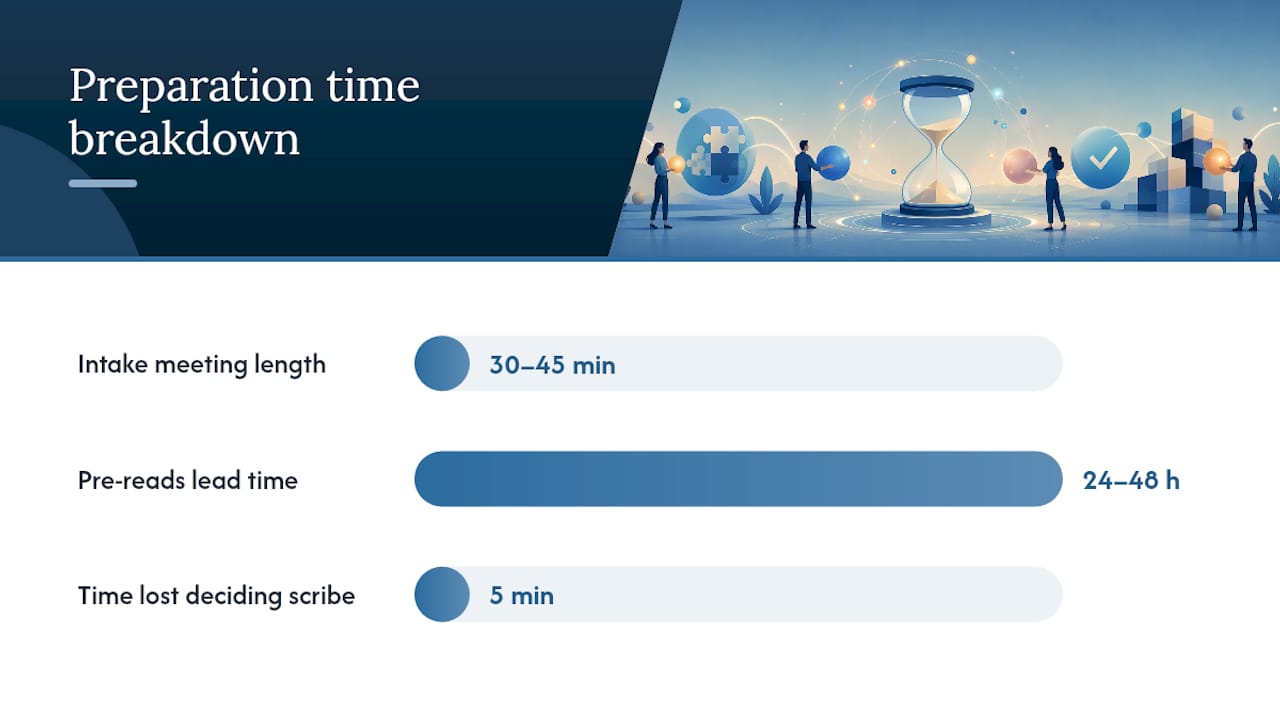
Preparation determines whether the 30 to 45 minutes gets used for decisions or for catching people up. SHRM recommends recruiters arrive with market research already done and qualifications narrowed to the essentials, rather than working that out live in the room.
- Send the annotated job description 24 to 48 hours ahead, with notes on which requirements are firm and which are negotiable.
- Attach two or three sample profiles at different seniority levels so the hiring manager reacts to real candidates instead of abstract criteria.
- Draft the brief template and question list in advance and share it, so the meeting starts with review instead of composition.
- Confirm attendees: the hiring manager, the final decision-maker if different, one panel representative for complex roles, and a notetaker.
- Set up a shared document before the call starts, with calendar holds already blocked so calibration can be scheduled on the spot.
Reacting to real profiles surfaces level and skill mismatches faster than talking through a requirements list in the abstract, a point echoed in guidance on structuring intake meetings to prevent search failure. For background on where these candidates come from, see this overview of modern recruiting and hiring processes.
Pro Tip: Name one person to own the shared notes document before the meeting starts, so nobody spends the first five minutes deciding who is typing.
Time-block agenda for a 30 to 45 minute intake
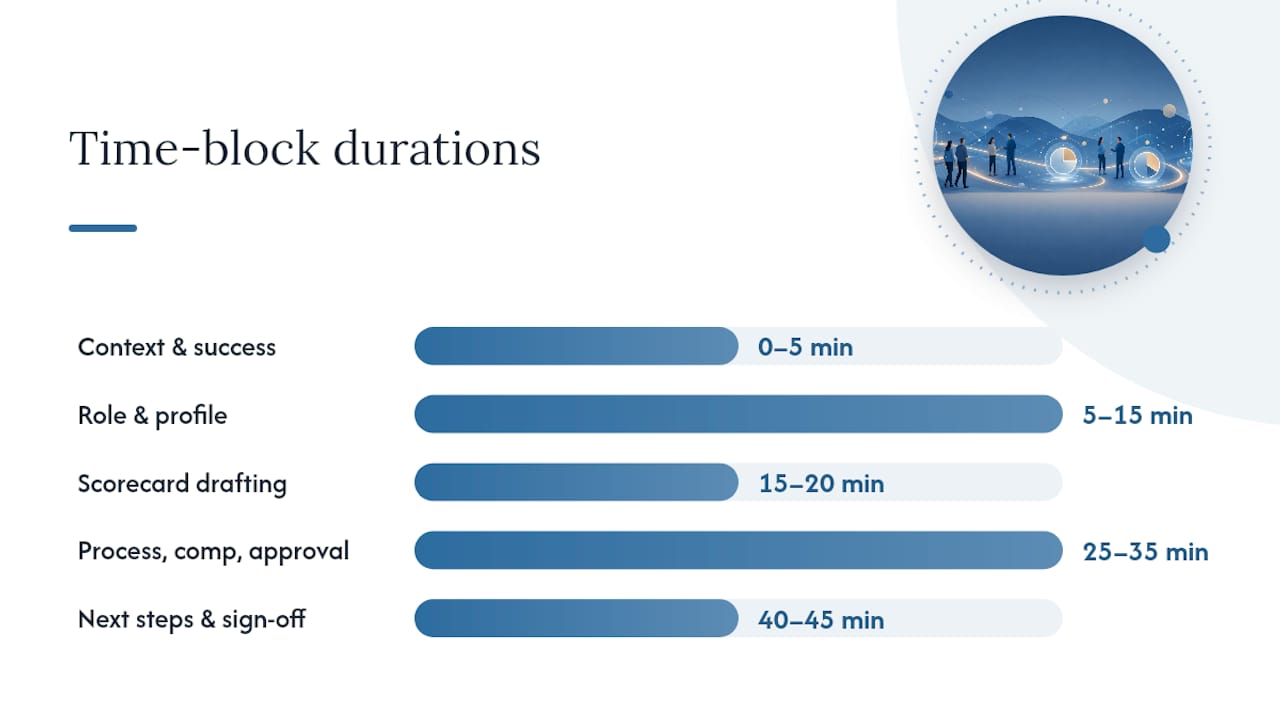
A time-blocked agenda keeps the meeting moving and guarantees each section produces something you can use afterward, rather than just conversation.
| Minutes | Segment | Output |
|---|---|---|
| 0 to 5 | Context and success definition | Written statement of why the role exists and what success looks like at 90 days |
| 5-15 | Role and candidate profile | Ranked must-haves versus nice-to-haves, agreed seniority level |
| 15 to 20 | Scorecard drafting | Draft scorecard with observable criteria tagged to interview stages |
| 25 to 35 | Process, compensation, and approval | Confirmed comp range, approval chain, and interview stage count |
| 35.3 | Calibration booking | Calendar hold for a calibration review with sample profiles |
| 40 to 45 | Next steps and sign-off | Verbal agreement on brief content and sourcing start date |
For senior or unfamiliar roles, extend the profile and scorecard blocks rather than the whole meeting. A vice president search or a role in an unfamiliar function usually needs more time on must-have versus nice-to-have trade-offs, since those are the areas most likely to be guessed rather than decided. One practical model treats the meeting as the first of two conversations for complex roles: use the intake to name what’s settled and what’s still open, then book a short follow-up to close the gaps instead of forcing a decision that isn’t ready.
If a decision can’t be reached inside its block, don’t let the whole agenda slip. Note it as open, assign an owner, and book a 15-minute follow-up rather than letting an unresolved comp question eat the calibration slot. A three-column format, tracking what’s agreed, what’s still open, and who owns the follow-up, prevents later arguments about whether a requirement was actually decided or just floated.
For roles that will also run through a client-signed agreement, protecting the commercial terms block early avoids sourcing against a deal that never closes, a practice detailed in agenda guidance for agency intake meetings.
Question bank grouped by the risk each question removes
Every intake question exists to remove a specific risk. Organizing the question bank this way makes it obvious what a vague answer actually costs you.
- Role and context risk: “Why is this role open, and why now?” A vague answer usually means the business case hasn’t been thought through, which will surface later as scope creep.
- First-90-days risk: “What does this person need to have accomplished by day 90?” Silence here means there’s no way to write a meaningful scorecard.
- Must-have versus nice-to-have risk: “If a great candidate is missing one requirement, which one can we flex on?” A refusal to rank anything means every requirement will later be treated as non-negotiable.
- Compensation and approval risk: “What’s the approved range, and who signs off on an offer above midpoint?” No answer here means an offer can stall at the finish line.
- Decision-maker risk: “Who makes the final call, and who else needs to weigh in?” An unclear chain means feedback loops multiply during the search.
- Process and timeline risk: “How many interview stages, and what’s the target time-to-fill?” A shrug here predicts a search with no urgency behind it.
- Red-flag risk: “What’s gone wrong on past searches for this type of role?” Skipping this question means repeating the same mistake.
A simple template to paste into your notes: role and context, first-90-days outcome, must-have versus nice-to-have list, compensation range and approval chain, decision-maker and panel, process stages and timeline, and known red flags from past searches.
Drafting a scorecard and running calibration
The scorecard turns agreed criteria into something interviewers can actually score against, rather than a gut-feel discussion after the fact. Guidance on shortlisting applicants with objective evaluation criteria covers how to keep scorecards consistent across a hiring panel.
- Write each criterion as observable evidence, such as “has led a team of five or more,” rather than a trait like “leadership.”
- Tag every criterion must-have or nice-to-have so trade-offs are visible during scoring, not argued about after.
- Assign which interviewer assesses which criterion and at what stage, so nobody scores the same thing twice while another goes unchecked.
Calibration is a 15 to 30 minute session, ideally booked directly out of intake, where the panel scores three sample profiles against the draft scorecard. Documented calibration keeps assessment consistent across interviewers on the same panel, which matters most when a search runs long enough to bring in a second wave of interviewers.
Pro Tip: Run calibration on sample profiles, not live candidates, so disagreements get resolved before a real applicant is affected by them.
Follow-up: the one-page brief and the first 24-hour checklist
The one-page brief is what makes the intake meeting binding rather than a conversation everyone remembers differently. It should include the role summary, ranked requirements, compensation range, interview stages, and decision-maker, with a line for the hiring manager’s sign-off.
In the first 24 hours after intake:
- Circulate the one-page brief for signature, ideally same day while details are fresh.
- Schedule the calibration session if it wasn’t locked during the meeting itself.
- Set the sourcing kickoff date and confirm it in writing with the hiring manager.
A short confirmation note works better than a long recap: state what was agreed, attach the brief, and ask for sign-off by end of day. That single message replaces what would otherwise become several days of clarifying emails.
Common pitfalls and best practices
Most failed intakes trace back to a handful of repeatable mistakes. Watching for them costs nothing and saves weeks of rework.
- Everything gets labeled must-have. Force a ranking during the meeting; a list with no trade-offs isn’t a real list.
- Calibration never gets booked. Treat the calendar hold as part of the agenda itself, not an optional follow-up.
- The decision chain stays fuzzy. Name the final decision-maker before the meeting ends, not after the first candidate is rejected.
- Compensation gets skipped. Confirm the range and approval chain in the same meeting, before any sourcing begins.
Pro Tip: If the hiring manager can’t name a single requirement they’d drop for the right candidate, pause and ask the ranking question again before you leave the room.
Careerscape’s approach to intake outputs
Intake meetings typically produce three artifacts: a signed one-page brief, a draft scorecard, and a scheduled calibration review, along with a proposed shortlist timeline agreed with the hiring manager. Because the brief and scorecard are settled before sourcing starts, candidates get matched against criteria the hiring manager actually agreed to, supporting an efficient turnaround on a search. Recruiters working within specific industries shape the sample profiles and market context brought into the room during intake.
A recruiter’s quick tip on making intake stick
Secure the calibration slot before you leave the room. It’s the one artifact people forget to book once the meeting ends and everyone scatters back to their inboxes. Use the same template on every search, even simple ones, and the habit will save you more time than any single clever question.
— Bradford
How Careerscape can turn intake into a shortlist faster
Running a tight intake is only half the job. Turning that brief into a shortlist takes sourcing capacity and market knowledge that not every internal team has time to build. Careerscape offers Direct Hire for permanent roles, Contract Staffing for flexible headcount, and RPO Services for teams that want the intake-to-shortlist process managed end to end.
If your team already runs intake well but lacks bandwidth to source at the pace the brief demands, an outsourced partner closes that gap without adding headcount. Visit the Direct Hire page to see how Careerscape structures a search from intake through offer.
FAQ
What happens at an intake meeting?
The recruiter and hiring manager agree on why the role exists, what success looks like, and how candidates will be evaluated. The meeting typically ends with a draft one-page brief, a scorecard outline, and a scheduled calibration session.
What are some good topics to include on a meeting agenda?
A strong agenda covers role context and success metrics, must-have versus nice-to-have requirements, compensation and approval chain, decision-makers, process timeline, and past red flags. Grouping topics by the risk each one removes keeps the conversation focused on decisions rather than discussion.
What is the purpose of an intake meeting?
The purpose is to align on role requirements, evaluation criteria, and process before sourcing starts, so the shortlist matches what the hiring manager actually needs. Structured, job-related criteria also support more defensible hiring decisions, a point the EEOC’s selection procedures guidance speaks to directly.
How do I prepare for an intake call?
Send the annotated job description and two or three sample profiles 24 to 48 hours before the call, and draft the brief template in advance. Confirm attendees, including the hiring manager and a notetaker, and set up a shared document before the meeting starts.