
A job requisition is a formal internal document submitted by a department manager to request approval for hiring, detailing the job title, responsibilities, required qualifications, salary range, and business justification for the hire. It must be approved by finance, HR, and senior leadership before recruiting can commence, making it critical to the hiring process. Best practices for creating effective requisitions include providing clear job titles, transparent salary ranges, and data-backed justifications to minimize approval delays and streamline recruitment efforts.
In this article
A job requisition is a formal internal document that a department manager submits to request approval for hiring a new employee or filling an open position. Before any recruiter posts a role or screens a single candidate, this document must exist and receive sign-off from finance, HR, and senior leadership. It captures the job title, department, salary range, reporting structure, and the business justification for the hire. Think of it as the financial and operational green light that turns a staffing need into an authorized recruiting effort.
What Is a Job Requisition and What Does It Include?
A job requisition is the foundational approval document that links a hiring need to a business strategy and a budget. Without an approved requisition, job postings and candidate sourcing cannot begin. That single fact explains why getting the document right matters more than most HR teams realize.
The standard components of a well-built requisition cover every dimension a finance team or senior leader needs to say yes:
- Job title and department: The title should be clear and specific. Best practices recommend keeping job titles under 80 characters for clarity and searchability.
- Role summary and responsibilities: A brief description of what the position does and how it contributes to team output.
- Required qualifications: Education, certifications, years of experience, and any technical skills the role demands.
- Salary range and benefits: The proposed compensation band and any benefits attached to the role.
- Budget justification: The business reason for the hire, whether it is backfilling a vacancy, supporting growth, or addressing a capacity gap.
- Reporting structure: Who the new hire reports to and, if applicable, who reports to them.
- Proposed start date: A target date that helps finance and operations plan accordingly.
Each field serves a purpose. The salary range and benefits section, for example, does more than satisfy finance. 69% of employees favor jobs with better benefits clarity, which means the information captured at the requisition stage directly influences candidate attraction later in the process.
Pro Tip: Complete every field in the requisition, even when a field feels optional. Incomplete submissions are the single most common cause of approval delays.

How Does the Job Requisition Approval Process Work?
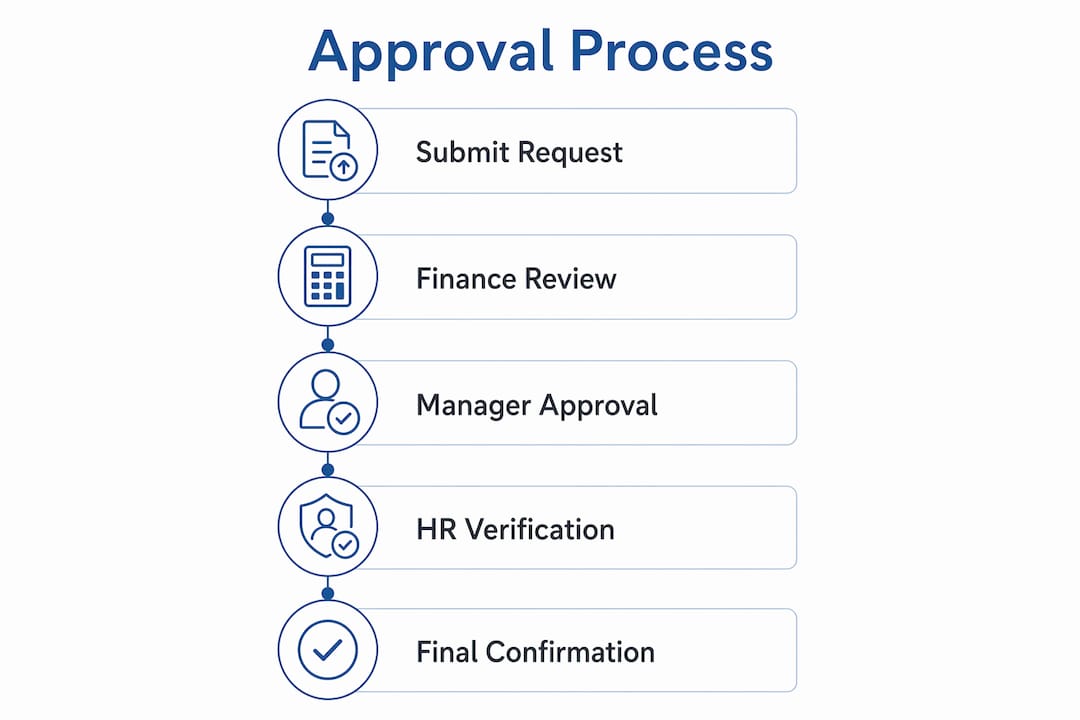
The approval workflow for a job requisition typically involves at least three distinct stakeholder groups. Each group reviews the document from a different angle, and a gap in any one review can stall the entire hiring timeline.
Here is how the process flows in most organizations:
- Hiring manager drafts the requisition. The manager specifies the role purpose, required qualifications, and a budget estimate. This draft reflects the team’s operational need.
- Finance reviews the budget. The finance team confirms the salary range fits within the department’s headcount budget. Many approval delays stem directly from misaligned budget information submitted at this stage.
- HR reviews for compliance and consistency. HR checks that the role aligns with compensation bands, job classification policies, and any internal equity considerations.
- Senior leadership provides final sign-off. For roles above a certain level or cost threshold, a VP or C-suite leader authorizes the requisition before recruiting begins.
- Approved requisition moves to the recruiting team. The requisition initiates recruitment and gives HR the information needed to build the job description and posting.
The most common bottleneck is step two. Finance teams frequently push back when the salary range is vague or when the justification for the hire lacks supporting data. Providing team capacity metrics, turnover data, or a direct link to a revenue target removes that friction. Strong justifications such as team capacity data or strategic growth targets significantly smooth the approval process.
Pro Tip: Schedule a 15-minute alignment call with your finance partner before submitting the requisition. Resolving budget questions before submission cuts review cycles in half.
Job Requisition vs. Job Description vs. Job Posting
These three documents are not interchangeable. Treating them as the same thing creates inefficiency and confusion across recruiting teams. Each document serves a distinct audience and a distinct purpose.
| Document | Audience | Primary purpose |
|---|---|---|
| Job requisition | Internal: manager, finance, HR, leadership | Approval and budget authorization for a new hire |
| Job description | Internal and candidate-facing | Detailed role responsibilities and qualifications for assessment |
| Job posting | External: job seekers | Advertisement designed to attract qualified applicants |
The job requisition focuses on the “why” behind the hire: the budget, the business justification, and the approval chain. The job description focuses on the “what”: the specific duties, required skills, and performance expectations. The job posting takes the job description and packages it for public distribution on platforms like LinkedIn or Indeed.
Confusing a requisition with a job description leads to inefficient hiring cycles. A requisition that reads like a job posting, for instance, often lacks the financial detail finance teams need to approve it. Keeping these documents separate and purpose-built protects your time-to-fill metric and reduces rework. For a deeper look at how postings connect to the broader process, the steps to effective job posting guide covers the downstream execution in detail.
Best Practices for Writing Job Requisitions That Get Approved Fast
The quality of a requisition determines how quickly hiring can begin. A vague or incomplete document cycles through reviews multiple times, adding weeks to your time-to-fill. The following practices produce requisitions that move through approval on the first pass.
Write a clear, specific job title. Avoid internal jargon or inflated titles. “Senior Data Analyst, Marketing” communicates more than “Marketing Insights Guru.” Titles under 80 characters perform better in both internal approval systems and eventual job postings.
Include a transparent salary range and full benefits detail. Finalizing salary and total employment costs at the requisition stage, including benefits and equipment, avoids downstream offer rework. Vague compensation ranges force HR and finance to revisit the document repeatedly.
Anchor the justification to a business metric. “We need a project manager” is not a justification. “Our current team of four project managers is managing 23 active accounts, and we have committed to onboarding six new clients in Q3” is. Objective, data-backed justifications reduce approval bottlenecks. You can find additional candidate attraction strategies that connect to requisition quality in this guide on attracting top talent.
Coordinate with finance and HR before you submit. Multi-layer internal reviews exist to ensure policy compliance and budget alignment. Engaging those stakeholders early means fewer surprises during the formal review. A quick conversation before submission is faster than a revision cycle after.
Avoid these common errors that trigger delays:
- Submitting without a proposed start date
- Listing a salary range that falls outside the approved compensation band
- Omitting the reporting structure
- Using a job title that does not match any existing job classification in your HR system
- Failing to distinguish between a backfill and a net new headcount request
Following a structured recruitment checklist alongside your requisition process helps catch these errors before submission and keeps the entire hiring workflow on track.
Key Takeaways
A job requisition is the single most important document in the hiring process because it determines whether recruiting can begin at all.
| Point | Details |
|---|---|
| Definition and purpose | A job requisition is a formal internal approval document that authorizes recruiting to begin for a new or existing role. |
| Core components | Every requisition must include job title, salary range, qualifications, reporting structure, and a business justification. |
| Approval workflow | At least three stakeholders review each requisition: the hiring manager, finance, and HR or senior leadership. |
| Distinct from job descriptions | Requisitions justify the hire internally; job descriptions communicate role details to candidates and assessors. |
| Speed up approvals | Data-backed justifications, transparent compensation, and early stakeholder alignment cut approval cycle time significantly. |
Why Most HR Teams Underestimate the Requisition
The job requisition gets treated as a bureaucratic checkbox in most organizations. That is a costly mistake. After working closely with hiring teams across multiple industries, the pattern is consistent: companies that invest care in the requisition stage fill roles faster, with less rework, and with candidates who are better matched to the actual business need.
The reason is structural. A well-built requisition forces alignment before recruiting begins. When the hiring manager, finance, and HR agree on the salary range, the qualifications, and the business case before a single resume is reviewed, the entire process moves in one direction. When that alignment is missing, you get offer rework, budget disputes mid-search, and job descriptions that do not reflect what the manager actually needs.
The other underappreciated function of the requisition is accountability. It creates a written record of what was approved, at what cost, and for what reason. That record matters when you are auditing cost-per-hire, defending headcount decisions to leadership, or onboarding a new HR partner who needs context. Treating the requisition as a living business document rather than a form to complete changes how your whole team approaches hiring. For organizations hiring across multiple specialties, understanding how industry-specialized recruiting connects to requisition quality is worth the time.
— Bradford
How Careerscape Supports Your Hiring Process
Careerscape connects organizations with qualified professionals across a wide range of industries and roles. Whether you are filling a permanent position through direct hire staffing or need flexible coverage through contract staffing solutions, Careerscape brings the industry knowledge and candidate access to move fast. The team works directly with HR professionals and hiring managers to align on role requirements, compensation expectations, and timelines from the start. If your organization is ready to hire and wants a recruiting partner who understands the full process from requisition to offer, request talent here.
FAQ
What Is a Job Requisition in Simple Terms?
A job requisition is a formal internal document a manager submits to request permission to hire someone. It must be approved by finance, HR, and leadership before recruiting can begin.
What Is the Difference Between a Job Requisition and a Job Description?
A job requisition is an internal approval and budget request. A job description details the role’s responsibilities and qualifications for candidate assessment and is created after the requisition is approved.
What Should a Job Requisition Include?
A complete job requisition includes the job title, department, salary range, benefits, required qualifications, reporting structure, proposed start date, and a clear business justification for the hire.
Who Approves a Job Requisition?
At least three stakeholders typically approve a requisition: the department head, a finance representative confirming budget alignment, and HR or senior leadership providing final authorization.
Why Does a Job Requisition Matter for Hiring Efficiency?
An approved requisition aligns all stakeholders on budget and role expectations before recruiting begins. That alignment reduces offer rework, shortens time-to-fill, and produces better-matched candidates.
Recommended
- Staffing & Recruiting by Job Title — 48 Roles | Careerscape
- What is recruiting? The employer’s guide to modern hiring
- Job Posting Optimization: A 2026 Recruiter’s Guide
- Steps to Effective Job Posting for Recruiters in 2026