
The employee referral process is a structured system that significantly enhances recruitment efficiency, with referral hires converting 30-50% faster and demonstrating better retention than candidates from job boards. Key elements for an effective program include easy submission, automated tracking, proactive feedback, and a clear incentive structure, such as tiered bonuses based on role difficulty. Continuous promotion, careful implementation, and regular reviews of incentives are essential for maintaining engagement and optimizing the program over time.
In this article
The employee referral process is a structured system where current employees recommend qualified candidates, those referrals are tracked through a defined workflow, and successful hires trigger a reward. Referral hires convert 30–50% faster and show stronger retention than candidates sourced from job boards. That speed and quality advantage makes referrals one of the highest-return channels in any recruitment strategy. Careerscape works with HR teams across industries and consistently sees referral programs outperform cold sourcing when they are built on clear policy, the right technology, and consistent communication.
How Does an Effective Employee Referral Process Work?
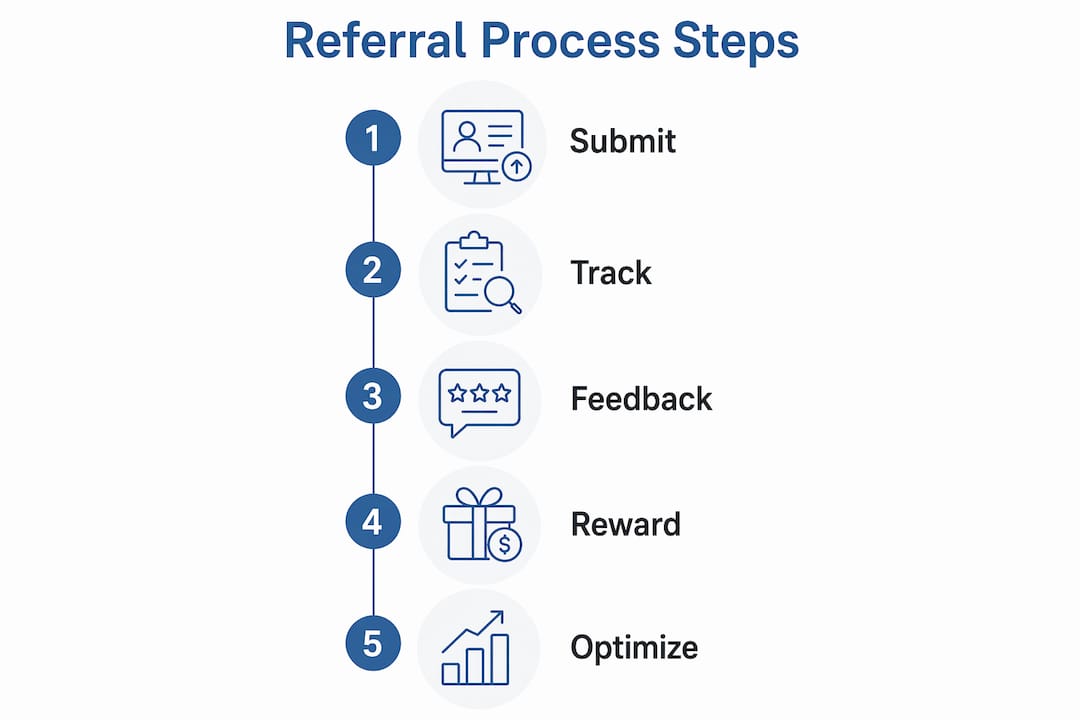
A referral program works when three things align: submission is easy, tracking is automatic, and employees receive timely feedback. Remove any one of those, and participation drops fast.
The submission step is where most programs lose momentum. If employees must email a spreadsheet or fill out a paper form, they will not bother. The referral channel must be mobile-friendly and ideally connected to your applicant tracking system (ATS) so every submission creates a timestamped record with no manual entry required. Manual tracking breaks the audit trail and delays incentive payouts, which erodes trust quickly.

Feedback is the second critical element. Employees stop referring when their submissions disappear into silence. Automated status updates, sent at each stage of the hiring workflow, keep referrers engaged and signal that the program is real and well-managed. This is not optional communication. It is the mechanism that sustains participation.
The incentive structure also shapes behavior. The most common and effective split is 50% paid at hire, 50% after 90 days of continuous employment. That structure rewards the referral and the retention outcome, aligning the employee’s interest with the company’s.
Key design elements of a functioning referral program:
- Simple submission: One form, mobile-accessible, connected to your ATS
- Automated tracking: No manual spreadsheets; every referral gets a unique ID
- Proactive updates: Automated emails or app notifications at each hiring stage
- Split payout schedule: Reward at hire and at the 90-day retention milestone
- Clear eligibility rules: Who can refer, which roles qualify, and how disputes are handled
Pro Tip: Set up an automated “thank you” message the moment a referral is submitted. That single touchpoint signals professionalism and keeps the referrer engaged before any hiring decision is made.
Most programs reach steady participation within 60–90 days when they are properly structured and tracked with automation. That timeline gives you a realistic window to measure early results before making adjustments.
What Are the Key Steps to Implement an Employee Referral Process?
Implementation works best when it follows a deliberate sequence. Skipping steps, especially the policy and pilot phases, leads to programs that generate noise but not hires.
-
Write a clear referral policy. Define eligibility, which roles qualify, payout amounts, the payment schedule, and how disputes are resolved. Put it in writing and make it easy to find. Ambiguity kills participation because employees will not refer if they are unsure whether they will get paid.
-
Choose the right submission channels. Meet employees where they already work. Options include a dedicated mobile app, a Slack integration, email submission, or SMS. The channel must require minimal steps. Every additional click reduces submission rates.
-
Connect referrals to your ATS. This is non-negotiable for programs above a handful of referrals per month. ATS integration preserves the audit trail, automates status updates, and makes reporting straightforward. Without it, you are managing referrals manually, which damages trust and delays payouts.
-
Launch with hard-to-fill roles first. Focusing your initial launch on high-priority, difficult-to-fill positions creates early wins. Those wins build internal credibility and generate the word-of-mouth momentum that carries the program forward. A broad launch across all open roles dilutes focus and makes it harder to demonstrate ROI quickly.
-
Establish a reporting cadence. Track participation rate, referral-to-hire conversion, time-to-fill, and 90-day retention quarterly. You cannot improve what you do not measure. A monthly dashboard shared with hiring managers keeps the program visible and accountable.
-
Promote continuously. Announce open roles eligible for referral in team meetings, Slack channels, and internal newsletters. Recognition of successful referrers in company-wide communications reinforces the program’s value and encourages others to participate.
Here is a quick reference for implementation milestones:
| Milestone | Target Timeline |
|---|---|
| Policy drafted and approved | Week 1–2 |
| ATS integration and submission channel live | Week 2–4 |
| Pilot launch for hard-to-fill roles | Week 4 |
| First referral hires and payouts | Week 8–12 |
| Steady-state participation | Day 60–90 |
| First quarterly program review | Month 3 |
Pro Tip: Assign a single program owner, not a committee, to manage the referral process. One accountable person responds faster, communicates more consistently, and keeps the program from stalling between hiring cycles.
Structured programs generate 2–4 times as many referrals as organic word-of-mouth from the same employee base. That multiplier is the core argument for investing in structure rather than hoping employees refer naturally.
What Does a Working Referral Program Look Like? A Sample Policy
Teams implementing these steps often ask for a template. Here is a compact policy skeleton you can adapt, consistent with the benchmarks in the next section:
- Eligibility: All employees except executives, HR, and the hiring manager for the role in question. Former employees and current contractors are excluded.
- How to refer: Submit through the ATS referral portal or a one-page form. The referrer adds two sentences on why the person fits.
- Bonus tiers: $1,000 for standard roles, $2,500 for priority roles, $5,000 or more for designated hard-to-fill positions, published in every internal job listing.
- Payout timing: 50% at the new hire’s start date, 50% at the 90-day mark, processed automatically through payroll.
- Tracking and transparency: Referrers receive a status update at every stage change. HR reports referral hires, conversion rate, and 90-day retention quarterly.
- Review: Bonus amounts and priority-role designations are revisited annually.
A policy this size fits on one page, which is exactly the point: if employees cannot explain the program from memory, participation drops.
What Incentives and Recognition Strategies Boost Referral Participation?
Monetary bonuses are the baseline, but they are not the whole story. The right incentive depends on your workforce, your roles, and how well you communicate the reward.
Current US benchmarks for referral bonuses break down by role type:
- Frontline and hourly roles: $500–$2,000
- Professional and mid-level roles: $1,000–$5,000
- Hard-to-fill clinical or technical roles: Up to $25,000 for specialized positions
Tiering bonuses by role difficulty signals to employees that the company takes hard-to-fill positions seriously. It also directs referral energy toward the roles where it matters most.
Non-cash rewards expand the appeal of the program beyond employees motivated primarily by money. Extra PTO, wellness days, charitable donations in the referrer’s name, and gift cards all perform well. Simple, meaningful rewards outperform complex bonus structures because employees can understand and remember them. Complexity is a participation barrier, not a motivator.
Public recognition is one of the most underused tools in referral program management. Calling out a successful referrer by name in a team meeting or company newsletter costs nothing and signals to the entire workforce that referring is valued behavior. Recognition drives referral motivation as powerfully as cash for many employees, particularly those who are already well-compensated.
Prompt payouts matter as much as payout size. An employee who waits three months for a promised bonus will not refer again. Automating the payout trigger at the hire date and the 90-day milestone removes delays and builds the trust that sustains long-term participation. For ideas on how structured recognition methods translate into measurable engagement gains, the research on employee achievement programs is worth reviewing.
Review your incentive structure at least once a year. Workforce preferences shift, and a bonus that motivated employees two years ago may feel underwhelming today. Gathering employee research and feedback on what rewards employees actually value is a straightforward way to keep the program competitive.
How Do You Maintain and Optimize an Employee Referral Process over Time?
A referral program is not a one-time launch. It requires ongoing attention to stay effective. The programs that plateau or collapse after six months almost always share the same failure: the team stopped actively managing them.
Automation handles the communication layer. Every referral, whether hired or not, should trigger a status update at each stage. Automated status updates prevent the “black hole” effect where employees submit a referral and never hear back. That silence is the single fastest way to kill future participation.
The metrics that matter most for ongoing optimization:
| Metric | What it tells you |
|---|---|
| Participation rate | Healthy programs see 25–40% of eligible employees referring |
| Referral-to-hire conversion | Measures quality of referrals and recruiter follow-through |
| Time-to-fill via referrals | Benchmark against job board and agency sources |
| 90-day retention rate | Validates that referral hires are a quality fit |
Participation below 20% signals a program design problem, not a lack of employee enthusiasm. When participation is low, the first places to investigate are submission friction, communication gaps, and whether the incentive structure is clearly understood.
Iterate quarterly. Review which roles are open for referral, adjust bonus amounts for roles that remain unfilled, and refresh internal communications. Avoid expanding the program company-wide before the pilot has produced measurable wins. Scaling a broken program just amplifies the problems.
Inclusivity is a real optimization lever. Employees from under-represented groups often face structural barriers to referring, including smaller professional networks or uncertainty about whether their referrals will be treated fairly. Addressing those barriers through targeted outreach and transparent hiring criteria improves both participation rates and the diversity of your referral pipeline. Pairing your referral program with staffing best practices that support an inclusive hiring culture strengthens both outcomes.
Pro Tip: Run a quarterly “referral spotlight” where you share one success story from a referred hire. Pair it with a reminder of open roles and current bonus amounts. That combination of social proof and clear opportunity consistently lifts submission rates in the following weeks.
Key Takeaways
A well-structured employee referral process, built on simple submission, ATS integration, automated feedback, and tiered incentives, produces faster hires, better retention, and higher referral volume than unmanaged word-of-mouth.
| Point | Details |
|---|---|
| Structure multiplies volume | Structured programs generate 2–4x more referrals than organic word-of-mouth from the same workforce. |
| ATS integration is non-negotiable | Connecting referrals to your ATS preserves the audit trail and automates payouts to maintain trust. |
| Split payout aligns incentives | Paying 50% at hire and 50% at 90 days rewards both the referral and the retention outcome. |
| Feedback sustains participation | Automated status updates at every hiring stage prevent drop-off and keep referrers engaged. |
| Measure participation rate first | Participation below 20% signals a design problem; healthy programs reach 25–40% of eligible employees. |
Why Most Referral Programs Fail Before They Find Their Footing
The programs I see struggle most are not struggling because employees do not want to refer. They struggle because the program asks employees to do something inconvenient, then goes quiet. That combination is fatal.
The friction problem is almost always underestimated at launch. HR teams spend weeks designing the incentive structure and almost no time testing the submission experience from an employee’s perspective. If submitting a referral takes more than two minutes on a phone, most employees will not do it, no matter how good the bonus is.
The transparency problem is equally damaging. Employees who refer a friend and never hear what happened feel disrespected. They do not refer again. The fix is not complicated. Automated updates at each stage of the hiring process cost almost nothing to set up and make an enormous difference in how employees perceive the program.
Leadership support is the variable that separates programs that scale from programs that stall. When a VP or department head publicly thanks a referrer in a team meeting, it signals that referring is a valued behavior, not just an HR initiative. That signal travels fast. Cross-team collaboration, where managers actively share open roles with their teams and encourage referrals, compounds the effect.
The programs that work best are also the most specific. A broad call to “refer anyone you know” produces low-quality submissions. A targeted message that says “we need a senior network engineer in Dallas by the end of the quarter, and the bonus is $4,000” produces focused, relevant referrals. Role-specific targeting is not just more effective. It is more respectful of employees’ time and professional networks.
— Bradford
How Careerscape Supports Your Talent Acquisition Goals
Careerscape connects HR teams with qualified professionals across industries, with the speed and honesty that internal referral programs alone cannot always deliver. When your referral pipeline runs dry or a role requires specialized expertise, Careerscape fills the gap. Their industry-specialized recruiting covers the roles where referral bonuses run highest and time-to-fill pressure is greatest. For teams that need flexible capacity, contract staffing solutions and direct hire services work alongside your referral program rather than replacing it. Contact Careerscape to discuss how external recruitment support can complement your internal referral strategy.
FAQ
What Is an Employee Referral Process?
An employee referral process is a structured system where current employees recommend candidates for open roles, those submissions are tracked through a defined workflow, and successful hires trigger a reward. It differs from informal word-of-mouth in that it has written policy, ATS integration, and automated communication.
How Long Does It Take for a Referral Program to Show Results?
Most referral programs reach steady-state participation within 60–90 days when they are properly structured and tracked with automation. Early wins come faster when the launch focuses on hard-to-fill roles rather than all open positions.
What Is a Typical Referral Bonus Amount?
US referral bonuses range from $500–$2,000 for frontline roles, $1,000–$5,000 for professional positions, and up to $25,000 for hard-to-fill clinical or technical roles. The most common payout structure splits the bonus 50% at hire and 50% after 90 days of continuous employment.
How Do You Measure Referral Program Success?
Track four metrics: participation rate (healthy programs reach 25–40% of eligible employees), referral-to-hire conversion rate, time-to-fill compared to other sourcing channels, and 90-day retention rate for referral hires. Participation below 20% signals a program design problem.
Why Do Employees Stop Participating in Referral Programs?
Employees stop referring when they receive no feedback on their submissions. Proactive, automated status updates at each hiring stage prevent this drop-off and keep referrers engaged regardless of whether their candidate was hired.
Recommended
- Referral Program — Earn Per Placement | Careerscape
- What is recruiting? The employer’s guide to modern hiring
- 9 Proven Ways to Attract Top Talent in 2026