
Direct hire is a recruitment model where an employer directly hires a candidate as a permanent, full-time employee from day one, assuming all legal and administrative responsibilities without an intermediary. This process includes defining the role, sourcing candidates, conducting interviews, and completing onboarding, with placement fees typically ranging from 15% to 25% of the candidate's first-year salary. Key benefits of direct hire include workforce stability, full benefits integration for new employees, cultural alignment, and stronger employer branding, making it an effective strategy for building a long-term team.
In this article
Direct hire is a recruitment model where an employer brings a candidate on as a permanent, full-time employee from day one, with no intermediary acting as employer of record. The new hire joins the company’s payroll, receives full benefits, and integrates into the organization immediately. This model differs sharply from contract staffing, temp-to-hire arrangements, and other flexible workforce solutions. For hiring managers focused on building a stable, long-term team, understanding the direct hire definition is the first step toward making smarter workforce decisions.
What Is Direct Hire Recruiting?
Direct hire recruiting is the process of sourcing, evaluating, and placing a candidate into a permanent role within a company. The employer, not a staffing agency, holds the employment relationship from the start. That distinction matters because it shifts all legal, administrative, and benefits responsibilities to the hiring organization immediately upon the candidate’s start date.
Staffing agencies often facilitate direct hire placements by sourcing and screening candidates on the employer’s behalf. However, the agency never becomes the employer of record. Once the candidate accepts the offer, the company owns the full employment relationship. This is the core of the direct hire staffing model and what separates it from every other staffing arrangement.

The term “permanent placement” is the standard industry phrase for this model. Both terms appear in HR and staffing conversations, so hiring managers should recognize them as interchangeable. Knowing the direct hire definition helps you evaluate agency proposals, compare fee structures, and set realistic expectations for time-to-fill.
How Does the Direct Hire Process Work?
The direct hire recruiting process generally involves seven steps, from defining the role to completing onboarding. Each stage requires deliberate effort from both the employer and, when applicable, the recruiting agency.
- Define the role. Write a precise job description that captures required skills, experience level, compensation range, and reporting structure. Vague job descriptions produce mismatched candidates and extend time-to-fill.
- Source candidates. The recruiting agency or internal talent team builds a pipeline through job boards, professional networks, referrals, and direct outreach. Effective job posting practices significantly affect the quality of inbound applicants.
- Screen applicants. Recruiters conduct initial phone screens to verify qualifications, compensation expectations, and availability. This stage filters out candidates who do not meet baseline requirements before they reach the hiring manager.
- Conduct in-depth interviews. Structured interview scorecards help hiring managers evaluate candidates consistently. Behavioral questions, technical assessments, and panel interviews all belong here depending on the role’s complexity.
- Run background checks. Employment verification, criminal history, and reference checks protect the organization and confirm the candidate’s credentials.
- Negotiate and extend the offer. The hiring manager or HR team presents a compensation package that aligns with market rates and internal equity. Offer negotiation in direct hire is the employer’s responsibility, not the agency’s.
- Complete onboarding. The new hire joins the company payroll, receives benefits enrollment information, and begins role-specific training. Full integration starts on day one.
Pro Tip: Assign a dedicated internal point of contact for each direct hire search. Agencies move faster and deliver better candidates when they have a single decision-maker to communicate with throughout the process.
What Are the Fees and Contract Terms for Direct Hire?
Direct hire placement fees typically range between 15% and 25% of the candidate’s first-year base salary, paid as a one-time fee at the candidate’s start date. That fee structure is straightforward compared to retained search models, which bill in installments regardless of outcome.
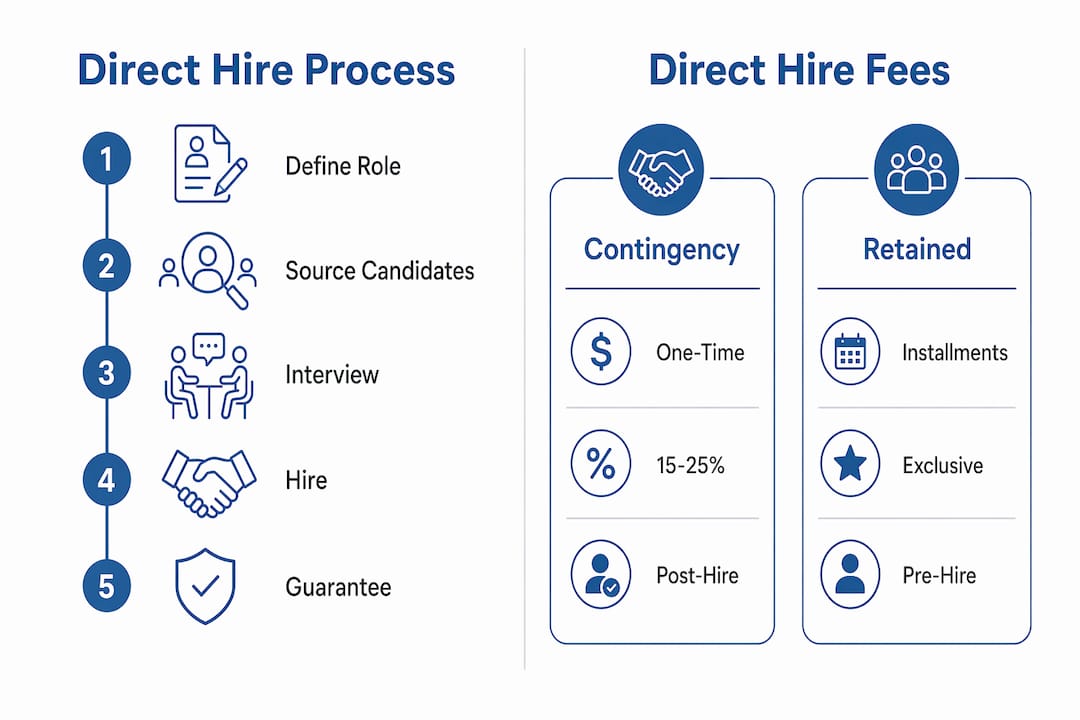
Understanding how these fees compare across models helps you budget accurately and choose the right approach for each role.
| Fee model | When you pay | Contingency on placement |
|---|---|---|
| Direct hire (contingency) | One time, on start date | Yes |
| Retained search | Installments during search | No |
| Contract staffing | Ongoing, per billable hour | Not applicable |
Retained search fees are paid in installments regardless of placement outcome, which signals higher exclusivity and is typically reserved for executive roles. Contingency-based direct hire fees, by contrast, are paid only when a successful placement occurs. That distinction makes direct hire a lower financial risk for most mid-level and professional roles.
Standard direct hire agreements include a 90-day guarantee period. If the placed employee leaves or is terminated within that window, the agency provides a free replacement search or a partial fee refund. That clause is your primary financial safety net, and it deserves careful review before you sign any agreement.
Pro Tip: Always negotiate the guarantee period before signing. Some agencies offer 60 days as a default. Pushing for 90 days is standard practice and protects your cost-per-hire if early turnover occurs.
What Are the Key Benefits of Direct Hire?
Direct hire recruiting delivers higher long-term retention and employee engagement compared to temporary staffing models. That outcome is not accidental. Permanent employees who join with full benefits and a clear career path invest more deeply in the organization from the start.
The core advantages of direct hire over other staffing models include:
- Workforce stability. Permanent employees provide continuity on projects, client relationships, and institutional knowledge. High turnover disrupts all three.
- Full benefits integration. New hires receive salary, benefits, and training as regular employees immediately, which accelerates their productivity and commitment.
- Culture alignment. Candidates selected through a thorough direct hire process are evaluated for cultural fit, not just technical skills. That alignment reduces friction during the first 90 days.
- Long-term talent development. Direct hiring is the most effective recruitment strategy when the goal is to develop talent internally and build lasting employee relationships. It supports succession planning and internal promotion pipelines.
- Stronger employer brand. Companies known for hiring directly into permanent roles attract candidates who want stability. That reputation improves the quality of your talent pipeline over time.
Direct hire requires more upfront investment in time and internal resources than temp-to-hire. The payoff is a workforce built for the long term, not just the next quarter.
How Does Direct Hire Differ from Contract Staffing and Temp-to-Hire?
The employment relationship is the clearest dividing line between these models. In direct hire, the employer assumes full legal and administrative employment responsibilities from day one. In contract staffing, the agency remains the employer of record, handling payroll taxes, workers’ compensation, and benefits for the duration of the assignment.
| Factor | Direct hire | Contract staffing | Temp-to-hire |
|---|---|---|---|
| Employer of record | Client company | Staffing agency | Agency, then client |
| Benefits from day one | Yes | No | No, until conversion |
| Fee structure | One-time placement fee | Ongoing billable hours | Conversion fee or markup |
| Best use case | Permanent, long-term roles | Project-based or short-term needs | Trial before commitment |
| Retention focus | High | Low | Medium |
Temp-to-hire, also called contract-to-hire, gives employers a trial period before committing to permanent employment. That model suits roles where cultural fit or technical performance is difficult to assess through interviews alone. Direct hire suits roles where you need a committed, fully integrated employee from the start and cannot afford a ramp-up period.
Contract staffing solutions serve a different purpose entirely. They address short-term capacity gaps, project-based work, or specialized skills needed for a defined period. Choosing between these models depends on your workforce planning goals, budget cycle, and the criticality of the role. For roles tied to long-term business outcomes, direct hire consistently produces better results.
Key Takeaways
Direct hire is the most effective recruitment model for building a stable, engaged workforce when permanent employment and full integration from day one are the priority.
| Point | Details |
|---|---|
| Direct hire definition | A permanent placement model where the employer owns the employment relationship from day one. |
| Placement fee range | Fees run 15%–25% of first-year salary, paid once at the candidate’s start date. |
| 90-day guarantee clause | Standard contracts include a free replacement or partial refund if the hire leaves within 90 days. |
| Benefits of direct hire | Permanent employees show higher retention, stronger culture fit, and deeper engagement than contract workers. |
| Model selection | Choose direct hire for long-term roles; use contract or temp-to-hire for short-term needs or trial periods. |
Why the 90-Day Guarantee Clause Is the Most Underused Tool in Direct Hire
Hiring managers spend significant energy evaluating candidates and negotiating fees, then sign contracts without reading the guarantee clause carefully. That is the single most costly oversight I see in direct hire engagements.
The 90-day guarantee period exists precisely because early turnover is expensive and unpredictable. A new hire who leaves in week six costs you the placement fee, the time-to-fill for a replacement search, and the productivity loss during the gap. The guarantee clause converts that risk into a manageable outcome. But only if you negotiated it correctly before signing.
My advice: treat the guarantee period as a non-negotiable term, not a nice-to-have. Ask the agency directly what triggers the guarantee, what the refund structure looks like, and whether a replacement search counts as fulfillment. Agencies that resist clear answers on this point are telling you something important about how they operate.
The other pattern I see consistently is employers treating direct hire as a transactional purchase rather than a partnership. The agencies that deliver the best candidates are the ones that receive detailed feedback at every stage, clear communication about internal changes, and honest input on why candidates were declined. That feedback loop shortens time-to-fill and improves candidate quality on the next search. You get out of a direct hire partnership exactly what you put into it.
— Bradford
How Careerscape Supports Your Permanent Hiring Needs
Careerscape, connects employers with qualified professionals through a direct hire model built on speed, honesty, and industry knowledge. Whether you are filling a single critical role or building out an entire department, Careerscape’s recruiters work within your industry to source candidates who meet your technical requirements and fit your team. The process is transparent from the first conversation to the final offer. If you are ready to move from reactive hiring to a deliberate, permanent placement strategy, request talent sourcing support or explore Careerscape’s direct hire staffing services to get started.
FAQ
What Is the Direct Hire Definition in Simple Terms?
Direct hire means a company recruits and employs a candidate as a permanent, full-time employee from day one, with no staffing agency acting as employer of record. The employee joins the company payroll and receives full benefits immediately.
How Does Direct Hire Differ from Temp-to-Hire?
In direct hire, the employment relationship is permanent from the start. In temp-to-hire, the worker is initially employed by the staffing agency and may convert to a permanent role after a trial period.
What Fees Should Employers Expect for Direct Hire Placements?
Direct hire placement fees typically range between 15% and 25% of the candidate’s first-year base salary, paid as a one-time fee on the candidate’s start date.
What Is a Guarantee Period in a Direct Hire Contract?
A guarantee period, typically 90 days, gives the employer a free replacement search or partial fee refund if the placed candidate leaves or is terminated within that timeframe.
When Should an Employer Choose Direct Hire over Contract Staffing?
Direct hire is the right choice when the role is permanent, requires full integration from day one, and supports long-term talent development goals. Contract staffing fits short-term or project-based needs better.
Recommended
- Contract-to-hire: Benefits, comparisons, and expert insights
- What is recruiting? The employer’s guide to modern hiring
- Direct Hire Staffing Services | Careerscape