
Seasonal hiring works best on a 90/60/30 timeline: set headcount and budget 90 days out, recruit at 60, onboard by 30. Here is the plan, a headcount formula, sourcing channels, compliance points and metrics.
- Start planning at least 90 days before your peak; waiting until demand arrives means competing for the smallest pool of candidates.
- Forecast headcount from last season’s labor hours, then add a buffer for no-shows and mid-season quits.
- Rehire pools, referrals and staffing partners fill seasonal roles faster than cold job postings.
- Seasonal workers are employees: they need a Form I-9, payroll withholding and, for minors, compliance with child labor hour limits.
- NRF expects retailers to hire 325,000 to 375,000 seasonal workers for the 2026 holidays.
In this article
Seasonal hiring is recruiting temporary workers to cover predictable peaks in demand, such as the holiday shopping rush, summer tourism or tax season. The most reliable seasonal hiring plan runs on a 90/60/30 timeline: set headcount and budget 90 days before the peak, open roles and screen at 60 days, and finish onboarding and schedules by 30 days out.
What seasonal hiring covers
Any business with a peak that repeats every year does seasonal hiring. Typical examples and when hiring for them usually starts:
| Peak season | Common seasonal roles | When to start hiring |
|---|---|---|
| Holiday retail and e-commerce (November to December) | Sales associates, cashiers, stockers, warehouse pickers and packers, delivery drivers, customer service | August to October |
| Summer tourism and recreation (June to August) | Hospitality staff, lifeguards, camp staff, food service, guides | February to April |
| Tax season (January to April) | Tax preparers, data entry, client service, seasonal accountants | October to December |
| Spring and summer outdoor work | Landscaping, construction labor, pool service | January to March |
| Year-end and open enrollment (fall) | Call center agents, benefits and insurance support | July to September |
The windows are general guides. Use your own history: when did last year’s applications slow down, and when did you wish you had more people on the floor?
A 90/60/30 seasonal hiring plan
Count backward from the first day you need full staffing. If your holiday peak starts November 1, day 90 is early August.
| When | What to finish | Owner |
|---|---|---|
| 90+ days out | Forecast headcount by role, shift and location. Approve the budget and pay rates. Decide what you will fill through rehires, internal moves, direct hiring and staffing partners. Contact last season’s best workers. | Operations lead, HR, finance |
| 60 days out | Post jobs and launch sourcing. Turn on referral bonuses. Brief your staffing partner. Screen and interview in batches (hiring events work well). Make offers within 48 hours of interviews. | Recruiter, hiring managers |
| 30 days out | Complete background checks and paperwork. Publish schedules. Run onboarding and safety training. Assign a buddy or lead to each new group. Confirm start dates with every hire. | HR, site managers |
| During the peak | Track attendance and quits weekly. Backfill from your bench of extra candidates. Give quick feedback and recognition. | Site managers, recruiter |
| After the peak | Rate every seasonal worker. Make offers to the ones you want to keep. Tell the rest you would rehire them next season. Write down what to change. | Managers, HR |
How to forecast seasonal headcount
Base the forecast on labor hours, not on a gut-feel headcount.
- Estimate peak labor hours per week. Use last season’s hours, adjusted for this year’s sales or volume forecast.
- Subtract what your core team covers. Include realistic overtime, not best-case overtime.
- Divide the gap by the hours each seasonal worker will work per week.
- Add a buffer for people who accept and never start, and for mid-season quits. Use your own past no-show and turnover rates; if you don’t track them, start this season.
Worked example: A distribution center expects 12,000 labor hours a week at peak. The core team covers 7,500 hours, including overtime. The gap is 4,500 hours. At 30 hours per seasonal worker, that’s 150 workers. Last year 15% of hires dropped out before or during the season, so the target is 150 × 1.15 ≈ 173 hires.
If you have several peaks or locations, a simple workforce plan keeps the numbers in one place.
Where to find seasonal workers fast
| Channel | Speed | Notes |
|---|---|---|
| Rehire pool (past seasonal workers) | Fastest | Already trained; contact them before you post jobs |
| Employee referrals | Fast | Offer a bonus paid after the referral works a set number of shifts; see our referral process guide |
| Staffing agency | Fast | The agency recruits, employs and pays the workers; useful for large or uncertain volumes |
| Hiring events and walk-in interviews | Fast | Interview and offer on the same day |
| Job boards and your careers page | Medium | Put pay, shifts, dates and any end-of-season bonus in the title or first lines |
| Local colleges and high schools | Medium | Good for holiday and summer peaks; check youth labor rules |
| Retirees and returning workers | Medium | Often prefer part-time seasonal shifts |
Seasonal candidates often apply to several employers at once. Short applications, mobile-friendly scheduling and same-week offers make the biggest difference. Our guide on preventing candidate ghosting covers the follow-up messages that keep people from dropping out between offer and start date.

Onboarding, retention and converting seasonal staff
- Keep onboarding short and practical. Cover safety, the three or four tasks the person will do most, who to ask for help, and how scheduling works. Pair new groups with an experienced lead.
- Make schedules predictable. Publish shifts as early as you can and let people swap shifts easily.
- Use a completion bonus. A bonus paid to workers who stay through the end of the season is a common way to reduce mid-season quits. Put the terms in writing.
- Spot keepers early. About three-quarters of the way through the season, ask managers to name the people they would hire permanently, so offers go out before the season ends.
- End well. Thank everyone, tell them when next season’s hiring opens, and keep their contact details for your rehire pool.
Retailers do keep some holiday hires. In BLS data, the five retail industries it tracks added 492,000 jobs from October to December 2024 and cut 463,000 in January and February 2025, keeping 29,000 seasonal employees, up from 4,000 a year earlier (BLS, The Economics Daily). If you want a formal tryout, temp-to-hire arrangements let you convert strong seasonal workers.
Seasonal hiring compliance checklist
Seasonal workers are employees for most purposes. Key federal points, as of October 2026:
- Form I-9 for every hire. USCIS says employers must complete and retain a Form I-9 for every employee hired in the U.S., including seasonal staff.
- Payroll taxes. Withhold and report as for any employee. If you pay no wages in some quarters, the Form 941 instructions (revised March 2026) let seasonal employers skip filing for quarters with no tax liability by checking line 18 on each return they do file.
- Affordable Care Act headcount. An employer is an applicable large employer if it averaged at least 50 full-time employees (including equivalents) in the prior year. Under the IRS seasonal worker exception, you are not an ALE if you exceeded 50 for 120 days or fewer and the employees above 50 during that time were seasonal workers.
- Teen workers. Under federal rules, 14- and 15-year-olds in nonfarm jobs may work no more than 3 hours on a school day, 18 hours in a school week, 8 hours on a non-school day and 40 hours in a non-school week, between 7 a.m. and 7 p.m. (9 p.m. from June 1 through Labor Day). Where state law is stricter, the stricter rule applies (DOL Fact Sheet #43).
- State and local rules. Paid sick leave, predictive scheduling, minimum wage and final-pay timing vary by state and city. Check them for every location.
- Classification. Seasonal workers you direct and schedule are usually employees, not independent contractors.
This is general information, not legal or tax advice. Check with employment counsel or a tax adviser for your situation.
The 2026 holiday hiring outlook
Holiday hiring has settled below its 2018 to 2021 levels. The October to December retail buildup was 454,000 in 2022, 478,000 in 2023 and 492,000 in 2024, compared with 560,000 to 634,000 a year from 2018 to 2021, according to BLS.
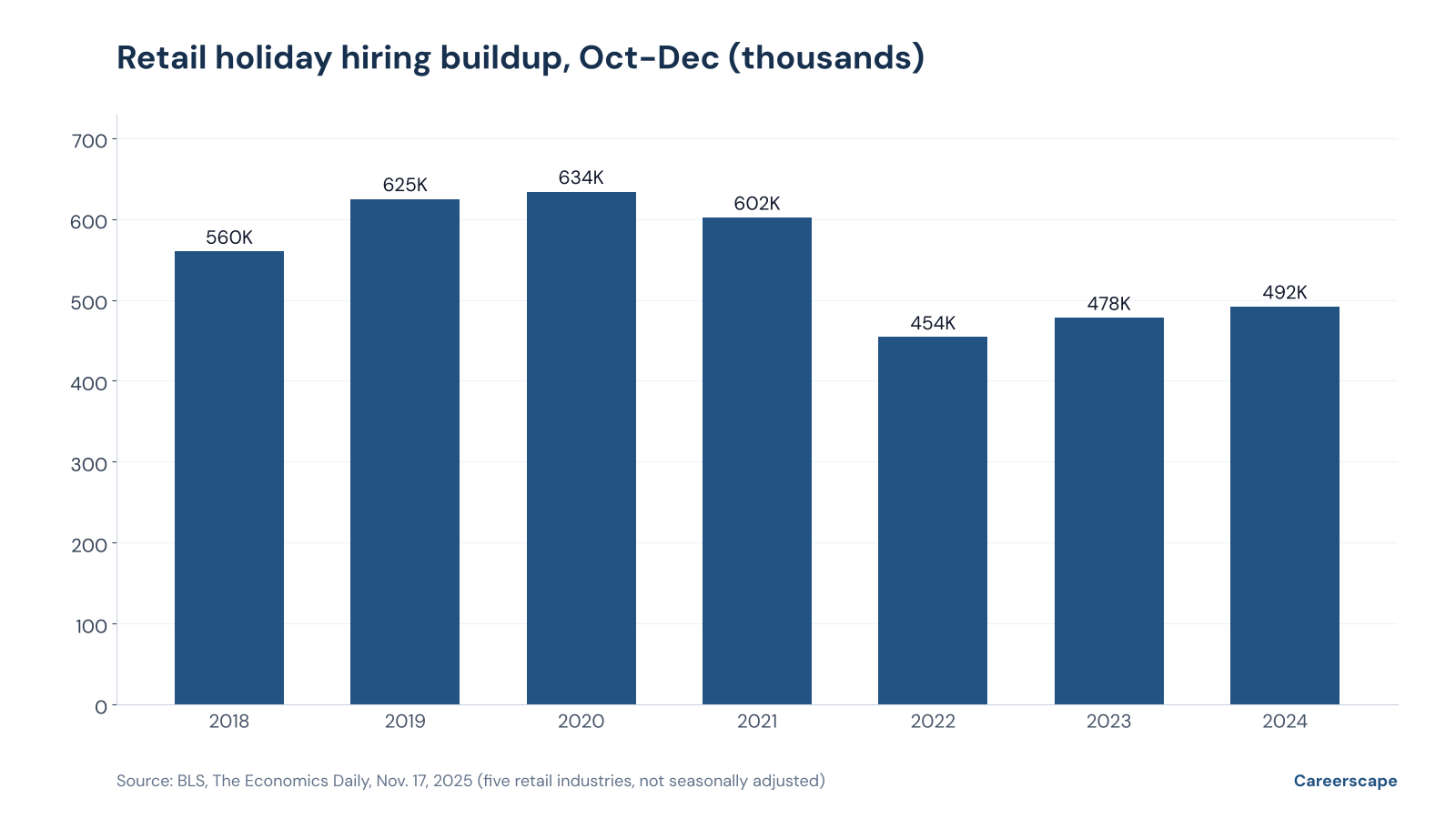
For 2026, the National Retail Federation forecasts that holiday sales will grow 4.2% over 2025 to about $1.013 trillion, and that retailers will hire between 325,000 and 375,000 seasonal workers (NRF, October 15, 2026). Note that NRF’s count measures something different from the BLS buildup, so the two numbers are not directly comparable.
Seasonal hiring metrics to track
| Metric | Formula | Why it matters |
|---|---|---|
| Fill rate by start date | Hires who started ÷ planned hires | Shows whether you started early enough |
| Time to fill | Days from posting to accepted offer | Tells you how far ahead to start next year |
| No-show rate | Accepted offers that never started ÷ accepted offers | Sets the size of next year’s buffer |
| Mid-season turnover | Seasonal workers who quit before the end date ÷ seasonal workers who started | Tests pay, scheduling and supervision |
| Rehire rate | Returning workers ÷ total seasonal hires | A higher rate cuts training time and cost |
| Conversion rate | Seasonal workers offered permanent roles ÷ seasonal workers | Shows the season’s value as a hiring pipeline |
How Careerscape can help
Careerscape is a U.S. staffing and recruiting firm. Our temporary staffing service can recruit, employ and pay seasonal workers for your peak, and our contract staffing covers longer seasonal projects.
Frequently asked questions
When should you start seasonal hiring for the holidays?
Start planning about 90 days before you need full staffing. For a November peak, that means setting headcount and budget in early August, opening roles and screening by early September, and finishing onboarding by early October. The earlier you post, the more candidates are still available.
How does seasonal hiring work?
An employer forecasts how many extra workers a peak needs, recruits them on a short timeline, trains them quickly and employs them for a set period. Workers are hired directly as temporary employees or supplied by a staffing agency. At the end of the season, most leave, and the best may receive permanent offers.
Do seasonal employees count toward the ACA 50-employee threshold?
They count in the calculation, but the IRS seasonal worker exception can help. If your workforce was above 50 full-time employees and equivalents for 120 days or fewer in the year, and the employees above 50 during that time were seasonal workers, you are not treated as an applicable large employer.
Is it better to hire seasonal workers directly or through an agency?
Hire directly if you have a strong rehire pool, recruiting capacity and steady volumes. Use a staffing agency when you need many people quickly, volumes are uncertain, or you don’t want to handle payroll and paperwork for short assignments. Many employers use both: rehires first, then an agency for the rest.
Can seasonal workers become permanent?
Yes. Many employers use the season as a tryout. Ask managers to name strong performers about three-quarters of the way through, and make offers before the season ends. If the workers came through an agency, check the conversion terms in your agreement first.
- U.S. Bureau of Labor Statistics: Trends in retail trade holiday employment buildups and layoffs (November 17, 2025)
- National Retail Federation: NRF forecasts 2026 holiday sales growth (October 15, 2026)
- USCIS: Complete and correct Form I-9
- IRS: Instructions for Form 941 (Rev. March 2026)
- IRS: Determining if an employer is an applicable large employer
- U.S. Department of Labor: Fact Sheet #43, Child labor provisions for nonagricultural occupations