
Workforce planning is a continuous process that analyzes current and future talent needs to ensure the right individuals with necessary skills are in appropriate roles at the right time. It progresses through five stages: analysis, projection, identification, design, and fulfillment, leveraging frameworks like the OPM model and Bain's strategic workforce planning approach. Effective workforce planning aligns with business strategy, focuses on skills rather than headcount, utilizes data-driven forecasting, and involves cross-functional governance to drive measurable outcomes and enhance operational resilience.
Workforce planning is the ongoing, systematic process of analyzing your current workforce, forecasting future talent supply and demand, and implementing strategies to close identified gaps so the right people, with the right skills, are in the right roles at the right time and at the right cost. According to the CIPD workforce planning factsheet, the process moves through five sequential stages: analysis (current workforce), projection (future needs), identification (gap analysis), design (solution development), and fulfillment (talent execution).
Two frameworks anchor most credible approaches to this work:
- The OPM five-step workforce planning model, a government-tested structure widely adapted by private organizations
- The Bain-style strategic workforce planning (SWP) approach, which backcasts from a long-range business vision to define required capabilities
Both treat workforce planning not as a once-a-year headcount exercise, but as a continuous, strategy-linked discipline.
Key Takeaways
Workforce planning is the discipline that converts business strategy into talent decisions, and the organizations that do it well treat it as a continuous process, not an annual event.
| Point | Details |
|---|---|
| Definition and outcome | Workforce planning aligns people, skills, roles, and timing to business strategy through five stages: analysis, projection, identification, design, and fulfillment. |
| Start with job families | Run gap analysis at the job-family level, not total headcount, to surface structural capability gaps that headcount counting misses. |
| Use the four levers | Close gaps with buy (hire), build (develop), borrow (contract), or automate, each with an assigned owner, timeline, and budget. |
| Governance drives results | A quarterly steering group with Finance and line-of-business co-owners converts a planning document into funded decisions. |
| Careerscape executes the plan | Careerscape maps its direct hire, contract staffing, and advisory services to your specific planning levers so gaps close on schedule. |
Table of Contents
- Why does workforce planning matter for HR and the business?
- What are the types of workforce planning?
- What are the core principles of effective workforce planning?
- How do you build a workforce planning process step by step?
- Which workforce planning models and tools should you use?
- How do you start workforce planning in the next 90 days?
- What are the most common workforce planning pitfalls?
- How can staffing partners like Careerscape support your workforce plan?
- What does successful workforce planning look like across industries?
- How does workforce planning connect to talent management and succession planning?
- How do external factors shape your workforce plan?
- What role does technology play beyond basic workforce tools?
- When should you bring in an external staffing partner?
- What actually works in workforce planning: a practitioner’s view
- Careerscape helps you turn your workforce plan into filled roles
- Sources
- FAQ
Why does workforce planning matter for HR and the business?
The case for workforce planning is partly defensive and partly offensive. On the defensive side, organizations that skip it tend to hire reactively, overpay for urgent talent, and carry skills gaps that compound over time. On the offensive side, a well-run planning process converts HR from a service function into a genuine strategic partner.
The concrete benefits include:
- Strategic alignment: Talent decisions reflect business priorities rather than departmental habit.
- Reduced cost-per-hire: Planned sourcing campaigns cost less than emergency fills.
- Improved retention: Identifying career paths and succession gaps early reduces unwanted attrition.
- Succession readiness: Critical roles have identified internal candidates before vacancies occur.
- Operational resilience: Scenario planning surfaces single points of failure before they become crises.
Automation and demographic pressure make the urgency real. Bain’s research on strategic workforce planning notes that automation is reshaping both supply and demand for talent, and that scenario modeling helps organizations decide where to automate, augment, or hire before the shift happens rather than after.
Pro Tip: Present workforce planning to the C-suite as a risk-reduction tool, not an HR project. Frame the conversation around business continuity and capability gaps in the growth strategy. That framing gets budget approved faster than any HR efficiency argument.
What are the types of workforce planning?
TechTarget’s workforce planning definition draws a clear line between two modes that HR teams often conflate.
Operational workforce planning is short-term, typically covering a 3–12 month horizon. It answers scheduling questions: How many people do we need on shift next quarter? Which roles are at risk of vacancy in the next 90 days? It is reactive by design and essential for day-to-day operations. A retail chain managing seasonal staffing surges or a healthcare system balancing nurse-to-patient ratios is doing operational planning.
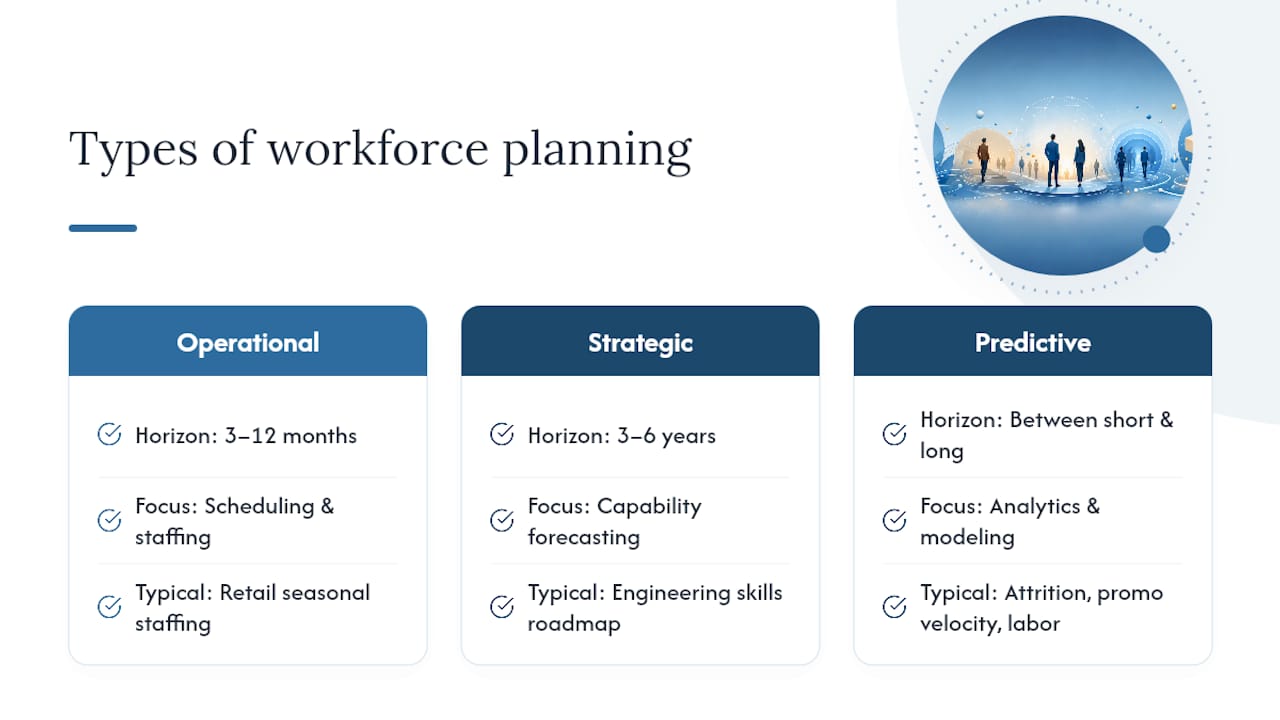
Strategic workforce planning operates on a multi-year horizon, usually 3–6 years, and focuses on capability forecasting rather than headcount. A technology company mapping which engineering skills it will need as its product roadmap shifts toward AI-driven features is doing strategic planning. The goal is not to predict the future precisely but to prepare the organization to respond to multiple plausible futures.
Predictive workforce planning sits between the two. It uses analytics and modeling to identify patterns in attrition, promotion velocity, and external labor supply that inform both short- and long-term decisions. Think of it as the analytical engine that feeds both operational schedules and strategic scenarios.
Pro Tip: Match your planning cadence to organizational maturity. A 200-person company running its first workforce plan should start with a simple operational snapshot and one strategic scenario. Adding predictive modeling before the basics are solid creates complexity without clarity.
What are the core principles of effective workforce planning?
Effective workforce planning rests on six principles that separate plans that get used from plans that collect dust.
- Alignment to business strategy: Every talent decision traces back to a specific business objective. If the strategy calls for geographic expansion, the plan addresses the skills and headcount that expansion requires.
- Skills over headcount: IBM’s workforce planning guidance emphasizes shifting focus from static roles to the specific skills each job will require as technology reshapes work. Counting bodies is not planning.
- Data-driven forecasting: Decisions rest on attrition rates, time-to-fill benchmarks, and external labor market signals, not gut instinct.
- Scenario planning and agility: No single forecast is correct. Build two or three plausible scenarios and define trigger points that tell you which one is materializing.
- Cross-functional governance: Finance, operations, and line managers must co-own the plan. HR alone cannot forecast demand accurately.
- Measurable outcomes: Define KPIs before the plan launches: time-to-fill for critical roles, internal mobility rate, succession coverage ratio, and cost-per-hire.
The process of agreeing on future capability requirements often delivers more value than the precision of the forecast itself. Leadership alignment is the highest-value output of any planning cycle. — IBM
Both the OPM model and the HCI framework treat governance and leadership alignment as structural requirements, not optional add-ons. That consensus is worth taking seriously.
How do you build a workforce planning process step by step?
A repeatable process follows seven steps. Each step has a clear owner and a defined output.
- Articulate business objectives. Translate the 1–3 year business strategy into specific talent implications. What growth, transformation, or risk-reduction goals require new or different capabilities?
- Supply analysis. Assess the current workforce: headcount by role and job family, skills inventory, attrition rate, retirement eligibility, and promotion pipeline. Your HRIS is the primary source; line managers validate the skills data.
- Demand analysis. Forecast future talent needs under two or three scenarios. Use revenue projections, product roadmaps, and operational plans as inputs. External labor market signals from salary benchmarks and hiring-velocity data sharpen the picture.
- Gap analysis. Compare supply to demand. Where are the surpluses? Where are the critical shortfalls? Prioritize gaps by business impact, not by size alone.
- Select levers. For each gap, choose the most cost-effective response. Paycor’s strategic workforce planning guidance frames these as buy (external hire), build (internal development), borrow (contract or contingent talent), or automate (technology substitution).
- Build an action plan. Assign an owner, a timeline, and a budget to every lever. A gap with no owner is not a plan; it is a wish.
- Monitor and adjust. Review progress quarterly. Workforce plans are living documents. Trigger a formal re-plan when a major business assumption changes.
Key data elements for supply and demand analysis
| Data Element | Primary Source | Owner |
|---|---|---|
| Current headcount by job family | HRIS (e.g., Workday, SAP SuccessFactors) | HR Operations |
| Skills inventory | HRIS / skills assessment platform | HR Business Partner |
| Attrition rate (trailing 12 months) | HRIS / payroll | HR Analytics |
| Retirement eligibility (next 3 years) | HRIS / benefits data | HR Operations |
| Revenue and growth projections | Finance / FP&A | CFO / Finance |
| Headcount demand by scenario | Operational plans | Line managers |
| External labor supply and salary benchmarks | Labor market data / salary surveys | HR / Compensation |
Pro Tip: Run your first gap analysis at the job-family level, not the individual role level. Job-family analysis reveals structural capability gaps that role-by-role counting misses, and it is the level at which the Bain SWP approach recommends building your bridge plan.
The SHRM workforce planning toolkit provides structured templates for translating strategic objectives into talent implications and action plans, making it a practical companion for steps 1 through 6.
Which workforce planning models and tools should you use?
Three models dominate practitioner conversations in the United States, and each serves a different organizational context.
- OPM five-step model: Designed for the public sector but widely adapted by private organizations. Its five steps (strategic direction, supply analysis, demand analysis, gap analysis, solution implementation) map cleanly onto the process above and come with documentation templates. Best for organizations that need a governance-ready, auditable framework.
- Bain-style strategic workforce planning: Starts with a “north star” vision, commonly six years out, then builds a three-year bridge of actionable targets by job family. The backcasting logic forces teams to think from the future back to today rather than projecting forward from today’s roster. Best for organizations undergoing significant strategic transformation.
- HCI tip-sheet framework: The Human Capital Institute’s approach emphasizes skills-based planning, leadership alignment, and iterative cycles. It is lighter-weight than the Bain model and well-suited to mid-market organizations building their first strategic plan.
On the tools side, most HR teams work across three categories. An HRIS (Workday, SAP SuccessFactors, UKG) provides the supply-side data foundation. Skills-mapping tools (Eightfold AI, Beamery, or a well-structured spreadsheet for smaller teams) help catalog current capabilities against future requirements. Scenario-modeling spreadsheets or purpose-built workforce analytics platforms handle the demand-side projections and gap calculations. For teams evaluating the broader career tech stack that modern professionals and HR functions rely on, the tooling landscape is evolving quickly.
Template types to have on hand: a skills matrix, a headcount driver model, and a scenario matrix. The SHRM toolkit and OPM model documentation both include vendor-neutral versions.
How do you start workforce planning in the next 90 days?
The 30/60/90 framework below is designed for HR teams that have not yet run a formal planning cycle. It is deliberately minimal.
- Days 1–30: Stakeholder alignment and governance. Identify your executive sponsor and form a small steering group that includes Finance, Operations, and at least two line-of-business leaders. Define the planning scope (which business units, which time horizon) and agree on a quarterly review cadence. Getting executive buy-in early is not a formality; it determines whether the plan’s action items get funded.
- Days 31–60: Supply snapshot and skills audit. Pull current headcount, attrition, and retirement data from your HRIS. Run a lightweight skills audit for your top three critical job families. Identify your top five open or at-risk roles. This snapshot becomes your supply baseline.
- Days 61–90: Demand scenarios and first gap analysis. Build one base-case and one stretch-case demand scenario using inputs from Finance and line managers. Run a gap analysis against your supply baseline. Identify one high-priority gap and pilot a targeted response: a reskilling cohort, a contract staffing engagement, or an accelerated sourcing campaign. Define three KPIs you will track at the 90-day review: time-to-fill for critical roles, internal mobility rate, and succession coverage for top-five roles.
Pro Tip: When pitching the planning process to senior leadership, lead with a single strategic use case: “We project a shortage of X engineers in the next 18 months as we launch Product Y. Here is what it will cost to fix it now versus later.” A concrete scenario with a cost comparison converts skeptics faster than any process diagram.
What are the most common workforce planning pitfalls?
Most planning failures are predictable. Knowing the patterns in advance lets you design around them.
- Treating SWP as annual headcount budgeting. Workforce planning is not a budget exercise. When it collapses into a headcount request process, it loses its strategic value and HR loses credibility with the business.
- Ignoring job-family and skills granularity. Plans built on total headcount numbers miss the capability dimension entirely. A company can be overstaffed in one job family and critically short in another simultaneously.
- Weak governance. A plan with no steering group and no quarterly review will not survive the first business disruption. Governance is what converts a document into a decision-making process.
- Overreliance on perfect data. Waiting for a clean, complete HRIS before starting is the most common reason organizations never start. CIPD notes that workforce planning can be scaled to organizational maturity and does not need to be complicated. Start with the data you have.
- Failing to translate gaps into owned actions. A gap analysis that ends with a list of shortfalls and no assigned owners is a diagnosis without a treatment plan. Every gap needs a lever, an owner, a timeline, and a budget line.
A generic but instructive example: a mid-size financial services firm completed a thorough gap analysis identifying a critical shortage of data analysts. The analysis sat in a slide deck for eight months because no one owned the action plan. By the time the firm began hiring, the external market had tightened and time-to-fill had doubled. The cost of the delay exceeded the cost of the original planning engagement by a wide margin.
How can staffing partners like Careerscape support your workforce plan?
A workforce plan identifies what needs to happen. A staffing partner helps execute it, particularly when the required capability does not exist internally or when speed matters.
- Buy lever: Sourcing and direct hire for permanent roles where the skill gap is structural and long-term. Industry-specialized recruiting ensures candidates are screened against the specific technical and cultural criteria the plan defines.
- Borrow lever: Contract and contingent staffing for gaps that are time-bound or uncertain. This is especially useful during transformation projects, product launches, or seasonal surges where permanent headcount is not justified.
- Build lever: Advisory support on talent pipeline development, succession planning, and skills-based hiring criteria. A staffing partner with deep market knowledge can tell you what skills are realistically available externally versus what must be developed internally.
- Surge capacity: Project-based teams assembled quickly for discrete initiatives, such as a system implementation or a market entry, without adding permanent overhead.
When a workforce plan identifies a critical capability gap, the fastest path to closing it is often a combination of internal development and targeted external sourcing. The two levers work together, not in competition.
Careerscape’s workforce advisory services help organizations map their planning gaps to specific sourcing and staffing strategies, so the plan translates into filled roles rather than open requisitions.
What does successful workforce planning look like across industries?
Workforce planning looks different depending on industry dynamics and organizational size, but the underlying logic is consistent.
In healthcare, a regional hospital system uses workforce planning to model nurse-to-patient ratios against projected patient volume growth and retirement eligibility among senior nursing staff. The plan identifies a three-year window before a critical shortage materializes and launches a graduate nurse pipeline program in response.

In technology, a software company backcasting from a six-year product vision identifies that its current engineering team is heavily weighted toward legacy stack skills. The plan defines a three-year bridge: a reskilling program for existing engineers, targeted hiring for cloud-native roles, and a contract staffing arrangement to cover project capacity during the transition.
In professional services, a consulting firm with 300 employees runs a simplified planning cycle focused on two job families: senior consultants and data analysts. The plan is lightweight by design, consistent with CIPD’s guidance that planning should be fit for organizational size, and it produces a single actionable output: a structured internship-to-hire pipeline that reduces time-to-fill for analyst roles by targeting university programs 12 months ahead of need.
Smaller organizations often get more value from a focused, two-job-family plan than from a comprehensive enterprise model they lack the data or governance to sustain.
How does workforce planning connect to talent management and succession planning?
Workforce planning, talent management, and succession planning are distinct disciplines that work best when they share data and a common governance structure.
Workforce planning defines what capabilities the organization needs and when. Talent management determines how to develop, engage, and retain the people who carry those capabilities. Succession planning identifies who is ready to step into critical roles when vacancies occur. Without workforce planning as the foundation, talent management programs often develop the wrong skills, and succession plans identify successors for roles that the business strategy is about to eliminate.
The practical integration point is the skills inventory. A workforce plan that catalogs current skills by job family feeds directly into talent management’s learning and development priorities and into succession planning’s readiness assessments. When all three processes draw from the same skills data, HR avoids the common failure of running three disconnected programs that each claim to address capability gaps.
How do external factors shape your workforce plan?
No workforce plan operates in isolation. Three external forces consistently reshape both supply and demand assumptions.
Labor market conditions affect the realism of the buy lever. In a tight market for data engineers or cybersecurity professionals, a plan that assumes external hiring will close a gap in six months may be off by a year. Monitoring talent market dynamics and adjusting sourcing timelines accordingly is a basic planning discipline.
Automation and technology shifts alter demand. Bain’s research notes that scenario modeling helps organizations decide where to automate, augment, or hire as technology reshapes job content. A role that exists today may be substantially different in three years, which means planning against today’s job description produces a misleading gap analysis.
Economic conditions affect both the cost and availability of talent. A tightening economy may increase the internal talent pool through reduced voluntary attrition, while a growth cycle may compress it. Scenario planning that includes an economic sensitivity variable produces more resilient action plans. For technology-intensive roles, resources like AI and tech talent strategy guidance offer useful frameworks for modeling automation-driven demand shifts.
What role does technology play beyond basic workforce tools?
Most HR teams use their HRIS for supply-side data and a spreadsheet for scenario modeling. That combination works, but it has limits.
Advanced workforce analytics platforms, such as Visier, One Model, or the analytics modules embedded in Workday and SAP SuccessFactors, add three meaningful capabilities. First, they surface attrition risk at the individual or team level before the resignation happens, giving HR a window to intervene. Second, they model the downstream effects of a hiring decision across the organization, including span-of-control changes and budget impacts. Third, they enable skills-gap analysis at scale, comparing the organization’s current skills profile against a defined future-state target across thousands of employees simultaneously.
Generative AI is beginning to appear in workforce planning workflows as well, primarily for synthesizing labor market data, drafting job-family capability frameworks, and generating scenario narratives. The technology is useful for accelerating analysis, but the judgment calls about which scenarios to prioritize and which levers to pull remain human decisions that require business context.
The practical guidance: invest in analytics capability proportional to the complexity of your planning challenge. A 500-person company with two critical job families does not need an enterprise analytics platform. A 5,000-person organization managing a multi-year transformation does.
When should you bring in an external staffing partner?
The decision to engage an external partner is straightforward when any of four conditions apply.
First, the gap is time-sensitive and the internal pipeline cannot close it fast enough. If a product launch requires ten engineers in 90 days and the internal development program takes 18 months, the buy or borrow lever is the only realistic option.
Second, the required skill is narrow and specialized. Recruiting for niche technical roles, regulatory specialists, or senior leadership positions requires market access and candidate relationships that most internal TA teams do not maintain at scale.
Third, the demand is uncertain. When a business unit is exploring a new market or a transformation initiative has unclear scope, contract or project-based staffing limits financial exposure while maintaining operational flexibility.
Fourth, the internal recruiting function is at capacity. A workforce plan that generates 40 new requisitions simultaneously will overwhelm a team built for steady-state hiring. A staffing partner absorbs the surge without requiring permanent TA headcount additions.
The timing matters as much as the decision. Engaging a partner after a gap has become a crisis costs more and produces worse outcomes than engaging during the planning phase, when sourcing strategies can be designed rather than improvised.
What actually works in workforce planning: a practitioner’s view
Most workforce planning failures share a common root cause: organizations treat the plan as the deliverable rather than the decisions it enables. A 60-slide workforce plan that no one acts on is not a planning success. It is an expensive research project.
Three lessons hold up across organizations of different sizes and industries. First, capability-level planning outperforms headcount planning every time. The moment a team starts asking “what skills do we need?” instead of “how many people do we need?”, the quality of the conversation changes. Second, iteration beats perfection. A plan built on 80% of the ideal data, reviewed quarterly and adjusted as conditions change, produces better outcomes than a plan built on perfect data that takes 18 months to complete. By the time the perfect plan is finished, the business has moved. Third, leadership alignment is not a soft outcome. It is the mechanism through which plans become funded, prioritized, and executed. A workforce plan that the CHRO owns but the CFO and COO have not co-signed will stall at the action-planning stage.
The organizations that get the most from workforce planning are not the ones with the most sophisticated models. They are the ones with a clear governance structure, a quarterly review rhythm, and executives who treat talent decisions as strategic decisions.
Careerscape helps you turn your workforce plan into filled roles
Workforce planning identifies the gaps. Filling them requires execution. Careerscape connects the two.
For the buy lever, Careerscape’s direct hire recruiting and industry-specialized staffing place permanent candidates screened against the specific skills and experience your plan defines. For the borrow lever, contract staffing and project-based teams cover time-bound gaps without permanent headcount commitments. For organizations managing contingent programs at scale, Careerscape’s MSP and partnership models provide a managed structure that keeps costs and compliance in check.

The difference from a traditional agency: Careerscape works from your workforce plan, not just your open requisitions. That means sourcing strategies are built around your capability gaps and timelines, not around whatever candidates happen to be available. Request talent to start a conversation about where your plan needs execution support.
Sources
- Workforce planning factsheet | CIPD
- OPM’s Workforce Planning Model
- What is Strategic Workforce Planning? | Bain & Company
- Workforce planning toolkit | SHRM
- Workforce planning definition | TechTarget
FAQ
What is meant by workforce planning?
Workforce planning is the process of analyzing your current workforce, forecasting future talent supply and demand, and implementing strategies to close identified gaps so the right people with the right skills are in the right roles at the right time.
What are the 5 R’s of workforce planning?
The 5 R’s are Right people, Right skills, Right roles, Right time, and Right cost. They define the outcome a workforce plan is designed to achieve.
What are the 5 activities of workforce planning?
The five core activities, as defined by CIPD, are analysis (current workforce), projection (future needs), identification (gap analysis), design (solution development), and fulfillment (talent execution).
What is the difference between HR planning and workforce planning?
HR planning typically covers the full scope of HR administration, including policies, compensation, and compliance. Workforce planning is a specific discipline within HR focused on forecasting talent supply and demand and aligning capabilities to business strategy, as TechTarget’s definition clarifies.
When should an organization bring in a staffing partner?
Engage an external staffing partner when a gap is time-sensitive, the required skill is specialized, demand is uncertain, or the internal recruiting team is at capacity. Careerscape’s contract staffing and direct hire services are designed to map directly to these scenarios.