
Candidate screening is a structured process that evaluates job applicants against specific criteria to efficiently narrow down a large applicant pool. It typically involves five stages: defining criteria, initial application review, pre-screening, skills assessments, and final shortlisting. To reduce bias and improve consistency, frameworks like SCORE can be employed, emphasizing specific and observable criteria, while best practices include automating knockout questions, standardizing interview questions, and protecting the candidate experience to ensure a fair and effective hiring process.
In this article
Candidate screening is the systematic evaluation of job applicants against predefined role-specific criteria to identify who qualifies for the next stage of hiring. Most recruiters know the volume problem firsthand: enterprise job postings receive 300–800 applications, making informal review both impractical and unreliable. Without a structured screening process, false negatives multiply, bias creeps in, and qualified candidates get filtered out before a hiring manager ever sees their name. The candidate evaluation process, when designed well, solves all three problems at once.
What Is Candidate Screening, and How Does It Work?
Candidate screening is the first formal gate in the hiring process. It filters a large applicant pool down to a manageable shortlist by measuring each applicant against must-have criteria before any in-depth interview takes place.
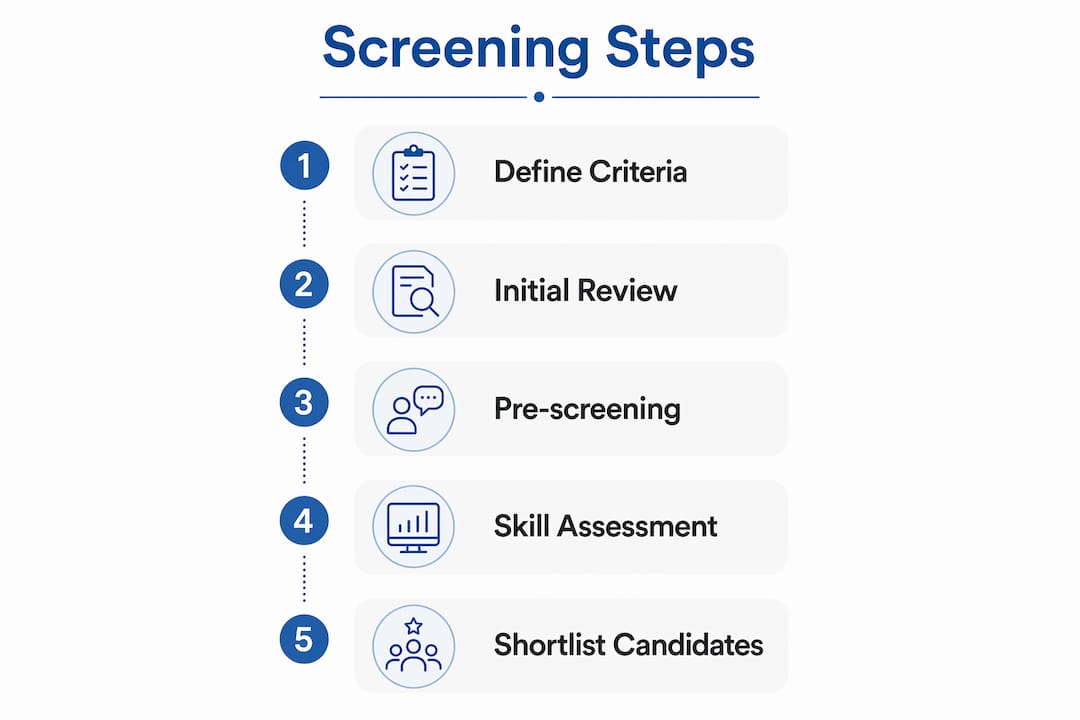
The 2026 screening process commonly involves five sequential stages:
- Criteria definition. Before reviewing a single resume, define the non-negotiable qualifications for the role. These include required certifications, minimum years of experience, and specific technical skills. A well-written job posting, like those outlined in effective job posting practices, reduces misalignment at this stage.
- Initial application review. An applicant tracking system (ATS) filters applications against keyword criteria and knockout questions. This stage removes obviously unqualified candidates without consuming recruiter time.
- Pre-screening. This includes phone screens, written questionnaires, or async video responses. Async video has become the most efficient format at scale.
- Skills assessments. Role-specific tests verify technical competency before a hiring manager invests time in a full interview.
- Final shortlisting. Recruiters score remaining candidates against the rubric and pass the top tier to the interview panel.
The efficiency gains at stage three are significant. Async video screening can reduce 12 hours of phone screening review to approximately 90 minutes when reviewed at double speed. That time savings compounds across every open role in a high-volume hiring cycle.
Pro Tip: Keep async video requests to a 10–15 minute candidate time commitment. Requests that exceed 15 minutes drive up abandonment rates and shrink your qualified pool before screening even finishes.

How Do Structured Frameworks Like SCORE Reduce Bias?
Subjective screening produces inconsistent results. Two recruiters reviewing the same resume often reach different conclusions, not because one is wrong, but because neither is working from a shared standard. The SCORE framework solves this.
SCORE requires that every evaluation criterion be:
- Specific: Tied to a defined competency or job requirement, not a vague trait like “culture fit.”
- Consistent: Applied identically to every candidate in the same role.
- Observable: Based on documented behaviors or examples the candidate provides, not impressions.
- Recorded: Linked to written evidence from the screening interaction, not recalled from memory.
The recorded requirement is the most legally significant. When every score connects to documented evidence, hiring decisions become defensible in compliance reviews and internal audits. That matters for any organization subject to EEOC standards or state-level employment law.
Building a SCORE rubric starts with the job description. Each required competency becomes a scored criterion. Recruiters then assign point values and write anchor descriptions for each level, so a “3 out of 5” means the same thing to every evaluator on the team.
| Criterion | Observable indicator | Score anchor (3/5) |
|---|---|---|
| Technical skill | Candidate demonstrates tool proficiency with a documented example | Describes correct method with one real example |
| Communication | Candidate explains complex ideas clearly in writing or video | Response is clear and organized, minor gaps |
| Problem-solving | Candidate walks through a past challenge with measurable outcome | Identifies problem and solution, outcome partially quantified |
Pro Tip: Have each recruiter score candidates independently before any team discussion. Top practitioners score independently to preserve signal integrity and prevent anchoring bias from influencing the group.
What Best Practices and Pitfalls Should Hiring Managers Know?
Structured screening frameworks only work when the process around them is equally disciplined. Several common mistakes undermine even well-designed rubrics.
Automate knockout questions first. Non-negotiable criteria, such as required licenses, work authorization, or minimum education, should be handled by automated knockout questions at the application stage. Automating these filters frees recruiter judgment for the candidates who actually warrant it.
Schedule human review early in the week. Manual resume screening done late in the week produces higher false negative rates. Fatigued reviewers miss qualified candidates. Front-loading review to Monday and Tuesday, when judgment is sharpest, measurably reduces this error.
Standardize questions across all candidates. Applying the same core questions to every applicant is the only way to generate comparable data. Without standardization, you are comparing apples to oranges and calling it a decision.
Focus on observable evidence, not vague traits. Scoring a candidate on “confidence” or “executive presence” introduces anchoring bias and produces legally indefensible decisions. Score on documented behaviors instead. For example, “candidate described a specific project outcome with quantified results” is observable. “Candidate seemed confident” is not.
Protect the candidate experience. Screening that feels disorganized or disrespectful drives away qualified applicants. Consistent communication timelines, clear instructions for async video tasks, and techniques for comfortable video interviews all reduce drop-off and improve the quality of the pool you are working with.
Pro Tip: Review your staffing best practices annually. Screening processes that worked for 50 applicants often break down at 500. Build for the volume you expect, not the volume you have today.
How Does Screening Differ from Candidate Evaluation and Interviewing?
Screening and evaluation are not interchangeable terms. They describe distinct phases with different goals, tools, and resource requirements.
Screening is early-stage filtering. Its purpose is elimination: removing applicants who do not meet minimum qualifications before investing significant recruiter or hiring manager time. Screening measures against must-have criteria and produces a yes/no or pass/fail outcome. The candidate selection methods used here are designed for speed and consistency across large volumes.
Evaluation is the deeper phase that follows. It assesses skills, motivation, cultural contribution, and growth potential among candidates who have already passed screening. Evaluation uses structured interviews, work samples, reference checks, and panel discussions. Its goal is not elimination but differentiation: identifying the best fit from a qualified pool.
The transition point between the two phases is the shortlist. Once screening produces a shortlist, the candidate evaluation process shifts from filtering to ranking. Resources, including hiring manager time and structured interview scorecards, are concentrated on this smaller group. Mixing the two phases, such as running deep behavioral interviews on unscreened candidates, wastes time and distorts the data you collect.
A practical rule: if the question is “does this candidate qualify?” you are screening. If the question is “which of these qualified candidates is the best fit?” you are evaluating. Keeping those questions in separate stages protects both process quality and cost-per-hire. For roles requiring industry-specialized recruiting, the screening criteria and evaluation depth will differ significantly from general hiring.
Key Takeaways
Effective candidate screening requires structured criteria, consistent application, and deliberate timing to reduce false negatives and produce defensible hiring decisions.
| Point | Details |
|---|---|
| Define criteria before reviewing | Set specific, role-based qualifications before opening the applicant pool to avoid subjective filtering. |
| Use SCORE for objectivity | Tie every evaluation score to observable, recorded evidence to reduce bias and support legal compliance. |
| Automate knockout questions | Filter non-negotiables automatically so recruiter time goes to candidates who genuinely warrant review. |
| Schedule review early in the week | Human screening accuracy drops later in the week; front-load review to reduce false negatives. |
| Separate screening from evaluation | Screening eliminates unqualified applicants; evaluation ranks qualified ones. Keep these phases distinct. |
What I’ve Learned About Screening That Most Guides Won’t Tell You
The biggest mistake I see in high-volume hiring is treating screening as a cost-reduction exercise rather than a signal-preservation exercise. Teams obsess over cutting the applicant pool fast. They automate aggressively, set tight keyword filters, and declare the process efficient. Then they wonder why their interview-to-offer ratio is low and their new hires are underperforming.
The real goal of screening is not to shrink the pile. It is to protect the signal. Every qualified candidate who gets filtered out by a tired recruiter on a Friday afternoon, or by an ATS that penalizes non-traditional career paths, is a false negative that costs you. You never see the cost because you never see the candidate again. That invisibility makes it easy to ignore.
The SCORE framework changed how I think about this. When you require observable, recorded evidence for every score, you stop rewarding candidates who interview well and start rewarding candidates who actually did the work. That shift alone improves retention rates more than most hiring managers expect.
The other thing I have found: timing is not a soft variable. Scheduling bulk resume review for Monday morning instead of Friday afternoon is a process decision with measurable impact on accuracy. You cannot improve what you do not measure, and most teams are not measuring false negative rates at all. Start there.
Conversational AI tools are entering the pre-screening stage quickly, and they will change the volume problem significantly. But the frameworks, SCORE, standardized questions, observable evidence, will remain the foundation. Technology changes the speed. Structure determines the quality.
— Bradford
How Careerscape Supports Structured Candidate Screening
Careerscape, builds hiring processes around the same structured principles described in this guide. Whether you need contract staffing solutions for a short-term surge or direct hire services for a permanent role, Careerscape applies defined screening criteria, standardized evaluation methods, and industry-specific expertise to every search. The firm specializes in connecting qualified professionals with companies that need to hire fast without sacrificing quality. If your current screening process is producing inconsistent shortlists or high time-to-fill, Careerscape’s recruiters can step in with a process that is built to perform at volume. Reach out to discuss your hiring needs and get a structured screening approach working for your team.
FAQ
What Is Candidate Screening in Recruitment?
Candidate screening is the process of evaluating job applicants against defined role criteria to identify who qualifies for further consideration. It filters large applicant pools down to a manageable shortlist before interviews begin.
How Many Stages Does a Standard Screening Process Include?
A standard screening process includes five stages: criteria definition, initial application review, pre-screening, skills assessment, and final shortlisting. Each stage progressively narrows the candidate pool using increasingly specific evaluation methods.
What Is the SCORE Framework in Candidate Screening?
SCORE stands for Specific, Consistent, Observable, and Recorded criteria. It is a structured evaluation method that ties every screening score to documented evidence, reducing bias and producing legally defensible hiring decisions.
How Do I Reduce False Negatives During Screening?
Schedule manual resume review early in the week when recruiter judgment is sharpest, automate knockout questions for non-negotiable criteria, and use standardized scoring rubrics to reduce subjective filtering errors.
What Is the Difference Between Screening and Candidate Evaluation?
Screening filters applicants against minimum qualifications to eliminate the unqualified. Candidate evaluation assesses the remaining qualified candidates in depth to identify the best fit for the role.
Recommended
- What is recruiting? The employer’s guide to modern hiring
- How to Shortlist Applicants: A Hiring Manager’s Guide