
Employers should avoid asking illegal interview questions related to age, disability, national origin, and other protected traits to mitigate legal risks of discrimination claims. Instead, they should focus on job-related inquiries that assess a candidate's qualifications without gathering unnecessary personal information. Candidates faced with illegal questions can respond briefly, redirect to their qualifications, or inquire about the relevance of the question, and should document any patterns of inappropriate questioning for potential reporting.
- Employers should avoid asking about age, religion, race, or medical history before a job offer to reduce legal exposure to discrimination claims.
- Questions about citizenship, family status, or pregnancy should be replaced with job-related inquiries about schedule adherence and ability to perform tasks.
- Asking about medical conditions or disabilities before a conditional offer is illegal under the ADA, so questions should focus strictly on job abilities.
- Structured interview guides centered on job requirements help prevent accidental illegal questions and protect both candidates and employers.
- Candidates can respond to illegal questions with brief answers, redirects, or by asking about relevance, and should document patterns of inappropriate questioning.
In this article
Several common interview questions carry real legal exposure under U.S. federal law, and asking one doesn’t require bad intent to trigger a discrimination claim. Federal statutes restrict questions tied to age, disability, national origin, and other protected traits, while the Americans with Disabilities Act (ADA) blocks most pre-offer medical inquiries outright. If you’re a candidate facing one of these questions, you have three practical options: answer, redirect, or ask why it’s relevant. Employers avoid the risk entirely by scripting interviews around job requirements.
Illegal Interview Questions by Protected Characteristic
Federal law doesn’t ban every question that touches a personal characteristic, but the EEOC warns that these inquiries often become evidence of discriminatory intent when a rejected candidate later files a charge. Below are the categories that generate the most complaints, paired with the job-related version employers can ask instead.
- National origin/citizenship: Avoid “Where were you born?” or “Is English your first language?” Ask instead: “Are you legally authorized to work in the United States?” For more on national-origin discrimination and English-only policy risks, see National Origin Discrimination: Your Legal Rights Explained.
- Age: Avoid “How old are you?” or “When did you graduate high school?” Ask instead: “Are you at least 18 years old?” (required for certain roles).
- Disability/medical history: Avoid “Do you have any disabilities?” or “Have you filed workers’ comp claims?” Ask instead: “Can you perform these specific job tasks, with or without accommodation?”
- Marital/family status: Avoid “Are you married?” or “Do you plan to have children?” Ask instead: “Can you meet this schedule, including occasional overtime or travel?”
- Pregnancy: Avoid “Are you pregnant?” Ask instead: “Are you able to perform the essential functions of this role?”
- Religion: Avoid “What religion do you practice?” or “Do you observe holidays that conflict with our schedule?” Ask instead: “This role requires weekend availability. Can you meet that requirement?”
- Race/ethnicity: Avoid any direct or indirect question about race or ethnic background. There is no legal alternative; this line of inquiry has no job-related justification.
- Genetic information: Avoid “Does a specific illness run in your family?” There’s no legal version of this question; GINA prohibits it outright.
- Arrest/conviction history: Avoid open-ended “Have you ever been arrested?” Ask instead a narrowly tailored, job-related question about convictions, where state law permits it.
- Language/accent: Avoid “Where did you get that accent?” Ask instead: “This role requires fluent spoken English for client calls. Are you comfortable with that?”
The ADA’s rule deserves its own callout: pre-offer questions about medical conditions, prescriptions, or past injuries are prohibited regardless of how they’re phrased, and employers can only ask about ability to perform specific, documented job tasks. State law adds another layer. Many states ban salary-history questions, and a growing number restrict how employers can use conviction records, so check your state’s guidance before finalizing an interview script.
Why These Questions Create Legal Risk, Even When They’re Not Explicitly Banned
Most of these questions aren’t criminal to ask. What they create is exposure: once an employer knows a candidate’s age, religion, or family status, a rejected applicant can argue that knowledge factored into the decision, even if it didn’t. The EEOC’s own guidance makes this point directly. Interviews that stay locked on qualifications are simpler to defend precisely because the employer never collected the information a plaintiff would need to build a discrimination case.
The ADA is the clear exception to the “it’s not technically illegal” rule. Disability-related and medical questions are generally prohibited before a conditional job offer is made, full stop, which is a stricter standard than Title VII’s evidentiary approach to race, sex, or religion.
Work authorization questions sit in their own gray zone. The Department of Justice’s Immigrant and Employee Rights Section has issued a technical assistance letter warning employers against asking about citizenship status, green card details, or visa sponsorship needs beyond the two permissible questions: whether the candidate is authorized to work in the U.S., and whether they’ll need sponsorship now or in the future. Going further, according to LegalClarity’s analysis, risks violating the Immigration and Nationality Act’s anti-discrimination provisions, since deeper immigration questions tend to deter or confuse candidates who are fully authorized to work.
The consequences scale with the pattern. A single awkward question rarely triggers a lawsuit, but a documented pattern across multiple interviews can support an EEOC charge, a DOJ referral, or a state civil rights complaint, and any of those can turn into costly discovery, settlement pressure, or reputational damage well before a case reaches trial.
What to Do If You’re Asked an Illegal Question
You don’t need a legal background to handle this well. Career offices, including Yale’s Office of Career Strategy, teach candidates three responses that work in almost any interview setting:
- Answer briefly, if you’re comfortable. Sometimes the fastest path forward is a short, factual answer that doesn’t invite follow-up. “Yes, I’m available for full-time work” closes the loop on a disguised age or family-status question without opening a longer conversation.
- Redirect to your qualifications. Reframe the question around what the employer actually needs to know. If asked about childcare plans, try: “I can commit fully to this schedule, and I’m confident in my ability to meet these deadlines.”
- Ask about relevance. A calm, direct question often resets the conversation: “Can you help me understand how that relates to the role?” Most interviewers back off immediately once they realize the question crossed a line.
If a question feels like part of a pattern rather than a one-off slip, jot down the date, the interviewer’s name, and the exact wording as soon as you can. That note becomes useful if you decide to raise it with HR or file a charge with the EEOC or your state’s fair employment agency later.
Pro Tip: Keep your response calm and professional in the moment. Save the documentation and escalation for after the interview. Reacting visibly during the conversation rarely helps your candidacy and almost never changes the interviewer’s behavior on the spot.
How Employers Can Build Interviews That Avoid These Questions Entirely
The fix isn’t a memorized list of banned topics. It’s a structural change to how interviews get built and run.
- Script every interview around job requirements. A structured guide with pre-approved questions keeps interviewers from improvising into risky territory. Careerscape’s equal employment guidance walks through how to keep screening conversations qualifications-first.
- Train interviewers, not just HR. Hiring managers who haven’t reviewed the rules recently are the most common source of accidental violations, often through small talk that veers into family status or national origin.
- Standardize scoring rubrics. Consistent scorecards make it obvious when a rejection is tied to job criteria rather than personal characteristics, which matters enormously if a decision is ever challenged.
- Keep documentation and audit trails. Interview notes, scoring sheets, and application records should tell the same consistent story about why a candidate was or wasn’t advanced.
- Centralize application intake. A standardized application process reduces the chance that informal conversations introduce protected-class information that never should have entered the file.
For work authorization, stick to the DOJ’s two approved questions. For physical or ability-based requirements, phrase questions around specific, documented tasks rather than general health status. For scheduling, ask about availability for the actual hours and travel the role requires, not about family obligations that might affect it.
Pro Tip: Build a one-page “job facts” sheet listing the essential physical and scheduling demands of the role before you write a single interview question. Every question you ask should trace back to something on that sheet. If it doesn’t, cut it.
Where to Verify the Rules and Get Help
Start with primary sources rather than secondhand summaries. The EEOC’s employer guidance on hiring questions and its broader Q&A factsheet cover Title VII, ADA, ADEA, and GINA in plain language. The DOJ IER letter settles the work-authorization wording question directly.
- Federal: EEOC employer guidance and EEOC Q&A factsheet
- Immigration-specific: DOJ IER technical assistance letter
- State-level: check your state labor agency for conviction-record and salary-history rules
- General federal contacts: Usa
Employers should treat any outdated script as an immediate fix, not a future project. Job seekers who suspect a pattern of illegal questioning should document it the same day, while details are fresh.
Why Structured Interviews Matter More Than a Banned-Questions List
Most hiring managers who ask an illegal question aren’t trying to discriminate. They’re making conversation, and personal questions feel natural in a room built around rapport. That’s exactly the problem. Good intentions don’t hold up in an EEOC charge, and “I was just being friendly” has never been a legal defense.
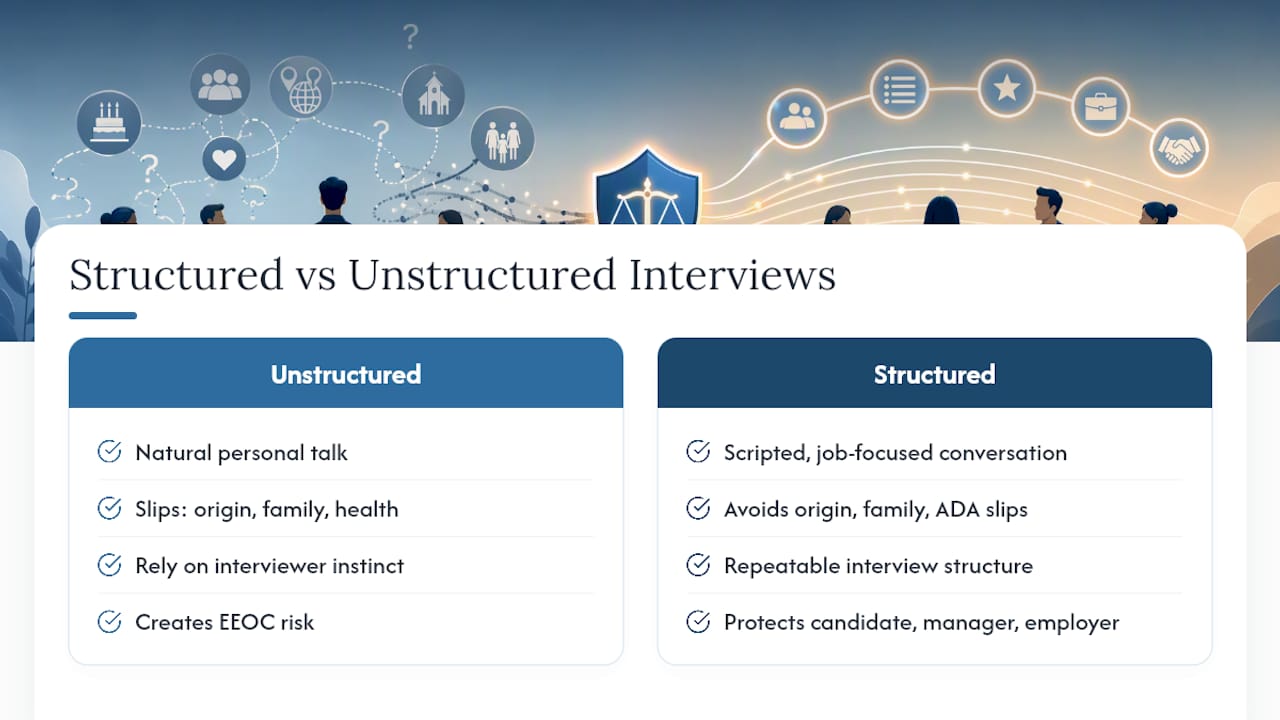
Structured interview guides built into every search provide a scripted, job-focused conversation that protects the candidate, the hiring manager, and the employer all at once. National-origin questions disguised as small talk, scheduling questions that slide into family-status territory, casual health check-ins that cross the ADA line: these show up constantly in unscripted interviews, and they’re avoidable with the right framework in place before the first candidate walks in.
Employers who want a fair, defensible hiring process don’t need to memorize case law. They need a repeatable interview structure and a team trained to use it. Careerscape works with hiring teams to build that structure through contract staffing engagements and direct hire placements, bringing structured screening and compliant interview templates into every search from day one. If your current process still relies on interviewer instinct, that’s the first thing worth fixing.
— Bradford
FAQ
What Are Five Illegal Interview Questions?
Common examples include asking about a candidate’s age, marital or family status, religion, national origin, and any medical or disability history before a job offer is made. Each one risks violating Title VII, the ADEA, or the ADA depending on the wording.
What Are Some Illegal Interview Questions Employers Should Watch for in 2026?
The core list hasn’t changed much: age, disability, pregnancy, religion, national origin, and genetic information remain the highest-risk categories. What has shifted is state-level enforcement, with more states banning salary-history questions and restricting how conviction records can be used.
Which Interview Question Is Prohibited by Law?
Questions about a candidate’s disability or medical history before a conditional job offer are prohibited under the ADA, making them one of the clearest, most consistently enforced restrictions in hiring law.
What Is Illegal for an Interviewer to Ask?
An interviewer generally can’t ask about a candidate’s age, race, national origin, religion, disability, genetic information, pregnancy status, or citizenship details beyond basic work authorization. The safer approach is asking only about the specific skills and requirements the job demands.