
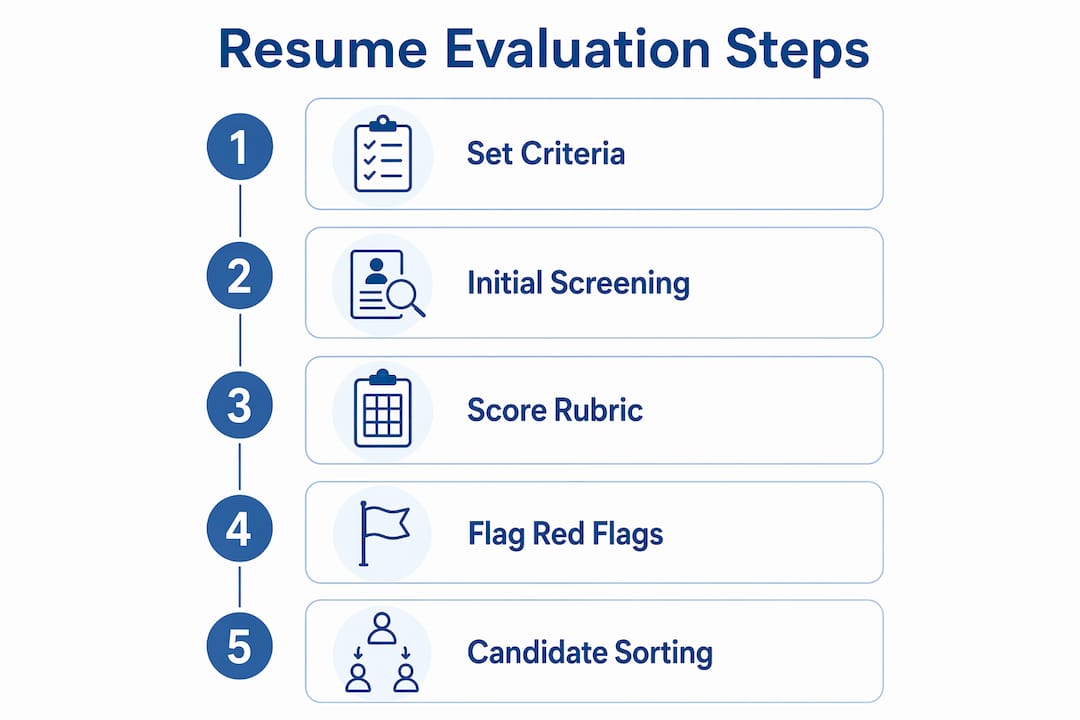
Effective resume evaluation requires establishing clear, job-relevant criteria before reviewing applications to minimize bias and streamline the hiring process. Hiring managers should identify 3-5 must-have criteria, perform an initial quick scan to eliminate unqualified candidates, and utilize a structured scoring rubric to rank candidates consistently. Red flags in resumes should be approached as signals for further inquiry rather than automatic disqualifiers, allowing for a more nuanced understanding of a candidate's qualifications.
In this article
Resume evaluation is the process of applying structured, job-relevant criteria to identify which candidates qualify for further assessment. Done well, it protects your time, reduces cost-per-hire, and builds a defensible talent pipeline. Done poorly, it lets unconscious bias fill your interview calendar with the wrong people. This guide gives hiring managers and HR professionals a repeatable system for screening, scoring, and ranking candidates with consistency and speed.
How to Evaluate Resumes: Setting Criteria Before You Start
The single most common mistake in resume review is starting without defined criteria. Before you open the first application, your hiring team needs consensus on what “qualified” actually means for this specific role.
Build a short list of 3–5 must-have criteria. These are binary gates: a candidate either meets them or does not. Common must-haves include a required license or certification, a minimum years of experience in a specific function, or a technical skill the role cannot operate without. Writing a clear job posting before screening begins forces this clarity and directly improves the quality of your applicant pool.

Separate must-haves from nice-to-haves. Nice-to-haves are ranking factors, not gates. A candidate who meets all must-haves but lacks a nice-to-have still advances. A candidate who has every nice-to-have but misses one must-have does not. This distinction prevents hiring managers from unconsciously favoring candidates who look impressive on paper but cannot perform the core job.
Involve the full hiring team in setting criteria before review begins. Disagreements about what matters most are far easier to resolve before 200 resumes arrive than after. Document the agreed criteria in writing. That document becomes the foundation of your scoring rubric and your legal defense if a hiring decision is ever challenged.
Pro Tip: Use targeted application questions tied directly to your must-have criteria. Screening questions can eliminate 40–50% of unqualified applicants before manual resume review even begins, which means your team spends time only on candidates who already cleared the first gate.
How to Perform an Efficient Initial Resume Screening Pass
Speed and consistency define a good first pass. The goal is not to find the perfect candidate. The goal is to remove candidates who clearly do not qualify.
Experienced recruiters use a six-second scan to identify immediate deal-breakers during initial review. That means your eyes go to three or four specific spots on the page, not the whole document. The initial pass should be binary: yes or no, based on must-haves only.
Here is a reliable sequence for the first pass:
- Check location or work authorization. If the role requires on-site presence in a specific city and the candidate lists a different state with no mention of relocation, that is a deal-breaker. Flag it immediately.
- Verify required credentials. If a license, certification, or degree is mandatory, confirm it appears. Do not assume it exists because the candidate sounds experienced.
- Scan for the core skill or function. A software engineer role requiring Python experience should show Python somewhere in the first half of the resume. If it does not appear at all, move on.
- Check for mandatory portfolio or work sample links. Some roles list a portfolio as a hard requirement. A missing link is a missing requirement.
AI screening tools work well as a first filter when application volume is high. They process large batches quickly and flag candidates who match keyword criteria. The risk is that AI misses edge cases: a candidate who used a different job title for the same function, or one who built a skill through project work rather than a formal role. Pair AI filtering with human spot checks on a sample of rejected applications to catch those cases.
Pro Tip: The initial screening pass should take 10–15 seconds per resume at most. If you are spending longer, you are doing second-pass work during the first pass. Save deeper reading for candidates who clear the binary gate.
How to Score and Rank Resumes Using a Structured Rubric
A scoring rubric converts subjective impressions into numbers you can defend. Without one, two reviewers evaluating the same resume will reach different conclusions, and neither can explain exactly why.
Assign weighted criteria based on what the role actually requires. Technical skills typically carry the highest weight, at 25–35% of the total score, followed by relevant experience at 20–30%. Education receives lower weight unless the role legally requires a specific degree. That weighting reflects what actually predicts job performance, not what looks impressive.
Limit your rubric to 5–6 criteria. More than that creates scoring fatigue and reduces consistency. Each criterion gets a 1-to-5 scale with written descriptions at each level. “5” is not “great resume.” It is a specific, observable standard: “Candidate has 5+ years of direct experience in the required function with documented results.”
| Criterion | Weight | Score (1–5) | Weighted Score |
|---|---|---|---|
| Technical skills | 30% | 4 | 1.20 |
| Relevant experience | 25% | 5 | 1.25 |
| Industry knowledge | 20% | 3 | 0.60 |
| Communication clarity | 15% | 4 | 0.60 |
| Education/credentials | 10% | 3 | 0.30 |
Once scores are calculated, rank candidates by total weighted score. The ranking removes the “gut feel” problem. A candidate who scores 4.1 advances over one who scores 3.3, regardless of which resume looked more polished at first glance.
Unstructured resume review allows unconscious bias to enter the process, often overvaluing prestige factors like a recognizable company name or a well-known university. A structured rubric aligned with EEOC guidelines keeps criteria job-relevant and makes your hiring decisions repeatable and legally defensible.
What Red Flags Should You Consider Carefully Rather than Strictly Reject?
Red flags on a resume are signals, not verdicts. Treating them as automatic rejections causes you to discard candidates who may be exactly right for the role.
The most common flags hiring managers encounter include:
- Employment gaps over six months. A gap may reflect caregiving, a health issue, a layoff during an industry downturn, or a deliberate career pivot. Context often explains gaps in ways that do not reflect on job performance at all.
- Frequent short tenures. Three jobs in two years looks unstable. It may also reflect contract work, company acquisitions, or an industry where short engagements are standard. Check the pattern before drawing a conclusion.
- Inconsistencies between job titles and described responsibilities. A candidate listed as “coordinator” who claims to have managed a team of 12 and owned a $2M budget warrants a clarifying question, not an immediate rejection.
- Vague language throughout. Words like “helped,” “assisted,” and “supported” reveal little about what the candidate actually did. Active, impact-oriented verbs like “owned,” “built,” and “reduced” signal accountability and a clear sense of personal contribution.
Spotting meaningful achievements versus generic duty lists is one of the most reliable ways to separate strong candidates from average ones. A resume that says “managed social media accounts” tells you nothing. One that says “grew organic reach by 40% in six months by restructuring content cadence” tells you exactly what the candidate can do.
Plan to investigate red flags during a screening call rather than using them as a filter. A 10-minute phone screen can resolve most ambiguities. Avoiding unconscious bias also means keeping your evaluation criteria job-relevant. Penalizing a candidate for attending a less prestigious school or for a gap explained by caregiving or health is both unfair and legally risky.
Pro Tip: Create a “flag for follow-up” column in your rubric. When a red flag appears, note it and move on. Address it in the screening call. This keeps your first-pass scoring focused on qualifications, not speculation.
How to Organize and Prioritize Candidates After Resume Evaluation
After scoring, you need a system to sort candidates without losing track of strong ones or wasting time on weak ones. The three-bucket method is the most practical approach.
- Yes. This candidate meets all must-have criteria and scores well on the rubric. Their resume shows clear achievements, not just duties. They move directly to the interview invitation queue.
- Maybe. This candidate meets most must-haves but has a partial match on one criterion, or their rubric score falls in the middle range. They do not get an interview invitation yet. They get one if the “Yes” pile does not produce enough candidates to fill your interview slots.
- No. This candidate failed one or more must-have criteria or scored below the threshold on the rubric. They receive a timely rejection.
The three-bucket sorting system reduces wasted time on borderline candidates and keeps your interview calendar focused. Limiting interview invitations to the top candidates by rubric score maintains quality and prevents panel fatigue.
Timing matters here. Send rejections and interview invitations promptly. Candidates who wait two weeks without communication often accept other offers. Prompt communication also protects your employer brand. A structured shortlisting process that moves quickly signals to candidates that your organization is organized and respectful of their time.
Key Takeaways
A structured resume evaluation process built on defined criteria, weighted scoring, and a three-bucket sorting system produces faster, fairer, and more defensible hiring decisions.
| Point | Details |
|---|---|
| Define criteria first | Agree on 3–5 must-have criteria with your hiring team before reviewing a single resume. |
| Use binary first-pass screening | Spend 10–15 seconds per resume checking must-haves only; save deeper review for qualified candidates. |
| Score with a weighted rubric | Weight technical skills at 25–35% and experience at 20–30% to reflect actual job performance predictors. |
| Investigate red flags, don’t reject them | Use screening calls to gather context on gaps, short tenures, or vague language before making a decision. |
| Sort into three buckets | Categorize candidates as Yes, Maybe, or No to keep your interview pipeline focused and manageable. |
What Structured Review Taught Me About Hiring Better
The most expensive mistake I see hiring managers make is treating resume review as a reading exercise rather than a filtering system. They read every word of every resume, form an impression, and then struggle to explain why they advanced one candidate over another. That approach wastes hours and invites bias into every decision.
The shift that changes outcomes is treating the first pass as triage, not evaluation. You are not deciding who is best. You are deciding who clears the minimum bar. That mental shift alone cuts review time significantly and forces you to be honest about what the role actually requires.
The red flag nuance matters more than most hiring guides admit. I have seen candidates with two-year gaps become top performers because the gap was for a reason that had nothing to do with their professional capability. Automatic rejection rules feel efficient, but they cost you candidates the market will happily hire instead.
The rubric is not bureaucracy. It is the tool that lets you explain every hiring decision in plain language, to your team, to your legal department, and to yourself six months later when you are wondering why a hire did not work out. You can’t improve what you don’t measure, and a rubric gives you the data to measure it.
— Bradford
Careerscape Connects You with Qualified Candidates Faster
Careerscape (Careerscape) is built for hiring managers who need qualified candidates without the volume problem. The firm’s contract staffing solutions and direct hire services give you pre-screened candidates matched to your specific role criteria, so your team spends time evaluating the right people rather than filtering out the wrong ones. Industry-specialized recruiters at Careerscape understand the technical and functional requirements of your roles, which means the resumes that reach your desk already reflect the must-haves you care about. Contact Careerscape to build a hiring process that works from the first application to the final offer.
FAQ
What Is the Most Effective Way to Screen Resumes Quickly?
Use a binary yes/no pass focused on 3–5 must-have criteria, spending 10–15 seconds per resume. Experienced recruiters scan for deal-breakers first rather than searching for the ideal candidate.
How Do You Score Resumes Fairly and Consistently?
Apply a weighted rubric with 5–6 criteria, scoring each on a 1-to-5 scale with written descriptions at every level. Weighting technical skills at 25–35% and experience at 20–30% aligns scores with actual job performance predictors.
Should Employment Gaps Automatically Disqualify a Candidate?
No. Employment gaps are signals to investigate, not automatic disqualifiers. A brief screening call often reveals context, such as caregiving, health, or a layoff, that has no bearing on job performance.
How Many Candidates Should You Invite to Interview?
Limit interview invitations to the top-scoring candidates from your rubric review. Keeping the pool focused on your strongest “Yes” bucket maintains quality and prevents panel fatigue.
How Does a Structured Rubric Protect Against Bias?
A rubric keeps all evaluation criteria job-relevant and documented, which reduces the influence of prestige factors like university name or employer brand. This approach aligns with EEOC guidelines and produces legally defensible hiring decisions.