
- Structured reference calls with standardized questions across verification, performance, behavior, and red flags significantly improve the accuracy of hiring decisions.
- Calling at least three references, preferably including direct supervisors and a blind contact for senior roles, ensures a comprehensive evaluation.
- Phone interviews lasting 15 to 20 minutes allow for consistent scoring, probing for specifics, and avoiding vague praise that clouds judgment.
- References should be asked about concrete achievements, specific examples, and how candidates compare to peers, with proper compliance and documentation.
- Avoid questions on protected characteristics and salary history, and follow legal guidelines to mitigate risks and maintain defensibility.
In this article
The most reliable reference checks follow a short, structured script instead of a casual chat. Call each reference, ask the same core questions in the same order, and move through five groups: verification, performance, behavior, red flags, and closing. Plan on a short, focused call per reference and contacting multiple people, with an optional additional blind reference for senior hires.
Reference Check Questions Employers Should Ask, Grouped by Purpose
A modular script beats a mental checklist because it produces comparable data across every finalist. Structured phone interviews that use the same job-related questions and standardized rating procedures improve the predictive value of what references tell you, according to OPM’s reference-checking guidance. Below are the question groups worth building into your own form.
1. Verification questions
- Can you confirm their job title, employment dates, and who they reported to?
- Is this person eligible for rehire?
- Did their responsibilities match what’s listed on their resume?
2. Performance questions
- Can you describe one or two specific accomplishments from their time in this role?
- How was that performance measured (sales numbers, project deadlines, customer scores)?
- How did their output compare to others doing similar work?
3. Behavioral questions
- Tell me about a time this person handled a conflict with a coworker or manager.
- How did they communicate with the team under deadline pressure?
- Did they take on any informal or formal leadership responsibilities?
4. Fit and stress questions
- What tends to stress this person out, and how do they typically respond?
- What kind of environment or management style helps them do their best work?
5. Red flag questions
Frame these around job requirements, never personal characteristics. Ask about attendance patterns, whether any performance or disciplinary issues came up, and the real reason they left the role. A hesitant or clipped answer here is often as informative as the words themselves.
6. Closing questions
- On a scale of 1 to 10, how strongly would you endorse this person for a similar role?
- Is there anyone else on your team I should talk to?
- Is there anything about this candidate that isn’t on their resume but that I should know?
That last question routinely surfaces the most useful detail on the call, according to TechCrunch’s reporting on reference-call best practices. References often hold back their best insight until you explicitly invite it.
Who to Call, How Many References, and When to Schedule It
Direct supervisors give you the most reliable performance data because they made the actual decisions about raises, projects, and reviews. Peers and direct reports fill in the gaps, especially around teamwork and how the candidate leads when no one’s grading them on it.
- Use a 2+1 approach: two references the candidate supplies, plus one blind or back-channel contact when the role is senior or high-risk.
- Confirm the reference’s exact role and relationship to the candidate before asking a single performance question. A reference who barely worked with the candidate is worth far less than one who managed them daily.
- Schedule checks after you’ve narrowed to finalists, or after a conditional offer. Checking earlier saves time on a mismatch; checking later avoids offending references before you’re serious about a candidate.
- At least three contacts is a reasonable minimum for anything beyond an entry-level hire, per OPM’s guidance.
Phone calls consistently produce richer answers than emailed reference forms, because you can push back on vague responses in real time instead of accepting whatever gets typed into a form.
How to Run the Call: Script, Timing, and Probing Techniques
Open with a short, friendly script: introduce yourself, confirm the reference has a few minutes, and explain you’ll ask about the candidate’s work in a previous role. From there, a 15 to 20 minute call typically breaks down like this:
- Opening and rapport (1 to 2 minutes)
- Verification questions (2 to 3 minutes)
- Four to six core performance and behavioral questions (8 to 10 minutes)
- Follow-up probes on any vague or interesting answers (3 to 5 minutes)
- Closing questions and endorsement score (2 minutes)
Ask the same core questions across every finalist, and score key competencies on a consistent scale. That consistency is what makes the data defensible later, if a hiring decision ever gets questioned.
The best probing technique is forcing a number out of a vague opinion. Instead of accepting “she was great,” ask the reference to rank the candidate against others they’ve supervised, or to give a 1 to 10 endorsement score. Forcing quantitative answers this way tends to surface a clearer, more honest signal than open-ended praise, according to Andy Bromberg’s writing on getting the truth from reference calls. Granting permission to be candid works the same way: referencing something the candidate already admitted (“They mentioned deadlines were sometimes tight for them, can you speak to that?”) makes references far more comfortable being honest about weaknesses.
Pro Tip: When an answer feels vague, ask for a specific example, the outcome of that example, and how the candidate stacked up against one or two peers doing similar work. Vague praise collapses fast once you ask for specifics.
Legal Limits, Compliance, and Simple Recordkeeping
Reference checks carry real legal exposure if you ask the wrong questions or skip required steps. Keep the conversation entirely job-related.
- Never ask about race, religion, pregnancy, disability, national origin, age, or other protected characteristics, and never let a reference’s unsolicited comment on these topics factor into your decision.
- If you use a third-party vendor to run checks, follow FCRA requirements: proper notice, written authorization, and adverse-action steps if the results affect your hiring decision.
- Many states and cities now ban salary-history questions; check your local rules before asking a reference (or the candidate) about past pay.
- Document who you called, when, what you asked, and what job-related findings came out of it. That documentation is your best defense if a hiring decision is ever challenged.
Best-practice checklists consistently point to the same combination: written authorization, a consistent question set, and retained records tied directly to the hiring decision, according to ADP’s checklist for conducting reference checks.
Turning Reference Answers Into an Actual Hiring Decision
Specific examples beat generic praise every time. A reference who says “she cut onboarding time by fixing our training doc” tells you more than one who says “she’s great, everyone loves her.”
- When references disagree, look for the common thread rather than picking the answer you like best, and consider re-interviewing the candidate about the specific concern that came up.
- Use the 1 to 10 endorsement score and any rank-order answers as tiebreakers when two finalists otherwise look equally strong.
- Write down how the reference findings actually shaped your final call. That record matters if you need to explain the decision later, and it sharpens your process the next time you hire for a similar role.
How Careerscape Builds and Runs These Checks
Careerscape aligns every reference script to the actual job analysis for the role, not a generic template, because a script built for a customer service lead shouldn’t look like one built for a director of engineering. Bradford, who leads much of Careerscape’s structured hiring work, has watched enough placements go sideways from a skipped or sloppy reference check to insist on the same rating scale across every finalist for a given role. On senior or high-stakes searches, that discipline is what separates a defensible hire from a guess dressed up as one. Outsourcing structured checks on those roles frees up internal time and produces cleaner documentation than most internal teams manage on their own.

Careerscape Handles the Calls So You Don’t Have To
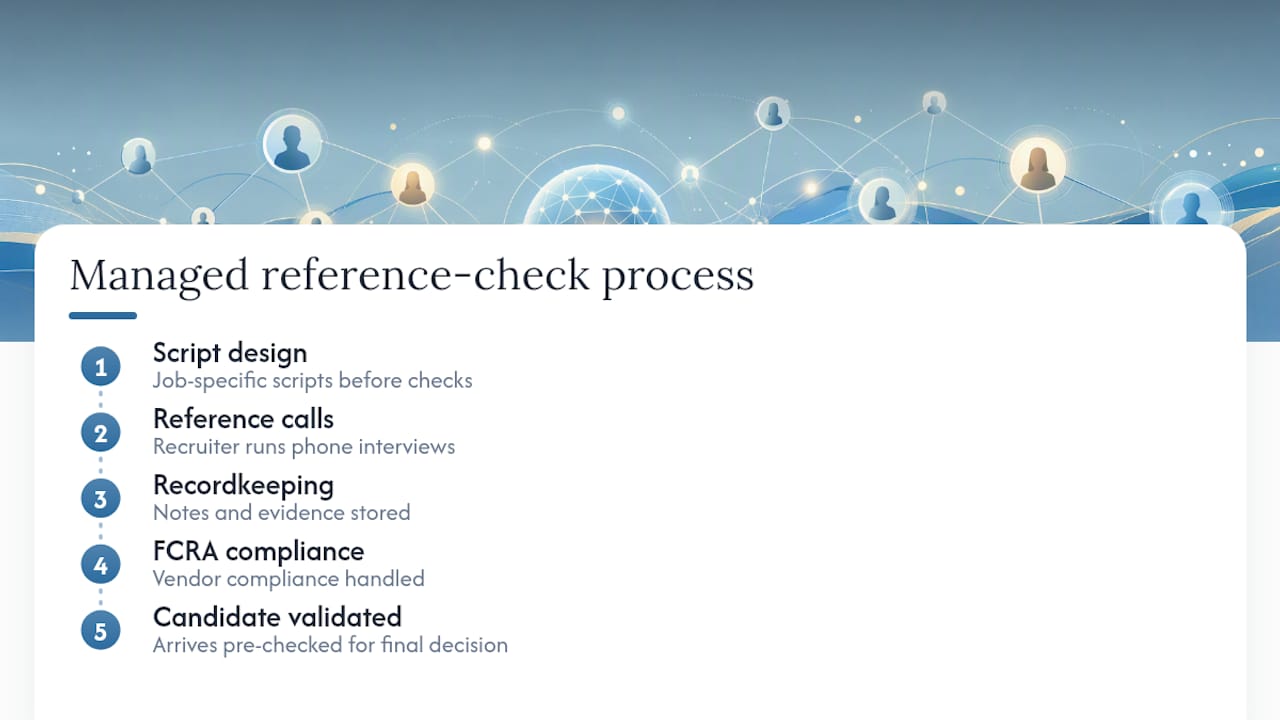
Careerscape runs managed reference checks as part of its sourcing and placement work, not as a bolt-on afterthought. That means the script design, the actual reference calls, the documentation, and FCRA compliance when vendors are involved all happen before a candidate ever lands on your desk for a final decision. Employers hiring for engineering, professional services, or technical roles get a candidate who’s already been validated against a job-specific script, not just a resume that sounded good in an interview. If you’d rather spend your week interviewing finalists than chasing down three references by phone, find talent through Careerscape and let a recruiter who already knows the role run the check for you.
Primary Sources and Further Reading
For deeper reading, see OPM’s reference-checking guidance, UNLV’s sample reference questions, and First Round Review’s 25 reference-call questions.
Two to three is standard, with OPM recommending at least three contacts for a fuller picture, plus an optional blind reference for senior roles.
FAQ
What questions can’t you ask in a reference check?
You can’t ask about race, religion, pregnancy, disability, age, national origin, or other protected characteristics, and in many states you can’t ask about salary history either.
What questions should you ask for a personal or character reference?
Ask how they know the candidate, how long, and for a specific example that shows the candidate’s reliability, integrity, or work ethic outside a formal job setting.
How should a candidate answer questions during a reference check?
Candidates aren’t usually on the call, but if you’re coaching a reference you supplied, tell them to keep answers specific and honest, since vague praise is less convincing than a concrete example.
What are the top rules for handling employment references?
Keep questions job-related, use the same question set for every finalist, get written authorization when using a vendor, document every call, and follow FCRA and state salary-history rules.