
By 2026, around two dozen U.S. jurisdictions require employers to disclose salary ranges in job postings, depending on the employee's work location. Employers must map roles to states, adopt a posting strategy compliant with the strictest applicable laws, and document pay ranges based on solid data to avoid compliance risks. Key actions include identifying applicable state laws, using documented pay ranges tied to budgets or benchmarks, and retaining records for three years to comply with regulations in states like Massachusetts and Maryland.
As of 2026, roughly two dozen U.S. jurisdictions (states and Washington, D.C.) require employers to disclose salary ranges in job postings, upon request, or before an offer, and the specific trigger depends entirely on where the employee performs the work. Employers who post one generic job ad and hope for the best are exposed. The immediate action item is not legal research. It’s a mapping exercise: identify every state where your candidates could plausibly work, then build documented, good-faith pay ranges before you publish another listing.
The Rippling state-by-state guide counts jurisdictions differently depending on how narrowly you define “pay transparency,” but the trend line is unmistakable: coverage keeps expanding, and thresholds keep dropping. New York applies its rule to employers with as few as four employees. Colorado applies to nearly all of them.
Three things to do this week:
- Map roles to states. List every open requisition and every state where a remote candidate could legally work from.
- Choose a posting strategy. Decide whether you’ll comply with the strictest applicable law across all postings or build state-specific templates.
- Document your ranges now. Tie every published number to a budget, a pay scale, or a benchmark report you can produce if asked.
Pro Tip: If you’re not sure which state law governs a remote hire, default to the employee’s physical work location, not your company’s headquarters. That’s the standard nearly every state statute uses.
Key Takeaways
Pay transparency compliance in 2026 depends on where the employee works, not where the employer is based, and defensible ranges require documented data, not estimates.
| Point | Details |
|---|---|
| Map roles to states | Identify every state where a candidate could work before finalizing a job posting. |
| Use documented ranges | Base every posted range on budgets, internal scales, or benchmark reports, not guesses. |
| Retain records for 3 years | Massachusetts and Maryland both require three years of posting and range documentation. |
| Add client clauses for staffing | Require written client-provided ranges and indemnification language in service agreements. |
| Benchmark before you post | Careerscape’s salary guide covers 450+ roles and supports defensible, market-based ranges. |
Table of Contents
- Pay Transparency Laws by State: 2026 Status and Thresholds
- How Do You Set a Defensible, Good-Faith Pay Range?
- Does Pay Transparency Apply to Remote Job Postings?
- How Careerscape’s Salary Guides Support Defensible Ranges
- What Happens If an Employer Violates Pay Transparency Law?
- Is There a Federal Pay Transparency Law in 2026?
- How Do Union Contracts Affect Pay Transparency Requirements?
- Which Roles Are Exempt from Pay Range Disclosure?
- Do Pay Transparency Laws Improve Pay Equity?
- The Compliance Gap Nobody Talks About
- Get Compliant Hiring Support from Careerscape
- Sources
- FAQ
Pay Transparency Laws by State: 2026 Status and Thresholds
The rules vary along three axes: employer size, whether ranges must appear in the posting itself or only on request, and effective date. Getting any one of those wrong is how a well-meaning HR team ends up out of compliance.
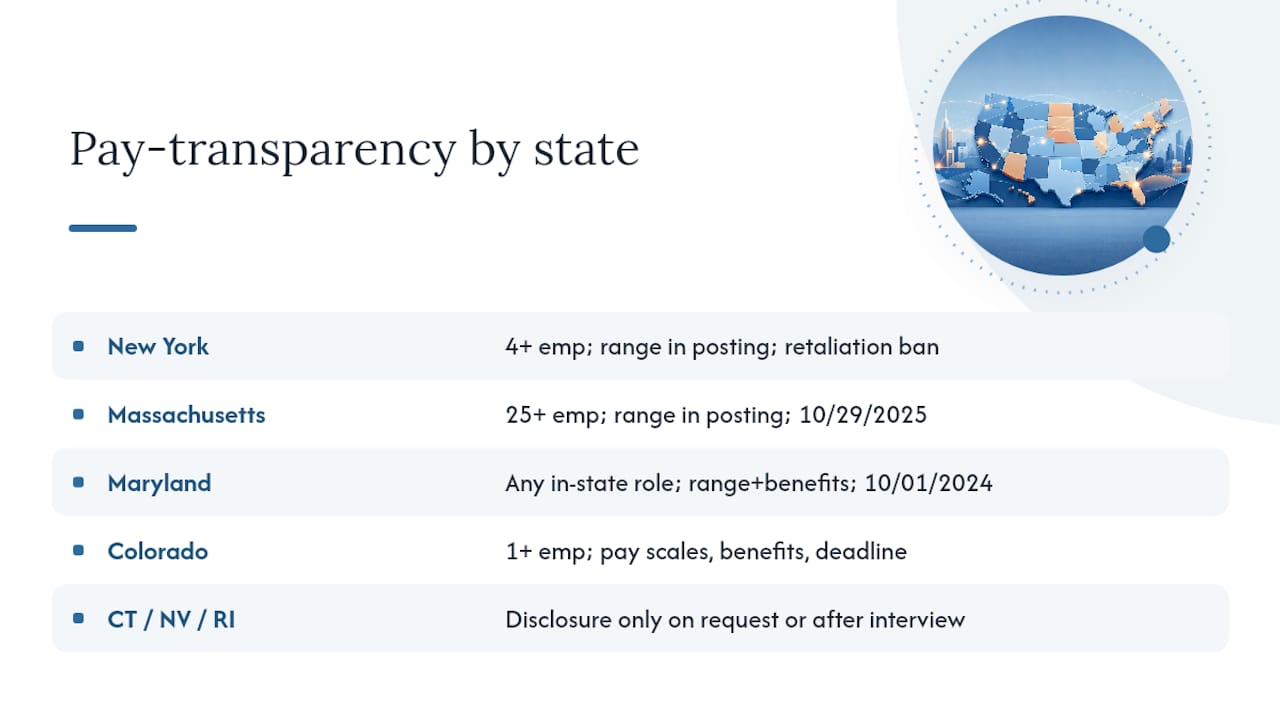
New York’s Labor Law Section 194-b requires employers with four or more employees to disclose compensation ranges for jobs, promotions, and internal transfers, and it bars retaliation against candidates who ask about pay. That four-employee threshold is one of the lowest in the country, which means most small businesses operating in New York are already covered whether they realize it or not.
Massachusetts joined the list more recently. Employers with at least 25 employees must include a good-faith pay range in job postings under a law that took effect October 29, 2025, and the state’s official FAQ specifies exactly what a posting must contain and requires three years of compliance records.
Maryland took a different approach on timing. Its wage-range transparency law, effective October 1, 2024, applies to any position performed at least partly within the state, and it requires a wage range, a benefits description, and the same three-year record retention Massachusetts uses, according to the Maryland Department of Labor’s FAQ.
Colorado remains among the strictest by employer size, applying to employers with one or more employees working in the state, and postings must include pay scales, a general benefits description, and the application deadline, per guidance on Colorado’s requirements.
A wave of newer states pushed effective dates into 2025 and 2026: Vermont’s law took effect July 1, 2025; New Jersey’s followed on June 1, 2025; Illinois moved first, on January 1, 2025; and Maine’s requirement begins January 1, 2026. Hawaii applies its rule to employers with 50 or more employees, while other states like Connecticut, Nevada, and Rhode Island require disclosure only upon request or after an initial interview, rather than in the posting itself.
This list isn’t exhaustive, and thresholds shift as legislatures amend existing statutes. Littler’s 50-state pay equity chart tracks the full landscape, including salary-history bans and pay-data reporting requirements that often travel alongside range-disclosure rules. Confirm current requirements with the relevant state labor agency before finalizing any posting template.
How Do You Set a Defensible, Good-Faith Pay Range?
“Good faith” is a legal standard, not a suggestion, and regulators increasingly scrutinize ranges that look designed to say nothing. A posting listing “$40,000 to $150,000” for a marketing coordinator role isn’t transparency. It’s a workaround, and enforcement guidance treats overly broad ranges as a compliance risk in their own right, according to practical guidance on good-faith ranges.
A defensible range comes from real documentation, not a guess:
- Start with budgeted compensation for the specific role, not a department-wide average.
- Cross-reference internal pay scales for comparable positions already on staff.
- Layer in market benchmark data, such as the Careerscape salary guide, to confirm your internal number reflects current market conditions.
- Narrow the spread to something a candidate could actually land within, typically 10% to 20% above and below the midpoint.
- Save the paperwork the day you post the role, not the day someone asks about it.
Recordkeeping matters as much as the number itself. Build a retention file for every posting that includes a copy of the listing, the documented basis for the range, the date it went live, any applicant requests for pay information, and updates if the role gets reposted. Massachusetts and Maryland both specify three years of record retention, and treating that as your baseline across every state is simpler than tracking different timelines by jurisdiction.
Staffing firms face an added layer of exposure. If Careerscape or any recruiting partner posts a role on a client’s behalf, the range published is only as defensible as the data behind it, and that data usually originates with the client, not the agency.
Pro Tip: Require every client to supply a pay range in writing before you publish a posting on their behalf, and keep that email or document in your file. It’s the single easiest way to establish who made the compensation decision if a complaint ever surfaces.
Add a standard pay-transparency clause to every client services agreement. It should state that the client is responsible for providing an accurate, good-faith range, and it should indemnify the staffing firm when the agency relied on client-supplied numbers without conducting its own benchmarking.
Does Pay Transparency Apply to Remote Job Postings?
Usually, yes, and this is where most multi-state employers get tripped up. The controlling law is generally the one where the employee will actually perform the work, not where your company is headquartered, according to guidance on remote-work implications. Post a fully remote role open to candidates in Colorado, New York, and Texas, and the Colorado and New York rules both apply, even though your office sits in Texas.
Two strategies handle this:
- Strategy A: comply with the strictest applicable law everywhere. One template, built to the highest bar (usually Colorado’s), used for every posting regardless of location. Simpler to manage, but you disclose more than legally required in states with no rule at all.
- Strategy B: geo-target postings with state-specific templates. More precise, but it demands tighter recruiter training and more careful tracking of where each listing actually runs.
A six-step checklist works for either approach:
- Identify every state where the role could realistically be filled.
- Select the template (unified or geo-targeted) that fits your posting volume.
- Log the documented basis for the range before publishing.
- Train recruiters on which states require which disclosures.
- Tag each posting internally with its applicable jurisdiction.
- Audit postings quarterly to catch template drift.
How Careerscape’s Salary Guides Support Defensible Ranges
Setting a range that survives scrutiny requires current market data, not last year’s assumption carried forward. The Careerscape salary guide covers benchmarks across 450+ roles, from HR Manager to Privacy Officer to Compliance Officer, and gives employers a documented data source they can point to if a range is ever questioned.
- Keep a screenshot or PDF of the benchmark data you used and the date you pulled it.
- Update ranges annually, since benchmark data ages faster than most job descriptions do.
- Store the source alongside your posting file so it’s ready if a state agency requests it.
What Happens If an Employer Violates Pay Transparency Law?
Enforcement varies by state, but nobody treats these laws as symbolic anymore. New York’s Department of Labor accepts complaints and can pursue penalties for noncompliant postings, escalating for repeat violations, under the same Labor Law Section 194-b framework that sets the disclosure requirement itself. Massachusetts built its penalty structure around a warning-first approach for a company’s initial offense, with civil penalties applying to later violations at the state’s discretion.
Recordkeeping failures compound the problem. Both Massachusetts and Maryland require employers to retain compliance records for three years, covering the posting, the documented basis for the range, and any applicant inquiries about pay. An employer that gets the range right but can’t produce the paperwork is still exposed if a complaint triggers an audit.
Most complaints originate the same way: a candidate notices a posting has no range, or notices the range looks implausibly wide, and files a report with the state labor agency. That means your compliance risk isn’t primarily about intentional violations. It’s about untrained hiring managers posting ads without knowing the rules changed. Build a review step into your posting workflow where every new listing gets checked against the applicable state’s requirements before it goes live, and treat that check as non-negotiable for any role open to multiple states.
Is There a Federal Pay Transparency Law in 2026?
No federal law mandates pay-range disclosure in job postings as of 2026. Coverage remains entirely state and local, which is exactly why the patchwork exists. Federal law does prohibit pay discrimination on the basis of sex under the Equal Pay Act, and Executive Order 11246 has historically restricted salary-history inquiries for federal contractors, but neither requires publishing a range in a job ad.
That absence of federal preemption matters practically. It means a national employer can’t adopt one compliance posture and call it done. Each state sets its own threshold, its own trigger (posting versus on-request), and its own recordkeeping window, and those requirements can change independently of each other from one legislative session to the next. ADP’s overview of pay transparency trends notes that this state-by-state approach is likely to continue expanding rather than consolidate into a single federal standard anytime soon.
For employers, the practical takeaway is to treat state law as the ceiling of your obligation, not a floor set by whatever your competitors are doing. A company operating in five states with pay-transparency laws and twenty without one still needs five separate compliance postures, even without a federal mandate tying them together.
How Do Union Contracts Affect Pay Transparency Requirements?
Collective bargaining agreements add a layer state pay-transparency statutes don’t always anticipate. Many state laws exempt roles filled under an existing CBA from certain posting requirements, on the theory that union pay scales are already negotiated, published, and known to represented employees through the contract itself.
That exemption isn’t universal, and it isn’t automatic. Employers need to check whether their specific state law carves out unionized positions or simply defers to the CBA’s own wage schedule as satisfying the “good faith range” requirement. Where a state law does apply to union roles, the CBA’s negotiated wage scale itself often functions as the documented, defensible range, since it’s already the product of formal negotiation rather than a unilateral employer estimate.
Employers with a mixed workforce, some roles under a CBA and some not, should build two separate compliance tracks rather than assume one policy covers both. A posting for a union-represented position should reference the applicable wage schedule from the contract. A posting for a non-represented role needs its own documented benchmark, built the way any other good-faith range is built. Treating the two identically risks either overexposing negotiated wage details the union didn’t intend to publish externally, or underdisclosing information a non-union candidate is legally entitled to see.
Which Roles Are Exempt from Pay Range Disclosure?
Exemptions exist, but they’re narrower than most employers assume. The most common carve-outs apply to internal promotions where no material change in compensation is expected, temporary staffing agency placements in certain states, and roles that will be performed entirely outside the state imposing the requirement.
Some states exempt very small employers entirely rather than scaling requirements down. Others exempt specific job categories, such as commission-only sales roles where a fixed range doesn’t reflect how pay actually works, though many statutes still require disclosure of the commission structure itself in place of a dollar range.
The safest assumption for any employer operating across multiple states is that an exemption in one jurisdiction does not carry over to another. A role exempt from Colorado’s posting requirement because it’s filled entirely by remote workers outside the state could still trigger New York’s rule if even one qualified candidate is based there. Confirm exemption language state by state rather than applying a blanket exception across your whole posting library, and default to disclosure whenever a role’s location or classification is ambiguous.
Do Pay Transparency Laws Improve Pay Equity?
They tend to force it, whether or not that was the original goal. Once ranges become public, internal inconsistencies that used to stay quiet become visible fast. Two employees in the same role with a $15,000 gap between them are a lot harder to justify once a candidate can see the posted range for that exact position.
That visibility is pushing more employers toward proactive pay equity audits rather than reactive ones. Reviewing current employee pay against the ranges you’re now required to publish externally is the fastest way to find disparities before a candidate, a current employee, or a regulator finds them for you. Where audits turn up gaps, most employers address them through phased salary adjustments tied to budget cycles rather than one-time corrections, paired with clearer documentation of how starting pay gets set for every new hire going forward.
The practical shift is cultural as much as procedural. Compensation decisions that used to live in a manager’s head now need to trace back to a documented rationale, whether that’s a pay scale, a benchmark report, or a formal band. Employers who build that documentation habit into their hiring process, rather than scrambling to reconstruct it after a complaint, tend to fare better when a state agency or an internal audit asks the same question: how did you arrive at this number?
The Compliance Gap Nobody Talks About
Most guidance on pay transparency treats it as a legal checklist problem: find your state, find the threshold, comply. That framing misses where employers actually get hurt, which is the six months after they publish a compliant range and someone on their existing team notices it.
Conventional advice stops at the posting. The harder work starts once a current employee sees a range that’s higher than what they’re earning for the same role. Employers who treat pay transparency purely as an external disclosure exercise, without running the internal audit first, are setting up their own retention crisis.
The employers handling this well aren’t the ones with the fanciest legal memo. They’re the ones who benchmarked their entire workforce against current market data before a single new posting went live, using something like salary benchmarking data to catch the gaps quietly rather than publicly. If there’s one priority to act on first, it’s this: audit internally before you disclose externally. The law asks what you’re willing to tell candidates. Your own employees are asking the harder question.

Get Compliant Hiring Support from Careerscape
Building state-specific posting templates, documenting good-faith ranges, and training recruiters on 20-plus different disclosure rules is a lot to manage alongside actually filling roles. Careerscape’s salary guide gives you current benchmark data across 450+ roles to anchor every range you publish, and Careerscape’s recruiters build compliant, location-aware job postings as a standard part of every search, so you’re not reinventing your template library state by state.
If you need to fill a role quickly while staying inside the applicable pay-transparency rules, contract staffing solutions give you flexibility without the long-term commitment of a direct hire, backed by recruiters who already understand disclosure requirements for your industry. Ready to move on an open role? Request talent from Careerscape and get a compliant search started this week.
Sources
- Pay transparency in Massachusetts
- Pay transparency — New York State Department of Labor
- Maryland Wage Range Transparency FAQ
- Pay transparency laws: A state-by-state guide
FAQ
Which states require salary ranges in job postings in 2026?
New York, Massachusetts, Maryland, Colorado, Hawaii, Illinois, New Jersey, Vermont, and Maine all require some form of salary-range disclosure, though thresholds and timing differ by state.
Does pay transparency law apply to remote workers?
Generally yes. The law of the state where the employee actually performs the work usually controls, even if the employer is headquartered elsewhere.
How long must employers keep pay transparency records?
Massachusetts and Maryland both require three years of retention covering the posting, the documented basis for the range, and any applicant pay inquiries.
Are union jobs exempt from pay transparency laws?
Sometimes. Many states treat a collectively bargained wage schedule as satisfying the good-faith range requirement, but the exemption isn’t universal across every state.
How can employers set a defensible pay range?
Base the range on budgeted compensation, internal pay scales, and current market benchmarks, such as the Careerscape salary guide, then document the source and date used.
Recommended
- Job Posting Optimization: A 2026 Recruiter’s Guide
- Privacy Officer Salary 2026 — GDPR, CCPA & Data Protection Pay