
Shortlisting candidates effectively requires defining essential versus desirable criteria before reviewing any applications, then applying a weighted scoring rubric consistently across all applicants to reduce bias and produce defensible decisions. Anonymizing demographic identifiers during scoring and running calibration sessions with reviewers further improves fairness and consistency. When using ATS or AI screening tools, organizations must audit for adverse impact and validate automated outputs against documented criteria to stay compliant with ADA and EEOC standards.
In this article
Shortlisting is how you turn a stack of applications into the three to eight people worth interviewing. Doing it with a structured process separates hiring teams that consistently land great hires from those that waste weeks on avoidable back-and-forth. When a job posting closes, you are often staring down hundreds of resumes, each one competing for a fraction of your attention. The challenge is not just speed. It is making fair, defensible decisions that hold up under scrutiny and actually predict on-the-job success. This guide walks through the full candidate selection process, from setting criteria before the first resume lands to notifying candidates and preparing for interviews.
Key Takeaways
| Point | Details |
|---|---|
| Define criteria before reviewing | Establish essential and desirable criteria before opening any applications to prevent bias from creeping in. |
| Use structured scorecards | Weighted scoring rubrics applied consistently across all applicants produce fairer, more defensible shortlists. |
| Anonymize where possible | Removing demographic identifiers during scoring measurably reduces the influence of unconscious bias. |
| Audit your hiring technology | ATS and AI tools require regular adverse impact testing to meet ADA and EEOC compliance standards. |
| Communicate promptly | Timely, consistent updates to both shortlisted and rejected candidates protect your employer brand. |
What Does Shortlisting Mean in Hiring?
Shortlisting is the step where you cut the full applicant pool down to the small group who genuinely merit an interview. It sits between application screening and the first interview: screening removes the clear noes, shortlisting ranks the plausible yeses against the role’s must-haves.
Done well, it is a scoring exercise, not a vibe check. The scorecard later in this guide turns it into one.
How to Shortlist Applicants: Start with Preparation
The most common shortlisting mistake happens before a single application is read. Recruiters open the applicant pool without a documented set of criteria, which means each reviewer is effectively working from a different mental scorecard. The result is inconsistency, bias, and shortlists that do not reflect what the role actually requires.
Effective preparation starts with the job description. Before the posting goes live, it should clearly distinguish between what a candidate must have and what would be a bonus. Clear, updated job descriptions and explicit essential versus desirable criteria improve consistency across reviewers significantly.
Here is how to structure that distinction in practice:
Essential criteria (non-negotiable qualifications a candidate must demonstrate):
- Minimum years of relevant experience in a specific function or industry
- Required licenses, certifications, or educational credentials
- Demonstrated technical skills tied directly to the role’s core responsibilities
- Geographic availability or work authorization where applicable
Desirable criteria (attributes that add value but should not eliminate otherwise strong candidates):
- Familiarity with specific software tools that can be learned on the job
- Experience in a related but not identical industry
- Advanced degrees when a bachelor’s level meets the baseline
- Exposure to particular methodologies or frameworks that complement the role
Once the criteria are documented, bring in at least one hiring manager or team leader to review and sign off. This step matters more than most recruiters realize. Hiring managers often hold implicit expectations that never make it into the job description. Surfacing those expectations before screening begins prevents the frustrating back-and-forth where a recruiter’s shortlist does not match what the manager actually wanted.
Pro Tip: Review your job posting for clarity before applications open. A well-optimized posting attracts better-matched candidates and reduces the volume of unqualified applications you need to screen. Careerscape has detailed job posting guidance worth reviewing before your next role goes live.
Building and Applying a Candidate Scorecard
Shortlisting is the process of reviewing applications using predefined, job-related criteria to produce a smaller group for interviews. The tool that makes this process repeatable is the candidate scorecard.
A scorecard assigns numeric weights to each criterion so that reviewers evaluate every applicant against the same standard. Here is a simplified example of how a scorecard might be structured for a project manager role:

| Criterion | Weight | Scoring Scale | Notes |
|---|---|---|---|
| PMP certification or equivalent | 30% | 0, 1, or 2 | 0 = absent, 1 = in progress, 2 = active |
| Years managing cross-functional teams | 25% | 1 to 5 | Scored relative to role requirement |
| Budget management experience | 20% | 1 to 5 | Documented examples required |
| Stakeholder communication evidence | 15% | 1 to 5 | Assessed from cover letter and resume |
| Relevant industry background | 10% | 1 to 5 | Desirable, not essential |
Applying the scorecard consistently requires a brief calibration session. Before scoring begins, all reviewers should score two or three sample applications together and discuss their reasoning. This alignment reduces scoring variance between reviewers and produces a more reliable shortlist. Once calibrated, each reviewer scores independently.
Anonymizing applications during scoring is one of the highest-leverage steps you can take. Removing names, photos, addresses, and graduation years before sharing applications with reviewers reduces the influence of unconscious bias without changing how the scorecard functions. Anonymized standardized evaluation through scoring rubrics meaningfully improves fairness in the applicant selection process. Google re:Work specifically recommends that rubrics over gut feeling assess candidate competencies with higher predictive validity and lower adverse demographic impact.
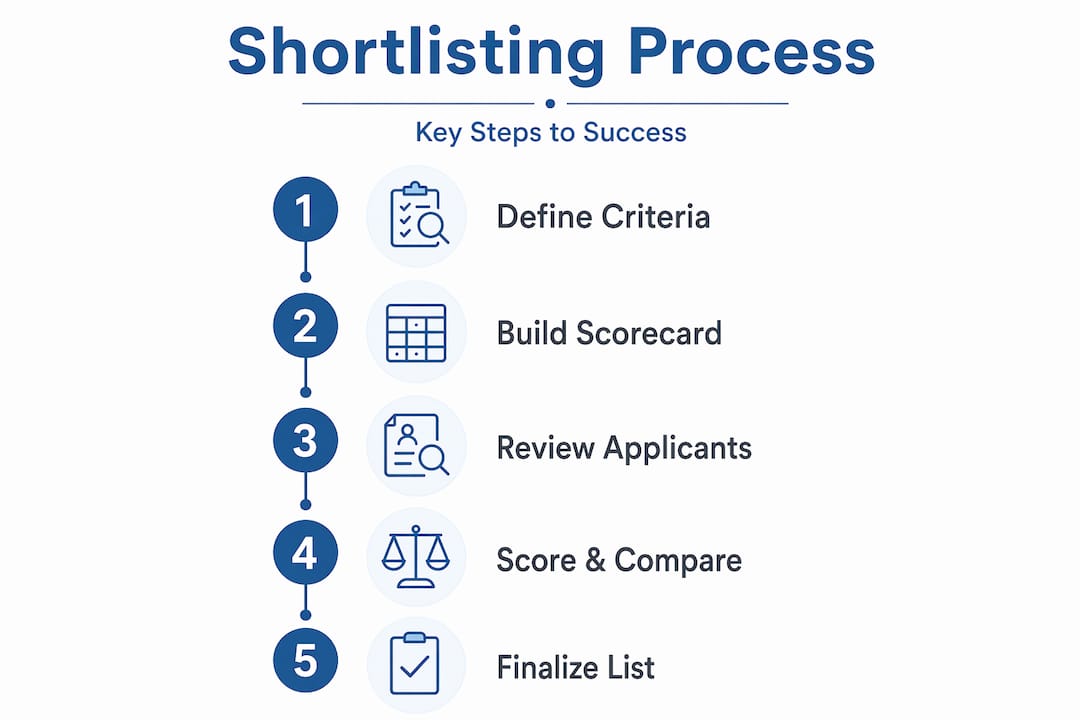
Document every scoring decision, including the rationale for any candidate who falls close to the cutoff. Defensible shortlists are those tied to clear, job-related goals scored uniformly with documented cutoffs. If a hiring decision is ever challenged, that documentation is your protection.
Also consider how evidence appears in resumes before finalizing your rubric. Rubrics aligned to how resume evidence typically appears, such as timeframes, tools listed, and quantified achievements, improve shortlist quality. A candidate who managed a $2M budget for three years should score higher on budget experience than one who lists “budget oversight” without context.
Using Technology Responsibly in Screening
Applicant tracking systems (ATS) and AI-powered screening tools can reduce time-to-fill significantly by automating the initial filtering of large applicant pools. Used well, they free recruiters to focus attention on the nuanced decisions that technology cannot reliably make. Used carelessly, they introduce legal and ethical risk.
Here is what a responsible technology-supported screening process looks like:
- Configure your ATS filters to match documented criteria. If the documented essential criteria include specific certifications or experience thresholds, those are appropriate filter parameters. Avoid filtering on proxies for protected characteristics, such as graduation year, which correlates with age.
- Audit AI screening tools before deployment. Employers are required under ADA and EEOC guidance to ensure that AI tools do not screen out qualified applicants with disabilities or create disparate impact among protected groups.
- Validate outputs against your documented criteria. An AI-ranked list is a starting point, not a final answer. Every candidate flagged for rejection by automated tools should be spot-checked against the scorecard before elimination.
- Run periodic adverse impact analyses. EEOC guidance requires selection procedures to be job-related and consistent with business necessity. Disparate impact testing is expected when automated screening tools are in use.
Compliance note: ADA.gov guidance is explicit that even neutral hiring technology can violate the ADA if it screens out qualified applicants with disabilities. Build in accessibility checks and offer accommodations before any screening tool touches an application.
Careerscape recommends treating AI shortlist outputs as decisions requiring review, not recommendations to rubber-stamp. Review your EEOC compliance obligations before integrating any new screening tool into your workflow. Tools like SparkCV can support resume optimization on the candidate side, which is worth understanding when you consider how automated parsers interpret resume formatting.
Common Pitfalls in the Shortlisting Process
Even well-structured processes can fail when recruiters lose discipline under time pressure. These are the most damaging errors, and how to prevent them.
- Affinity bias. Reviewers score candidates higher when they attended the same school, worked at a recognizable company, or share interests visible on the resume. Anonymizing applications and using calibrated scorecards significantly reduces this effect. Multiple reviewers balance individual subjective perceptions.
- Overweighting credentials at the expense of potential. A candidate with eight years of experience at a well-known firm can look better on paper than someone with four years of experience but a documented track record of high impact. Scorecards that include performance indicators, not just tenure, surface that distinction.
- Inconsistent criteria application across the pool. Applying essential criteria strictly to some candidates but flexibly to others is one of the fastest paths to a discrimination claim. Apply your rubric without exception. If a criterion turns out to be poorly worded, correct it for the next search, not mid-process.
- Poor documentation. If you cannot explain in writing why a candidate was advanced or cut, your process is not defensible. Document scoring decisions, cutoff rationale, and any deviations from standard procedure in real time, not after the fact.
- Candidate communication delays. Slow follow-up after shortlisting damages your employer brand more than most hiring teams acknowledge. Candidates talk. A strong applicant who does not hear back within a week of applying will often accept another offer.
Pro Tip: Build a standard candidate communication template that goes out automatically when someone is moved to each stage. Even a brief “We have received your application and expect to follow up by [date]” response reduces drop-off and protects the candidate experience.
Finalizing the Shortlist and Preparing for Interviews
Once scoring is complete, most hiring teams benefit from a brief review meeting before locking in the final shortlist. Bring the hiring manager into the room with scored applications and walk through any candidates near the cutoff together. This is not the moment to override the scorecard based on gut instinct. It is a structured conversation about whether the rubric captured everything the role requires.
A few practical guidelines for finalizing:
- Aim for five to eight candidates per position as a starting point. Fewer than five limits your flexibility if a top candidate withdraws. More than ten significantly increases time-to-fill and interview fatigue.
- Notify shortlisted candidates within 48 hours of finalizing the list. Speed signals organizational efficiency and keeps candidates engaged. The best candidates are rarely waiting exclusively for your role.
- Send timely, respectful rejections to candidates who did not make the list. A brief, professional note preserves goodwill and protects your employer brand in the talent market.
- Use the shortlist to structure your interview plan. Each scorecard criterion that could not be fully assessed from the resume becomes a structured interview question. This creates a direct link between your shortlisting criteria and your interview evaluation framework.
Shortlisting and interviewing should function as a single connected system, not two separate events. When the criteria that informed your shortlist also inform your interview scorecard, you get consistency from first review to final offer.
Why Structured Shortlisting Beats Gut Feel
I have spent years watching well-intentioned hiring managers talk about wanting the best candidate while using a process that virtually guarantees they will not find that person. Gut-feel shortlisting is not just inefficient. It is a self-reinforcing cycle that rewards familiarity over fit and penalizes candidates who simply do not look like whoever was hired last.
The shift I have seen make the biggest difference is not the technology or the ATS. It is the moment a team commits to writing down their criteria before they open a single application. That one discipline change forces clarity, surfaces hidden disagreements among stakeholders, and gives everyone a shared definition of what “qualified” actually means for this specific role.
I have also learned to be skeptical of AI screening tools that promise to take the bias out of hiring. No tool does that on its own. The bias often lives in the training data, the filter configuration, or the criteria the recruiter fed into the system in the first place. Technology is only as fair as the human decisions that set it up.
My practical advice: build the scorecard, calibrate your reviewers, anonymize what you can, and treat every shortlisting decision as one you may need to explain out loud. That accountability alone will sharpen your process faster than any software purchase.
— Chris
How Careerscape Simplifies Your Shortlisting Process
Building a structured shortlisting process from scratch takes time, expertise, and the kind of institutional knowledge that is hard to develop quickly. Careerscape exists to fill exactly that gap. Careerscape’s staffing solutions are built around the same evidence-based practices covered in this guide, including criteria-defined screening, calibrated reviewer processes, and documented selection decisions that hold up under scrutiny.
Whether you need contract staffing solutions for immediate headcount needs or project-based staffing for specialized team builds, Careerscape brings industry-specific recruiting expertise that reduces your time-to-fill without cutting corners on candidate quality. You can also explore staffing best practices tailored to your organizational context. When your internal bandwidth is stretched, partnering with a recruiting firm that already has the process built is often the most efficient move you can make.
Request talent today and let Careerscape put a structured, bias-minimized shortlisting process to work for your next hire.
FAQ
What Is the Shortlisting Process in Recruitment?
Shortlisting is the process of reviewing applications using predefined, job-related criteria to identify a smaller group of candidates for interviews. It serves as the structured step between resume review and interview scheduling.
How Many Candidates Should Be on a Shortlist?
Most hiring teams aim for five to eight shortlisted candidates per position. This range provides enough flexibility if top candidates withdraw while keeping the interview process manageable for your team.
How Do You Reduce Bias When Shortlisting Applicants?
Anonymizing applications before scoring, using calibrated scorecards with weighted criteria, and involving multiple reviewers are the most effective methods. Anonymized scoring reduces the influence of unconscious bias on candidate evaluations.
Are AI Screening Tools Compliant with EEOC and ADA Requirements?
Not automatically. Employers must validate that AI screening tools do not create disparate impact among protected groups and do not screen out qualified applicants with disabilities. EEOC guidance requires adverse impact testing and documentation when automated tools are used in selection.
What Criteria Should Be Used When Shortlisting Candidates?
Criteria should be divided into essential qualifications, which are non-negotiable job requirements, and desirable qualifications, which add value but should not eliminate otherwise strong candidates. All criteria must be documented, job-related, and applied consistently across every applicant in the pool.