
Patient registration jobs are widely available on hospital career pages, job boards like Indeed and ZipRecruiter, and through staffing agencies such as Careerscape. Applicants should tailor their resumes to match job postings, apply promptly, and focus on gaining relevant experience in customer service and healthcare administration. Entry-level salaries range from $16.50 to $25.00 per hour, with higher pay at larger systems, and knowledge of HIPAA and EMR systems is crucial for candidates.
In this article
Patient registration jobs are posted daily on hospital career pages, Indeed, ZipRecruiter, LinkedIn, and through staffing firms like Careerscape. The immediate next step: build a resume that mirrors the language in the posting, then apply within 24 hours of the listing going live.
Three search strings to use right now:
"patient registrar" + [your city] + "full-time""patient access representative" + [hospital system name] + "nights""registration specialist" + "part-time" + "sign-on bonus"
Three ways to act today:
- Apply online directly through a hospital’s career portal or a job board listing.
- Upload your resume to a staffing agency profile so recruiters can match you to openings before they’re publicly posted.
- Contact a recruiter at Careerscape to get matched to patient services representative roles that fit your schedule and market.
Pay context: Bureau of Labor Statistics data shows entry-level healthcare registration roles typically range from about $16.50 to $25.00 per hour, while large integrated systems such as Kaiser Permanente post ranges up to $34.23/hr. HIPAA compliance knowledge is a baseline expectation in every posting you’ll encounter.
Where are patient registration jobs posted?
The short answer: everywhere, but not all channels are equally efficient. Hospital career portals are the most direct source because they list openings before they syndicate to job boards, and applying there puts your application directly into the system’s ATS.
Hospital career portals. Go to the careers page of every major health system in your target area. Search using title variants: “patient registrar,” “patient access representative,” “registration specialist,” and “patient access associate.” Set a location radius of 25–50 miles and filter by department (patient access, admissions, or front desk).
National job boards. Indeed and ZipRecruiter aggregate listings from hundreds of systems simultaneously. Use the shift filter to narrow to nights, weekends, or per diem if your availability is specific. On Indeed, the “Urgently hiring” badge often signals a faster hiring timeline.
LinkedIn. Beyond job listings, LinkedIn lets you see whether you have a first- or second-degree connection at the hiring facility. A warm introduction to a hiring manager cuts time-to-interview significantly. Set job alerts for “patient registrar” and “patient access” in your target cities.
Staffing agencies and contract staffing pages. Agencies like Careerscape source roles that never reach public boards, particularly for contract and per diem positions. Creating a candidate profile and uploading your resume takes about 15 minutes and puts you in front of a recruiter who already knows which facilities are hiring. Ask specifically about sign-on bonuses; large employers like UnitedHealth Group include them in select postings, and a recruiter will know which active openings carry them.
Niche healthcare job boards. Sites like Health eCareers and PracticeLink focus on healthcare roles and attract postings from smaller clinics and specialty practices that don’t always post on general boards.
Pro Tip: Set saved searches and email alerts on at least two platforms simultaneously. New patient registration postings often receive 50+ applications within 48 hours, so being among the first 10 applicants measurably improves your callback rate.
What qualifications and skills do employers require?
The baseline is accessible. Franklin University’s career guide for patient registrars confirms that most U.S. employers require a High School Diploma or GED at minimum, with a preference for one or more years of experience in customer service, healthcare administration, or a clinical support setting.
Education and experience baseline:
- High School Diploma or GED (required at virtually every facility)
- 1+ years in customer service, medical office, or healthcare administration (preferred)
- Prior hospital registration or patient access experience (a strong differentiator)
Technical skills employers list in postings:
- EMR proficiency (Epic, Cerner, Meditech, and Athenahealth appear most frequently)
- Insurance eligibility verification and basic knowledge of ICD-10/CPT codes
- Typing speed of 40+ WPM with high accuracy (some systems require a data-entry assessment)
- Cash handling and POS collection experience
- Bilingual ability, particularly Spanish/English, is listed as preferred in a significant share of urban and regional postings
Soft skills that move candidates to the top of the pile:
- Empathy and patience under pressure (patients are often anxious or in pain)
- Conflict de-escalation when patients dispute balances or wait times
- Multitasking across simultaneous systems without losing accuracy
- Attention to detail that holds up during a busy ED surge
Higher-tier systems raise the bar further. Kaiser Permanente’s patient registration associate posting lists a pay range of $25.13–$34.23/hr and requires candidates to pass data-entry and assessment thresholds during the hiring process, including cash-handling experience. Preparing for those assessments before you apply is time well spent.
Pro Tip: On your resume, quantify accuracy and collections rather than describing them generically. “Maintained 98% registration accuracy across 80+ daily patient encounters” tells a hiring manager far more than “responsible for patient check-in.”
What pay can you expect in patient registration roles?
Entry-level healthcare registration jobs typically start around $16.50/hr and climb to $25.00/hr with experience at standard facilities. Large integrated systems pay noticeably more: Kaiser Permanente’s posted range of $25.13–$34.23/hr reflects what top-tier systems offer candidates with verified EMR experience and strong assessment scores. LifeBridge Health’s Baltimore posting lists $18.00–$27.29/hr, a useful benchmark for mid-sized regional systems.
| Market / Employer Type | Typical Hourly Range | Common Premiums |
|---|---|---|
| Entry-level, standard facility | $16.50 – $25.00/hr | None standard |
| Mid-sized regional system | $18.00 – $27.29/hr | Night/weekend differential |
| Large integrated system | $25.13 – $34.23/hr | Sign-on bonus, shift premium |
| Per diem / PRN | — | Higher base, no benefits |
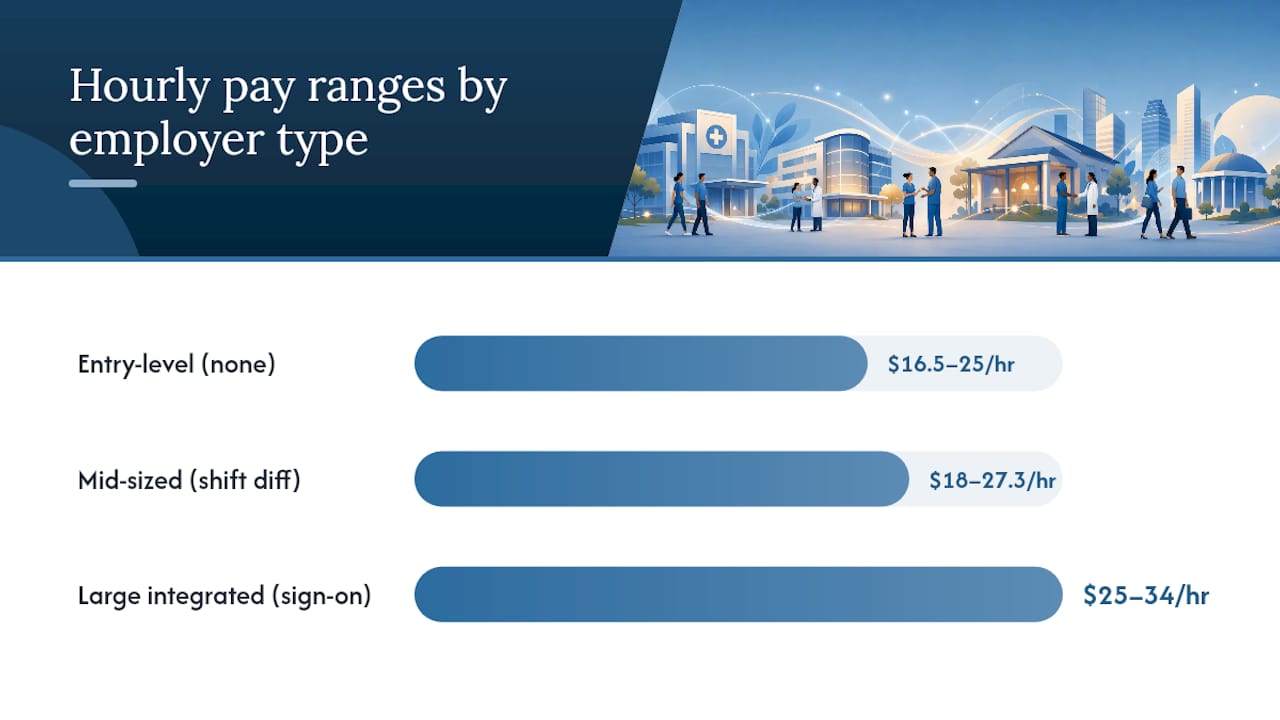
Sign-on bonuses appear most often at large national employers and in markets with high registration turnover. Night and weekend shifts routinely carry a differential of $1.00–$3.00/hr above the base rate. Bilingual candidates in markets with large Spanish-speaking populations sometimes negotiate a language premium on top of the posted range.
Pay ranges are always listed in the posting itself at facilities that comply with state pay transparency laws. If a posting doesn’t show a range, ask the recruiter before your first interview.
How to search and apply for patient registration jobs effectively
A structured approach cuts the time between first search and first interview.
- Set your location and radius. Start with a 25-mile radius; expand to 50 miles if volume is low in your market.
- Use multiple title variants. Search all of these: “patient registrar,” “patient access representative,” “registration specialist,” “patient access associate,” “admissions representative,” and “patient intake coordinator.”
- Filter by shift and schedule. If you need part-time or nights, filter immediately rather than reading through postings that don’t fit.
- Set saved searches and daily alerts on Indeed, ZipRecruiter, and LinkedIn so new postings reach you within hours of going live.
- Apply within 24–48 hours. High-volume postings at large systems close or stop reviewing applications quickly.
- Tailor your resume for each posting. Mirror the exact language in the job description: if the posting says “insurance eligibility verification,” use that phrase, not “benefits checking.”
- Upload your resume to a staffing agency. Careerscape’s healthcare staffing team sources roles that aren’t publicly posted and can match you to openings based on your shift preference, EMR experience, and target pay range.
- Follow up on applications. A brief, professional email to the recruiter or HR contact five to seven business days after applying is appropriate and often appreciated.
Useful search strings to copy and paste:
"patient registrar" "Epic" "full-time" [city]"patient access representative" "nights" "sign-on bonus""registration specialist" "part-time" "no experience required""patient intake coordinator" "bilingual" [state]"admissions representative" "hospital" "immediate hire""central registration" "remote" OR "hybrid"
Sample resume bullets for a patient registration role:
- Processed check-in and check-out for 75+ patients daily across two outpatient clinics using Epic, maintaining a registration accuracy rate above 97%.
- Verified insurance eligibility and collected co-pays and deductibles at point of service, averaging $1,200 in daily POS collections.
- Completed bedside registration for ED patients during high-census periods, coordinating with charge nurses to prioritize urgent cases.
Resume and interview tips for patient registration roles
The Lehigh Valley Health Network registration representative posting is a useful template for what employers want to see on a resume: insurance verification, collections, demographic accuracy, and patient interaction. Mirror that language precisely.
Strong resume bullets use this structure: Action verb + system or metric + outcome.
- “Verified insurance eligibility for 60+ daily patients using Cerner, reducing claim denials by flagging authorization gaps before service.”
- “Collected outstanding balances and co-pays at point of service, maintaining a monthly POS collection rate above the department benchmark.”
- “Trained two new registrars on HIPAA-compliant data entry procedures and EMR navigation within their first two weeks.”
Common interview questions and how to answer them:
“Tell me about a time you handled a difficult patient interaction.”
Frame your answer around empathy first, then process. Describe the situation briefly, explain how you acknowledged the patient’s concern, and close with the resolution and what it meant for the patient’s experience. Avoid making the story about your frustration.
“How do you handle a high-volume shift when the waiting room is full?”
Employers want to hear that you prioritize accuracy over speed, use your EMR efficiently, and communicate proactively with clinical staff. Mention any specific triage or queue management process you’ve used.
“What do you know about HIPAA as it applies to registration?”
Keep it practical: you verify patient identity before releasing any information, you don’t discuss patient details in public areas, and you follow your facility’s minimum-necessary standard when sharing data with third parties. You don’t need to recite the statute; you need to show you apply it.
Pro Tip: When asked about POS collections experience, frame it as patient financial counseling, not collections. Saying “I helped patients understand their financial responsibility and offered payment plan options” positions you as a patient advocate, which is exactly how hiring managers want to see that skill.
How Careerscape helps you land a patient registration role
Careerscape works as a direct placement and contract staffing partner for candidates pursuing patient services and healthcare administrative roles. The process is straightforward and costs job seekers nothing.
Here’s how the candidate journey works:
- Create your profile — Submit your resume and availability through Careerscape’s candidate intake. The team reviews your EMR experience, shift preferences, and target pay range.
Careerscape’s patient services representative staffing page outlines the specific roles the team fills, including front-desk registration, centralized patient access, and revenue cycle support positions. For candidates interested in the revenue cycle pathway, the medical biller and coder staffing page shows where registration experience can take you next.
Key Takeaways
Patient registration jobs are accessible with a High School Diploma and customer service experience, but candidates who quantify accuracy, collections, and EMR proficiency on their resumes move to interviews faster.
| Point | Details |
|---|---|
| Apply fast and use title variants | New postings fill quickly; search “patient registrar,” “patient access representative,” and “registration specialist” simultaneously. |
| Pay ranges vary by system size | Entry-level roles start around $16.50/hr; large integrated systems like Kaiser Permanente post ranges up to $34.23/hr. |
| Quantify your resume bullets | Metrics like daily patient volume, accuracy rates, and POS collections dollar amounts outperform generic duty descriptions. |
| Nights and weekends pay more | Shift differentials of $1.00–$3.00/hr above base are common; these shifts also have lower applicant competition. |
| Careerscape accelerates placement | Registering with Careerscape gives you access to unpublished openings and a recruiter who prepares you for the specific facility’s interview process. |
What actually separates candidates who get hired
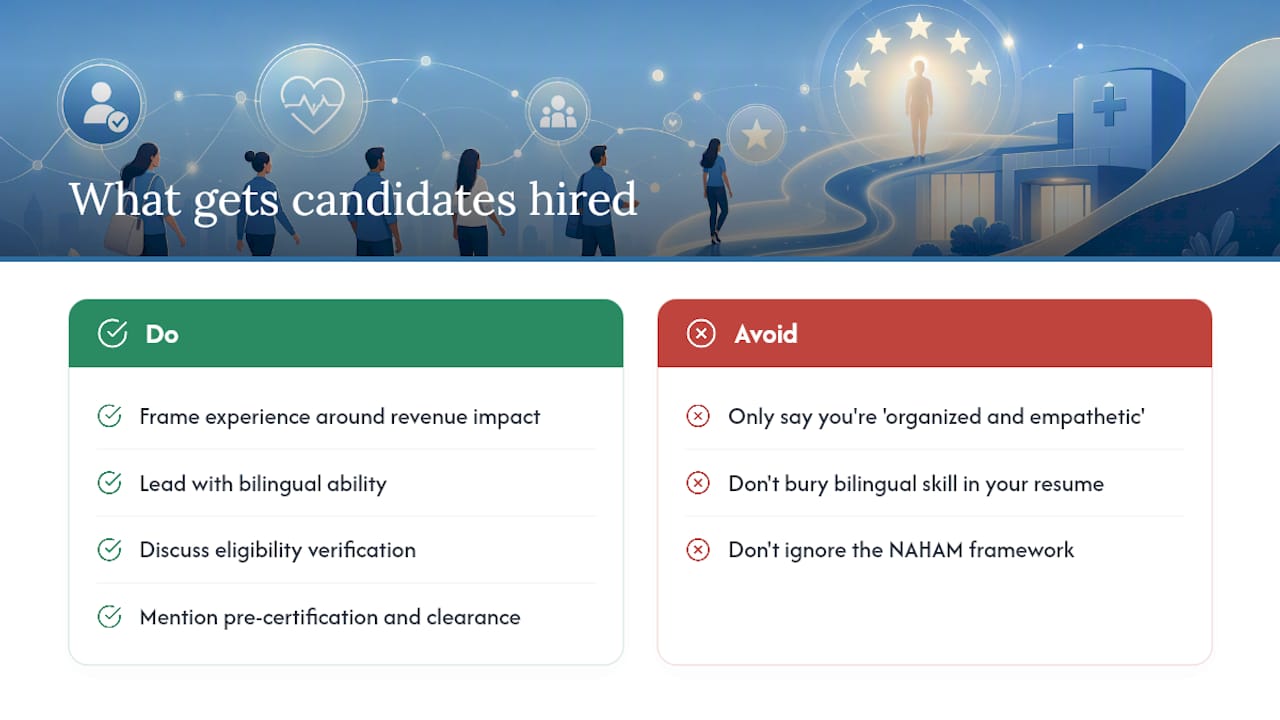
Most articles on patient registration careers stop at “be organized and empathetic.” That’s accurate but incomplete. The candidates who move through hiring fastest are the ones who understand that registration is a financial function as much as a patient-service function.
Hiring managers at large health systems are not just looking for someone who can smile and type quickly. They’re looking for someone who grasps that an uncollected co-pay at check-in is a claim that may never be recovered, and that a demographic error in the EMR can trigger a denial 60 days later. Candidates who frame their experience around revenue impact, even at entry level, signal a level of professional awareness that most applicants don’t demonstrate.
The other underrated factor: bilingual ability. In markets with large Spanish-speaking populations, a bilingual registrar isn’t just a preference on a job posting. That candidate reduces interpreter call volume, shortens registration time for a significant share of patients, and improves consent accuracy. If you’re bilingual, lead with it in your resume summary and mention it in the first 60 seconds of your phone screen.
One more thing worth saying plainly: the NAHAM framework around patient access and revenue cycle isn’t just background reading. Candidates who can speak to eligibility verification, pre-certification, and financial clearance in an interview are the ones who get promoted out of registration into higher revenue cycle roles within 18–24 months. The front desk is a legitimate career launchpad for anyone who treats it that way.
Careerscape matches you to patient registration openings faster
Searching job boards on your own works, but it puts you in the same pool as every other applicant who saw the same posting. Careerscape gives you a different path: a recruiter who already has relationships with hiring managers at healthcare systems in your market, access to roles before they’re publicly listed, and preparation support so you walk into the interview knowing exactly what the facility screens for.
Job seekers pay nothing for Careerscape’s services. You submit your profile, a recruiter reviews your background and availability, and matching begins immediately. For candidates interested in contract or per diem patient registration work, Careerscape’s contract staffing solutions cover short-term placements with competitive pay and clear timelines.
Ready to get matched? Submit your profile and a Careerscape recruiter will follow up within one business day.
Useful sources and further reading
- How to become patient registrars | Franklin University career guide
- What is a patient registrar? | Rasmussen College
- A day in the life of a patient registration specialist | UTMB
- Occupational employment and wages, medical secretaries and administrative assistants (BLS) — (relevant series)
- Registration Representative | Lehigh Valley Health Network
- Patient Registration Associate at Kaiser Permanente
- PATIENT REGISTRATION ASSOCIATE in Baltimore, MD — LifeBridge Health Career Site
- Registration Representative at UnitedHealth Group
- NAHAM: Patient access and revenue cycle connections
FAQ
What qualifications do you need for patient registration jobs?
Most employers require a High School Diploma or GED and prefer at least one year of customer service or healthcare administrative experience. Technical skills like EMR familiarity, typing at 40+ WPM, and basic insurance knowledge strengthen your application significantly.
What are the main duties of a patient registrar?
Patient registrars greet patients, collect demographic and insurance information, verify eligibility, process point-of-service payments, scan documents, schedule follow-up appointments, and coordinate with clinical staff. The role sits at the intersection of patient service and revenue cycle operations.
Is patient registration a stressful job?
It can be, particularly in emergency department settings where volume is high and patients are often anxious or in pain. Accuracy under pressure and the ability to de-escalate tense interactions are skills hiring managers actively screen for during interviews.
What does patient registration typically pay per hour?
Entry-level roles generally range from $16.50 to $25.00/hr based on BLS data for the healthcare administrative category, and large integrated systems such as Kaiser Permanente post hourly ranges up to $34.23/hr. Night and weekend shifts typically add a differential on top of the base rate.
How do you find patient registration jobs quickly?
Search hospital career portals directly, set daily alerts on Indeed and LinkedIn using title variants like “patient access representative” and “registration specialist,” and register with a staffing firm like Careerscape to access roles that aren’t publicly posted.