
Job matching aligns candidates' skills, experience, and preferences with job requirements using advanced techniques that go beyond simple keyword filtering. Modern systems leverage AI, including semantic embeddings and natural language processing, to evaluate contextual factors such as career trajectory and company specifics, resulting in better candidate rankings and reduced hiring biases. Effective job matching enhances the recruitment process by speeding up candidate discovery, improving the quality of hires, and providing a more equitable experience for job seekers.
In this article
Job matching is the process of aligning a candidate’s skills, experience, and preferences with the specific requirements of a job opening. Unlike simple keyword filtering, modern job matching incorporates motivational fit, career trajectory, and contextual factors such as company size and industry sector. The practice has become a recognized standard in talent acquisition, with applicant tracking systems (ATS), staffing firms, and AI platforms all building matching logic into their core workflows. Understanding how job matching works gives both recruiters and job seekers a measurable advantage in a competitive hiring market.
What Is Job Matching and How Does It Differ from Keyword Search?
Job matching is the systematic pairing of candidates to roles based on a multi-dimensional analysis of skills, experience, seniority, location, and compensation expectations. Traditional keyword search simply looks for exact word matches between a resume and a job description. Job matching goes further by evaluating the meaning behind those words, not just their presence.

The distinction matters because two candidates can describe the same skill using completely different language. A software engineer might write “built REST APIs” while a job post asks for “web services development.” Keyword search misses that connection. Job matching, when done well, catches it.
Intelligent matching also evaluates career trajectory and company context, recognizing how roles differ by company size and sector. A “senior engineer” at a 10-person startup carries different weight than the same title at a Fortune 500 company. Matching systems that account for this context produce far more accurate candidate rankings.
How Does Modern Job Matching Work Using AI?
Modern AI job matching uses semantic embeddings to represent meaning beyond simple keyword overlap. Embedding models transform job descriptions and candidate profiles into high-dimensional vectors, where mathematically close vectors indicate strong contextual similarity. This means a candidate who lists “data wrangling” can still match a role requiring “data preprocessing,” because the system understands those terms occupy the same conceptual space.
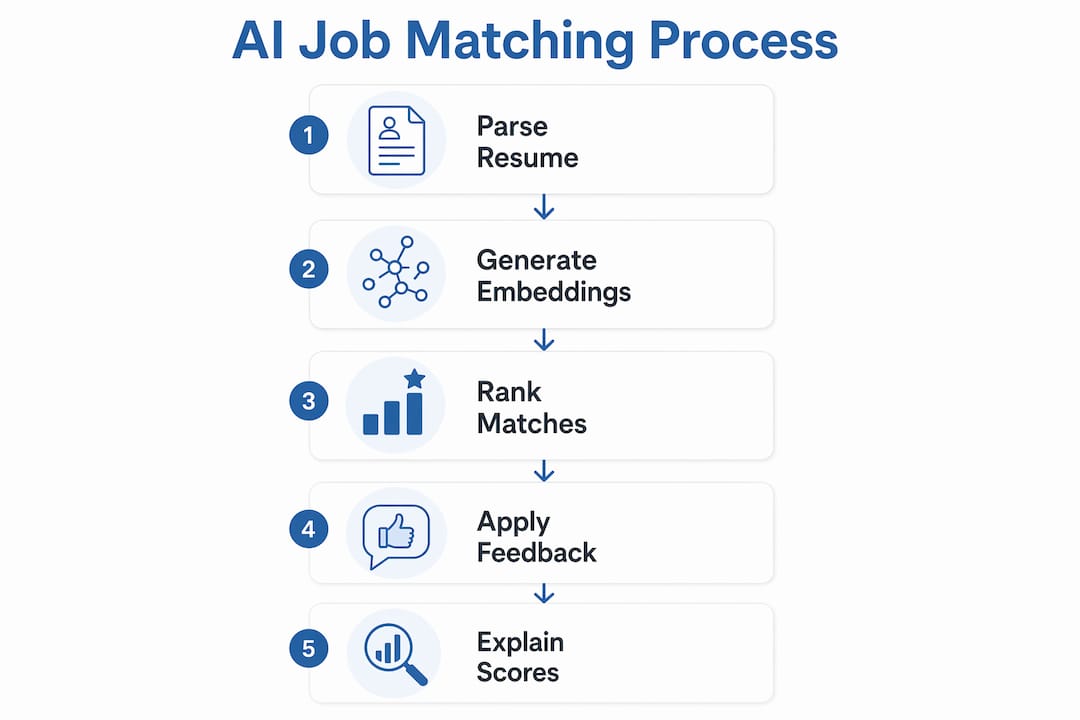
High-performance platforms use a two-stage architecture that combines embedding ranking with a reasoning model for detailed scoring. The first stage narrows a large candidate pool down to the most relevant profiles using vector similarity. The second stage applies a reasoning model that scores each candidate with a detailed rationale, not just a number.
Resume parsing sits at the foundation of this entire process. AI parsing systems in 2026 successfully handle over 95% of standard resume formats and 80%–90% of complex cases. Poor parsing corrupts the data that feeds the matching model, so the quality of the input directly determines the quality of the output.
Pro Tip: Format your resume with clean section headers and standard fonts. Unusual layouts, graphics, and tables confuse parsing engines and reduce your match scores before a human ever reads your profile.
Key components driving the job matching process include:
- Natural language processing (NLP): Reads and interprets resume text, job descriptions, and skills taxonomies with contextual understanding.
- Machine learning models: Trained on real hiring outcomes to weight factors like skill adjacency, seniority level, and domain fit.
- Vector similarity scoring: Measures how close a candidate profile is to a job description in semantic space.
- Reasoning layer: Produces a scored breakdown across dimensions like skill match, location, and compensation alignment.
What Are the Key Benefits of Effective Job Matching?
Effective job matching reduces time-to-hire by surfacing the most relevant candidates first, cutting the hours recruiters spend manually reviewing applications. For employers, that speed translates directly into lower cost-per-hire and faster team productivity. For job seekers, it means relevant opportunities reach them faster, without requiring a perfectly worded resume.
-
Reduced bias in screening. Modern matching incorporates fairness mechanisms by training models on who historically thrived in roles rather than just credentials. This approach opens opportunities for candidates who might get overlooked by traditional filters based on school name or job title alone.
-
Better quality of hire. When matching evaluates skill fit, seniority, domain experience, and cultural context together, the candidates who advance are genuinely qualified. That alignment improves retention rates because candidates land in roles that match their actual capabilities and expectations.
-
Enhanced discoverability of transferable skills. Job seekers with non-linear career paths benefit significantly. A former teacher applying for a corporate training role may not use the same vocabulary as the job post, but a well-built matching system recognizes the overlap in instructional design, curriculum development, and adult learning.
-
Automated initial screening. Recruiters who use matching tools to rank candidates attract top talent more efficiently because they spend less time on manual review and more time on structured interviews and relationship building.
-
Improved candidate experience. Job seekers who receive ranked recommendations with fit scores can prioritize their applications strategically. They apply where they are most likely to succeed, which reduces wasted effort on both sides of the hiring process.
What Techniques Enable Intelligent Job Matching Beyond Keywords?
The most capable job matching systems combine several distinct AI techniques. Each one addresses a limitation that simpler keyword-based systems cannot overcome.
Embedding models trained on recruiting data understand the difference between a “project manager” in construction and one in software development. Generic language models do not carry that domain-specific context. Recruiting-specific embeddings are trained on job postings, resumes, and hiring outcomes, so they recognize industry-specific skill clusters and title hierarchies.
Knowledge graphs map relationships between skills, job titles, companies, and industries. They allow a system to know that proficiency in Salesforce implies familiarity with CRM workflows, or that a background in logistics often transfers to supply chain management roles. This relational layer adds depth that vector similarity alone cannot provide.
Reinforcement Learning from Human Feedback (RLHF) allows matching models to improve continuously based on recruiter preferences and feedback. When a recruiter marks a candidate as a strong fit or a poor one, that signal recalibrates the model for future searches. Over time, the system learns the specific preferences of a hiring team, not just general patterns.
Pro Tip: If your ATS or matching platform supports feedback inputs, use them consistently. Recruiters who rate candidates after review give the system the signal it needs to surface better matches on the next search.
Explainable AI scoring addresses one of the biggest barriers to recruiter trust. A comprehensive match score includes dimensions like skill match, seniority, domain fit, location, and compensation, combined with a written rationale. Recruiters can audit the reasoning, not just accept the ranking. That transparency is what separates a useful tool from a black box.
The table below compares the core techniques by what problem each one solves:
| Technique | Problem it solves |
|---|---|
| Semantic embeddings | Misses skill synonyms and related terminology |
| Knowledge graphs | Lacks relational context between skills and roles |
| RLHF feedback loops | Cannot adapt to team-specific hiring preferences |
| Explainable AI scoring | Produces opaque rankings recruiters cannot audit |
| Career trajectory modeling | Ignores how role weight varies by company context |
Job Matching vs. Candidate Matching
Same engine, two directions. Job matching starts from the person — aligning a candidate’s skills and preferences to open roles. Candidate matching starts from the requisition — a recruiter ranks the available talent pool against one job’s requirements. Most modern platforms do both, but the inputs that matter differ: candidate matching lives or dies on how precisely the role’s must-haves are defined, which is why vague job descriptions produce noisy shortlists no matter how good the algorithm is.
How Do Job Matching Systems Apply in Practice?
Recruiters use matching outputs inside ATS platforms to rank incoming applicants before any human review begins. The system scores each application against the job description and surfaces the top candidates first. This does not replace recruiter judgment. It removes the mechanical work of reading 200 resumes to find the 15 worth a closer look.
Job seekers benefit from ranked job recommendations with fit scores that show how well their profile aligns with each role. These scores help candidates prioritize applications and identify gaps they can address before applying. A job seeker who sees a low score on “domain fit” knows to add more context about their industry experience in their resume or cover letter.
Practical applications for both groups include:
- Recruiters: Use match scores as a first-pass filter, then apply structured interview scorecards to validate what the AI flagged. Never skip the human verification step.
- Job seekers: Tailor your resume language to match the job description’s terminology. Matching systems reward alignment between your profile and the role’s vocabulary.
- Hiring managers: Provide specific feedback on AI-recommended candidates. That input feeds the RLHF loop and improves future searches for your team.
- HR teams: Audit match score breakdowns regularly to catch any patterns that suggest the model is over-weighting or under-weighting specific factors.
The most common failure point in any job matching system is resume parsing quality. Even the best AI can misinterpret complex or poorly formatted resumes. Human recruiters remain responsible for verifying candidate claims, especially for senior or specialized roles. For a deeper look at how to write job posts that feed matching systems accurately, the job posting optimization guide from Careerscape covers the key formatting and language decisions that affect match quality.
AI enhances but does not replace human recruiters, handling the mechanical tasks and freeing recruiters for strategic hiring decisions. That division of labor is the practical model that works in 2026. Staffing firms dealing with AI-driven recruitment challenges can also find useful context in this guide on overcoming staffing challenges with AI.
Key Takeaways
Effective job matching requires semantic AI, structured feedback loops, and human oversight working together to produce accurate, fair, and auditable candidate rankings.
| Point | Details |
|---|---|
| Job matching goes beyond keywords | Semantic embeddings capture meaning, not just word overlap, for more accurate candidate ranking. |
| Two-stage AI architecture drives precision | An embedding ranker narrows the pool; a reasoning model scores with a detailed rationale. |
| Fairness is built into modern systems | Models trained on real hiring outcomes reduce bias and surface overlooked candidates. |
| Resume quality determines match quality | Poor formatting corrupts parsing and lowers match scores before any human review occurs. |
| Human oversight remains non-negotiable | Recruiters must verify AI recommendations, especially for senior and specialized roles. |
Where Teams Get Job Matching Wrong
After years of watching hiring teams adopt AI matching tools, the pattern I see most often is this: recruiters use the match score as a final answer instead of a starting point. They approve the top five candidates and ignore the rest. That approach misses the entire point of the technology.
The real value of job matching is not the ranking. It is the reasoning behind the ranking. When a system tells you a candidate scores low on “domain fit” but high on “skill match,” that is a conversation worth having. Maybe the candidate’s domain experience is labeled differently on their resume. Maybe they have transferable depth that the model underweighted. A recruiter who reads the score breakdown and then makes a call is using the tool correctly.
The future of job matching will bring deeper contextual modeling, including hiring manager preference profiles and team composition analysis. But the teams that will benefit most are not the ones with the best AI. They are the ones that build consistent feedback habits today, so their models actually learn. You can’t improve what you don’t measure, and you can’t teach a model what you never tell it.
— Bradford
Careerscape: Matching Qualified Professionals with Companies Ready to Hire
Careerscape connects employers with candidates who fit, not just candidates who apply. The firm’s contract staffing solutions place qualified professionals quickly across a range of industries, using a matching process built on real industry knowledge, not just resume scanning. For teams with project-specific needs, Careerscape also offers project-based staffing that scales with your timeline. Every placement is backed by recruiters who understand the role, the sector, and the difference between a candidate who looks right on paper and one who will actually perform. If you are ready to hire with confidence, find talent through Careerscape today.
FAQ
What Is Job Matching in Recruitment?
Job matching is the process of aligning a candidate’s skills, experience, and preferences with the requirements of a specific job opening. Modern systems use AI and semantic analysis to measure fit across multiple dimensions, including seniority, domain, and compensation.
How Does AI Job Matching Work?
AI job matching converts job descriptions and candidate profiles into high-dimensional vectors, then measures their similarity. A two-stage system narrows the candidate pool using embedding ranking, then scores the top candidates with a detailed reasoning model.
What Is Employee Matching vs. Job Matching?
Employee matching typically refers to aligning existing employees with internal roles or projects, while job matching focuses on external candidates and open positions. Both processes use similar techniques, including skills analysis and preference modeling.
What Are the Main Benefits of Job Matching for Employers?
Job matching reduces time-to-hire, improves quality of hire, and cuts the manual effort of initial screening. It also surfaces candidates with transferable skills who might be missed by traditional keyword filters.
How Can Job Seekers Improve Their Job Matching Scores?
Job seekers should use clear, standard resume formatting to support accurate parsing, and mirror the language used in target job descriptions. Providing complete work history with specific skills and measurable outcomes gives matching systems more data to work with.
Recommended
- Job Posting Optimization: A 2026 Recruiter’s Guide
- What is recruiting? The employer’s guide to modern hiring
- Steps to Effective Job Posting for Recruiters in 2026