
Redeployment in staffing involves the employer-led reassignment of employees or contractors to new internal roles, driven by business needs rather than employee initiative. It offers significant cost savings (25-40% less than hiring new candidates), preserves institutional knowledge, and boosts employee morale. Effective redeployment strategies include automating outreach, integrating with ATS systems, utilizing mobile-first communication, and providing support for skills development, while challenges such as skills gaps and limited role availability must be recognized and addressed.
In this article
Redeployment in staffing — often called internal redeployment or employee redeployment — is the employer-led reassignment of employees or contractors to different internal roles, preserving employment relationships instead of ending them. Unlike an internal transfer, which an employee initiates for career growth, workforce redeployment is triggered by business needs: automation, restructuring, role elimination, or shifting project demands. The financial case is clear. Cost-to-redeploy runs approximately 25–40% of what it costs to source a new candidate. For HR professionals and organizational leaders managing workforce transitions, redeployment is not a fallback option. It is a primary tool for controlling cost-per-hire, protecting institutional knowledge, and maintaining talent pipelines under pressure.
What Is Redeployment in Staffing and How Does It Work?
Redeployment in staffing follows a defined operational sequence. The process begins before an assignment or role ends, not after. Best practice calls for outreach to begin roughly 30 days before an assignment concludes, giving recruiters and HR teams enough time to match skills to open roles before the contractor or employee goes idle.
The mechanics break down into four steps:
- Identify the end-of-assignment window. HR or the staffing agency flags roles or contracts approaching their end date. This trigger point is the foundation of any redeployment program.
- Run a skills-match analysis. The employee’s or contractor’s verified skills are compared against open internal roles or client needs. ATS and CRM systems like Bullhorn can automate this matching in real time.
- Send multi-channel opportunity alerts. Multi-channel outreach using SMS, LinkedIn, and ATS integrations significantly improves engagement compared to manual, desktop-only methods. Mobile-first communication reaches contractors where they actually are.
- Confirm placement and track the outcome. A successful redeployment is measured by how quickly the worker moves into the next role. The most accurate benchmark is a 14-day window between assignments. Longer windows of 30 or 60 days inflate reported redeployment rates without reflecting real operational efficiency.
One distinction HR leaders must get right: redeployment is employer-driven, triggered by business need. An internal transfer is employee-driven, triggered by career ambition. Confusing the two leads to poorly designed programs and weak retention outcomes during restructuring.
Pro Tip: Track your redeployment rate using a strict 14-day window between assignments. If your agency or HR team uses a 30-day or 60-day window, you are likely overstating success and masking real talent leakage.

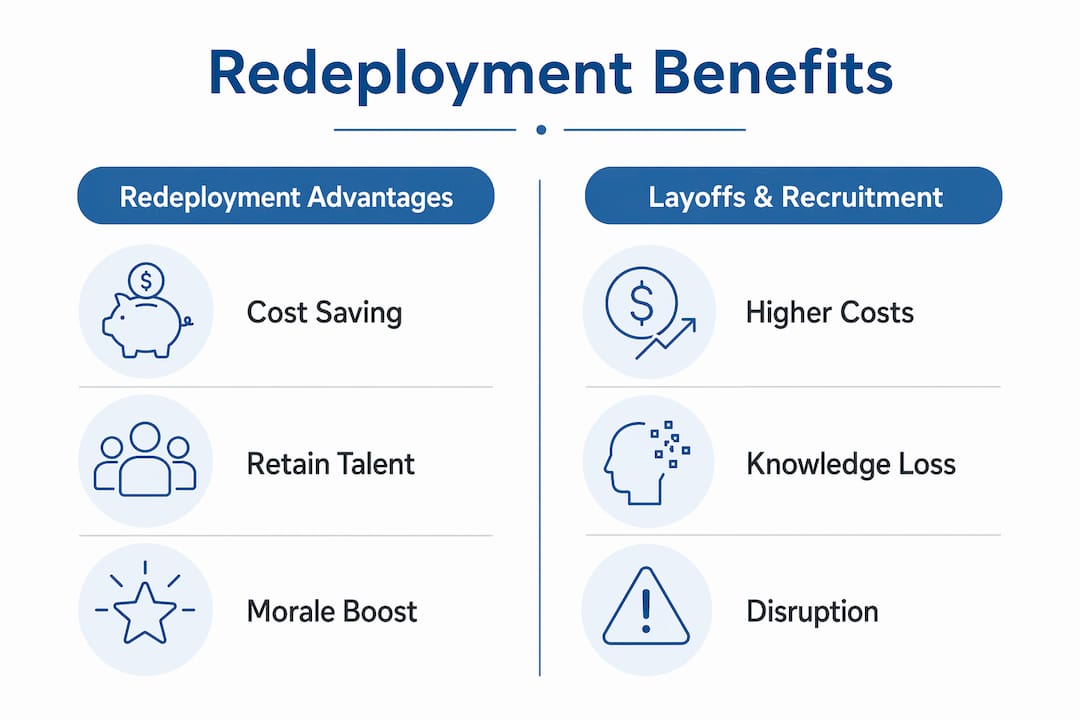
What Are the Benefits of Redeployment Compared to Layoffs and New Recruitment?
Redeployment delivers measurable advantages across cost, culture, and operational continuity. The financial benefit alone justifies building a formal program.
- Lower cost-per-hire. Redeploying an existing employee or contractor costs approximately 25–40% of sourcing a new candidate. That gap includes job advertising, screening, interviewing, and onboarding time.
- Preserved institutional knowledge. A redeployed worker already understands your systems, culture, and client expectations. A new hire needs weeks or months to reach the same productivity level.
- Stronger employee morale. Workers who see a path forward inside the organization during restructuring are less likely to disengage or leave. Redeployment preserves morale and avoids the trust damage that layoffs create across the broader workforce.
- Reduced turnover overhead. Every departure triggers a replacement cycle. Redeployment breaks that cycle by keeping qualified talent inside the organization or staffing ecosystem.
- Better client relationships. Staffing agencies that maintain stable, familiar talent pools give clients continuity. A contractor who already knows a client’s environment is a lower-risk placement than an unknown quantity.
The industry data makes the opportunity cost of inaction visible. Best-in-class staffing agencies achieve redeployment rates above 70%, while the industry average sits at 30–40%. That gap represents tens of thousands of dollars in avoidable sourcing costs per year for mid-size agencies and enterprise HR teams alike.
The contrast with layoffs is equally stark. Layoffs eliminate headcount but destroy institutional knowledge, damage morale across the surviving workforce, and create future hiring costs when demand returns. Redeployment keeps the talent relationship intact and positions the organization to respond faster when conditions shift.
What Are Effective Staffing Redeployment Strategies?
A redeployment program fails without structure. The most common failure is not a lack of intent but a reliance on outdated manual processes that contractors and employees simply ignore. Building a program that works requires four interconnected elements.
Automate the Pre-End Assignment Outreach
Automation is the single highest-leverage investment in redeployment. Automating the 30-day outreach window can boost redeployment rates by 15–25 percentage points and deliver ROI within six months. The automation must be proactive and skills-matched, not a generic broadcast. Set-and-forget email blasts do not move the needle.
Integrate with Your ATS and CR
Redeployment workflows must live inside your existing systems. Bullhorn and similar platforms allow you to build automated triggers based on contract end dates, skills tags, and open requisitions. When the system surfaces a match, the recruiter or HR manager receives an alert and can act immediately. Manual spreadsheet tracking cannot match that speed or accuracy.
Use Mobile-First, Multi-Channel Communication
SMS open rates far exceed email open rates for contractor populations. LinkedIn messaging reaches professionals who check their phones before their laptops. A redeployment outreach strategy that relies only on email will underperform. Build sequences that use at least two channels, with SMS as the primary touchpoint for time-sensitive alerts.
Support Transitions with Coaching and Skills Development
Redeployment only succeeds when open roles exist, skills transfer within a reasonable timeframe, and the organization actively supports the move. When a skills gap exists, a short reskilling plan can bridge it. Pairing redeployment with coaching or targeted training increases placement success and signals genuine investment in the employee’s future. This also fits naturally within a broader talent mobility framework that HR leaders are increasingly building into workforce planning.
Pro Tip: Maintain clean skills data in your ATS. Outdated or incomplete profiles produce poor matches and slow the entire redeployment cycle. Audit contractor and employee records at least once per quarter.
Redeployment vs. Transfer: What’s the Difference?
A transfer is usually employee-initiated or role-to-role — same job family, different team or location, with the position itself continuing to exist. Redeployment is employer-led and triggered by the work changing: the current role is ending, shrinking, or being restructured, and the organization moves the person to where demand actually is. The distinction matters for process — transfers run through normal internal mobility, while redeployment typically carries consultation requirements, retraining budgets, and, done well, replaces a layoff.
What Challenges Exist in Redeployment and How Do You Overcome Them?
Redeployment programs face real constraints. Recognizing them early prevents wasted effort and sets realistic expectations for HR leaders and staffing partners.
- Skills gaps slow placement. A contractor with deep expertise in a legacy system may not transfer easily to a role requiring a different technical stack. Reskilling takes time, and not every gap can be closed within the assignment window.
- Limited internal role availability. Redeployment requires open positions. During a broad restructuring or economic contraction, the number of available roles may not match the volume of workers needing placement. This is the hardest structural constraint to work around.
- Confusion between redeployment and internal transfers. Internal transfers are employee-driven and career-focused. Redeployment is employer-driven and need-focused. Treating them as the same program leads to misaligned incentives, wrong metrics, and poor outcomes for both the organization and the worker.
- Low engagement from manual outreach. Contractors who receive a generic email about “new opportunities” at the end of an assignment rarely respond. Without personalized, timely, and mobile-accessible communication, outreach rates stay low and redeployment rates follow.
- Inflated metrics from loose measurement windows. Many agencies report redeployment rates using 30-day or 60-day windows. The industry average contractor redeployment rate for second assignments is approximately 3%. That number reflects how few contractors actually return to the same agency. Accurate measurement starts with tighter windows and honest tracking.
Overcoming these challenges requires a combination of technology, data hygiene, and structured human support. No single fix works in isolation. Organizations that pair automation with genuine coaching and accurate measurement consistently outperform those that rely on one element alone. Reviewing your staffing best practices across the full recruitment and retention cycle also surfaces gaps that redeployment alone cannot solve.
Key Takeaways
Redeployment in staffing is the most cost-effective way to retain verified talent, with cost-to-redeploy running 25–40% of new sourcing costs and best-in-class agencies achieving redeployment rates above 70%.
| Point | Details |
|---|---|
| Define redeployment correctly | Redeployment is employer-led and triggered by business need, not employee career choice. |
| Measure with a 14-day window | A strict 14-day gap between assignments is the most accurate indicator of real redeployment success. |
| Automate the 30-day outreach | Automated pre-end assignment outreach can increase redeployment rates by 15–25 percentage points. |
| Cost savings are significant | Redeploying talent costs approximately 25–40% of what it takes to source and onboard a new candidate. |
| Technology alone is not enough | Successful redeployment requires open roles, transferable skills, and active organizational support alongside automation. |
Why Redeployment Deserves Its Own Seat at the Workforce Planning Table
I have watched organizations treat redeployment as an afterthought, a last-minute scramble when a contract ends or a restructuring announcement goes out. That approach consistently produces the same result: good people leave, sourcing costs climb, and the organization spends the next quarter trying to replace institutional knowledge it never had to lose.
The distinction between redeployment and internal transfers matters more than most HR teams realize. When you design a program for both under the same umbrella, you end up with metrics that mean nothing and processes that serve neither group well. Redeployment needs its own workflow, its own triggers, and its own success criteria. A 14-day placement window is a demanding standard. It is also the right one.
Technology is necessary but not sufficient. I have seen agencies implement Bullhorn automations and still report 3% second-assignment rates because the underlying skills data was stale and the outreach messages were generic. The automation amplifies whatever is already in the system. If the data is bad, the results will be bad faster.
The organizations that get redeployment right treat it as a workforce management discipline with its own KPIs, its own budget line, and its own owner inside HR. They measure it honestly, invest in the pre-end window, and pair technology with real human coaching. That combination is what separates a 70% redeployment rate from a 3% one.
— Bradford
How Careerscape Supports Your Redeployment Goals
Careerscape operates as a staffing and recruiting partner built for speed and transparency. For HR leaders and organizational decision-makers who need to move fast during workforce transitions, Careerscape’ contract staffing solutions are designed to keep qualified professionals active and placed without the sourcing delays that come with starting from scratch. The firm’s industry-specialized approach means contractors already carry verified skills relevant to your sector, which shortens the redeployment cycle significantly. For teams managing larger workforce shifts, project-based staffing options provide additional flexibility. Connect with Careerscape to put a faster, more cost-effective redeployment process in place.
FAQ
What Is the Redeployment Meaning in Staffing?
Redeployment in staffing is the employer-led process of moving employees or contractors to new internal roles instead of ending their employment. It is triggered by business needs such as restructuring, automation, or role elimination.
How Does Redeployment Differ from an Internal Transfer?
An internal transfer is initiated by the employee for career development purposes. Redeployment is initiated by the employer in response to operational need, making the program design, metrics, and outcomes fundamentally different.
What Is a Good Redeployment Rate for a Staffing Agency?
Best-in-class staffing agencies achieve redeployment rates above 70%. The industry average sits at 30–40%, and the average second-assignment rate for contractors is approximately 3%, which signals significant room for improvement at most firms.
How Do You Measure Redeployment Success Accurately?
The most accurate measure of redeployment success is a 14-day window between assignments. Longer windows of 30 or 60 days inflate reported rates and obscure real operational gaps.
What Is the Biggest Barrier to Successful Employee Redeployment?
The biggest barrier is reliance on manual outreach processes that workers ignore. Automating the 30-day pre-end assignment window with personalized, mobile-first communication is the most direct way to improve redeployment outcomes.
Recommended
- What is recruiting? The employer’s guide to modern hiring
- Hire HR & People Operations Talent | Staffing Agency | Careerscape
- What Is Talent Mobility? A Guide for HR Leaders