
A two-week hiring plan is achievable for urgent, well-defined roles by securing key elements before the process begins, including a clear intake, pre-approved compensation, and a single process owner enforcing a 24-hour feedback rule. The hiring sprint should adhere to a structured timeline with a maximum of three interview rounds, utilizing role-relevant assessments to maintain momentum and prevent delays. Daily metrics such as time-to-offer and feedback lag should be tracked to quickly identify and resolve any stalls, with external staffing support available if necessary.
- Lock the success outcome, decision authority, sourcing plan, assessment design, feedback process, and compensation bands before posting the job to avoid delays.
- Cap interview rounds at three and use structured, role-relevant assessments with a 24-hour feedback SLA to maintain momentum within the two-week timeframe.
- Track daily metrics such as time-to-offer, feedback lag, and sourcing yield to identify and address stalls immediately during the sprint.
- Ensure stakeholder commitment to the 24-hour feedback rule and avoid vague role briefs or budget delays that can silently derail timely hiring.
- Use external support from a staffing firm to handle sourcing, screening, and shortlist delivery, especially when internal capacity or urgency require extra resources.
In this article
Yes, a two week hiring plan is realistic for urgent, well-scoped roles when you lock three things before day one: a finished intake and scorecard, a pre-approved compensation band, and a single process owner enforcing a 24-hour feedback rule. Start today by scheduling a 30 to 45 minute intake meeting, confirming the offer range with finance, and naming who decides. A staffing firm can run or support this sprint if your team lacks the bandwidth to execute all of it internally.
What Is a Two Week Hiring Plan and When Should You Use It?
A two week hiring plan compresses the full recruitment cycle, intake through offer, into 14 calendar days instead of the standard four to six weeks. It only works when the role is genuinely urgent and tightly scoped, because there’s no slack for redoing a vague job description mid-sprint. The average complete recruitment cycle in the U.S. runs 44 days, so a 14-day plan isn’t a minor tweak to normal process. It’s a fundamentally different operating mode that trades some search breadth for speed.
This approach fits certain situations far better than others:
- Good fit: backfilling a critical operational role, covering parental or medical leave, replacing a sudden departure, or filling a short-term project seat with defined runway.
- Poor fit: executive searches, roles requiring extensive stakeholder alignment, or positions where the success profile is still being debated internally.
Before you launch, define what success looks like. Track time-to-offer (days from intake to signed offer), acceptance rate (offers accepted versus extended), and a simple candidate experience score from a short post-interview survey. Skip any of these and you’re flying the sprint blind.
Six Inputs Every Two Week Hiring Plan Must Lock Before Day One
Every fast hire that falls apart does so for the same reason: something that should have been decided in week zero gets decided, badly, in week two. Lock these six inputs before you post a single job.
- Intake and success profile. Three concrete outcomes the hire needs to deliver in the first 90 days, plus two measurable metrics tied to those outcomes. Not a duties list. An outcomes list.
- A single process owner with clear RACI. One person owns scheduling, decision timing, and stakeholder communication. Committees kill sprints.
- Recruiter capacity and a sourcing plan. Know who’s sourcing, how many hours they have, and which channels come first: internal referrals, then targeted outbound, then job boards.
- Assessment design. A short, role-relevant work sample or structured interview, decided in advance, not improvised after the first candidate call.
- Decision authority and the 24-hour feedback commitment. Every interviewer knows they must submit scored feedback within 24 hours of a candidate touchpoint.
- Pre-approved compensation bands and negotiation guardrails. The hiring manager knows the ceiling before the first offer conversation, not after finance gets involved.
Pro Tip: Run the intake meeting with the hiring manager, one senior team member, and HR in the same room. Getting three perspectives on the success profile in one 45-minute session beats three separate follow-up emails that stretch over four days.
Miss any of the six and the sprint doesn’t fail loudly. It fails quietly, one day of “waiting to hear back” at a time, until you’re at day 12 with no offer out.
Day-by-Day 14-Day Hiring Sprint Roadmap
A sprint only works if every day has an owner and a deadline attached to it. The structure below adapts a lean hiring framework built specifically around a two-week window, with a fixed cap on interview rounds and a hard feedback SLA at every stage.
- Day 1: Intake and scorecard finalization. Hiring manager, process owner, and HR meet for 30 to 45 minutes. Finalize the scorecard, confirm the compensation band, and block decision windows on every stakeholder’s calendar for the next two weeks.
- Day 2: Sourcing launch. Post internally, activate referral bonuses, and start targeted outbound to a short list of passive candidates. Set up ATS or CRM tracking so every application funnels into one pipeline view.
- Days 3 and 4: Structured screening calls. Run 15 to 30 minute calls against the scorecard, not a freeform chat. Score each candidate immediately after the call while it’s fresh, and build a shortlist of four to six finalists by end of day 4.
- Days 5 through 8: Interviews and practical assessment. Group technical and culture-fit rounds on the same day per candidate wherever possible. Parallelizing interviews and using async assessments keeps feedback fresh and cuts the elapsed time between a candidate’s first and last touchpoint, which directly reduces drop-off.
- Day 9: Panel debrief and finalist selection. Interviewers bring completed scorecards to a single debrief meeting. Select a finalist and a backup candidate within 24 to 48 hours of the last interview, no exceptions.
- Days 10 and 11: Reference checks and offer drafting. Run references on the finalist while HR drafts the offer letter using the pre-approved compensation band, so there’s no delay waiting for a second approval round.
- Days 12 and 13: Verbal offer and written confirmation. Extend the verbal offer immediately after references clear. Send the written offer within 24 hours, with negotiation limited to guardrails set on day 1.
- Day 14: Onboarding prep and contingency activation. IT provisioning, manager introduction plan, and first-week schedule get built. If the finalist declines, activate the backup candidate or a contract staffing bridge the same day.
A few structural rules make this timeline hold together:
- Cap interviews at three rounds maximum for any role. A higher number of rounds rarely improves the decision and risks losing momentum.
- Combine panels instead of stacking sequential one-on-ones across separate days.
- Treat every 24-hour feedback deadline as fixed, not aspirational.
Senior technical roles follow the same logic. A small, pre-vetted candidate pool combined with structured interviews and a named decision owner makes it realistic to hire a senior engineer in about two weeks, provided the round count stays capped and debriefs happen the same day as the last interview.
Templates and Scorecards That Keep the Sprint on Schedule
The sprint lives or dies on three documents, and none of them need to be complicated.
Your intake template should capture: the three target outcomes, two measurable KPIs, must-have qualifications, nice-to-have qualifications, reporting structure, and target start date. If a hiring manager can’t fill this in during the intake meeting, the role isn’t ready to source yet.
Your scorecard should score each competency on a 0 to 4 scale with a written behavior anchor for each number, so two interviewers scoring the same candidate land within one point of each other. Weight the must-have competencies higher than the nice-to-haves in the final total.
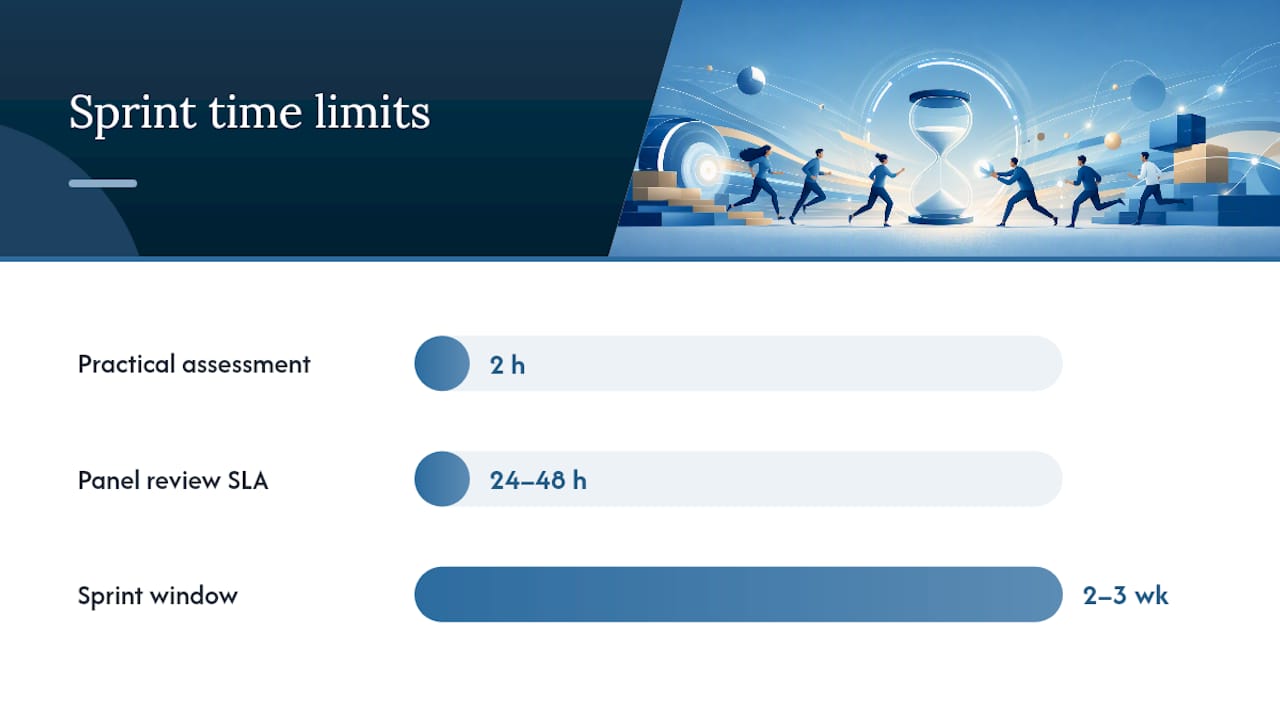
Your practical assessment needs firm rules: capped at two hours of candidate time, built as a direct work sample rather than a hypothetical exercise, and reviewed by the panel within a 24 to 48 hour SLA. A longer assessment doesn’t produce better signal. It just produces slower hires and candidate fatigue.
Finally, keep a running sprint checklist:
- Interview windows blocked on every stakeholder’s calendar before day 1
- Feedback deadlines attached to every scheduled touchpoint
- A pre-close script the recruiter uses with the finalist to confirm interest before the formal offer
- A named backup candidate and contract staffing option ready to activate
A nearshore hiring sprint framework built around a two- to three-week window uses this same combination: clear scope, fast feedback, and a shared scorecard. The specifics vary by market, but the checklist logic holds for any urgent U.S. hire.
Common Failure Modes and Fixes to Protect Your 14-Day Goal
Most sprints don’t fail because the plan was wrong. They fail because one predictable habit crept back in halfway through week one.
- Slow feedback. The single most common failure point in a two-week sprint is dead time between stages. Fix it with a named owner, calendar-blocked debrief slots, and a strict 24-hour feedback SLA after every touchpoint.
- Vague role brief. Sourcing on a fuzzy job description wastes days three through six. Fix it by enforcing the three-outcomes-plus-two-metrics rule before a single job posting goes live.
- Too many interview rounds. Fix it by capping rounds at three, combining separate panels into one session, and using async assessments instead of adding a fourth live round.
- Budget delays. Fix it by giving hiring managers pre-approval authority for offers up to a set threshold, so finance sign-off never becomes a day-12 bottleneck.
- Candidate drop-off. Fix it with a transparent timeline shared on day one, fast scheduling turnaround, and a pre-closing conversation before the formal offer goes out.
Pro Tip: If any single stakeholder cannot commit to the 24-hour feedback SLA in writing before day one, the two-week goal is not achievable for that role. Address it in the intake meeting, not on day 9 when the debrief stalls.
Turning the Hiring Plan Into a Living Dashboard
A sprint plan written once on day one and never revisited turns stale by day 5. Track five metrics in real time instead: time-to-offer, conversion rate by stage, interviewer load, sourcing yield, and feedback lag. Feedback speed and sourcing yield are the two numbers that move fastest during an active sprint, and they’re the first to reveal whether a stage is quietly stalling.

Refresh the dashboard weekly for standard pipeline planning, but daily once a sprint is live. A weekly glance won’t catch a stalled debrief until it’s cost you two full days.
Build the dashboard directly in your ATS if it supports custom views, or in a lightweight spreadsheet or BI tool if it doesn’t. Assign one owner, usually the process owner from day one, to update it and flag any stage running behind. A living plan that updates daily catches a capacity problem on day 6 that a static quarterly headcount plan wouldn’t surface until the quarter was already over, giving you time to shift recruiter hours before the sprint window closes.
How Careerscape Supports a Fast, Well-Scoped Hire
A staffing and recruiting firm built on a simple idea: hiring should be fast, honest, and backed by people who understand your industry. That principle maps directly onto sprint mechanics. Contract staffing can provide a bridge candidate when a permanent search can’t close in 14 days, and direct-hire sourcing can deliver a pre-screened shortlist without using your own recruiter’s sourcing hours during week one. An employer portal with real-time dashboard access supports the daily-refresh cadence a live sprint demands, so your process owner isn’t chasing status updates by email.
Planning the First 90 Days: Your 30-60-90 Ramp
A two-week hire that lands without a ramp plan often churns within the first quarter, which erases whatever speed you gained. Build the 30-60-90 plan during the offer stage, not after the start date, so it’s ready on day one of onboarding.
The first 30 days focus on orientation and the outcomes defined during intake: system access, initial shadowing, and one or two small, well-scoped tasks tied directly to the success metrics you set before sourcing began. The next 30 days, days 31 to 60, shift toward independent ownership of a slice of the role, with weekly check-ins against the original scorecard competencies rather than a generic satisfaction survey. By days 61 to 90, the new hire should be operating against the full success profile from the intake document, with a formal review comparing actual performance to the two measurable KPIs set on day one.
The connection back to the sprint matters here: because your intake template already captured outcomes and metrics before you sourced a single candidate, the ramp plan writes itself from the same document. Teams that skip the intake step usually improvise a 30-60-90 plan from scratch during week one of onboarding, which is exactly the kind of dead time a 14-day sprint can’t absorb twice.
What to Prioritize in the First 48 Hours
If there’s one place hiring teams waste sprint time, it’s overthinking the plan instead of locking the inputs. Get the intake meeting and scorecard done first. Get compensation pre-approved second. Name a process owner third. Everything else, sourcing channels, interview scheduling tools, panel composition, can flex. Those three cannot.
Block decision windows on every stakeholder’s calendar before day one ends, and start referral outreach the same afternoon. A simple 48-hour checklist:
- Hour 0 to 4: intake meeting, scorecard drafted
- Hour 4 to 24: compensation approved, process owner named, calendars blocked
- Hour 24 to 48: sourcing live, first referral conversations underway
Teams that hit this window rarely miss the 14-day target. Teams that spend two days debating the job description almost always do.
— Bradford
How Careerscape Runs the Sprint When Your Team Can’t
Careerscape becomes the difference between a two-week goal you hope to hit and one you actually close, because it hands off the parts of the sprint that most often stall: sourcing hours, initial screening, and pre-screened shortlist delivery. A typical engagement starts with an intake call that mirrors the sprint’s own day-1 meeting, moves to a shortlist of pre-screened finalists within days, and includes offer support once you’ve picked a candidate. For roles where a permanent search genuinely can’t close in the window, Contract Staffing provides a bridge hire while the direct-hire search continues in parallel. If you’re ready to move, start with Direct Hire and get a shortlist delivered against your scorecard instead of building one from scratch.
FAQ
Is Two Weeks Too Long to Wait for a Job Offer?
For candidates, two weeks between a final interview and an offer is on the longer end and raises real drop-off risk. That’s exactly why a structured sprint enforces a 24 to 48 hour decision window after the panel debrief instead of letting the offer decision drift.
What Is the 70/30 Rule in Hiring?
Definitions vary across recruiting circles, and no single authoritative version applies universally. Rather than force a number that doesn’t hold up, focus on the metrics that do matter in a sprint: time-to-offer, acceptance rate, and feedback lag.
What Is the 30-60-90 Rule for a New Job?
It’s a ramp plan broken into three phases: orientation and small initial tasks in the first 30 days, growing ownership of the role in days 31 to 60, and full performance against the original success profile by day 90. Building it during the offer stage, using the same outcomes and KPIs from your intake document, keeps onboarding aligned with why you hired the person in the first place.
What Is the 80/20 Rule in Interviewing?
That’s the same logic behind weighting must-have competencies higher on a structured scorecard.
Can Careerscape Run the Entire Sprint for Us?
Careerscape can handle sourcing, pre-screening, and shortlist delivery so your internal team focuses on interviews and the final decision. Pricing depends on the placement type and role, and current details are available directly on the Direct Hire and Contract Staffing pages.
Recommended
- 9 Proven Ways to Attract Top Talent in 2026
- Staffing best practices to boost recruitment and culture