
The average hiring process takes 44 days, but top candidates are only available for 10 — meaning most hiring delays stem from internal friction at three key stages: resume screening, interview scheduling, and the debrief-to-offer handoff. Automation tools like AI resume screening and self-scheduling platforms can dramatically compress these delays, with one case study showing an 85% reduction in time to hire, while structured interviews with consistent scoring rubrics are 2.5x more predictive of job performance and enable same-day decisions. Faster hiring requires pre-approved offer ranges, 24-hour communication SLAs, parallelized assessment stages, and scorecard submission within 30 minutes of each interview — none of which sacrifice quality, but all of which eliminate the administrative drag that costs organizations their best candidates.
Time to hire is defined as the number of days between a candidate entering your pipeline and accepting an offer. The industry average sits at 44 days, yet top candidates stay available for only 10 days. That gap is where great hires are lost. Knowing how to reduce time to hire is not a nice-to-have for HR teams. It is a competitive requirement. This guide breaks down where delays hide, which tools eliminate them, and how structured processes let you hire faster without lowering your standards.
What Are the Main Bottlenecks Slowing Your Hiring Funnel?
Most hiring delays are not caused by a shortage of candidates. They are caused by friction inside your own process. The three biggest offenders are resume screening, interview scheduling, and the debrief-to-offer stage.
Screening alone can consume days when recruiters manually review unqualified applications. Interview scheduling compounds the problem. Coordinating calendars across hiring managers, panels, and candidates often burns 2–3 hours of coordinator time per role. The debrief-to-offer stage is the most overlooked bottleneck. Without same-day debriefs, decision delays stretch a week or longer with no candidate communication in between.

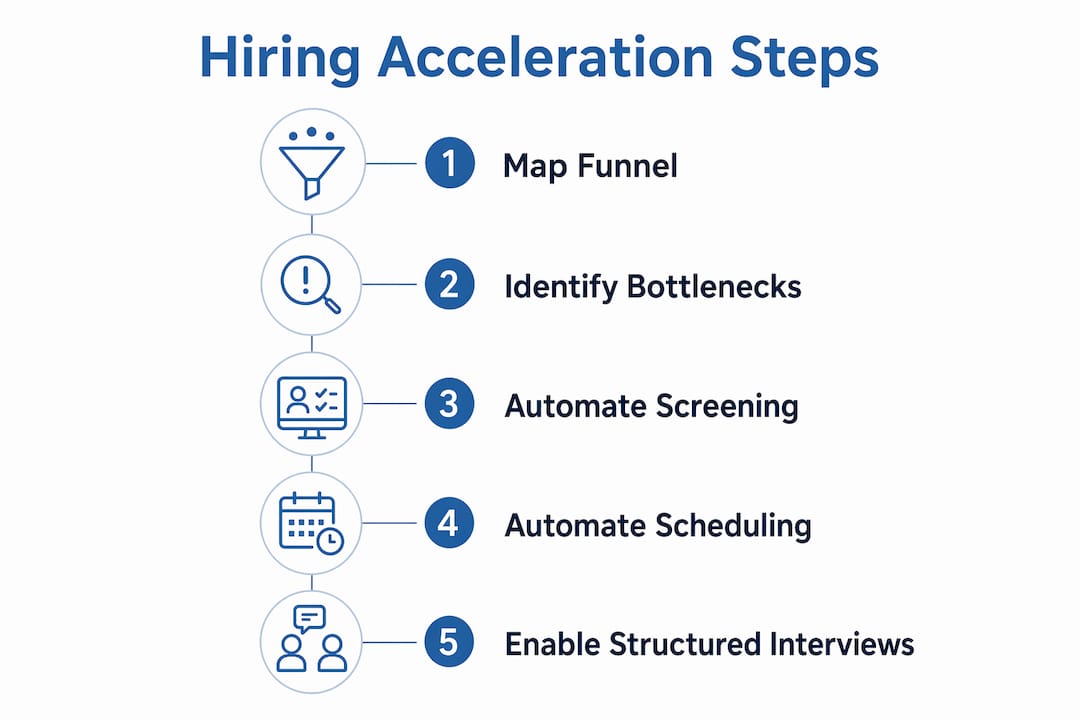
Pro Tip: Map your hiring funnel by stage and record the average days spent in each one. You cannot improve what you do not measure.
The table below shows where time typically disappears in a standard hiring cycle:
| Hiring stage | Typical time lost | Primary cause |
|---|---|---|
| Resume screening | 3–5 days | Manual review of unqualified applicants |
| Interview scheduling | 4–7 days | Calendar conflicts and back-and-forth emails |
| Debrief to offer | 5–10 days | Delayed feedback and missing approvals |
| Offer approval | 2–4 days | No pre-approved compensation ranges |
Pre-approved offer ranges for roles are one of the fastest fixes available. Removing approval bottlenecks at the offer stage reduces rescissions and cuts days from the final stretch of every hire. Aligning hiring managers early on shortlist criteria prevents the rework that comes from late-stage rejections.
Which Automation Tools Can Accelerate the Hiring Process?
Automation is the fastest lever available for reducing recruitment time at scale. AI-driven resume screening, automated multi-step outreach, and scheduling tools each target a different delay point in the funnel.
The ISS North America case is the clearest proof of what is possible. The company deployed a conversational AI chatbot named Iris to handle candidate engagement and scheduling around the clock. The result was an 85% reduction in time to hire and more than 10,000 recruiter hours saved. That scale of impact is not achievable through process tweaks alone. It requires technology doing the repetitive work.
The key benefits of hiring automation tools include:
- AI resume screening filters unqualified applicants in minutes, not days, and surfaces ranked shortlists for recruiter review
- Conversational chatbots answer candidate questions, collect pre-screening responses, and book interviews without human coordination
- Automated scheduling platforms reduce scheduling-related delays by 4 to 7 days compared to manual coordination and increase candidate show rates by 12–15%
- Automated reminders reduce no-shows and keep candidates engaged between stages
- AI-driven outreach sequences personalize follow-up at scale without adding recruiter workload
“Automation should free recruiters for human-centric moments like candidate engagement while handling repetitive tasks such as scheduling and onboarding paperwork.” — ISS North America
The distinction matters. Automation handles the administrative load. Recruiters handle the relationship. That division of labor is what makes AI-driven recruitment workflows sustainable rather than just fast.
How to Design a Structured Hiring Process That Balances Speed and Quality
Speed without structure produces bad hires. The best practices for hiring fast and well share one common feature: they replace subjective, ad hoc decisions with predetermined criteria.
Structured interviews with consistent questions and numerical scoring rubrics are 2.5x more predictive of job performance than unstructured conversations. They also speed up consensus. When every interviewer scores against the same criteria, post-interview debriefs take minutes instead of hours. Google’s re:Work research on structured interviewing confirms that standardizing evaluation with uniform questions and grading accelerates decisions and reduces bias simultaneously.
The comparison below shows how structured and unstructured processes differ in practice:
| Factor | Unstructured process | Structured process |
|---|---|---|
| Interview questions | Varies by interviewer | Predetermined and consistent |
| Scoring | Gut feel | Numerical rubric |
| Decision speed | Days of debate | Same-day consensus |
| Bias risk | High | Reduced |
| Predictive validity | Low | 2.5x higher |
Parallelizing assessment stages is the other major lever. Running technical tests, hiring manager conversations, and reference checks concurrently rather than sequentially can cut 8–15 days from engineering and technical hiring cycles. Most organizations run these stages in series out of habit, not necessity.
Pro Tip: Set a firm internal SLA requiring interviewers to submit scorecards within 30 minutes of each interview. Delayed scorecards are the single most common reason debriefs get pushed to the next day.
Additional rounds rarely add predictive value. Merging panel interviews and completing scorecards within 30 minutes of each session prevents the delays that accumulate when feedback sits unsubmitted overnight.
What Scheduling and Engagement Tactics Keep Your Pipeline Moving?
Candidate drop-off is a direct cost. Every candidate who goes silent between interview rounds represents a failed search and a restarted process. The tactics that prevent drop-off are simpler than most teams expect.
-
Reserve weekly interview blocks. Treat dedicated interview windows the same way you treat customer-facing meetings. Pre-blocked interview windows eliminate the calendar coordination that silently kills hiring speed and reduce coordinator time by 2–3 hours per week.
-
Enable candidate self-scheduling. Give candidates a direct link to book their own interview slot. This removes the back-and-forth entirely and signals respect for their time. Pair it with automated reminders 24 hours and 1 hour before the interview.
-
Set a 24-hour communication SLA. Candidates contacted within 3.6 days are significantly more likely to be hired than those who wait 6.1 days. A 24-hour internal SLA for feedback and status updates keeps candidates engaged and reduces the risk of losing them to a faster competitor.
-
Communicate timelines upfront. Tell candidates at the first touchpoint how many rounds to expect and when they will hear back. Transparency reduces anxiety and increases offer acceptance rates.
-
Assign a single point of contact. Candidates who receive consistent communication from one recruiter report higher satisfaction and are less likely to withdraw. This also prevents the confusion that comes from multiple team members sending conflicting updates.
Pro Tip: Review your offer acceptance rate alongside your time-to-hire data. A low acceptance rate often signals that candidates received competing offers during a slow process, not that your offer was uncompetitive.
Faster hiring is not about sacrificing quality. It is about removing administrative friction through process design and technology. Every day you shorten the cycle is a day you protect your pipeline from attrition.
Key Takeaways
Reducing time to hire requires eliminating bottlenecks at each funnel stage, deploying automation for repetitive tasks, and standardizing evaluation so decisions happen faster without losing quality.
| Point | Details |
|---|---|
| Map your funnel first | Measure time spent in each hiring stage before making changes. |
| Automate scheduling and screening | AI tools can cut scheduling delays by 4–7 days and save thousands of recruiter hours. |
| Use structured interviews | Consistent questions and scoring rubrics speed consensus and improve hire quality. |
| Parallelize assessment stages | Running tests and interviews concurrently removes 8–15 days from technical hiring cycles. |
| Set 24-hour SLAs | Fast candidate communication directly increases the probability of a successful hire. |
Speed Versus Quality: What I’ve Actually Seen Work
Most hiring managers I talk to believe that moving faster means accepting more risk. That belief is the biggest obstacle to real improvement. In practice, the organizations that hire fastest are also the ones with the tightest process discipline.
The misconception comes from confusing speed with shortcuts. Cutting interview rounds arbitrarily is a shortcut. Running those rounds in parallel with pre-set scoring criteria is a process improvement. The outcome looks the same from the outside. The quality of the hire is completely different.
What I have seen work consistently is this: fix the debrief stage first. It is the least visible bottleneck and the one with the most recoverable time. When teams commit to same-day debriefs and 30-minute scorecard completion, the entire back half of the hiring cycle compresses naturally. You do not need new software to do it. You need a clear internal agreement and a hiring manager who enforces it.
Technology matters, but it works best when it is layered onto a process that already has structure. Deploying an AI scheduling tool into a chaotic funnel just automates the chaos. The teams that see results like ISS North America’s 85% reduction had already defined their stages, their criteria, and their SLAs before they introduced automation.
Protect the human touchpoints. A recruiter who calls a finalist candidate the evening before an offer is extended does more for acceptance rates than any automated sequence. Speed and care are not opposites. The best hiring processes deliver both.
— Bradford
How Cs-Recruiters Helps You Hire Faster Without Starting from Scratch
Cs-recruiters is built for exactly this challenge. When your internal team is stretched or a role needs to be filled faster than your current process allows, Cs-recruiters provides contract staffing solutions that put qualified professionals in front of you quickly. For larger initiatives, project-based staffing teams give you the flexibility to scale without rebuilding your entire recruitment function. Cs-recruiters combines industry-specialized recruiting expertise with a process designed around speed and fit. If you are ready to accelerate your hiring timeline, connect with the Cs-recruiters team to find the right approach for your organization.
FAQ
What Is a Good Time-to-Hire Benchmark?
The industry average is 44 days, but top candidates are typically available for only 10 days. High-performing recruiting teams target a time to hire of 14–21 days for most roles.
How Does Structured Interviewing Speed up Hiring Decisions?
Structured interviews use consistent questions and numerical scoring rubrics, which are 2.5x more predictive of performance. Shared scoring criteria allow interviewers to reach consensus the same day rather than debating subjective impressions.
What Is the Fastest Single Change to Reduce Recruitment Time?
Switching from manual to automated scheduling eliminates 4–7 days of delay per hire and reduces no-shows by 12–15%. It requires minimal process change and delivers immediate results.
How Do I Keep Candidates from Dropping Out During a Long Process?
Set a 24-hour SLA for all candidate communications, communicate the full timeline upfront, and assign one recruiter as the single point of contact. Candidates contacted within 3.6 days are measurably more likely to complete the process.
Does Hiring Faster Mean Lower-Quality Hires?
No. Faster hiring removes administrative friction, not evaluation rigor. Parallelizing assessments, using structured scorecards, and setting internal SLAs all reduce time to hire while maintaining or improving the quality of hiring decisions.