
Most employment background checks return results within a few days, but delays often stem from manual county criminal searches or international education verifications, which can extend the process to weeks. Key factors influencing turnaround times include the digitization of court records, responsiveness of third-party verifiers, and the complexity of the candidate’s background. To expedite checks, employers should use complete intake forms, run components simultaneously, and ensure vendors have in-house researchers to minimize delays.
- Manual county criminal searches and international education verifications are the primary sources of delays, often extending checks from days to weeks.
- County criminal record retrieval can take several days to weeks if records are physical and not digitized, significantly slowing the overall process.
- Slower response times from employers, schools, or government agencies, especially in manual or multi-jurisdictional cases, are the most common causes of background check delays.
- Vendors relying solely on outsourced court runners or lacking in-house researchers tend to have longer, less predictable turnaround times for criminal searches.
- Proper planning, parallel component checks, and detailed vendor SLAs can help streamline background checks without sacrificing compliance or accuracy.
In this article
Most comprehensive employment background checks typically return within a few business days, but that range can vary widely depending on circumstances. Database and identity checks often clear quickly within a short time; manual county criminal searches or international education verifications can take significantly longer. The fastest way to build a reliable estimate is to identify every component you’re ordering and plan around whichever one is slowest.
How Long Does A Background Check Take By Component?
Background check duration depends almost entirely on which components you order, since each one runs through a different data source with its own speed limits. Understanding the typical range for each piece lets you build an honest overall estimate instead of guessing.

Identity verification is usually the fastest step in the entire process. Automated database matching against government and credit-header records often completes in seconds to minutes, which is why many employers run it first to catch clerical errors before other checks even start.
Criminal record checks vary the most. National and state-level database searches, which cross-reference records from digitized repositories, often return same-day or within one to three business days. County-level searches are a different story: when a court hasn’t digitized its records, a search requires a clerk or an on-site researcher to pull physical files, and that manual process can add days or even weeks to the timeline.
Employment verification splits into two speeds. When a former employer uses an automated verification service, confirmation can be nearly instant. When verification depends on a manual response from HR or a hiring manager, expect one to three business days at minimum, longer if the contact is on leave or the company is small enough that verification requests aren’t a routine task.
Education verification generally takes one to three business days as well, but older records, small or defunct institutions, and foreign universities routinely extend that window. A registrar’s office at a large state university can confirm a degree in minutes through an automated portal; a decades-old diploma from a school that changed its name twice is a different kind of search.
Motor vehicle records (MVR) typically return within one to three business days, depending on how a state’s DMV structures electronic access. Some states offer instant electronic pulls; others still require a batch request that adds a day or two.
Drug screening turnaround depends on specimen type and lab workload. Rapid onsite tests can produce results same day, while lab-based tests, especially anything requiring confirmation testing after a non-negative screen, can take several days.
Here’s the quick-reference range hiring teams use to plan:
- Identity verification: seconds to same day
- National/state criminal database: same day to 1–3 business days
- County criminal search (manual): several days to weeks
- Employment verification: near-instant (automated) to 1–3+ business days (manual)
- Education verification: 1–3 business days, longer for older or foreign records
- MVR: 1–3 business days
- Drug screening: same day (rapid) to several days (lab-based)
Pro Tip: Screening vendors report that most complete checks often land within a few days, so if you’re five business days in with no update, that’s worth a status check, not just patience.
What Actually Causes Background Check Delays?
Turnaround time is really a function of how many manual steps stand between your request and a verified answer. Five factors explain almost every delay you’ll encounter.
Court access is the single biggest variable in criminal search speed. Some counties maintain fully digitized, searchable records that a vendor’s system queries automatically. Others still require a human being to physically visit a courthouse, request a file, and transcribe the result by hand. That gap between digitized and manual court access is why two candidates with identical backgrounds in different counties can get results a week apart.
Third-party responsiveness determines how fast verification checks close. A former employer’s HR department, a university registrar, or a state licensing board all have to respond to an outside request, and none of them treat that request as urgent. Small businesses without dedicated HR staff and understaffed school registrar offices are common bottlenecks.
Candidate data problems slow down even well-run searches. A missing Social Security number, a maiden name that isn’t disclosed, or gaps in address history force researchers to trace identity before they can even start the substantive search.
Multiple jurisdictions compound everything. A candidate who lived in three states and worked for four employers over the past seven years needs three separate county or state criminal searches and four separate verification calls, and the overall timeline is set by the slowest one, not the average.
Vendor capacity matters more than most employers realize. A provider with in-house court researchers and strong automation coverage moves county searches faster than one that relies entirely on outsourced or third-party court runners. Seasonal volume spikes, around graduation season and after major holidays, can also slow every vendor’s queue at once.
- Court digitization level (statewide database vs. manual county pull)
- Speed of employer/school/licensing board response
- Accuracy and completeness of candidate-supplied data
- Number of jurisdictions and past employers to check
- Vendor staffing, automation, and current volume
How To Speed Up Employment Background Checks
You can’t control county court schedules, but you control most of the variables that actually create delay. Here’s the operational checklist HR teams use to compress timelines without cutting corners.
- Build a complete intake form. Capture full legal name, any former names or aliases, date of birth, Social Security number, and a seven-year address history up front. Standardized digital intake with e-signature consent eliminates the back-and-forth that stalls authorization before the search even begins.
- Run components in parallel, not sequence. Identity verification, criminal database searches, and MVR pulls are typically independent of each other. There’s no compliance reason to wait for one to finish before starting the next.
- Negotiate a real SLA with your vendor. Ask for a specific turnaround commitment by component type, not a vague “most checks complete quickly.” Request status logs with timestamps so you can see exactly where a file sits, not just that it’s “in progress.”
- Confirm your vendor has in-house court researchers covering the counties where your candidates have lived, not just an outsourced network that adds a layer of scheduling delay.
- Communicate expectations clearly to candidates. Tell them exactly what you need, why, and how fast a response from them (like confirming a former address or employer contact) keeps their file moving. A thoughtfully designed hiring process reduces friction on both sides of the screening step.
- Track every open file on a dashboard with a defined escalation trigger, such as any component untouched for 48 hours past its SLA, so stalled cases get attention before they become a hiring-timeline crisis.
Pro Tip: Ask your provider one blunt question during vendor selection: “What percentage of your criminal searches use in-house researchers versus third-party court runners?” The answer predicts your county-search speed better than any marketing claim.
FCRA and EEOC Rules That Affect Your Hiring Timeline
Compliance steps add time between getting a completed report and making a final offer, and skipping them creates legal exposure, not speed. The Fair Credit Reporting Act requires employers to notify a candidate before taking adverse action based on a background check, and that notice period is where a lot of hiring managers lose track of their own timeline.
The FCRA doesn’t specify an exact number of days between a pre-adverse action notice and a final decision. In practice, compliance practitioners commonly build in at least five business days as a prudent buffer, giving the candidate a real opportunity to dispute inaccurate information before the decision becomes final. Treat that window as customary practice rather than a hard statutory countdown, but plan for it every time you’re prepared to rescind an offer based on a report.
A compliant adverse-action notice needs to include the name and contact information of the consumer reporting agency that produced the report, a statement that the agency didn’t make the hiring decision, and a clear explanation of the candidate’s right to dispute the report’s accuracy as required by law. Missing any of these elements can restart the clock on your process.
- Pre-adverse action notice sent before any final decision
- Minimum practical window of five business days for candidate response
- Adverse-action notice includes agency contact info and dispute rights
- Records retained per EEOC recordkeeping guidance, for a period of at least one year and longer in some sectors
Fold these steps into your hiring calendar from the start. If you know a role has a hard start date, build the five-business-day buffer into your offer timeline rather than discovering it after the fact, and route recordkeeping through the same system your team uses for EEO compliance tracking so nothing falls through when a hire moves fast.
Is Your Background Check Delay Normal Or A Vendor Problem?
Some delays are structural. A county with no electronic court records, an international education verification routed through a foreign registrar, or a candidate with residences in four states over the past decade will always take longer, sometimes multiple days or weeks for the manual pieces. That’s the nature of the source, not a vendor failure.
A vendor problem looks different. If your provider can’t produce a status log with timestamps, can’t tell you which specific component is pending, or gives you the same “still processing” answer for a week straight, that’s a legitimate red flag worth escalating.
Before you escalate, ask your vendor three specific questions: which component is holding up the file, what timestamp shows the last action taken on it, and what attempts have been made to contact the source (court, employer, or school). A provider with in-house researchers should be able to answer all three within a business day.
- Normal: county manual search, foreign verification, multi-jurisdiction candidate history
- Red flag: no status updates, no timestamps, vague “processing” responses for days
- Red flag: vendor refuses to share an escalation path or assign an in-house researcher
- Action: proceed conditionally on unaffected roles, pause only the specific decision tied to the pending item
- Action: switch providers if the same failure pattern repeats across multiple hires
Speed and Compliance Aren’t Actually in Tension
The instinct to treat “fast” and “compliant” as competing goals is one of the more persistent misconceptions in hiring. Hiring should be fast, honest, and run by people who understand your industry, and the fastest screening processes are the ones designed correctly from the intake form forward, not the ones that skip steps under deadline pressure.
Digital intake that captures aliases and full address history the first time, pre-screening candidates before a formal background check even starts, and coordinating parallel searches with a vendor that provides real status logs will consistently outperform an ad hoc process that scrambles to fix data errors mid-search. The employers who move fastest aren’t cutting corners. They’re removing friction before it has a chance to cause a delay.
Get Compliant Hires Moving Faster With Careerscape
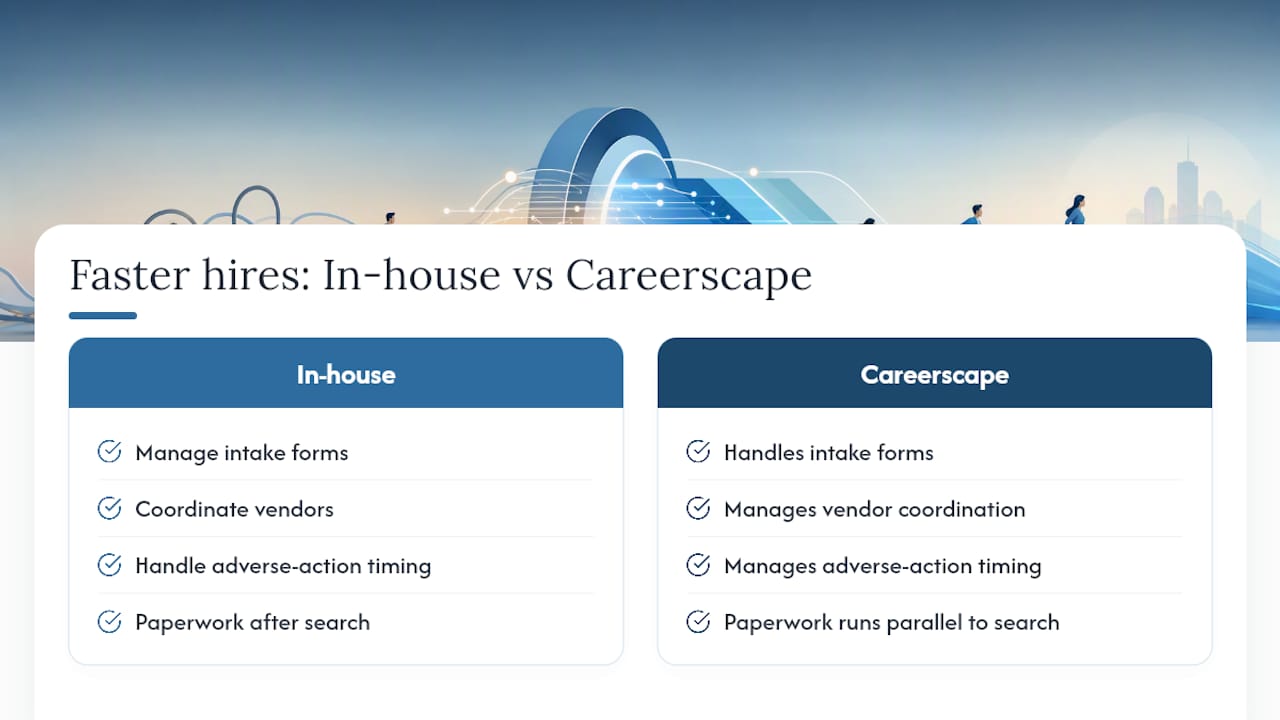
Employers can gain a faster path to qualified, screened candidates than building an internal recruiting-and-compliance process from scratch. Rather than managing intake forms, vendor coordination, and adverse-action timing on their own, staffing services can handle candidate sourcing, pre-screening, and interview process consultation as part of direct hire and contract staffing engagements, so the paperwork moves in parallel with the search instead of after it.
Whether you need one specialized hire or ongoing contract staffing support, Careerscape’s team works from a candidate pipeline that’s already been vetted for the role and your industry. If you’re ready to fill an open position without absorbing every screening delay yourself, start a hiring request and Careerscape will walk you through what to expect during onboarding.
FAQ
Can a background check come back in 2 days?
Yes. Identity verification, national criminal database searches, and automated employment verifications often complete within 24 to 72 hours when there are no manual steps involved.
How will I know if I passed my background check?
Your screening provider or HR team will notify you once the report is complete; if anything on the report could lead to a negative hiring decision, federal law requires a pre-adverse action notice before any final decision is made.
How fast can an employer do a background check?
An employer can often move through the full screening process in one to five business days when every component uses digitized records and third parties respond promptly, though this depends entirely on which checks are ordered.
What’s the longest a background check could take?
Manual county criminal searches, international education verifications, or cases involving multiple jurisdictions and unresponsive third parties can extend a background check to several weeks in less common cases.
Does a slow background check mean something was found?
Not necessarily. A delay is far more often caused by a manual county court search, an unresponsive former employer, or incomplete candidate data than by anything concerning in the report itself.