
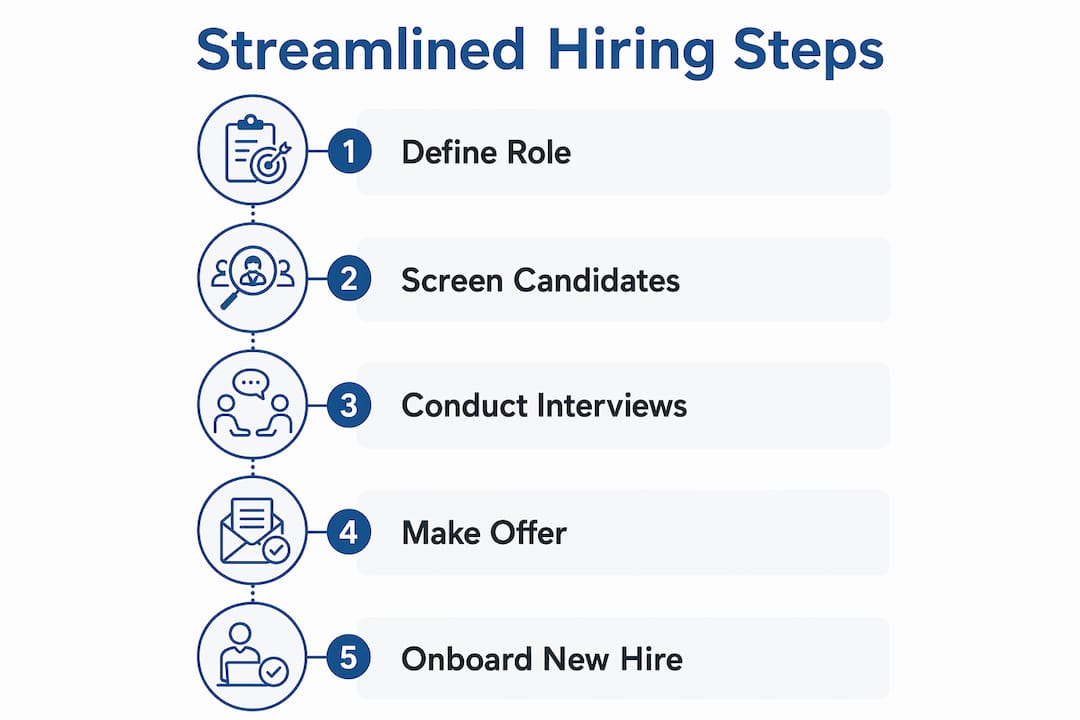
A streamlined hiring process eliminates bottlenecks and unnecessary steps, enhancing the recruitment experience while preventing the loss of qualified candidates to faster-moving employers. Slow hiring can lead to significant opportunity costs, damage employer branding, and negatively impact team productivity. Key strategies for improvement include optimizing interview structures, integrating technology for scheduling and candidate communication, and implementing clear role criteria and milestone deadlines to expedite decision-making.
In this article
A streamlined hiring process is the deliberate removal of bottlenecks and unnecessary steps that slow down recruitment without improving the quality of hires. Recruiters and hiring managers who understand why streamline hiring process improvements matter gain a measurable competitive edge. Hiring a new employee costs an average of $4,700, and that figure climbs sharply when a role stays open for weeks longer than necessary. Slow, complex processes do more than drain budgets. They push qualified candidates toward faster-moving employers, damage your employer brand, and leave teams understaffed during critical growth periods.
Why Streamline Your Hiring Process? The Real Cost of Moving Slowly
A slow hiring process carries costs that go far beyond the recruiter’s time. Every unfilled role creates a productivity gap, redistributes work across existing staff, and delays revenue-generating activity. These are the opportunity costs that rarely appear on a cost-per-hire report but accumulate fast.
The candidate experience suffers most visibly. 57% of job seekers lose interest when a hiring process feels too complex or lengthy. That means more than half your applicant pool is at risk of dropping out before you ever extend an offer. The problem compounds at the top of the talent market.
- Time-to-offer: High-demand talent is typically off the market within 10–14 days. Companies that take 30–40 days to decide routinely lose their first-choice candidates.
- Candidate ghosting: 61% of candidates report being ghosted after interviews. Poor communication during a slow process accelerates this problem.
- Application abandonment: 60% of candidates abandon applications due to complexity or excessive length. Friction in the early stages reduces the quality and volume of your pipeline before evaluation even begins.
Employer brand damage is the long-term consequence that hiring managers underestimate. Candidates who experience a disorganized or drawn-out process share that experience publicly. Negative reviews on employer rating platforms reduce future application rates, making each subsequent hire more expensive and difficult. The benefits of streamlined hiring are not just operational. They are reputational.
How Does Interview Structure Affect Hiring Speed and Quality?
The number of interviews in a hiring process is one of the most controllable variables in your time-to-fill. Most hiring teams default to more interviews as a proxy for thoroughness. The data does not support that assumption.

Google’s research shows four interviews provide 86% confidence in hire quality. Adding a fifth, sixth, or seventh interview increases complexity and candidate fatigue without meaningfully improving prediction accuracy. That is a significant finding. It means every interview beyond four is costing you time and candidate engagement for near-zero additional insight.
Effective hiring strategies for interview design include:
- Consolidated panel interviews: Combine multiple stakeholder perspectives into a single session rather than scheduling separate one-on-one conversations across multiple days.
- Structured interview scorecards: Standardize the questions and evaluation criteria each interviewer uses. This reduces subjective variation and speeds up debrief conversations.
- Parallel evaluation: Running interviews and assessments concurrently rather than sequentially cuts timeline without reducing thoroughness.
- Authentic problem-solving assessments: As AI makes resume tailoring easier, companies should move toward assessments of reasoning and problem-solving rather than scripted interview questions.
Pro Tip: Before scheduling any interview, assign each round a specific decision purpose. If you cannot name what new information that round will produce, eliminate it.
Standardizing your applicant shortlisting process before interviews begin reduces the number of candidates who reach the interview stage without meeting core criteria. Fewer unqualified interviews means faster cycles and less interviewer fatigue.
How Does Technology Speed up the Hiring Timeline?
Technology addresses the parts of recruitment that consume the most recruiter time without requiring human judgment. Scheduling, initial screening, and candidate communication are the three highest-volume, lowest-complexity tasks in most hiring workflows. Automating them produces measurable results.
AI-enabled screening reduces time-to-hire by up to 40% in high-volume hiring environments. The mechanism matters here. AI uses semantic understanding to surface qualified candidates based on context and meaning, not just keyword matching. A candidate who describes “managing vendor contracts” will surface for a procurement role even if the resume does not contain the exact phrase “contract management.”
| Feature category | Manual approach | Technology-assisted approach |
|---|---|---|
| Resume screening | Recruiter reviews each application | AI ranks and filters by fit score |
| Interview scheduling | Back-and-forth email coordination | Automated scheduling with calendar sync |
| Candidate communication | Manual status updates | Triggered messages at each stage |
| Evaluation consistency | Varies by interviewer | Standardized scorecards with scoring guides |
The limitations of technology in hiring are real and worth naming. AI screening tools can encode historical bias if trained on non-representative data. Automated communication can feel impersonal if not calibrated carefully. Human oversight at every decision point is not optional. Technology accelerates the process. Recruiters still own the judgment calls.
Pro Tip: Audit your AI screening tool quarterly. Pull a sample of rejected applications and review them manually to check whether qualified candidates are being filtered out by flawed criteria.
For teams managing high-volume or specialized industry hiring, technology integration delivers the greatest return when paired with clear role criteria set before sourcing begins.
What Practical Steps Improve the Recruitment Process Immediately?
Optimizing the candidate selection process does not require a full technology overhaul. Most hiring teams can reduce time-to-fill significantly by fixing process gaps that already exist. The following steps address the most common upstream and downstream delays.
-
Run a documented requisition kickoff. Misaligned role criteria cause upstream hiring delays. A structured conversation between the recruiter and hiring manager before sourcing begins aligns expectations on must-have qualifications, compensation range, and decision timeline. This single step eliminates the most common source of rework in the sourcing and screening stages.
-
Write a precise job posting. Vague job descriptions attract unqualified applicants and inflate screening time. A well-written posting filters candidates before they apply. Careerscape recommends treating the job posting as the first screening tool. Effective job postings specify the role’s core deliverables, not just a list of responsibilities.
-
Set milestone deadlines for each stage. Define the maximum number of days allowed between application receipt, first screen, interview, and offer. Without explicit milestones, stages expand to fill available time. A 5-day rule between each stage keeps the process moving without cutting corners.
-
Shift from individual effort to system-driven hiring. Structured and standardized evaluation creates consistent, defensible, and faster decision-making. Top-performing talent teams build repeatable systems rather than relying on individual recruiter skill. This improves both reliability and the ability to scale hiring across multiple roles simultaneously.
-
Communicate proactively with candidates. Set a response time standard for every stage. Candidates who receive timely updates are significantly less likely to withdraw or accept competing offers. This is one of the highest-return, lowest-cost improvements any hiring team can make.
Reasons for hiring efficiency improvements extend beyond speed. Teams that attract top talent consistently do so because their process signals organizational competence. Candidates evaluate employers during the hiring process. A well-run process is itself a competitive differentiator.
Key Takeaways
A faster, more structured hiring process reduces cost-per-hire, retains top candidates, and signals organizational credibility to every applicant who moves through your pipeline.
| Point | Details |
|---|---|
| Speed protects candidate quality | High-demand talent leaves the market within 10–14 days; delays cost you the best applicants. |
| Four interviews is the sweet spot | Google’s data shows four rounds deliver 86% confidence; more rounds add cost without better outcomes. |
| AI cuts screening time significantly | AI-enabled screening reduces time-to-hire by up to 40% in high-volume environments. |
| Alignment prevents upstream delays | A documented kickoff conversation between recruiter and hiring manager eliminates the most common source of rework. |
| Systems outperform individual effort | Standardized evaluation criteria produce faster, more consistent, and more defensible hiring decisions. |
The Alignment Problem No One Talks About Enough
After working in and around recruiting for years, the pattern I see most often is not a technology problem or a budget problem. It is an alignment problem. Hiring managers and recruiters start a search without ever agreeing on what “qualified” actually means for the specific role. The recruiter sources based on assumptions. The hiring manager rejects candidates based on unstated criteria. The process stalls. Everyone blames the pipeline.
The fix is not complicated. A documented requisition kickoff, as the research consistently shows, resolves this before it starts. But most teams skip it because it feels like overhead. It is not overhead. It is the single most effective upstream investment you can make in your hiring process.
I also want to push back on the instinct to add more interviews when a hire feels uncertain. That uncertainty is almost never resolved by a sixth conversation. It is resolved by better evaluation design in the first four. If you are not confident after four structured interviews with a scoring rubric, the problem is the rubric, not the number of interviews.
The future of efficient hiring belongs to teams that treat their process as a product. You iterate on it. You measure it. You fix the stages that create friction. Technology helps, but the discipline to build and maintain a system is a human responsibility. No tool replaces that.
— Bradford
How Careerscape Helps You Hire Faster Without Cutting Corners
Careerscape is built on the premise that hiring should be fast, honest, and backed by people who understand your industry. When internal processes are creating delays or your team lacks the bandwidth to run a full search, contract staffing solutions give you qualified professionals quickly without a lengthy internal cycle. For larger needs, project-based staffing scales your team on a defined timeline. Careerscape operates across 29 U.S. markets with industry-specific recruiters who already know your candidate pool. That specialization cuts sourcing time and improves first-round candidate quality from day one.
FAQ
What Does It Mean to Streamline the Hiring Process?
Streamlining the hiring process means removing unnecessary steps, reducing delays between stages, and standardizing evaluation so decisions happen faster without sacrificing quality. The goal is a shorter time-to-fill with no drop in hire quality.
How Many Interviews Should a Hiring Process Include?
Google’s research shows four interviews deliver 86% confidence in hire quality. Additional rounds increase cost and candidate fatigue without improving prediction accuracy.
Why Do Candidates Drop Out of Slow Hiring Processes?
57% of job seekers lose interest when a process feels too complex or lengthy, and 60% abandon applications due to friction in the early stages. Speed and clear communication are the two most effective retention tools.
What Is the Fastest Way to Reduce Time-to-Hire?
Running a documented requisition kickoff to align the recruiter and hiring manager on role criteria before sourcing begins is the most common and highest-impact fix for reducing time-to-hire.
How Does AI Improve Recruitment Efficiency?
AI-enabled screening reduces time-to-hire by up to 40% in high-volume hiring by using semantic matching to surface qualified candidates more accurately than keyword-based filtering alone.
Recommended
- Steps to Effective Job Posting for Recruiters in 2026
- What is recruiting? The employer’s guide to modern hiring
- How to Shortlist Applicants: A Hiring Manager’s Guide
- 9 Proven Ways to Attract Top Talent in 2026