
Choose staff augmentation for increased capacity under your management, allowing for greater control but requiring more internal oversight. Opt for consulting when seeking a defined outcome, where the consulting firm is accountable for results and typically involves fixed pricing models. The decision should consider factors like project clarity, internal capacity, risk, and budget, with a focus on clearly defined ownership and acceptance criteria to avoid project stalls.
- Staff augmentation is suitable for capacity gaps when the organization wants control over priorities and daily management, but adds internal oversight overhead.
- Consulting is ideal for well-defined projects where the provider is accountable for outcomes, scope is fixed, and milestones determine payment, reducing internal management needs.
- The decision hinges on project ambiguity, strategic risk, internal management capacity, timeline, accountability needs, and budget, with scoring guiding the choice.
- Pricing models reveal the type: hourly or role-based for augmentation, fixed or milestone-based for consulting, and legal risks relate to worker classification accuracy.
- Clarity in ownership of acceptance criteria and scope at the outset prevents most project stalls, especially in hybrid consulting and augmentation arrangements.
In this article
Choose staff augmentation when you need extra people under your direction; choose consulting when you need diagnosis, a roadmap, or a delivered outcome. Some projects blend both, pairing an outside expert’s plan with augmented staff who execute it, so the real decision often comes down to who owns the result and who governs the daily work.
What staff augmentation is and how it typically works
Staff augmentation is a staffing model where an outside provider places skilled professionals inside your team, under your management, to fill a capacity or skill gap. The organization buying the talent keeps control of priorities, workflow, and quality. The provider’s job ends at supplying a qualified person who shows up ready to work.
Commercial shapes vary, but most augmentation contracts fall into a few patterns: time-and-materials billing, role-based hourly or daily rates, or fixed-term contract staffing agreements. None of these shift accountability for the finished product away from the client. Contract staffing arrangements, for example, are priced around the role and duration, not around a defined deliverable.
For the engagement to succeed, the buyer has to show up prepared. That means:
- An internal manager assigned to direct the augmented staff’s daily work.
- A usable backlog, work plan, or set of tickets ready on day one.
- Access to systems, tools, and credentials provisioned before the start date.
- A process for reviewing and accepting completed work.
The benefits are straightforward: faster hiring than a full-time search, direct control over how the work gets done, and the flexibility to scale a team up or down as demand shifts. The drawbacks are equally straightforward. Augmentation adds management overhead, since someone on the client side still has to plan, supervise, and quality-check the work. When internal governance is thin, the lower apparent unit price of a contractor can disappear into slower output and rework.
What consulting is and what clients are buying
Consulting is fundamentally different. The client isn’t buying a person’s time: it’s buying a diagnosis, a strategy, or a finished deliverable, with the consulting firm accountable for the outcome. A consultant might be asked to assess why a supply chain keeps missing targets, design a new operating model, or deliver a completed system migration. The expertise and the judgment are the product.
Pricing reflects that shift in accountability. Instead of hourly rates tied to headcount, consulting engagements commonly use fixed fees tied to a scope, milestone-based payments released as phases are completed, or retainers for ongoing advisory access. According to a benchmark guide for sales consulting engagements, project sizes and budgets vary widely depending on scope and seniority, which is why a clear statement of work matters more in consulting than in almost any other procurement decision.
A well-structured consulting engagement typically includes:
- A statement of work defining objectives, deliverables, and assumptions.
- Milestones tied to payment and acceptance criteria that define what “done” looks like.
- Defined client responsibilities, such as data access or stakeholder availability.
- Change control terms for scope adjustments and a plan for post-delivery support.
A guide to enterprise IT consulting engagements makes a similar point: the quality of the SOW, not the hourly rate, usually determines whether a consulting project delivers what the client actually needed. Vague deliverables are the most common failure point in consulting contracts, and they are the first thing a buyer should scrutinize before signing.
Key differences: control, scope, pricing, and risk
The cleanest way to separate these models is to ask what you’re actually buying: capacity or an outcome. Staff augmentation sells capacity, additional hands working inside your existing structure. Consulting sells an outcome, a result the provider is accountable for delivering regardless of how many hours it takes.
That single distinction drives everything else:
- Day-to-day control: with augmentation, your internal manager directs the work; with consulting, the provider’s team leads execution against the SOW.
- Ownership of the result: augmentation leaves outcome ownership with the client; consulting places outcome ownership with the provider.
- Pricing model: augmentation typically bills by time and materials or a role-based rate; consulting typically bills by fixed fee, milestone, or retainer.
- Engagement length and scope: augmentation tends to run open-ended or contract-length with flexible scope; consulting runs for a defined project window with a locked scope and change-control process.
- Management burden: augmentation requires sustained internal oversight; consulting requires governance check-ins but less day-to-day direction.
Pricing terms alone often reveal which model you’re really signing. The Bureau of Labor Statistics separates temporary-help and contract-firm workers from independent consultants in its labor measurements, a reminder that titles and marketing labels don’t reliably tell you which operating model you’re buying. A contract that reads like a staffing order, with hourly rates and a reporting line into your organization, is capacity-based no matter what the vendor calls it. A contract that specifies deliverables, acceptance criteria, and milestone payments is outcome-based, even if the provider calls its people “consultants.”
Replacement policy is another tell. Augmentation contracts usually include a clause letting the client request a replacement worker if the fit isn’t right, since the client is managing performance directly. Consulting contracts rarely include an individual replacement clause: the firm, not a single person, is accountable for the deliverable, so the firm manages its own staffing internally.
Risk allocation follows the same logic. Under augmentation, the client absorbs the risk that the work plan is wrong, the backlog is thin, or the internal manager lacks bandwidth. Under consulting, the provider absorbs more of the delivery risk, which is exactly why consulting carries a higher price per hour of actual work performed. Neither allocation is better in the abstract. The question is which risk your organization is better equipped to carry: the risk of managing people, or the risk of defining and accepting a deliverable.
How to choose: a decision checklist and example scenarios
A short scoring exercise cuts through most of the ambiguity. Rate your project from 0 to 3 on each of the following criteria, where a higher score points toward consulting and a lower score points toward augmentation:
- Ambiguity: is the problem well-defined (0) or still being diagnosed (3)?
- Strategic risk: are the stakes operational (0) or company-level (3)?
- Internal leadership bandwidth: do you have a manager ready to direct the work (0) or no one available (3)?
- Timeline pressure: is this ongoing capacity (0) or a bounded project with a deadline and deliverable (3)?
- Need for external accountability: will you manage quality yourself (0) or need the provider to own the result (3)?
- Cost sensitivity: is the budget tight and hourly-rate driven (0) or built around paying for a finished outcome (3)?
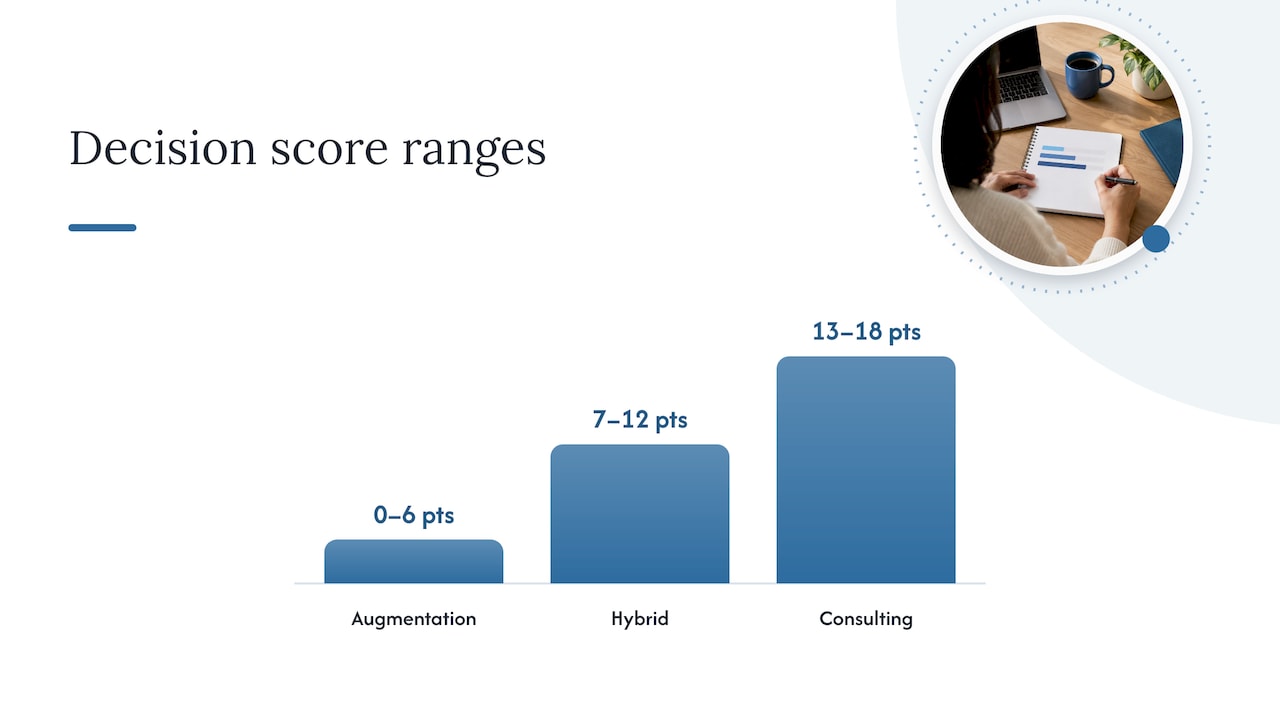
A total score of 0 to 6 points toward staff augmentation. A score of 13 to 18 points toward consulting. Scores in the middle often suggest a hybrid: a consultant to set direction, augmented staff to execute against it.
Pro Tip: Score the project before you call any provider. Vendors will happily shape their pitch to match whichever model they sell, so decide the model first and shop second.
Three quick scenarios illustrate the pattern. A fast-growing support team that just needs three more people answering tickets under an existing manager is a clean augmentation case. A company that suspects its pricing strategy is broken but doesn’t know why needs a diagnosis first, which points to consulting. A manufacturer rolling out a new ERP system with a known vendor and a tight go-live date often needs both: a consulting-led implementation plan, staffed in part by augmented specialists who execute the migration tasks.
Implementation checklist: onboarding and governance for each model
Getting the model right on paper doesn’t guarantee a smooth engagement. Each path has its own kickoff sequence, and skipping steps is where most engagements lose time.
For staff augmentation, before the first day:
- Provision accounts, system access, and any required security credentials.
- Assign an internal manager who owns the augmented worker’s daily priorities.
- Define KPIs or output expectations tied to the role, not just the hours billed.
- Confirm replacement terms in the contract in case the fit isn’t right.
- Build a two-week backlog so the new hire has work ready on arrival.
For consulting, before signing:
- Finalize the statement of work, with objectives and deliverables spelled out.
- Set milestone dates tied to payment and written acceptance criteria.
- Schedule recurring governance meetings between your sponsor and the consulting lead.
- Confirm who on your side is responsible for providing data, access, and decisions.
Across both models, a handful of contract clauses deserve particular attention: intellectual property ownership of anything created during the engagement, confidentiality terms covering your internal data, a change-control process for scope adjustments, termination terms that specify notice periods, and a knowledge-transfer requirement so your team isn’t left without documentation when the engagement ends. These clauses matter more than the headline rate, since a cheap engagement with weak IP or knowledge-transfer terms can cost far more to unwind later.
Careerscape’s view on choosing between the two paths
Careerscape is a staffing and recruiting firm built around fast, honest hiring backed by people who understand the industries they staff for, connecting qualified professionals with companies ready to hire. That focus shapes how we advise clients working through the augmentation-versus-consulting decision: we don’t push one model to fit every problem.
When a client needs capacity under their own management, contract staffing or temporary staffing fills the gap quickly without adding the overhead of a full-time hire. When a client needs an outcome, a defined team built around a specific deliverable, project-based staffing is built for that scope: a team assembled against a defined project rather than an open-ended role.
The guidance we give clients before they commit to either path is consistent: name the decision-maker, define whether you’re buying capacity or an outcome, and get that distinction into the contract before work starts. Skipping that step is the single most common reason engagements of either type underdeliver.
Employment classification and tax considerations
Worker classification isn’t a formality. It determines who withholds payroll taxes, who provides benefits, and who bears legal liability if the classification is wrong. The IRS evaluates classification based on three factors: behavioral control, financial control, and the nature of the relationship between the parties. None of these hinge on what the contract calls the worker.
Behavioral control looks at whether the company directs how, when, and where the work gets done. Financial control looks at who bears the risk of profit or loss, who invests in tools and equipment, and how the worker is paid. Relationship factors include benefits, permanency, and whether the work is a key part of the company’s regular business.
This is where the augmentation-versus-consulting decision intersects directly with legal risk. A staffing arrangement that behaves like direct employment, with set hours, close supervision, and company-provided equipment, can expose the client to misclassification liability if the worker is treated as an independent contractor on paper. Consulting engagements structured around deliverables and milestones, with the consulting firm controlling how its own staff perform the work, generally sit more comfortably on the contractor side of the IRS test. Before signing either type of agreement, match the actual working relationship to the classification on paper, not the other way around.
Cost and pricing shapes worth comparing
The pricing model you choose should match the type of work, not the other way around. Fixed-fee pricing works when the scope is well-defined and deliverables are clear enough to write into a contract: it protects the client’s budget but requires a tight statement of work, since any scope creep has to go through formal change control.
Time-and-materials pricing, the dominant model for staff augmentation, works when the scope is still evolving or when the client wants to retain flexibility over what the team works on week to week. The tradeoff is budget predictability: a time-and-materials engagement can run longer or shorter than expected depending on how well the client manages the work.
Milestone-based pricing sits between the two. Common in larger consulting engagements, it ties payment to specific checkpoints, giving the client more control than a pure retainer while still rewarding the provider for progress rather than just hours logged. A public pricing framework for retainer and fractional services illustrates how providers structure recurring access differently from one-time project fees, a useful reference point when comparing quotes across models.
Whichever shape you choose, the contract should specify what happens if the project runs over scope or over time, since that clause determines whether a pricing disagreement becomes a budget problem or a legal one.
Industry examples that show the split in practice
A software company scaling its engineering team to meet a product deadline is a textbook augmentation case: the roadmap already exists, and the team needs more hands executing against it. Technology-sector recruiters fill these roles by matching engineers to the specific stack and seniority level a sprint plan requires.
A healthcare system trying to redesign patient intake because wait times keep climbing is a different problem. Nobody inside the organization is certain whether the bottleneck is staffing, scheduling software, or physical layout, which makes it a diagnosis problem suited to consulting rather than a capacity problem suited to augmentation.
A retail chain opening ten new locations in a quarter needs both: a consulting-led rollout plan for store operations, paired with augmented staff who handle the week-to-week hiring, training, and launch logistics at each site. The pattern holds across industries. When the work is defined and repeatable, augmentation fits. When the problem itself is still being defined, consulting fits first, often followed by augmented staff who execute the plan once it exists.
How each model affects culture and team dynamics
Staff augmentation integrates outside workers into existing teams, which means culture fit matters immediately. An augmented employee sits in daily standups, uses the same tools, and often becomes indistinguishable from permanent staff within weeks. That closeness is an advantage when the fit is good, since it speeds collaboration, but it creates friction when augmented staff are treated as lesser members of the team or excluded from decisions that affect their work.
Consulting engagements operate at more of a distance. Consultants typically interact with a defined set of stakeholders rather than embedding across the organization, which limits cultural friction but can also create resentment if employees feel decisions are being made about their work without their input. A consulting team that parachutes in, delivers a report, and leaves without engaging the people who have to live with the recommendations tends to generate exactly the skepticism Steve Jobs warned about: advisors who hand over a plan without sticking around to see it work.
The practical takeaway is that augmentation requires more attention to day-to-day inclusion, while consulting requires more attention to communication and buy-in before and after the engagement. Neither model is automatically easier on team morale. Both require deliberate management of how the outside provider interacts with the people already there.
Managing risk across both engagement types
Risk shows up differently depending on which model you choose, and planning for it has to match the model. In augmentation, the biggest risk is management failure: if the internal manager lacks time or clarity to direct the work, productivity drops regardless of how skilled the augmented worker is. Mitigating that risk means budgeting real management hours into the project plan, not just the hourly rate of the contractor.
In consulting, the biggest risk is a gap between recommendation and execution. A consulting firm can deliver a sound strategy and still leave the client worse off if nobody owns implementation once the engagement ends. Steve Jobs’ critique of outside advisors centered on exactly this gap: consultants who hand over recommendations without staying accountable for whether they get implemented. The mitigation is contractual: build post-delivery support or a transition plan into the SOW before signing, not after the final report lands.
Both models share one risk that’s easy to overlook: misclassification exposure, which ties back directly to the IRS factors covered earlier. A contract that blurs the line between augmentation and employment, or between consulting and informal staffing, creates legal exposure that outlasts the engagement itself. Writing the operating model clearly into the contract protects against that risk in both directions.
Strategic implications: short-term fix or long-term capability
The choice between augmentation and consulting isn’t just operational. It shapes what your organization looks like six months or two years later. Augmentation is well suited to short-term capacity problems: a hiring freeze, a surge project, a skills gap while a permanent search runs. It rarely builds lasting internal capability on its own, since the knowledge and process stay with the augmented worker rather than transferring into the organization, unless knowledge transfer is explicitly built into the engagement.
Consulting, done well, is built to leave something behind: a roadmap, a redesigned process, a decision framework the internal team can run without the consultant in the room. That’s also where consulting engagements most often fall short, when the deliverable is a document rather than an embedded capability.
The longer-term question worth asking before any engagement starts is whether you want this problem solved once, or whether you want the capability to solve it again without outside help. A single surge in demand probably calls for augmentation. A recurring strategic gap, the kind that keeps resurfacing every planning cycle, calls for consulting focused explicitly on building internal capability, not just delivering a one-time fix. The right answer depends less on the current project and more on how often this type of problem is likely to come back.
What experience with this decision actually teaches
The single governance decision that matters most, more than pricing model or provider reputation, is naming who owns acceptance criteria before any contract is signed. Projects that stall almost always trace back to a moment where nobody could say clearly what “done” meant or who had the authority to say so.
The most common mistakes are predictable: underestimating the internal management time augmentation requires, writing a statement of work vague enough that both sides can claim they met it, and assuming a consulting deliverable will implement itself once it’s handed over. None of these are provider failures. They’re planning failures that happen before the first invoice arrives.
Hybrid arrangements, consulting for direction paired with augmented staff for execution, work well precisely because they force that ownership conversation early. The model matters less than the clarity behind it.
— Bradford
Put Careerscape’s staffing expertise to work
Whichever model fits your project, the fastest path to a good outcome starts with a clear conversation about what you actually need. This firm connects qualified professionals with companies ready to hire, applicable whether the gap is a seat on your team or a complete project crew.
- Need capacity under your own management: contract staffing fills skill gaps quickly without the overhead of a permanent hire.
- Facing a short-term surge: temporary staffing covers urgent coverage needs on a defined timeline.
- Need a team built around a specific deliverable: project-based staffing assembles people against the outcome rather than an open-ended role.
- Need to fill a permanent leadership or specialist role: direct hire and executive search handle the full search process.
The first call with Careerscape should cover the same ground this guide walks through: is this a capacity problem or an outcome problem, who will manage the day-to-day work, and what does a successful placement look like within the first ninety days. Start that conversation at Careerscape or explore the full range of staffing options at Careerscape.
FAQ
What did Steve Jobs say about consultants?
Steve Jobs criticized outside advisors for lacking long-term accountability, questioning whether they would stay involved long enough to see their recommendations implemented. His 1992 talk, later unearthed and reported by MIT Sloan, framed this as a test buyers should apply before hiring consultants.
Is staff augmentation considered a form of outsourcing?
Staff augmentation is a form of outsourcing in the broad sense that an outside provider supplies labor, but it differs from project outsourcing or managed services because the client retains day-to-day control and accountability for the result. The contract’s operating model, not its marketing label, determines whether an engagement is capacity-based or outcome-based.
What is the difference between staffing and consulting?
Staffing supplies people to work under the client’s direction, with the client managing priorities and accepting the finished work. Consulting supplies a diagnosis, strategy, or delivered outcome, with the consulting firm accountable for results regardless of hours worked.
Is it better to work as an employee or an independent consultant?
It depends on what the worker values: employees typically get continuity and benefits, while independent consultants gain autonomy and variety but accept more business risk themselves. The IRS classification rules, based on behavioral control, financial control, and the nature of the relationship, determine which category actually applies regardless of personal preference.