
Retained search is best for critical, confidential, or hard-to-fill leadership roles, while contingency search is suited for volume hires or positions with a strong local talent pool. A hybrid approach allows for shared risk and reduced costs, ideal for difficult but not highly confidential roles. Key considerations for choosing between these models include role criticality, confidentiality, talent scarcity, timelines, internal capacity, and risk tolerance, along with ensuring clear contract terms on guarantees, off-limits, and fee structures.
- Contingency search is suitable for roles with active candidates and urgent timelines, typically costing 15% to 25% of the first-year salary and providing faster results.
- Retained search invests more upfront, usually 25% to 33% of first-year compensation, offering deeper market mapping, passive candidate outreach, and higher success rates for scarce or confidential roles.
- Hybrid or container searches combine staged payments with shared risk, ideal for roles that are hard to fill but not highly confidential or budget-dependent.
- Clear contract clauses on guarantees, off-limits, and fee bases are essential to protect value and ensure accountability in retained arrangements.
- The choice depends on role criticality, confidentiality needs, talent scarcity, timeline, internal capacity, and risk tolerance.
In this article
Use retained search for critical, confidential, or hard-to-find leadership roles, and use contingency search for volume hires or roles with a deep local talent pool. If your situation splits the difference, a container or hybrid arrangement lets you share the risk without paying full retainer cost or gambling on a purely pay-on-placement model.
Contingency vs. Retained Search: What Each Term Actually Means
Contingency vs retained search comes down to who assumes the risk and when the fee gets paid. Contingency recruiting is a non-exclusive, pay-on-placement arrangement: you can hire multiple firms for the same role, and none of them earns a dime unless one of their candidates gets hired. That structure shapes recruiter behavior. Contingency recruiters are rewarded for speed and volume, so they lean on active candidates already searching rather than passive prospects who need to be persuaded to look.
Fees typically run 15% to 25% of first-year salary, with lower percentages common on high-volume or lower-salary roles. Contingency delivers the best value when:
- You have a broad, active candidate pool for the role (customer service, administrative, entry-level sales).
- Speed matters more than exhaustive market coverage.
- You’re comfortable running multiple recruiters or channels at once to maximize submissions.
The tradeoff is consistency. Multiple firms working the same pool can mean duplicate outreach to the same candidates and uneven vetting depth from firm to firm.
How Does Retained Search Work?
Retained search flips the model: one firm, exclusive engagement, staged billing. You’re not paying for a chance at a hire. You’re paying a firm to run a real search, and that search is typically billed in installments tied to milestones, such as engagement, candidate slate delivery, and placement.
US retained fees commonly land at 25% to 33% of first-year cash compensation, unless negotiated otherwise. That premium buys real deliverables:
- Market mapping to identify every plausible candidate, not just the ones already applying.
- Direct outreach to passive candidates who aren’t job hunting but might move for the right opportunity.
- Structured assessment, including scorecards and reference work built around the role’s actual requirements.
Retained search takes longer on the calendar. In exchange, it carries a meaningfully higher completion probability for roles that are hard to fill precisely because the right candidate isn’t actively looking.
Which Model Wins on Speed, Quality, and Cost Risk?
The honest answer is that neither model wins outright. Each is built to optimize a different variable, and knowing which variable matters most for your open role is the entire decision.
Speed vs. completion probability. Contingency pipelines fill faster because recruiters submit whoever is available now. Retained search moves slower up front, but you’re buying a structured, exclusive process built to find the right person, not just an available one.
Candidate universe. Contingency recruiters work active candidates: people applying, browsing job boards, responding to outreach. Retained search reaches passive candidates, often through confidential, direct conversations that never touch a job board at all.
Cost profile. Contingency is pay-on-hire, so there’s no upfront financial exposure, but you may run several firms simultaneously to hedge against a slow search. Retained is a staged investment, billed whether or not the search concludes quickly, which means the firm’s incentives are aligned with getting the search right rather than getting it done fast.
Here’s a quick side-by-side:
| Factor | Contingency | Retained |
|---|---|---|
| Exclusivity | Non-exclusive | Exclusive |
| Fee timing | On placement only | Staged (engagement, slate, placement) |
| Typical fee | 15%–25% of salary | 25%–33% of first-year cash |
| Candidate pool | Mostly active | Active plus passive, confidential |
| Best fit | Volume, urgent, broad-market roles | Senior, scarce, or confidential roles |
Candidate experience differs too. A confidential retained search protects your employer brand during sensitive replacements, while a contingency campaign run by several firms at once can flood the same candidates with duplicate outreach, which some candidates read as disorganized.
How Do You Choose Between Contingency and Retained Search?
Run through this checklist before you engage anyone:
- How critical is the role? A single point of failure at the VP or C-suite level justifies a different investment than a role with three qualified backups on your team.
- Does the search need to stay confidential? Replacing a sitting executive, restructuring a department, or recruiting from a competitor without tipping them off all point toward retained.
- How scarce is the talent? If the skill set is common in your local market, contingency will likely produce candidates fast. If it’s rare or highly specialized, passive outreach matters more than volume.
- What’s your real timeline? Retained searches typically run longer, often for several weeks or months for senior roles; contingency can move in weeks when the market is deep.
- How much internal bandwidth do you have? A hiring manager already stretched thin benefits from a firm doing full market mapping rather than screening dozens of contingency submissions.
- What’s your risk tolerance? If a bad hire at this level would be costly, retained’s staged accountability is worth the premium.
A few quick examples: a confidential CFO replacement with only a handful of qualified candidates nationally almost always calls for retained. A 15-person customer service ramp-up in a market with plenty of qualified applicants is a contingency or direct-hire situation. A director-level marketing hire that’s important but not confidential, where budget is tight, is exactly where a container search earns its place.
What Contract Terms Should You Negotiate Before Signing?
Read the contract before you sign anything, not after the first candidate slate arrives. Three clauses decide most of your real risk:
- Off-limits clause. Defines which of your employees the firm won’t poach later, and for how long.
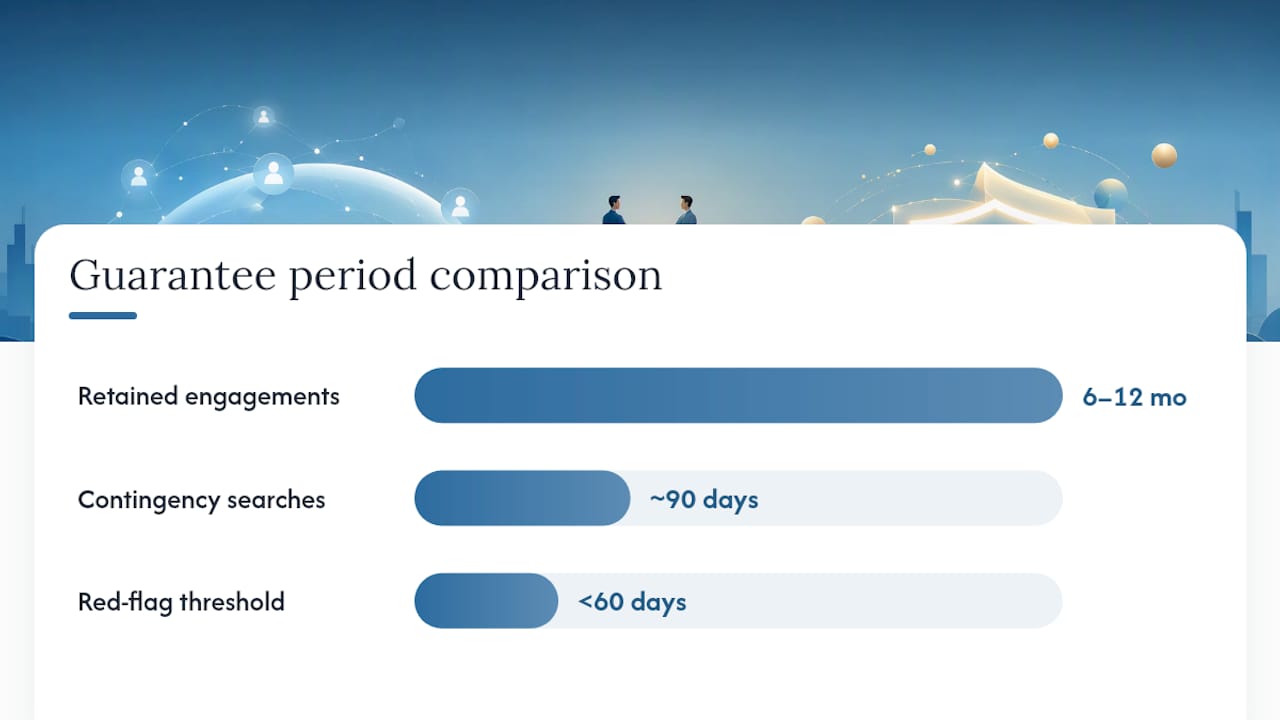
- Guarantee terms. Retained engagements often carry longer guarantee periods, commonly six to twelve months, while contingency guarantees are usually shorter, often around 90 days. Make sure the guarantee matches how long it realistically takes your new hire to ramp up.
- Refund and credit rules. If a placed candidate leaves within the guarantee window, does the firm refund a pro-rated amount, offer a free replacement search, or issue credit toward a future search?
Watch for red flags: guarantees under 60 days, off-limits language so vague it’s unenforceable, or a retainer with no deliverables tied to each billing milestone. If a retained contract doesn’t specify what you get at each payment stage, you’re paying for access, not accountability.
Pro Tip: Ask every retained firm to define its fee base in writing, base salary only or base plus bonus and equity, before you sign. That single clause can swing your total cost by tens of thousands of dollars on a senior hire.
What Is Container or Engaged Search?
An engaged (or container) search splits the difference. You pay a smaller upfront fee, often around a third of the projected total, and the balance on placement. It’s not full exclusivity, but it buys meaningfully more commitment than pure contingency.
Container search fits roles that are hard to fill but not strictly confidential, or situations where your budget can’t absorb a full retainer up front. Negotiate the same way you would a retained deal: attach deliverables and a rough timeline to the upfront payment so the firm has real accountability for that initial investment, not just a smaller check with no strings attached.
How Careerscape Applies This Framework in Practice
The retained-versus-contingency decision is ideally the first real conversation with a hiring manager, not an afterthought. Before recommending a model, our recruiters ask about confidentiality, how scarce the skill set actually is in your market, and how much runway you have before the seat costs you revenue or momentum.
For senior, confidential, or highly specialized roles, that usually means executive search with staged deliverables you can track. For volume or fast-turnaround roles, direct hire or contract options make more sense. When a role sits in between, we’ll say so and structure a hybrid engagement instead of forcing it into whichever model happens to be easiest to sell. If you’re not sure which bucket your open role falls into, that’s worth a conversation before you commit to either fee structure.
Careerscape’s Services for Executive and Hybrid Searches
Choosing between contingency, retained, and hybrid only matters if the firm executing the search actually delivers on the model you pick. A good recruiting firm positions itself with results-based pricing with no upfront fees on many engagements, pre-screened candidates matched for fit and longevity, and industry-specialized recruiters who tailor searches by role complexity. Whether your open role calls for the depth of a retained-style process or the speed of a direct placement, Careerscape structures the engagement around your actual risk tolerance and timeline, not a one-size-fits-all fee sheet.
- Direct Hire for permanent placements where speed and market depth matter more than full retained exclusivity.
For a deeper look at fee structures and risk allocation, see HireAgent’s breakdown, AESC’s industry framing, EisnerAmper’s role-fit guidance, and Indeed’s recruiting overview. Recruitment agencies managing multiple engagements may also find this useful for back-office operations.
FAQ
Can You Run Contingency and Retained Search at the Same Time?
Yes. Many organizations use retained search for their most critical or confidential openings while running contingency on higher-volume, lower-risk roles simultaneously.
How Long Does a Retained Search Typically Take?
Retained searches typically take several weeks or months for senior roles, since they involve market mapping and passive outreach before candidates are even presented.
Are Retained Search Fees Negotiable?
Yes. Fee base, staging of payments, and guarantee length are all standard negotiation points, and clarifying the fee base (salary only vs. total compensation) in writing can meaningfully change your total cost.
What Guarantee Period Should I Expect?
Retained engagements often carry six to twelve month guarantees, while contingency placements typically carry shorter guarantees, commonly around 90 days.
Does Careerscape Offer Retained-Style Executive Search?
Yes. Careerscape’s Executive Search service is built for confidential and senior-level roles, with results-based pricing detailed on request rather than a fixed published rate.