
Employers facing a tight labor market, with only 1.1 unemployed workers per job opening, should focus on three key strategies: reducing time-to-fill by streamlining hiring processes, offering competitive total rewards and career growth opportunities rather than just higher base salaries, and enhancing internal mobility to lower future hiring needs. Speed and honest communication about job expectations are crucial, as candidates increasingly value comprehensive offers that include flexibility and clear career paths. Additionally, leveraging technology like AI for screening and structured interviews can improve hiring efficiency while maintaining a positive candidate experience.
- Speed and honesty in sourcing justify prioritizing urgent, outcome-focused hiring over traditional credentials, especially in high-demand fields like healthcare and engineering.
- Employing skills-based screening, diversifying sourcing channels, and streamlining interview processes can significantly shorten time-to-fill and increase offer acceptance.
- Building internal mobility and transparent career paths reduces future hiring needs by improving retention, especially among top performers.
- In a competitive market, aligning compensation benchmarks with role, sector, and location, and emphasizing non-salary incentives can offset slower pay adjustments.
- Using technology such as AI screening, video assessments, and structured scorecards enhances efficiency without sacrificing candidate experience or compliance standards.
In this article
Hiring in a tight labor market comes down to three levers: compress your time-to-fill, compete on total rewards and visible career growth instead of base pay alone, and cut future hiring volume through internal mobility. The BLS reports about 1.1 unemployed workers per job opening as of February 2026, which means most employers are competing for the same shrinking pool. Experience in various sectors shows the same pattern: speed and honest positioning win more offers than salary bumps do.
Why the Labor Market Is Tight (and Where It’s Tightest)
The national numbers look almost balanced. The BLS Job Openings and Labor Turnover data put the ratio at roughly 1.1 unemployed persons per job opening in February 2026, close to parity on paper. That average hides real unevenness. Healthcare, engineering, and skilled trades still run far tighter than that headline number suggests, while some administrative and entry-level customer service roles have loosened.
This matters for prioritization. If you’re filling a nursing role or a mechanical engineering seat, treat it like an emergency: escalate sourcing, loosen non-essential requirements, and move fast. If you’re filling a generalist administrative role, you likely have more room to be selective.
Three forces are driving the divergence:
- Demographic shifts — retirements are outpacing new entrants in several skilled trades.
- Skills mismatches — training pipelines haven’t caught up to demand in healthcare and technical fields.
- Industry-specific demand spikes — certain sectors are growing faster than their local talent supply can absorb.
What Candidates Expect Now (And Why It Changes Your Offer)
Candidates in 2026 evaluate an offer as a full package, not a single number. Base salary still matters, but bonus structure, benefits, and flexibility now get weighed together, and the combination often decides whether someone accepts or walks. Forbes Coaches Council advises that when you can’t win on base pay alone, you win by offering something candidates value disproportionately: faster autonomy, direct access to leadership, and uncapped incentive structures.
Career visibility carries similar weight. MIT Sloan Management Review finds that organizations making growth paths visible see stronger acceptance and retention, because candidates are increasingly wary of roles that sound like dead ends.
Employer-brand honesty accelerates all of this. A realistic job narrative, one that names the hard parts of the role along with the upside, tends to shorten the decision cycle because candidates aren’t left guessing what they’re signing up for.
Two things worth building into every offer conversation:
- Show, don’t just tell, career progression: name the next two roles someone in this seat has moved into.
- Quantify flexibility (hybrid days, schedule control) as concretely as you’d quantify a bonus.
Pro Tip: During the interview, ask your hiring manager to describe one real internal promotion from this exact team in the last 18 months. A specific story lands harder than “we offer growth opportunities” ever will.
Practical Hiring Strategies That Work Right Now
Speed and precision beat volume in a tight market. Here’s what actually moves time-to-fill and offer-acceptance rates.
Rewrite job descriptions around outcomes, not credentials. A requirement like “bachelor’s degree required” screens out capable candidates who learned the skill on the job. Replace degree gates with skills-based screening questions tied to what the role actually demands day to day.
Diversify your sourcing mix. Employee referrals convert faster than cold outreach and tend to produce better retention. Layer in targeted outreach campaigns, contingent staffing for immediate coverage, and one-way video screening or timed skills assessments to filter candidates before you spend interview time. Research on video-first hiring shows this approach shortens the path to offer while keeping the process fair when paired with structured scorecards. A well-timed outreach message also matters more than volume; templates built around hiring triggers tend to outperform generic cold emails.
Redesign your interview loop for speed. Cap most roles at three rounds. Standardize scorecards so every interviewer rates candidates against the same criteria, which cuts decision paralysis and reduces bias. Build a hire-accelerator schedule: same-week interviews, 48-hour decision windows, and offers issued before a competing employer can move.
Know when to bring in a staffing partner. If a role sits open past your sector’s benchmark time-to-fill, or you need coverage while running a permanent search, a partner supplies talent immediately rather than adding months of vacancy cost.
A practical rollout looks like this:
- Quick wins (next 30 days): launch or boost referral incentives, cut interview rounds, add scorecards.
- Medium-term (60 to 90 days): convert job descriptions to skills-based language, build a repeatable sourcing playbook, adopt video or async screening.
- Structural investments (ongoing): build skills intelligence systems and internal mobility architecture so future openings shrink on their own.
This sequencing mirrors what the Richmond Fed’s research on tight-market recruiting found: employers who succeed are increasing recruiting effort and diversifying methods, not just raising pay.
Retention Strategies That Lower Future Hiring Pressure
Every retained employee is a requisition you don’t have to run. MIT Sloan’s research found that most turnover is preventable, and pay counteroffers rarely fix what’s actually driving people out.
Build retention architecture in this order:
- Map internal mobility. Create transparent career ladders, publish stretch-assignment opportunities, and build a skills map so employees can see a real path forward without leaving.
- Invest in manager capability. Train managers to run regular career conversations, not just performance reviews, and to flag flight risk early rather than after a resignation letter lands.
- Fix onboarding and the first 90 days. Early attrition is often an onboarding failure, not a hiring one. Set 30/60/90-day milestones so new hires know what success looks like before frustration sets in.
- Reserve counteroffers for genuine retention saves, not band-aids. A one-time raise can retain someone for a quarter. It rarely fixes a systemic problem like a broken promotion path or an unsupportive manager.
Workday’s research backs this up directly: organizations with strong skills intelligence and visible internal mobility see meaningfully lower attrition among their top performers, precisely because employees see growth without needing to search elsewhere.
Pro Tip: Ask departing employees a direct question in the exit interview: “What would have made you stay six months ago?” The answer usually points to a systemic fix, not a pay gap.
How to Measure Hiring Effectiveness and Set Realistic Benchmarks
Track four key metrics: time-to-fill, offer-acceptance rate, source-to-hire quality, and initial retention. Each one tells you something different, and none of them means much in isolation.
- Time-to-fill tells you how competitive your process is against the market.
- Offer-acceptance rate tells you whether your total rewards package is landing.
- Source-to-hire quality tells you which channels produce employees who stay and perform.
- 90-day retention tells you whether onboarding, not sourcing, is your real leak.
The BLS ratio as your calibration point: With roughly 1.1 unemployed workers per job opening nationally, a “normal” time-to-fill baseline from three years ago is probably outdated for high-demand roles like healthcare and engineering. Recalibrate benchmarks by sector, not by company-wide average, since national figures without sector adjustment tend to mislead prioritization.
Run any process change as a small controlled test before rolling it out company-wide. A sample of five hires isn’t enough to prove a new interview format works. Give it a full quarter and enough volume to see a real pattern before you scrap or scale it.
Using Technology and AI Tools to Improve Hiring Efficiency
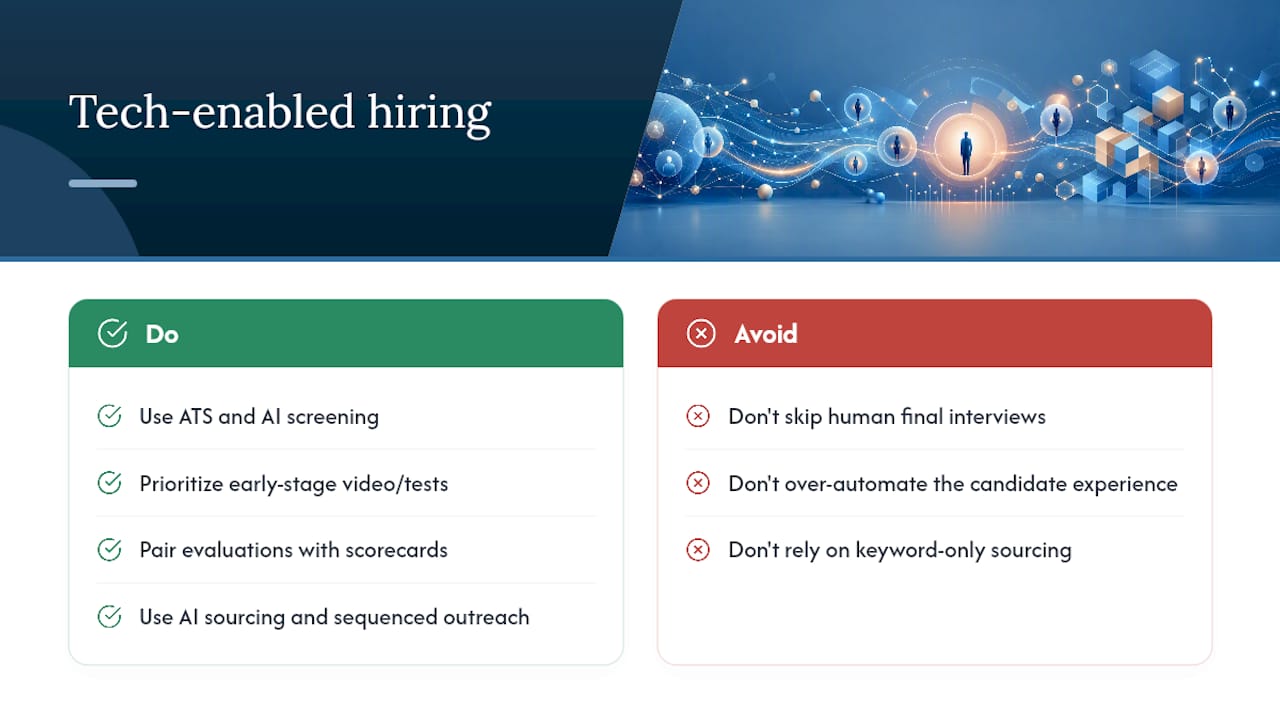
Applicant tracking systems and AI screening tools now do the sorting work that used to eat a recruiter’s week. Resume parsing, skills matching, and automated scheduling cut administrative drag out of the process, which matters most when speed decides who gets the offer.
The clearest efficiency gain sits in early-stage screening. One-way video interviews and timed skills assessments let hiring teams evaluate a larger candidate pool without booking dozens of live interviews. Research on video-first hiring shows this shortens time-to-offer while still giving candidates a real chance to demonstrate ability, provided the process pairs with a standardized scorecard so evaluation stays consistent.
AI-assisted sourcing tools also help recruiters identify passive candidates who match skills profiles rather than keyword-matched resumes, which widens the funnel for hard-to-fill technical and healthcare roles. Automated outreach sequencing, timed around signals like a company hiring surge or a role reopening, tends to get stronger response rates than a generic cold email blast.
None of this replaces human judgment in the final interview stages. Treat AI tools as a way to widen and speed up the top of the funnel, not as a substitute for a structured conversation with a hiring manager. Teams that over-automate the candidate experience often see acceptance rates drop, because candidates notice when no human engaged with them until the offer stage.
Competitive Compensation Benchmarking in a Tight Market
National salary averages are close to useless for a tight-market role. A software engineer’s median pay in one metro area can differ substantially from another, and healthcare compensation shifts by facility type and shift differential in ways a generic salary survey won’t capture.
Benchmark by role, sector, and geography together, not any one in isolation. Pull data from multiple sources: BLS regional employment releases for metro-level wage trends, industry-specific salary surveys, and, where available, real placement data from a staffing partner who’s actively closing offers in that market right now.
Refresh benchmarks quarterly for roles in high-tightness sectors like healthcare, engineering, and skilled trades. A compensation band set a year ago in a fast-moving field is often already behind what competitors are paying.
When base pay can’t move as fast as the market, widen the definition of “competitive.” Signing bonuses, accelerated review cycles, and defined equity or incentive structures can close a gap that a rigid salary band can’t. This is the same principle Forbes Coaches Council points to: candidates weigh the whole package, so a strong non-salary lever can offset a base pay that lags the market by a few percentage points.
Legal and Compliance Considerations in Aggressive Hiring
Speed should never come at the cost of compliance. The most common risk in fast-moving hiring pushes is inconsistency: different interviewers asking different questions, unequal screening standards across candidates for the same role, or informal decisions that leave no documented rationale.
Structured scorecards protect you here as much as they protect candidate experience. When every interviewer rates candidates against the same criteria, you build a defensible record that shows decisions were made on job-relevant factors, not something else.
Pay transparency laws now apply in a growing number of states, requiring salary ranges in job postings. Confirm your posting practices match the requirements in every state where you’re actively recruiting, since a national job posting can trigger multiple state-level obligations at once.
Background check and reference processes deserve the same discipline under pressure. Skipping steps to close faster creates liability that outweighs the time saved, particularly in regulated industries like healthcare where credentialing requirements aren’t optional.
If you’re using contingent or contract staffing to cover urgent gaps, clarify worker classification up front. Misclassifying a contract hire as an independent contractor when the role functions like an employee position creates tax and labor-law exposure that can cost far more than the hire itself. When in doubt, a compliance review before the offer goes out is cheaper than a dispute after.

Personalizing Candidate Communication and Experience
Generic, templated communication is the fastest way to lose a candidate in a tight market, because a slow or impersonal process signals exactly how the company operates once someone’s hired.
Personalization starts with response time. A candidate who hears back within 24 hours forms a different impression of your organization than one who waits two weeks for a form rejection. Automated scheduling tools can maintain that speed without adding recruiter workload, freeing up time for the parts of the process that actually need a human touch.
The content of communication matters as much as the speed. Reference something specific from the candidate’s application or interview in every follow-up rather than sending a generic template. Tell candidates where they stand in the process and what happens next, since ambiguity is one of the most common reasons strong candidates disengage before a decision is even made.
Tailor the interview itself to what that candidate actually cares about. If a candidate flagged career growth as a priority, make sure someone on the panel speaks directly to internal mobility. If flexibility is their top concern, address it concretely rather than leaving it for the offer letter to explain. Small, specific touches like these compound: a candidate who feels seen throughout the process is far more likely to accept, and more likely to stay once they do.
Careerscape’s Perspective: Lessons From Placements
Across placements in administrative, IT, healthcare, and leadership roles, the same pattern shows up: candidates rarely reject offers over pay alone. They reject slow, vague processes. A staffing partner adds the most value when time-to-fill stretches past sector benchmarks or offer-acceptance rates start slipping, since those are signals that a search needs sector expertise and immediate coverage, not just more job postings.
— Bradford
How Careerscape Helps: Services and Next Steps
Careerscape matches the tactics in this article to real coverage. Need a role filled now while your internal search continues? Contract staffing gets qualified candidates in the seat within days, not months. Building out a team for a defined initiative? Project-based staffing scales resourcing to the project’s actual timeline instead of locking you into a permanent headcount decision. For roles where sector expertise decides whether you fill the seat at all, industry-specialized recruiting connects you with recruiters who already know your candidate pool.
Every recommendation here, skills-first screening, faster interview loops, honest job narratives, is the same approach Careerscape’s recruiters use on active searches. If your time-to-fill has stretched past what your sector should allow, submit a hiring request and get a specific plan for your open roles.
FAQ
Why Is It So Hard to Get a Job Right Now in 2026?
Overall labor supply and demand are close to balanced, with roughly 1.1 unemployed workers per job opening, but that average masks big differences by sector and role. Job seekers in oversaturated fields feel a much tighter market than the headline ratio suggests, while healthcare, engineering, and skilled trades remain genuinely short on qualified candidates.
What Are the 5 C’s of Recruitment?
Definitions vary by source, but the concept generally points to candidate experience, communication, consistency, culture fit, and clarity of process as the pillars of an effective recruiting operation. There’s no single authoritative version of this framework.
What Is the Hardest Month to Get Hired?
Hiring activity typically slows in December and early January as budgets reset and hiring managers deprioritize new requisitions until the new fiscal year starts. Volume usually picks back up by February and March as annual hiring plans get approved.
Why Is Gen Z Not Getting Hired?
Some employers report a mismatch between what entry-level roles require and the workplace experience newer graduates have had, particularly around communication norms and independent judgment on the job. This is a friction point in specific roles and industries, not a universal hiring freeze on younger candidates.
How Does Careerscape Help Employers Hiring in a Tight Labor Market?
Careerscape supplies contract staffing for urgent coverage, project-based teams for defined initiatives, and industry-specialized recruiting for roles where sector knowledge determines whether a search succeeds at all.