
Utilizing a mixed-channel, skills-first sourcing strategy enhances candidate diversity and prevents dependency on a single source. Regularly measuring shortlist composition and channel effectiveness allows hiring teams to identify underperforming sources and optimize recruitment efforts. Implementing bias-reducing tools and structured scoring throughout the sourcing process can significantly improve candidate diversity before the interview stage.
- Using multiple channels like niche job boards, talent communities, and referrals diversifies the candidate pool and prevents over-reliance on any single source.
- Tracking shortlist composition, channel mix, and stage-to-stage progression weekly helps identify underperforming sources and optimize resource allocation.
- Implementing skills-first briefs, bias-reducing tools, and structured scoring throughout sourcing can widen candidate diversity before interviews.
- AI sourcing and applicant tracking systems with analytics streamline candidate discovery and measure input-layer metrics effectively.
- Small, deliberate experiments testing three channels over 60 days produce measurable insights that improve pipeline quality and diversity outcomes.
In this article
Use a deliberately mixed-channel, skills-first sourcing plan and measure channel mix and shortlist composition at the sourcing stage, not after offers go out. The best approach combines LinkedIn and professional networks, niche job boards, talent communities, and referrals, each anchored to skills-based briefs instead of pedigree filters. Track shortlist composition and time-to-shortlist by channel weekly. The practical channel breakdown and how to test it follows below.
What Are the Main Types of Diverse Candidate Sourcing Channels?
Every sourcing channel falls into one of three buckets: active, passive, or internal. Active channels are where candidates already showed up looking for work, like job boards. Passive channels require you to go find people who aren’t actively job hunting, which is most of the workforce at any given time. Internal channels mine talent you already have some relationship with, whether that’s past applicants or current employees’ networks.
Relying on just one bucket narrows your pool more than most hiring managers realize. A multi-channel approach works because each channel type surfaces a genuinely different slice of the labor market, not just a different volume of the same slice.
Here’s how the major channels stack up:
- LinkedIn and professional networks: Best for mid-to-senior and specialized roles; reaches candidates already visible in their industry, though it can underrepresent people who haven’t built a polished online profile.
- Job boards and niche boards: Best for volume and for reaching specific communities through boards built for HBCU alumni, veterans, or women in tech; reaches candidates actively applying rather than passively browsing.
- Talent communities and ERGs: Best for building a repeatable pipeline for roles you hire often; reaches candidates who value belonging signals over a single job posting.
- Referrals: Best for quality and retention; reaches whoever your current team already knows, which can be a limitation if your team lacks diversity itself.
- Events and universities: Best for early-career and passive pipelines; reaches candidates before they’re even job hunting.
- Boolean, X-Ray search, and AI sourcing: Best for hard-to-find specialists; reaches candidates who never applied anywhere because nobody asked.
- Talent rediscovery: Best for fast, low-cost fills; reaches qualified people already sitting in your applicant tracking system from a prior search.
Referrals tend to produce the highest quality-to-hire ratio of any single channel, but they also replicate whatever network your current staff already has. That’s precisely why no single channel should carry your whole strategy. Pipeline composition can shift within one or two sourcing cycles simply by adding a new channel and watching what changes.
How Do You Run Each Sourcing Channel Effectively?
Knowing the channel map only gets you halfway. The tactics you use within each channel determine whether it actually widens your pool or just gives you more of the same résumés with different names on top.
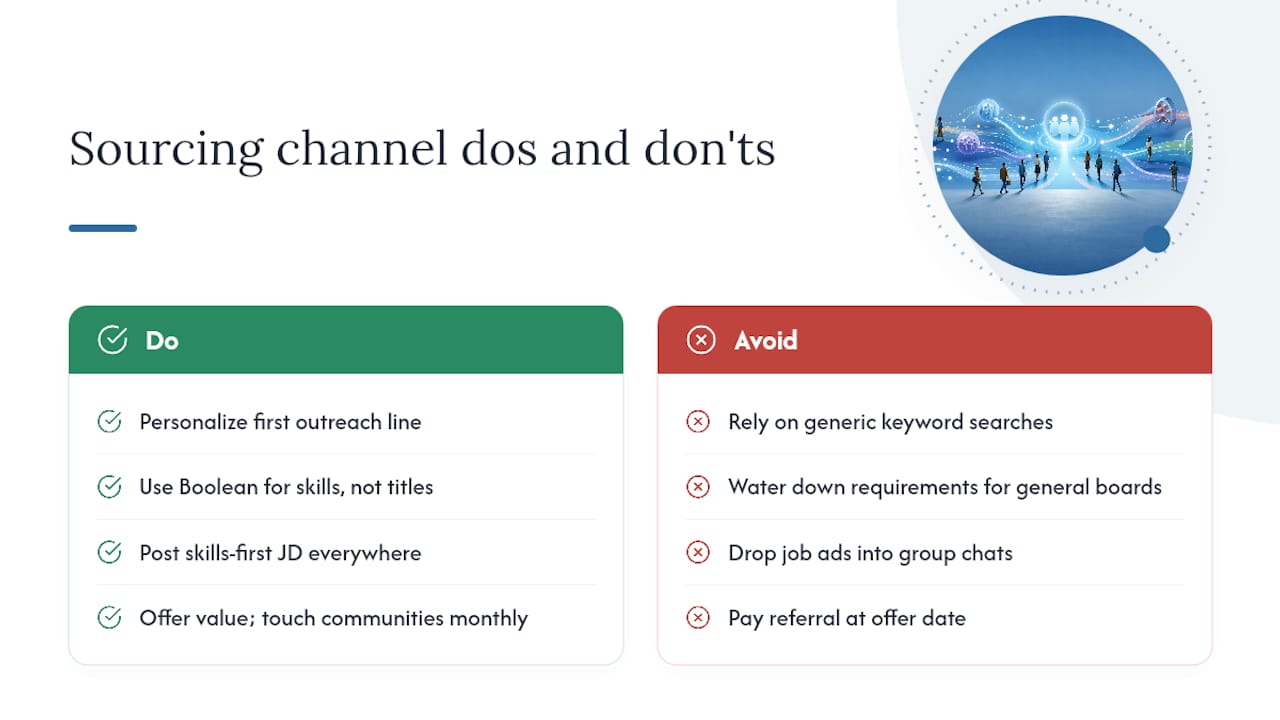
1. LinkedIn and professional networks. Anchor here when you need someone with a specific, verifiable title history, but don’t stop at keyword search. Boolean strings like ("data engineer" OR "analytics engineer") AND (Python OR dbt) NOT "senior manager" pull candidates who match the skill, not just the job title convention that happens to dominate a particular demographic. Personalize the first line of outreach to something specific from their profile. A generic InMail gets ignored regardless of who receives it.
2. Job boards and niche boards. General boards handle volume for high-turnover roles like customer service or administrative support. Niche boards do the real diversity work: boards built specifically for underrepresented groups in tech, for veterans transitioning out of service, or for bilingual professionals reach cohorts that never show up in a generic search. Post the same skills-first job description everywhere. Don’t water down requirements for the general board and tighten them for the niche one.
3. Talent communities and ERGs. These take longer to build than a job posting but pay off across multiple hiring cycles. Find affinity groups, professional associations, and bootcamp alumni networks relevant to your industry. Approach them with something to offer, like a panel spot or a mentorship connection, not a job ad dropped into a group chat. Set an outreach cadence of one genuine touchpoint a month rather than one blast when a req opens.
4. Employee referrals. Ask proactively, and ask for specific skill profiles rather than “know anyone good?” A vague ask returns whoever’s already in your employee’s network, which tends to mirror your current headcount. Time incentive payouts to the new hire’s 90-day mark, not the offer date, so referrers stay invested in a good fit rather than a fast one. If your referral pipeline looks homogeneous after a quarter, pause the blanket incentive and target it at underrepresented referral sources specifically.
5. Events and universities. Choose events by the outcome you need, not by prestige. A regional coding bootcamp demo day often produces stronger early-career diversity results than a flagship university career fair with ten other companies competing for the same short list. Build a follow-up sequence before the event: a same-week thank-you, a 30-day check-in, and a standing invite to your talent community.
6. Boolean, X-Ray search, and AI sourcing. Use AI sourcing agents to scale first-pass discovery across large candidate databases, then apply curated boolean searches for precision once you’ve narrowed the field. Write prompts around skills and outcomes: “identify candidates with production experience shipping mobile apps in Swift” outperforms “find senior iOS engineers” because it skips the title bias baked into how companies label roles.
Pro Tip: Run talent rediscovery before opening any new channel. Search your applicant tracking system for candidates who made it to a final round in the past 18 months but didn’t get the offer. They’re often still job hunting, already vetted, and completely free to re-engage.
How Do You Measure Whether Your Sourcing Channels Work?
Diversity outcomes get decided at the sourcing stage, not the offer stage. If your shortlist skews narrow, no amount of structured interviewing later fixes it. That’s why measuring at the input layer matters more than measuring hires after the fact.
Four metrics matter most:
- Channel mix: What share of your total candidate pool came from each channel this cycle?
- Shortlist composition: Does the makeup of your shortlist reflect the makeup of your original applicant pool, or is something filtering people out between stages?
- Stage-to-stage progression: Are candidates from certain channels dropping off at the resume screen, the phone screen, or the panel interview at a noticeably higher rate?
- Time-to-shortlist by channel: Which channels take the longest to produce a qualified shortlist, and is that lag worth the eventual candidate quality?
A simple biweekly tracking cadence works for most hiring teams. Pull channel-level numbers into a spreadsheet or your applicant tracking system every two weeks and compare progression rates side by side. If a channel’s shortlist-to-interview drop-off rate runs noticeably above your other channels for two consecutive cycles, pause outreach there and investigate before spending more budget.
Set targets around stage-progression parity rather than final headcount by protected characteristic. Comparing what percentage of each channel’s applicants advance from screen to interview, and interview to offer, gives you a defensible signal without collecting or acting on protected-attribute data during the sourcing process itself. That distinction protects you legally while still surfacing where your pipeline actually narrows.
Careerscape’s Sourcing Playbook You Can Adapt
Careerscape runs a repeatable cadence across every search: build the pool, run outreach, assemble the shortlist, review progression data, then refresh the channel mix for the next cycle. That loop, applied consistently across 29 U.S. markets, is what keeps a shortlist from going stale after the first round of outreach dries up.
Two templates make this repeatable for any hiring team:
- Skills-first brief: A one-page document that replaces “5+ years, Bachelor’s required” with the actual outcomes the role demands, reviewed by the hiring manager before any channel gets touched.
- Proactive referral ask: A short message to current employees naming the specific skill gap, sent before the req opens publicly, not after other channels have already stalled.
Pro Tip: Access to an established talent community shortens the build phase considerably, since the relationship groundwork is already in place before a req even opens.
A 6-Step Checklist to Test Diverse Sourcing This Hiring Cycle
Most hiring teams don’t need a full strategy overhaul. They need one deliberate test run this quarter to see what actually moves the needle.
- Define skill outcomes and strip pedigree proxies. Rewrite the job description around what the person needs to accomplish, not which school or company name they need on their resume.
- Pick three complementary channel types. Run one active channel (a niche job board), one passive channel (Boolean or AI sourcing), and one relationship channel (referrals or a talent community) at the same time.
- Build outreach templates and a schedule. Draft two or three message variants per channel and set a cadence so outreach doesn’t stall after the first week.
- Instrument input-layer metrics. Set up your applicant tracking system or a spreadsheet to log channel source, stage, and date for every candidate from day one.
- Run a 30 to 60 day trial. Capture time-to-shortlist per channel and don’t judge results before the trial window closes.
- Reallocate based on shortlist composition. Shift budget and recruiter time toward whichever channels actually moved your shortlist closer to your targets, and scale back the ones that didn’t.
| Step | Action | What to Track |
|---|---|---|
| 1 | Rewrite job description around skills | Pedigree requirements removed |
| 2 | Select 3 channel types | Active, passive, relationship mix |
| 3 | Build outreach cadence | Message variants sent per week |
| 4 | Log candidates by source | Channel mix percentage |
| 5 | Run 30 to 60 day trial | Time-to-shortlist by channel |
| 6 | Reallocate resources | Shortlist composition shift |
Legal and Ethical Considerations in Diverse Candidate Sourcing
Sourcing for diversity and sourcing based on protected characteristics are not the same activity, and confusing the two creates real legal exposure. Title VII of the Civil Rights Act prohibits hiring decisions based on race, color, religion, sex, or national origin, and that protection extends to sourcing practices, not just final offers. Widening the channels you use to reach candidates is lawful and encouraged. Screening or selecting candidates based on a protected characteristic once they’re in your pipeline is not.
The safer, more defensible approach targets where you look, not who you pick once people show up. Posting a role on a board built for veterans or bilingual professionals widens who sees the opportunity. Setting quotas for how many candidates from a specific group must reach the shortlist crosses into legally risky territory. The distinction matters even more under equal pay laws in the US, since several states now require pay transparency in job postings and prohibit asking about salary history, both of which affect how equitably your outreach lands across different candidate groups.
Document your sourcing rationale for every role: which channels you used, why, and what skill outcomes drove the job description. That record protects you if a hiring decision is ever questioned, and it also happens to be exactly the data you need for the input-layer metrics covered earlier. Run a periodic pay equity analysis alongside your sourcing review, since a wider, more diverse pipeline that funnels into inequitable offers undermines the entire effort before it starts paying off.
Strategies for Reducing Bias in Sourcing and Screening
Bias creeps into sourcing long before a human reviews a resume. Job description language is the first checkpoint: words like “ninja,” “rockstar,” or excessive years-of-experience requirements discourage qualified candidates, particularly women and career changers, from applying at all. Run every job description through a plain read for gendered or unnecessarily exclusionary language before it goes live.
Boolean search strings carry their own bias risk. A search built entirely around companies known for a narrow hiring funnel, like a handful of elite tech firms, reproduces that same narrow funnel in your results. Build search strings around the skill itself, then expand the company and school list deliberately to include less obvious sources.
Structured interview scorecards matter just as much on the sourcing side as later in the process. If a recruiter is manually screening resumes before they even reach a hiring manager, give that recruiter a rubric tied to the skills-first brief rather than a gut-check pass. Blind resume review, where names, schools, and graduation years are redacted during the first pass, removes a layer of unconscious pattern matching that has nothing to do with job performance.
Rotate who conducts initial phone screens when possible. A single screener applying the same instinctive filters across every candidate compounds bias faster than a rotating panel would. None of this requires new software. It requires treating the screening step with the same rigor most teams already apply to the final interview panel.
Best Practices for Engaging and Nurturing Diverse Talent Pools
A wider sourcing funnel only pays off if candidates stay engaged long enough to reach an offer. Talent communities and consistent employer branding build the kind of long-term pipeline that a single job posting never will, but only if the relationship-building happens before you need to fill a specific req.

Communicate on a real cadence, not just when a role opens. A monthly newsletter, an invite to a company panel, or a simple check-in message keeps candidates warm without asking anything of them. Silence for six months and then a sudden “we have an opening” message reads as transactional, and candidates notice.
Respond to every applicant, even a rejection, with a specific reason tied to the role rather than a form letter. Candidates from underrepresented backgrounds who report a respectful, transparent process are far more likely to reapply to a future opening or refer someone else your way, and word travels fast within tight-knit professional communities and affinity groups.
Give talent community members something beyond a job pipeline: mentorship connections, early access to open roles, or a seat at an internal panel discussion. That reciprocity is what separates a genuine community from a resume database with a newsletter attached.
Technology Tools and Platforms Specialized for Diversity Sourcing
Applicant tracking systems built with sourcing analytics baked in make the input-layer measurement described earlier far easier to run consistently. Look for a platform that reports channel mix and stage progression out of the box rather than requiring a manual export every cycle.
AI sourcing agents now handle first-pass candidate discovery across large public databases, surfacing people who match a skill profile even when they’ve never applied anywhere or optimized a profile for recruiter search. That capability matters most for hard-to-fill technical or specialized roles where the qualified pool is thin and scattered.
Blind screening tools that strip names, schools, and graduation dates from resumes before a human reviewer sees them address bias at the exact moment it’s most likely to creep in. Pair that with a structured scorecard and the two together do more to widen a shortlist than any single sourcing channel on its own.
Whatever stack you choose, the platform matters less than whether it actually surfaces the four input-layer metrics covered earlier. A tool with a polished dashboard that can’t tell you time-to-shortlist by channel isn’t solving the problem that actually determines your diversity outcomes.
Sourcing Is Where Diversity Hiring Gets Won or Lost
Most diversity hiring conversations focus on interview training and unconscious bias workshops, both worth doing, but both happening too late to fix a shortlist that was already narrow before the first interview got scheduled. Sourcing is the stage where the real decisions get made, and it’s also the stage most teams measure the least.
Small, measurable experiments beat vague commitments every time. A team that tests three channels for 60 days and tracks stage progression will outperform a team that issues a diversity statement and hopes the applicant pool changes on its own. Treat your sourcing metrics as the primary lever, not a side dashboard nobody checks.
— Bradford
How Careerscape Delivers Broader, Faster Shortlists
Careerscape is the direct alternative to running this entire sourcing overhaul in-house with a stretched internal team. Where the channel testing and measurement described above can take a hiring manager months to build from scratch, Careerscape already runs that cadence across active talent communities and 29 U.S. markets, which means a broader, skills-first shortlist without the setup time.
For roles you need filled fast without a long-term headcount commitment, contract staffing taps a pre-vetted pool built on exactly the skills-first briefs covered earlier. For permanent roles where you want a managed search that widens the funnel without lowering the bar, direct hire staffing applies the same input-layer discipline from the first outreach message to the final shortlist.
Ready to see what a wider, faster pipeline looks like for your next opening? Request talent and get a shortlist built around outcomes, not pedigree.
FAQ
What Are the Best Candidate Sourcing Platforms?
There’s no single best platform since different tools serve different needs. LinkedIn works well for mid-to-senior professional roles, niche job boards reach specific underrepresented communities, and an applicant tracking system with built-in sourcing analytics helps you measure which channel actually delivers.
What Are the 5 C’s of Recruitment?
Definitions vary across the industry, but the concept generally centers on clarity in the job description, consistency in the process, communication with candidates, capability assessment tied to actual skills, and a candidate-focused experience throughout.
What Are the Best Diversity Job Boards?
The strongest diversity job boards target a specific underrepresented community rather than trying to serve everyone, whether that’s a board built for veterans, bilingual professionals, or historically Black colleges and universities alumni networks. Pairing a niche board with a general board and a referral push tends to outperform relying on any single board alone.
What Are the Top Sourcing Tools for Recruiters?
Effective recruiters combine a professional network like LinkedIn, Boolean and AI-powered search tools for passive candidates, an applicant tracking system for talent rediscovery, and direct partnerships with talent communities. Careerscape’s talent community access gives hiring teams a shortcut past the months it typically takes to build that pipeline from scratch.