
Combining structured interview techniques—such as standardized questions, anchored scoring rubrics, and calibrated panels—significantly reduces bias in hiring processes. Implementing blind practices, like resume redaction, can further mitigate biases related to affinity and first impressions. The effectiveness of these strategies relies on a systematic approach rather than individual intent, emphasizing the importance of consistent scoring and independent evaluations to enhance fairness and defensibility in hiring decisions.
- Structured interview components like consistent questions, anchored rubrics, and calibrated panels significantly reduce bias compared to unstructured formats.
- Limiting early judgments and creating a standardized process can prevent biases such as halo, horn, and confirmation effects from influencing outcomes.
- Employing blind practices like resume redaction and anonymous work samples can diminish affinity and halo biases but may require operational adjustments.
- Requiring independent scores and pre-discussion calibration improves panel consistency and minimizes subjective influences during evaluations.
- Implementing simple pilot steps, like adding one anchored question or requiring written notes, can quickly enhance fairness and build trust in the process.
In this article
The most effective way to achieve interview bias reduction is to combine structured questions, anchored scoring rubrics, multiple calibrated raters, and blinded elements where feasible, then track the results. This approach produces fairer, more valid hiring decisions and gives organizations a defensible, evidence-backed process. The sections below walk through each component, from question design to scoring to a rollout checklist you can adapt within a single hiring cycle.
What interview bias looks like in practice
Bias in interviews rarely announces itself. It shows up as a gut feeling that gets mistaken for judgment. Recognizing the specific patterns is the first step toward controlling them.
- Halo effect: one strong answer, often about a shared alma mater or impressive employer, makes an interviewer rate every later answer more favorably.
- Horn effect: a single weak or awkward answer early on colors every response that follows, regardless of quality.
- Affinity bias: an interviewer favors a candidate who shares a hobby, background, or communication style, mistaking comfort for competence.
- Confirmation bias: after forming an early opinion, the interviewer unconsciously steers questions to confirm it rather than test it.
- First-impression bias: judgments formed in the opening minute, based on handshake, dress, or small talk, anchor the rest of the evaluation.
- Contrast effect: a mediocre candidate looks strong simply because they interviewed right after a weak one.
- Leniency or strictness: some raters consistently score everyone high or low regardless of actual performance.
- Central tendency: raters avoid extreme scores, clustering everyone near the middle and erasing real differences between candidates.
The timing problem is well documented. Research summarized in a systematic review on interview format and bias found that many hiring decisions form very early in the interview, often before the substantive questions even begin. That single finding explains why so many of the biases above take root before a candidate has had a real chance to answer anything.
Why awareness or one-off training alone usually fails
Diversity and bias-awareness training is common, and it is rarely enough on its own. Training raises intent, interviewers leave the session meaning to be fairer, but intent does not reliably change behavior in the room. A systematic review on reducing bias in interviews found that awareness-only training rarely eliminates bias when it operates in isolation. Trained interviewers still form rapid impressions; the difference is they now have a vocabulary for justifying those impressions after the fact.
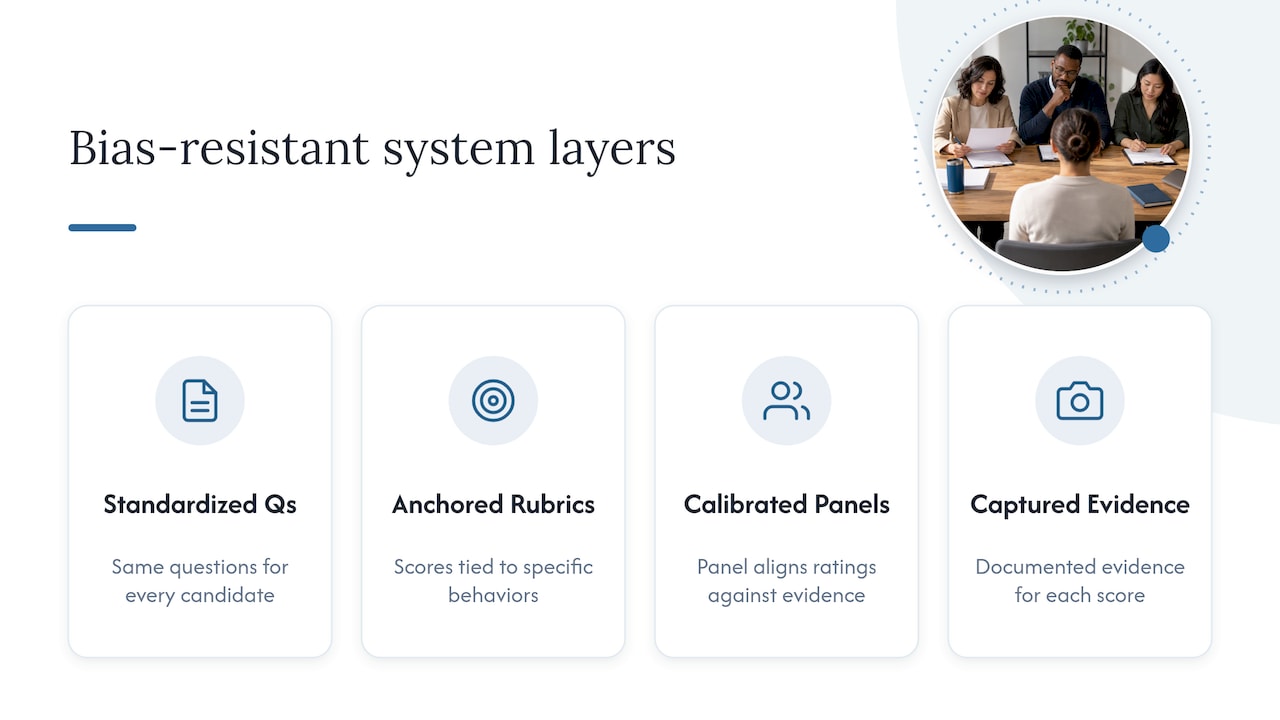
What actually changes outcomes is structural, not motivational. When every candidate answers the same questions, when scores are anchored to specific behaviors, and when a panel calibrates its ratings against shared evidence, individual discretion has far less room to operate. Bias reduction becomes a property of the system, not a matter of any one interviewer’s goodwill. That is the layered approach the review recommends: standardized questions, anchored rubrics, calibrated panels, and captured evidence working together rather than any single fix carrying the weight alone.
How to design structured interviews that reduce bias
Structure is the foundation everything else builds on. A structured interview is not a rigid script. It is a repeatable, job-related process that gives every candidate a fair shot at the same evaluation.
- Start with job analysis. Identify four to six core competencies that actually predict success in the role, based on what the job requires rather than what feels impressive in conversation.
- Write behavioral and situational questions for each competency. A behavioral question asks about a past experience (“Tell me about a time you resolved a conflict with a coworker”); a situational question poses a hypothetical tied to the job.
- Define allowed probes in advance. If a candidate gives a thin answer, decide ahead of time what follow-up prompts are acceptable, and use the same probes for every candidate answering that question.
- Deliver the same questions in the same order to every candidate for a given role. Rotate the question bank by role, not by candidate, so no one gets an easier or harder path through the process.
- Keep the environment consistent. Same room type, same timing, same materials available to the panel, so external factors do not shape the outcome.
OPM’s guidance on structured interviews confirms that structured formats increase both validity and reliability compared with unstructured conversation, largely because standardizing the questions and the scoring removes the variability that lets bias creep in.
Pro Tip: Write your probes into the interview guide itself, not just the questions, so every interviewer knows exactly how far they can push a thin answer.
Scoring and anchored rubrics that hold up under scrutiny
A good question bank means little without a scoring system that turns answers into comparable numbers. The standard approach is a 1 to 5 proficiency scale, with each level described by a short behavioral anchor rather than a vague label like “good” or “excellent.”
- Write anchors that describe observable behavior at each score level, tied to the specific competency being assessed.
- Weight competencies equally by default; OPM’s scoring guidance treats equal weighting as the legally defensible starting point, and any deviation should be documented with job-analysis evidence.
- Require each interviewer to score independently before any group discussion happens.
- Hold a short calibration conversation afterward to resolve outliers, with reasoning for any score changes logged for the record.
A worked example makes the aggregation concrete. Say a role has four competencies, each scored 1 to 5 by three panelists. If a candidate earns average scores across four competencies, the overall score is calculated as the simple mean of those scores, resulting in an easily comparable number out of the maximum scale value. That single number, backed by anchored notes for each competency, is far easier to defend later than a panelist’s recollection of “a good vibe.”
Blinded and anonymized practices: what to blind and when
Blinding removes information that has no bearing on job performance but has plenty of bearing on unconscious judgment. Resume redaction strips names, schools, and addresses before a hiring manager ever screens a candidate. Blind work samples ask candidates to complete a task under a candidate number rather than a name. Blind phone screens, conducted before video or in person, focus purely on voice and content.
Evidence on blinding is encouraging but not absolute. Guidance on navigating bias on interview day notes that blinding tends to reduce affinity and halo effects specifically, since it removes the visual and biographical cues those biases feed on. The tradeoff is real: blinding can strip useful context and adds administrative effort to coordinate. The practical fix is to pilot one blind stage, such as resume redaction for a single role, and tell candidates why the extra step exists so the process feels deliberate rather than opaque.
Panels, calibration, and capturing evidence
A panel of trained raters catches what one interviewer alone will miss, since different people notice different signals and can check each other’s assumptions in real time. Where possible, reuse the same interviewer set across candidates for a given role rather than rotating panelists in and out, since a consistent panel calibrates faster and more consistently than a shifting one.
- Hold a short calibration meeting before the hiring cycle starts, walking through one or two sample cases so every rater applies the anchors the same way.
- Require written notes tied to specific competencies, not general impressions, captured during or immediately after each interview.
- Keep score logs in a secure, auditable format that separates the raw scores from any later discussion notes.
- Follow applicable privacy rules if recording interviews, and disclose recording to candidates in advance.
Treating the interview as a data-collection exercise, rather than a memory exercise, is the shift that makes the biggest difference. Notes and scores captured in the room hold up; recollections reconstructed during a debrief a week later do not.
A rollout checklist for bias-resistant interviews
Rolling this out does not require a quarter-long project. A single hiring cycle is enough to pilot the core pieces.
- Pre-launch (2 to 4 weeks): complete the job analysis, build the question bank and rubric, and set a pilot plan for one open role.
- Launch (first hiring cycle): train interviewers on the guide, run one or two mock interviews to test timing and probes, execute the pilot, and tell candidates what to expect.
- Post-launch (1 to 3 months): collect scoring data, run a calibration session against real cases, refine weak questions in the bank, and schedule a refresher training.
- Quick wins you can start this week: add one anchored question to your next interview, stop reviewing resumes while the candidate is in the room, and require written notes from every interviewer before any debrief.
Pro Tip: The fastest way to build buy-in is a small pilot on one role, not a company-wide mandate on day one.
Measuring outcomes and staying compliant
None of this matters if you cannot show it worked. A short set of metrics tells you whether the new process is doing its job.
- Inter-rater reliability: how closely independent scores from different panelists agree before calibration.
- Score distributions: whether ratings cluster suspiciously at the middle or top, a sign of central tendency or leniency.
- Pass rates by group: tracked at each stage to catch disparities early, not after an offer has gone out.
- Time-to-offer and post-hire performance proxies: whether the new process is slower or faster, and whether it is actually predicting who succeeds on the job.
Compliance matters just as much as the metrics themselves. EEOC guidance on employment tests and selection procedures requires that selection procedures be job-related and consistent with business necessity, and employers must be able to validate a procedure, or show there is no less discriminatory alternative, when adverse impact appears. Careerscape’s own equal employment opportunity practices reflect that same standard. Set a quarterly audit cadence, and if pass-rate gaps between groups exceed a threshold your legal counsel considers meaningful, pause and get a statistical review before changing anything further.
How a staffing partner supports bias-resistant interviewing
Building all of this in-house takes time most HR teams do not have during an active search. Careerscape offers interview-process consulting alongside its core Direct Hire and RPO Services, helping teams build structured scorecards and train interviewers without pausing an open requisition. For a single urgent hire, keeping the process in-house with a tightened rubric is often faster; for a recurring hiring pattern across multiple roles, a partner who already runs structured scorecards across industry-specialized recruiting teams can shorten the learning curve considerably.
Strategies for diverse and inclusive interview panels
A panel’s composition shapes what it notices. When every rater shares a similar background, blind spots compound instead of canceling out. Building a panel with varied roles, tenure, and perspectives gives a candidate’s answers more than one lens to be judged against.
Practical steps matter more than good intentions here. Rotate panel composition across a hiring cycle so no single perspective dominates every decision for a given role. Include at least one rater who works outside the immediate team, since someone without a stake in team dynamics tends to score against the rubric rather than against personal fit. Set an expectation that every panelist scores independently before group discussion begins, which protects newer or more junior panelists from anchoring their scores to a senior colleague’s opinion voiced first.
Training panelists together, rather than separately, also helps. A shared calibration session where the whole panel discusses sample answers against the anchored rubric builds a common standard faster than individual training modules ever will. It also surfaces disagreements about what “good” looks like before those disagreements show up as inconsistent scores on a real candidate.
None of this requires a large panel. Three raters with genuinely different vantage points on the role will usually surface more useful disagreement than five raters who all think alike.

Best practices for candidate preparation to ensure fairness
Fairness is not just about what happens inside the interview room. What candidates know beforehand shapes how well they can show what they actually know.
Send every candidate for a given role the same information in advance: the competencies being assessed, the interview format, roughly how long it will run, and who they will meet. This is not a courtesy, it is a control. If one candidate learns the interview will include a work sample and another finds out only when they arrive, the process is no longer measuring the same thing for both people.
Give candidates a realistic sense of what a strong answer looks like without handing them the rubric itself. A brief note that questions will ask for specific examples from past work, rather than general opinions, helps candidates unfamiliar with behavioral interview formats compete on equal footing with candidates who have done this before.
Accommodate scheduling and accessibility needs consistently, using the same process for every applicant who asks rather than handling requests case by case. Consistency here protects fairness in the same way an anchored rubric does: it removes discretion that could otherwise tilt toward whichever candidate is easiest to accommodate.
A lesson from watching interview panels in practice
The single biggest jump we have seen in panel consistency came from something small: requiring independent written scores before anyone spoke. Silence before discussion changes everything. Pick one change, run it for a cycle, and measure it.
— Bradford
How Careerscape can help you get there
If building this playbook internally feels like more than your current cycle allows, Careerscape’s Direct Hire service places pre-screened, industry-matched candidates into permanent roles without asking your team to build a structured process from scratch. For recurring hiring needs across multiple roles or departments, Recruitment Process Outsourcing hands off some or all of the process, including interview design, while your team keeps final decision-making. The Employer Portal gives you real-time visibility into candidate pipelines and scoring as the search progresses. If you want to compare partnering against building in-house first, our guide on types of recruitment agencies is a useful next read. Reach out for a pilot consultation on your next open role.
For deeper reading: EEOC selection procedure guidance covers legal context, OPM structured interviews covers scoring design, and the PMC and F1000Research reviews cover the underlying evidence. Readers building out agency-side operations may also find this useful for operational planning.
FAQ
What is the 30-60-90 rule in an interview?
The 30-60-90 rule generally refers to a plan candidates or new hires present covering initial periods in a role, rather than a bias-reduction framework. It is more common in onboarding and candidate preparation than in structured interview design.
What is the 80/20 rule in interviewing?
It is a rule of thumb for prioritizing question design, not a formally validated standard.
What are the 5 C’s of interviewing?
There is no single standardized definition of the “5 C’s” across hiring literature, and the term is used inconsistently. Rather than relying on that framing, structured interviews built on job analysis, anchored rubrics, and calibrated panels offer a better-documented path to fairness.
What is the 70/30 rule in hiring?
Like the 80/20 rule, the 70/30 rule is not a formally recognized standard and definitions vary by source. Some use it to describe a rough split between technical skill assessment and cultural or team fit, but it is not backed by the validity evidence that supports structured interviewing.
How quickly can a team reduce interview bias?
Meaningful reduction can start within a single hiring cycle by adding anchored questions, independent scoring, and a short calibration meeting. Full measurement of impact, including score distributions and pass-rate tracking, typically takes a few hiring cycles to show a reliable pattern.