
The right job aligns with your skills and values while offering growth opportunities; a tailored application significantly increases interview chances by over 200%. A structured job search involves self-assessment, research, application, and interview preparation, with an emphasis on informational interviews and tailored resumes to stand out. Job seekers should focus on evaluating fit through measurable criteria, engaging in active research, and preparing compelling evidence of their capabilities for interviews, treating the process as a sales conversation.
The right job is defined as a role that matches your skills, aligns with your values, and offers real growth. Most job seekers treat the search as a numbers game, sending out hundreds of applications and hoping for a response. That approach fails. Research on 1.7 million applications shows that tailoring your resume to a specific job description increases your interview likelihood by over 200%. The gap between a generic application and a targeted one is not marginal. It is the difference between silence and a callback.
What Does a Finding the Right Job Guide Actually Cover?
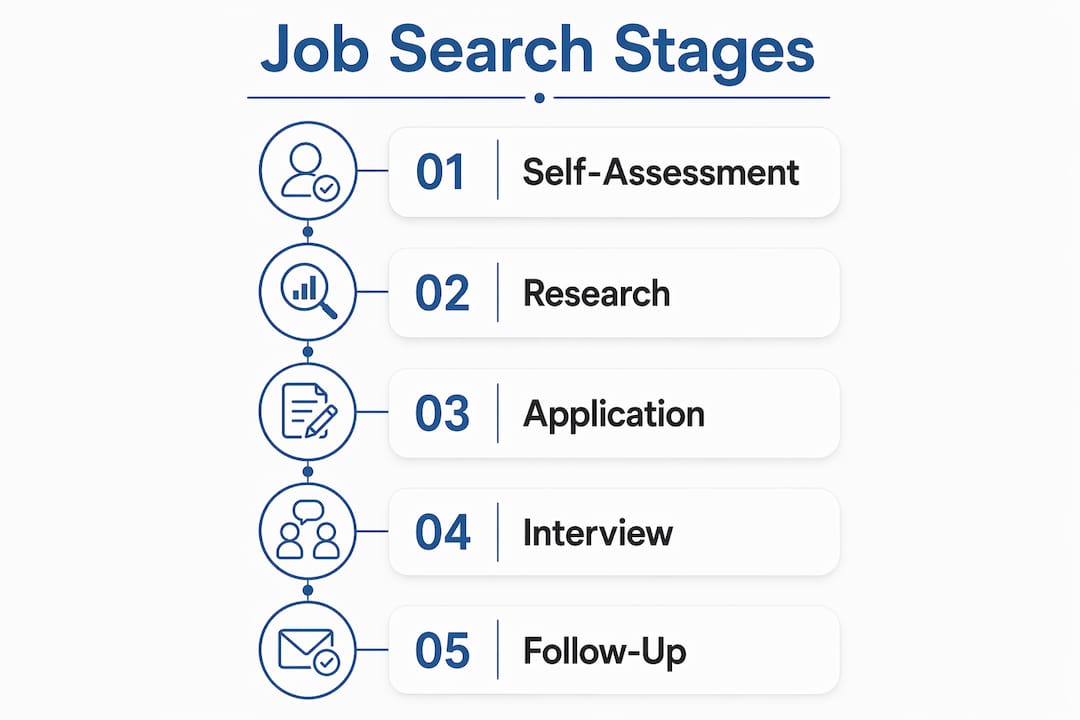
A structured job search covers four stages: self-assessment, research, application, and interview. Each stage builds on the last. Skipping self-assessment means you apply to roles that drain you. Skipping research means you apply blind. The 80,000 Hours career guide defines the best approach as generating multiple career options, ranking them on core factors, and testing them through low-cost experiments. That framework replaces the outdated advice to “follow your passion,” which research shows leads to poor career decisions.
Job seekers at every level, from new graduates to mid-career professionals, benefit from the same structured process. The tactics shift based on experience, but the logic stays the same.

How Do You Evaluate Fit and Clarify Your Career Goals?
Fit is not a feeling. It is a measurable match between what a role demands and what you offer and want. Recruiters recommend evaluating every role against three core filters: energy, growth, and culture. If two or three of those filters are negative, the role is not a good fit, regardless of the salary or title.
Use a ranking framework to compare your options objectively. List your top three to seven career options and score each one against factors like daily tasks, learning potential, compensation trajectory, and alignment with your personal values. Scoring forces you to confront trade-offs that gut instinct hides.
Two exercises sharpen this process further:
- Pre-mortem: Imagine it is one year from now and the career choice failed. Write down every reason why. This surfaces risks you would otherwise ignore.
- Pre-party: Imagine the same year passed and the choice succeeded beyond expectations. Write down what made it work. This reveals benefits you may be undervaluing.
- Values audit: List the five work conditions that matter most to you, such as autonomy, collaboration, or technical challenge. Score each option against that list.
- Energy check: Think about past roles or projects. Which tasks left you energized at the end of the day? Which ones drained you by noon? Pattern recognition here is more reliable than any career personality test.
Pro Tip: Avoid generic online career assessments as your primary decision tool. They measure preferences, not performance. Use them as a starting point, then validate with real conversations and real work.
What Research Techniques Help You Discover and Test Opportunities?
Research is not passive reading. It is active information gathering that updates your assumptions about a career path. The most effective method is the informational interview. Networking and informational interviews should account for 70% of your job search effort, and research shows that one in twelve informational interviews leads directly to a job offer. That conversion rate far exceeds what mass applying produces.
Here is a practical ladder for testing career options before committing:
- Read for two to five hours. Find the best books, industry reports, and long-form articles on the field. This gives you enough vocabulary to have a real conversation with insiders.
- Talk to insiders for two to twenty hours. Reach out to people currently doing the work you are considering. Ask about daily realities, not just career highlights. Ask what they wish they had known before entering the field.
- Do a short project for up to four weeks. Volunteer, freelance, or take on a side project in the target area. Cheap tests like short projects give you direct evidence about whether you enjoy and can perform the work.
- Update your hypothesis. After each step, revise your ranking. New information should change your list. If it does not, you are not gathering real information.
- Seek referrals from every conversation. Every insider you speak with knows two or three others. Ask for introductions. This builds a network that pays off during the application stage.
Pro Tip: When reaching out for informational interviews, ask a specific question rather than a general “Can I pick your brain?” request. Specific questions get responses. Vague ones get ignored.
Resources like Way of Work offer structured frameworks for professional networking and informational interviews that make this process more systematic.
How Do You Craft Tailored Applications That Stand Out?
Tailoring is the single highest-impact application strategy. Analysis of 1.7 million applications confirms that resume tailoring drives a 200% increase in interview rates. The mechanism is straightforward: applicant tracking systems (ATS) filter resumes by keyword match before a human ever reads them. A generic resume fails that filter.
Here is what effective tailoring looks like in practice:
- Match the job title. If your previous title was “Marketing Coordinator” and the posting says “Content Marketing Specialist,” use a combined format such as “Marketing Coordinator / Content Marketing Specialist” to remain honest while passing ATS filters.
- Mirror the job description language. Pull the exact phrases the employer uses for required skills and responsibilities. Paste them into your resume where they accurately describe your experience.
- Lead with a summary that speaks to this role. Write two to three sentences that connect your background directly to what this employer needs. Change it for every application.
- Quantify results. Replace task descriptions with outcome statements. “Managed social media” becomes “Grew LinkedIn following by 4,000 followers in six months.”
- Keep your authentic voice. ATS optimization and authentic writing are not in conflict. Keyword stuffing reads as hollow to every human recruiter who sees it.
The table below shows the difference between a generic and a tailored application approach:
| Element | Generic approach | Tailored approach |
|---|---|---|
| Resume summary | Broad career overview | Directly addresses the employer’s stated needs |
| Skills section | Standard list of tools | Mirrors exact language from the job description |
| Job title | Your official title only | Combined format when titles are similar |
| Cover letter | Same letter, different name | References the company’s specific challenge or goal |
| Keywords | General industry terms | Pulled directly from the posting |
Modern job search research confirms that mass applying with AI-generated resumes reduces effectiveness. Personal voice and network-backed applications consistently outperform volume strategies. Use AI to draft and refine, but always rewrite in your own words before submitting.
How Do You Prepare for Interviews and Prove You Can Do the Work?
Job seeking is a sales process with three stages: generating leads, proving you fit, and negotiating the offer. 80,000 Hours research frames it this way explicitly. Treating the interview as a sales conversation changes how you prepare.
- Define three key selling points before you walk in. Each point should be a specific capability backed by a concrete example. Candidates who enter with three clear messages hold attention and communicate qualifications more effectively than those who improvise.
- Prepare a pre-interview project. If the role involves writing, bring a sample piece. If it involves analysis, bring a short memo on a relevant problem the company faces. Employers value evidence of doing the work more than a perfect qualification checklist.
- Practice behavioral questions with the STAR method. Situation, Task, Action, Result. Structure every story this way. It keeps answers concise and evidence-based.
- Prepare questions that show you researched the company. Ask about the team’s current priorities, not about information available on the homepage. Specific questions signal genuine interest.
- Negotiate every offer. Salary negotiation is expected. Research the market rate for the role using Bureau of Labor Statistics data and industry salary surveys. Come in with a specific number, not a range.
Cs-recruiters works with candidates across industries and consistently finds that pre-interview preparation, especially work samples, shortens the hiring timeline and increases offer rates.
Key Takeaways
A structured, research-backed job search that combines self-assessment, targeted networking, tailored applications, and interview preparation produces better outcomes than any volume-based approach.
| Point | Details |
|---|---|
| Tailoring beats volume | Customizing your resume to each job description increases interview rates by over 200%. |
| Network first | Spend 70% of your search effort on networking and informational interviews, not mass applying. |
| Test before committing | Use cheap experiments like short projects and insider conversations to validate career fit. |
| Prove ability, not credentials | Pre-interview work samples convince employers faster than a perfect resume alone. |
| Self-assessment is the foundation | Evaluate every role against energy, growth, and culture before applying. |
What I Have Learned After Years of Watching Job Searches Succeed and Fail
The most common mistake I see is job seekers treating self-knowledge as optional. They skip the assessment phase and go straight to applications. Then they land interviews for roles that are technically a match but personally wrong. They either decline offers or accept them and leave within a year. That cycle is expensive for everyone involved.
The second mistake is underestimating the hidden job market. A significant share of roles are filled before they are ever posted publicly. The candidates who get those roles are the ones who built relationships before they needed them. Informational interviews are not just a research tool. They are a lead-generation tool.
What actually works in 2026 is a combination of scientific decision-making and genuine human connection. The data tells you which roles to pursue. The relationships get you in the door. Neither works well without the other. Job seekers who treat their search as a data problem and ignore networking fail. Those who network without clarity about what they want waste everyone’s time.
The job market rewards preparation and specificity. It always has. The tools change. The fundamentals do not.
— Bradford
How Cs-Recruiters Connects Qualified Professionals with the Right Roles
Cs-recruiters operates on a straightforward principle: hiring should be fast, honest, and backed by people who understand your industry. For job seekers, that means working with recruiters who already have relationships with companies actively hiring in your field. Cs-recruiters offers both contract staffing solutions and direct hire placement across a range of industries, from professional services to technology and engineering. If you are ready to move from research to real opportunities, Cs-recruiters matches your qualifications to roles that fit your skills and career goals, without the guesswork of applying blind.
FAQ
What Is the Most Effective Job Search Strategy in 2026?
Tailoring your resume to each job description and spending the majority of your search effort on networking and informational interviews produces the highest results. Research on 1.7 million applications confirms tailoring increases interview rates by over 200%.
How Do I Know if a Job Is the Right Fit Before Applying?
Evaluate the role against three filters: energy, growth, and culture. If two or more of those filters are negative, the role is likely not a good match, regardless of compensation.
How Important Is Networking Compared to Applying Online?
Networking accounts for 70% of effective job search effort. Informational interviews convert to job offers at a rate of one in twelve, which far exceeds the conversion rate of online applications alone.
Should I Use AI to Write My Resume?
Use AI to draft and structure your resume, but always rewrite the final version in your own voice. Authentic, tailored language outperforms AI-generated text in both ATS scoring and human review.
How Do I Prepare for a Job Interview Effectively?
Define three specific selling points backed by concrete examples, prepare a relevant work sample or pre-interview project, and research the company’s current priorities. Candidates who enter with clear messages and evidence of their work consistently outperform those who rely on credentials alone.