
Resume optimization is essential for improving visibility and ranking within applicant tracking systems (ATS), which are used by 99% of Fortune 500 companies to filter candidates. Properly optimized resumes can achieve an 11.7% callback rate compared to 4.2% for non-optimized ones, with key strategies including using a single-column layout, standard section headings, and embedding relevant keywords in achievement statements. While optimization enhances visibility, it does not substitute for genuine qualifications; thus, candidates must align their experience with job requirements to secure offers.
In this article
Resume optimization is the process of refining your resume’s content and structure to improve its ranking and visibility within automated applicant tracking systems (ATS) and to appeal to human recruiters. The role of resume optimization has never been more direct: 99% of Fortune 500 companies use ATS to filter candidates, yet 51% of resumes score below 50 on those systems. That gap between submission and visibility is exactly what optimization closes. Properly optimized resumes receive an 11.7% callback rate versus 4.2% for generic ones. That is a 178% increase in interview opportunities from formatting and keyword decisions alone.
How Does an ATS Rank Your Resume?
ATS software does not read your resume the way a recruiter does. It parses the document into structured data fields, then scores each resume against the job description using four composite signals.
ATS systems rank resumes using keyword match, recency of experience, section completeness, and term frequency. Candidates are then sorted in descending order by that composite score. Only the top-ranked resumes surface to a recruiter’s screen. If your resume ranks low, it never gets human eyes on it, regardless of your qualifications.

The keyword gap is the most common failure point. The median resume misses 52% of keywords required by the job description. That means most job seekers are submitting resumes that score poorly before a human ever reads a single line.
Technical errors compound the problem. 43% of automated rejections trace back to formatting issues: multi-column layouts, creative section headings, or contact information embedded in headers. These errors prevent the ATS from parsing your resume correctly, which tanks your score before keywords even factor in.
Here is what the ATS scoring breakdown looks like in practice:
| ATS Signal | What It Measures | Common Failure |
|---|---|---|
| Keyword match | Alignment with job description terms | Missing 50%+ of required keywords |
| Recency | How current your experience is | Gaps or outdated roles listed first |
| Section completeness | Presence of standard resume sections | Missing skills, summary, or dates |
| Term frequency | How often relevant terms appear | Single mention of a key skill |
Understanding these signals tells you exactly where to focus your effort. Fixing keyword gaps and formatting errors produces the largest score gains.
What Resume Optimization Techniques Drive the Biggest Results?
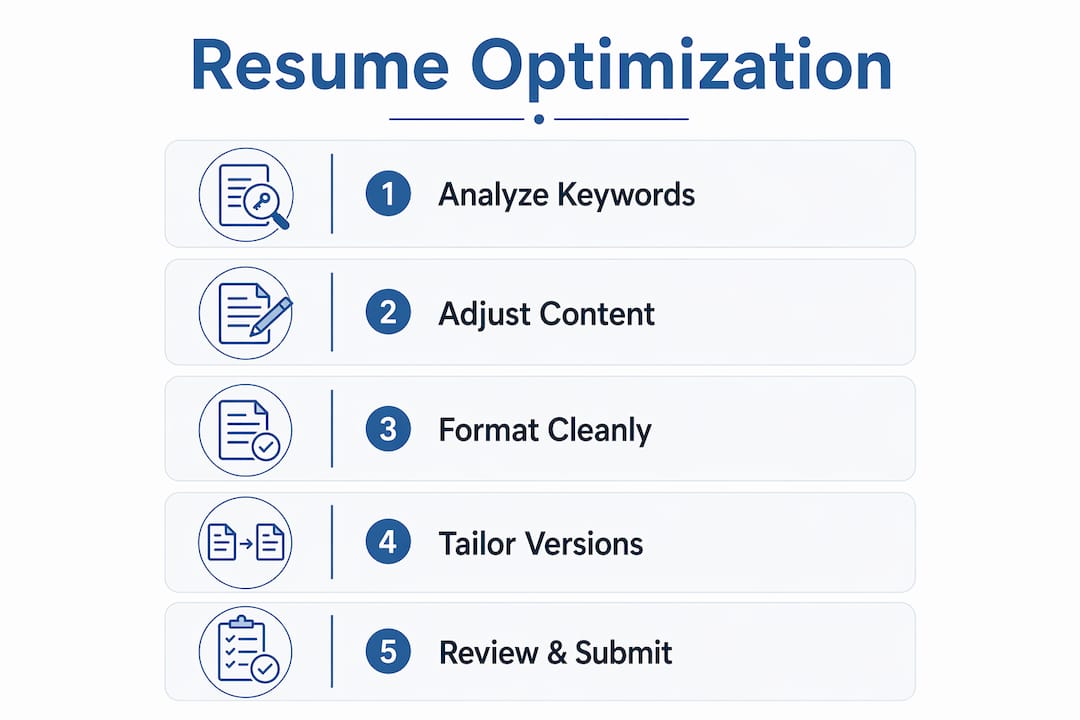
Five specific actions account for 80% of ATS score improvements. The remaining 20% comes from minor polish items like consistent date formatting and file naming. Focus your energy on the high-impact moves first.
-
Use a single-column layout. Multi-column or graphical layouts reduce ATS parsing accuracy and trigger automated rejections. A clean, single-column format in .docx or plain PDF ensures the system reads every line correctly.
-
Use standard section headings. Labels like “Work Experience,” “Education,” and “Skills” are what ATS systems expect. Creative alternatives like “My Story” or “Where I’ve Been” confuse the parser and cause sections to be ignored entirely.
-
Embed keywords inside achievement bullets. The What + How + Why formula works best. For example: “Reduced customer churn by 18% by redesigning the onboarding workflow, improving 90-day retention across the enterprise segment.” That sentence contains the keyword, the metric, and the context. It signals genuine expertise to both the ATS and the recruiter reading it.
-
Quantify every accomplishment you can. Numbers give ATS systems clear signals and give recruiters a reason to call. Revenue figures, percentages, team sizes, and timelines all work. Vague phrases like “improved performance” score lower than “cut processing time by 30%.”
-
Build a role-version strategy. Two to four distinct resume versions tailored to different job families prevent the time drain of rebuilding your resume from scratch for every application. You maintain relevance without starting over each time.
Pro Tip: Avoid keyword stuffing. Repeating a term eight times in a skills list does not improve your score. ATS systems use term frequency as one signal among four, and human recruiters will flag a stuffed resume immediately. One to three well-placed, contextual uses of each keyword outperforms a list every time.
For a broader view of how job postings and resume alignment interact, the 2026 recruiter’s guide from Careerscape breaks down what hiring managers actually look for on the other side of the ATS.
What Are the Real Limits of Resume Optimization?
Resume optimization solves a visibility problem. It does not solve a qualifications problem. This distinction matters because job seekers sometimes treat optimization as a workaround for experience gaps, and it is not.
Keyword optimization moves your resume from filtered to visible. Once visible, the recruiter evaluates your actual background. If your experience does not match the role’s core requirements, a high ATS score will not produce an offer. Optimization and genuine skill development must work together, not in place of each other.
The weight of each ATS signal also varies by system and employer. Keyword match carries the most influence in most platforms, but section completeness and recency matter significantly in competitive candidate pools. A resume with a strong keyword match but a two-year employment gap will still rank below a well-rounded candidate.
“Optimization solves the keyword problem. Real career growth requires relevant experience and education. The two are not interchangeable, and treating them as such leads to frustration when callbacks do not convert to offers.”
The good news is that human recruiters prefer the same clear structure, consistent formatting, and quantified achievements that ATS parsing favors. Optimizing for the machine also optimizes for the person. The goals align, which means a well-optimized resume performs better at every stage of the screening process.
How Do You Optimize Your Resume Efficiently for Multiple Roles?
The most common mistake job seekers make is treating every application as a full resume rewrite. That approach burns time and produces inconsistent results. A structured workflow solves both problems.
Start by collecting five to ten job descriptions for your target role. Read them side by side and extract the keywords and skill requirements that appear repeatedly. These repeated terms are the ones the ATS is trained to find. They belong in your resume’s skills section, your summary, and your achievement bullets.
- Identify your core resume. This is your master document with every role, achievement, and skill you have. You never submit this version. It is your source material.
- Build two to four role-specific versions. Each version targets a distinct job family: for example, project management, operations, or business analysis. Tailor the summary, skills section, and top bullet points for each family.
- Run an ATS compliance check. Use a structured audit framework to verify single-column layout, standard headings, correct file format (.docx preferred), and keyword coverage before submitting.
- Customize the top third for each application. The summary and first job’s bullet points carry the most ATS weight. Adjust those two areas to match the specific job description without rebuilding the entire document.
Pro Tip: When tailoring your resume, mirror the exact phrasing from the job description rather than synonyms. If the posting says “cross-functional collaboration,” use that phrase, not “interdepartmental teamwork.” ATS systems match strings, not concepts.
The role-version strategy also pairs well with a broader job search plan. For job seekers targeting professional services roles, the social media manager resume examples resource shows how keyword embedding and formatting choices translate across different professional contexts.
Here is a quick workflow reference for efficient resume customization:
| Step | Action | Time Required |
|---|---|---|
| 1. Analyze job descriptions | Extract repeated keywords from 5–10 postings | 30–45 minutes |
| 2. Build core resume | Document all roles, skills, and achievements | 2–3 hours |
| 3. Create role versions | Tailor summary and skills for 2–4 job families | 1–2 hours each |
| 4. ATS compliance audit | Check format, headings, file type, keyword coverage | 15–20 minutes |
| 5. Per-application tweak | Adjust top third to match specific posting | 10–15 minutes |
This workflow turns resume customization from a recurring burden into a repeatable process. You invest the time once in building the system, then spend minutes on each application instead of hours.
Key Takeaways
Resume optimization is the single highest-leverage action a job seeker can take before submitting an application, because it directly controls whether a recruiter ever sees the resume at all.
| Point | Details |
|---|---|
| ATS controls recruiter visibility | 99% of Fortune 500 companies use ATS; low-scoring resumes never reach a human reviewer. |
| Keyword gaps are the top failure | The median resume misses 52% of required keywords, making targeted embedding the highest-priority fix. |
| Five actions drive 80% of gains | Technical compliance, standard headings, keyword-embedded achievements, quantified results, and role versions produce most score improvements. |
| Optimization has clear limits | A high ATS score increases visibility but cannot substitute for genuine qualifications or relevant experience. |
| Role-version strategy saves time | Two to four tailored resume versions let you apply efficiently without rebuilding from scratch each time. |
What I’ve Learned After Watching Thousands of Resumes Succeed and Fail
After years of working alongside recruiters and watching candidates move through hiring pipelines, one pattern stands out clearly. The job seekers who struggle most are not the least qualified. They are the ones whose resumes never surface because they submitted a generic document to a system designed to filter it out.
Resume optimization is not a trick. It is alignment. You are telling the ATS, in its own language, that your background matches what the employer needs. The candidates who do this well do not game the system. They read the job description carefully, reflect it accurately in their resume, and present their real experience in a format the system can read.
What I find underappreciated is the compounding effect of the role-version strategy. Job seekers who build two or three strong, targeted resume versions early in their search apply faster, apply more consistently, and convert at higher rates. The upfront investment pays back within the first week of applications.
The future of resume screening will involve more AI, not less. Systems will get better at reading context, not just matching strings. That means the job seekers who combine genuine skill development with clear, well-structured communication will always outperform those who rely on either alone. Optimization gets you in the room. What you have actually done gets you the offer.
For job seekers who want to pair a strong resume with a direct path to relevant opportunities, Careerscape’ job hunting strategies guide covers how to move beyond the application queue entirely.
— Bradford
Careerscape Connects Optimized Candidates with the Right Opportunities
A well-optimized resume gets you past the ATS. The next step is getting it in front of the right hiring managers. Careerscape specializes in industry-specific recruiting across professional services, technology, and engineering, connecting qualified professionals with companies that are actively hiring. The firm’s recruiters understand what employers in each sector look for, which means your optimized resume lands in the right context, not just any open role. Whether you are seeking contract work or a permanent position, Careerscape offers contract staffing solutions built for professionals who want fast, honest placement backed by people who know their industry.
FAQ
What Is Resume Optimization?
Resume optimization is the process of adjusting your resume’s content, keywords, and formatting to improve its score and ranking within applicant tracking systems. It also improves readability for human recruiters who review top-ranked candidates.
Why Do so Many Resumes Fail ATS Screening?
The median resume misses 52% of the keywords required by the job description, and 43% of automated rejections result from technical formatting errors like multi-column layouts or non-standard headings.
How Many Resume Versions Should I Maintain?
Two to four role-specific resume versions cover most job families without requiring a full rewrite for each application. Each version targets a distinct role type with a tailored summary, skills section, and achievement bullets.
Does Resume Optimization Guarantee an Interview?
Optimization increases your callback rate significantly, with properly optimized resumes receiving an 11.7% callback rate versus 4.2% for generic ones. It does not guarantee an interview if your qualifications do not match the role’s core requirements.
What File Format Works Best for ATS Submissions?
The .docx format is preferred for ATS submissions because it produces the most consistent parsing results. Plain PDF is acceptable on most modern systems, but graphical or designed PDF formats frequently cause parsing errors.
Recommended
- Job Posting Optimization: A 2026 Recruiter’s Guide
- Job Hunting Strategies 2026: Win the Hidden Market