
A structured remote job application workflow is essential for maximizing interview rates, especially given the high competition for remote roles. Key components include targeted role selection, efficient asset preparation, tailored applications, and systematic tracking of submissions. To improve success, applicants should focus on personalized applications, optimal submission timing, and consistent follow-up strategies, as generic applications significantly reduce conversion rates.
In this article
A remote job application workflow is a repeatable system that organizes how you find, apply to, and follow up on remote positions to maximize your interview rate. Without a structured process, job seekers waste hours on low-return applications and miss the timing and personalization signals that hiring teams actually measure. Remote roles now attract 300–500% more applicants than equivalent on-site positions. That volume makes a disciplined, data-backed approach the difference between consistent interviews and months of silence. This guide breaks down each phase of the remote job application process so you can build a workflow that performs.
What Does a Strong Remote Job Application Workflow Look Like?
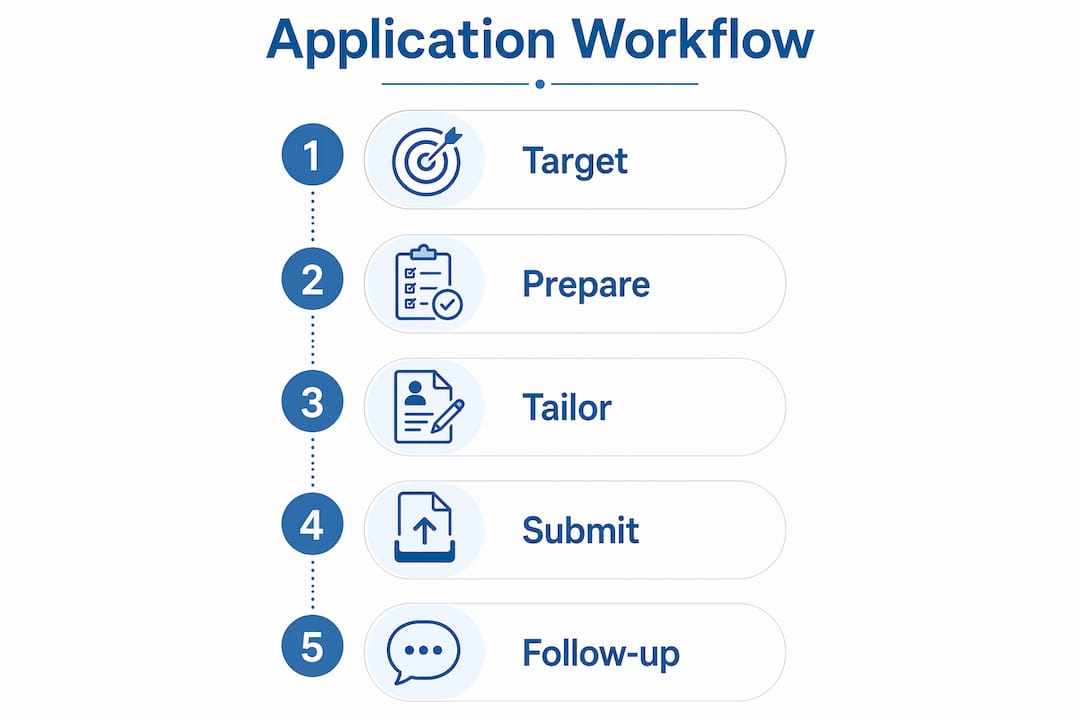
A strong remote job application workflow covers four core levers: role targeting, asset preparation, tailoring alignment, and tracking your pipeline. Each lever compounds the others. Weak targeting wastes your best-written cover letter. Strong targeting with a generic resume still fails. The workflow only produces results when all four levers work together.
The typical remote job search runs 8–16 weeks from setup to offer, with senior roles stretching to 20 weeks. That timeline is long enough to lose momentum without a system. A defined workflow keeps your effort focused and your pipeline measurable week over week.

How Do You Identify and Target the Right Remote Opportunities?
Selective targeting is the single highest-return decision in the remote hiring process. Applying to 5–10 targeted roles weekly with personalized applications yields a 20–25% conversion rate. That is a 40x improvement over mass-applying to 50+ generic listings. Volume without fit is noise.
Use a match percentage of 70% or higher as your filter before committing to an application. If you meet fewer than 7 of 10 listed requirements, the role is likely outside your conversion zone. Spending 30–45 minutes researching a company before applying is not optional. That research shapes every sentence in your resume and cover letter, and hiring managers can tell the difference immediately.
- Check the company’s remote culture signals. Look for async communication norms, documented processes, and distributed team mentions in job descriptions and on their careers page.
- Prioritize niche job boards over general ones. Spending no more than 15 minutes daily on 2–3 reliable, niche-specific sources beats scrolling broad platforms for an hour.
- Filter by recency. Apply to listings posted within the last 7 days. Older postings have already accumulated hundreds of submissions.
- Cross-reference the role with LinkedIn. Confirm the hiring manager exists, the company is actively hiring, and the role has not been filled quietly.
Pro Tip: Before applying, find the hiring manager on LinkedIn and note one specific project, article, or company initiative you can reference. That one detail, woven into your cover letter, signals genuine interest in a way no template can replicate.
You can also review job roles by specialty to understand what qualifications employers actually prioritize across different functions before you set your targeting criteria.
How Do You Build Application Assets That Work at Scale?
Efficient asset preparation is what separates job seekers who apply well from those who apply often. The goal is a modular system: one master resume, one bullet bank, and one cover letter framework that you recombine quickly for each role.
- Build a master resume with 30–40 achievement bullets. Write each bullet with a quantified outcome: “Reduced onboarding time by 3 weeks by building an async training library in Notion.” Pull the 8–12 bullets most relevant to each role.
- Match the job title language exactly. ATS-friendly formatting and exact job title mirroring improve passage through automated screening. If the posting says “Senior Content Strategist,” your resume should use that phrase, not “Content Lead.”
- Signal remote readiness explicitly. List tools like Slack, Notion, Jira, and Asana by name. Async communication fluency is a proxy hiring managers use to predict job performance in distributed teams.
- Treat your cover letter as a writing sample. Remote hiring managers evaluate cover letters as samples of async communication skill. Clarity, brevity, and structure matter as much as content.
- Use clean, single-column formatting. Tables, text boxes, and graphics break ATS parsing. A plain, well-structured document outperforms a visually complex one every time.
Pro Tip: Save a plain-text version of your master resume. Paste it into a text editor before submitting to catch any formatting characters that ATS systems misread as errors.
For a deeper look at how employers evaluate job postings and what they expect from applicants, the job posting optimization guide from Careerscape breaks down the recruiter’s perspective clearly.
When Should You Submit Remote Job Applications?
Timing your submissions affects whether a human or an algorithm reviews your application first. The best window is Tuesday or Wednesday between 9:00 AM and 11:00 AM in the employer’s local time zone. Submissions in that window improve response rates by 30–40%. That improvement comes from landing at the top of a recruiter’s inbox during their highest-focus hours.
- Avoid Monday mornings. Recruiters return from the weekend to a backlog. Your application competes with everything that arrived over the prior 48 hours.
- Avoid Friday afternoons. Applications submitted late in the week get deprioritized and often sit unread until the following Tuesday.
- Schedule submissions in advance. Draft your application the day before and set a calendar reminder to submit during the optimal window.
- Account for time zone differences. A 9:00 AM submission in New York lands at 6:00 AM in San Francisco. Always convert to the employer’s local time before scheduling.
The timing effect applies to both ATS queues and human review. Many ATS platforms surface recently submitted applications first when a recruiter opens a role. Submitting at the right moment keeps you near the top of that queue before the next wave of applicants arrives.
How Do You Track Applications and Follow up Effectively?
You cannot improve what you do not measure. Tracking your remote hiring pipeline gives you the data to identify which sources, roles, and approaches actually produce interviews. Build a simple spreadsheet with columns for company name, role title, submission date, source, follow-up dates, and current status.
- Log every application within 24 hours of submission. Delayed logging leads to gaps, and gaps mean missed follow-up windows.
- Track your application-to-interview rate by source. If LinkedIn produces a 5% rate and a niche board produces 12%, shift your time accordingly.
- Follow the three-touch system over 30 days. A three-touch follow-up sequence increases interview rates by 25–35%. Touch one: a LinkedIn connection request with a brief note on day 3. Touch two: a value-adding email referencing a specific company initiative on day 10. Touch three: a concise final check-in on day 25.
- Make every follow-up add something. Reference a recent company announcement, a relevant article, or a specific skill gap you noticed in the role description. Generic “just checking in” messages get ignored.
Pro Tip: Set a recurring 20-minute block every Friday to update your tracking sheet, review your pipeline, and schedule next-week follow-ups. Consistency in tracking is what separates job seekers who land offers from those who lose momentum after week four.
Combining direct ATS applications with personalized outreach to hiring managers ensures visibility at multiple levels of the review process. One track gets you into the system; the other gets you noticed by a person.
What Mistakes Break a Remote Application Workflow?
Generic applications are the most common and most costly mistake in the remote job application process. Tailored applications convert to interviews at 7–9%, while generic ones convert at 2–3%. That gap represents a 3–4x difference in results for the same hours invested.
- Skipping the job description fine print. Many companies embed hidden instructions in listings to filter inattentive candidates. Missing a phrase like “include the word ‘async’ in your subject line” triggers automatic rejection regardless of your qualifications.
- Omitting remote-specific skills. A resume that reads as on-site focused signals a candidate who has not thought about distributed work. Name the tools, the time zones you have worked across, and the async workflows you have managed.
- Ignoring culture fit signals. Remote companies publish their values, communication norms, and team rituals publicly. Not referencing them in your application is a missed opportunity to demonstrate alignment.
- Failing to analyze your own pipeline data. If your application-to-interview rate drops below 5% over four weeks, the problem is either targeting or tailoring. Data tells you which one to fix.
“The candidates who succeed in remote hiring are not the ones who apply the most. They are the ones who apply with the most precision, follow up with the most consistency, and treat every written touchpoint as a demonstration of how they will actually work.”
Review your pipeline every two weeks. If a particular role type or source consistently underperforms, cut it and reallocate that time to higher-converting channels. The workflow is only as good as your willingness to act on what the data shows.
Key Takeaways
A structured remote job application workflow built on targeted selection, tailored assets, precise timing, and disciplined follow-up consistently outperforms volume-driven approaches by a measurable margin.
| Point | Details |
|---|---|
| Target selectively | Apply to 5–10 roles weekly at 70%+ match to achieve a 20–25% conversion rate. |
| Tailor every asset | Customized applications convert to interviews at 7–9% versus 2–3% for generic ones. |
| Time your submissions | Submit Tuesday or Wednesday, 9:00–11:00 AM employer local time, for 30–40% better response rates. |
| Track and follow up | Use a three-touch system over 30 days to increase interview rates by 25–35%. |
| Audit your pipeline | Review application-to-interview rates every two weeks and cut underperforming sources. |
What I Have Learned from Watching Job Seekers Win and Lose in Remote Hiring
After years of watching candidates navigate the remote market, the pattern is clear: the job seekers who land offers fastest are not the most qualified. They are the most disciplined. They apply to fewer roles, write better applications, and follow up without fail.
The advice to “apply everywhere” is genuinely harmful. It burns time, dilutes your writing quality, and trains you to treat applications as disposable. The candidates I have seen succeed treat each application like a short consulting pitch. They know the company, they know the role, and they write with that knowledge visible in every sentence.
The other thing I would push back on is the idea that the workflow ends at submission. Your written touchpoints, from your resume to your follow-up emails, are the only evidence a remote hiring manager has of how you communicate. They are not just application materials. They are work samples. Build them accordingly.
Finally, build your personal brand and network in parallel with your applications. The hidden job market fills roles before they are ever posted. A strong LinkedIn presence and consistent outreach to people in your target companies put you in front of opportunities your workflow will never surface on its own.
— Bradford
How Careerscape Connects Remote Job Seekers with the Right Roles
Careerscape operates as a staffing and recruiting firm built on speed, honesty, and deep industry knowledge. For job seekers applying to remote positions, working with a specialized recruiter removes the guesswork from targeting. Careerscape matches qualified professionals with companies that are actively hiring, cutting weeks off the typical search timeline. The firm’s contract staffing solutions are particularly well-suited for candidates who want to enter a new industry or build remote work credentials quickly. If you are ready to put your workflow to work with expert support behind you, Careerscape is worth a direct conversation.
FAQ
What Is a Remote Job Application Workflow?
A remote job application workflow is a structured system for finding, applying to, and following up on remote roles in a repeatable, measurable way. It covers role targeting, resume and cover letter customization, submission timing, and pipeline tracking.
How Many Remote Jobs Should I Apply to Each Week?
Apply to 5–10 targeted roles weekly rather than mass-applying. This approach yields a 20–25% conversion rate, compared to far lower rates from high-volume, generic submissions.
What Is the Best Time to Submit a Remote Job Application?
Tuesday or Wednesday between 9:00 AM and 11:00 AM in the employer’s local time zone produces the highest response rates, improving your chances by 30–40% over off-peak submissions.
How Do I Follow up After Applying for a Remote Position?
Use a three-touch system: a LinkedIn connection request on day 3, a value-adding email on day 10, and a brief final check-in on day 25. This sequence increases interview rates by 25–35%.
Why Do Tailored Applications Perform so Much Better?
Tailored applications convert to interviews at 7–9%, while generic ones convert at 2–3%. The difference comes from matching role language, demonstrating company knowledge, and signaling remote work readiness in every section of the application.
Recommended
- Job Posting Optimization: A 2026 Recruiter’s Guide
- Job Hunting Strategies 2026: Win the Hidden Market