
In this article
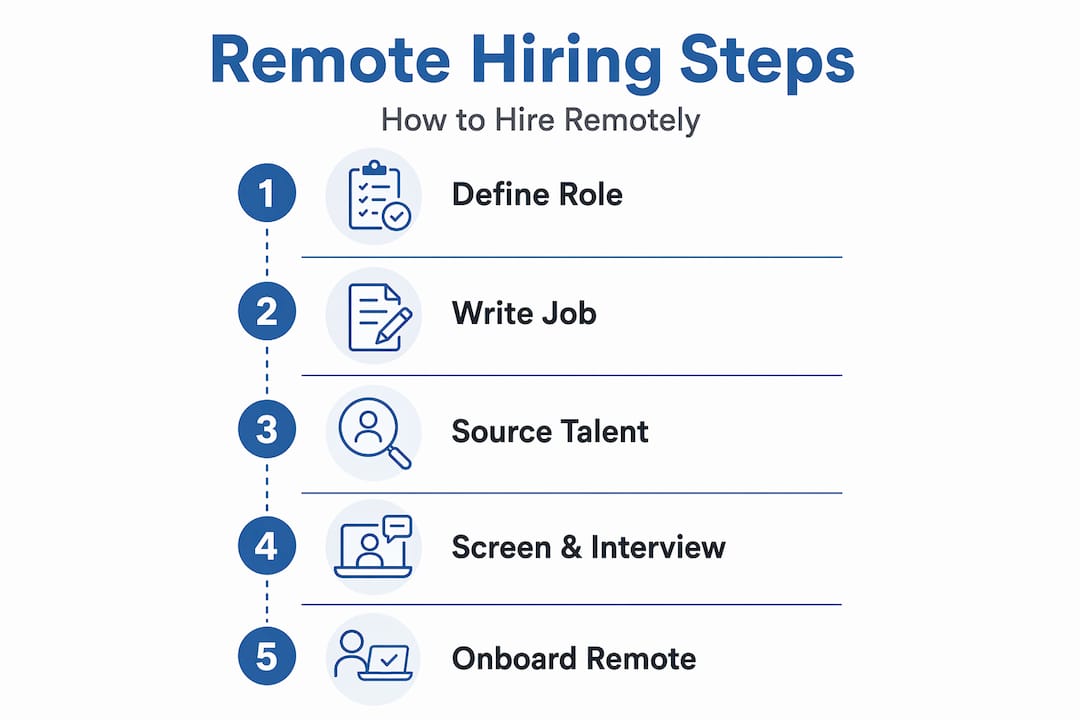
Remote hiring has permanently changed how companies compete for talent, and the volume alone creates immediate pressure. Remote roles attract roughly three times more applicants than comparable in-office positions, which means your process has to be fast, consistent, and legally sound before the first resume lands. This guide gives you a structured framework for building a remote work hiring process that scales. From defining what remote readiness actually looks like to navigating multi-state compliance and onboarding distributed employees effectively, every section is designed to close the gap between where most companies are and where their remote hiring needs to be.
Key Takeaways
| Point | Details |
|---|---|
| Define remote readiness first | Screen for async communication skills and self-direction, not just technical qualifications. |
| Use a two-round interview structure | A 30-minute video screen followed by a 60-minute competency interview improves consistency and reduces bias. |
| Treat compliance as infrastructure | Multi-state tax nexus, classification, and work authorization must be built into your process from day one. |
| Pre-board before day one | Send equipment, credentials, and documented workflows before a new hire’s first day to reduce early attrition. |
| Run pre-offer intent conversations | Surface competing offers and candidate concerns early to prevent offer drop-offs and no-shows. |
The Remote Hiring Guide: Building Your Strategy
Before you post a job or schedule a screen, you need a clear picture of what remote success looks like for your specific role. This is where most hiring managers skip a step, and it costs them.
Remote-ready candidates are not simply candidates who own a laptop and have a spare room. They share a distinct behavioral profile. The strongest predictors of remote work success include:
- Proactive async communication. Candidates who document decisions, summarize conversations in writing, and follow up without prompting.
- Self-directed work management. A track record of setting and meeting deadlines without close supervision.
- Comfort with ambiguity. The ability to move forward on a project when a manager is unavailable or asynchronous.
- Technology fluency. Not just familiarity with tools, but adaptability when workflows change.
Hiring managers should assess how candidates document decisions and handle stalled projects as key indicators of remote readiness, not just their technical competencies. A senior developer who cannot communicate clearly across time zones is a much higher risk than a mid-level developer who documents their work thoroughly and flags blockers immediately.
Once you know what you are looking for, build that into your role brief. Your job description should reflect both technical requirements and behavioral expectations. Specify communication norms, expected response times for async channels, and whether the role operates across time zones. Standardized job descriptions that reflect both technical and behavioral competencies enable consistent candidate evaluation from the very first screen.
Pro Tip: Add a short paragraph to every remote job description that describes your team’s communication culture, including which tools you use, how decisions get documented, and what your async expectations are. Candidates who self-select in based on that description will be far better fits than those drawn in by salary alone.
This preparation phase also shapes your sourcing channels and your interview questions. If you define the role well before you post it, every downstream decision from sourcing to offers becomes easier and more consistent.
Sourcing and Screening at Scale
Because remote roles attract a significantly larger applicant pool, your sourcing and screening process has to be built for volume without sacrificing quality. The answer is structure, not speed.
Start sourcing where your competitors are not. Most hiring managers default to job boards, but the best remote candidates are often passive. Network mapping, referrals from current distributed employees, and targeted outreach through professional communities yield higher-quality candidates than broad job board applications. For technical roles, industry-specialized recruiting across your sector can surface candidates who are not actively applying anywhere.
Once candidates are in the pipeline, a structured two-round process keeps evaluation consistent at scale:
- Round 1: 30-minute video screen. Focus on remote work experience, communication clarity, and async work preferences. Ask candidates to describe how they handle stalled projects and how they document decisions for distributed teammates.
- Round 2: 60-minute competency interview. Use a structured scorecard with uniform questions. Involve at least one cross-functional team member to reduce interviewer bias. This is also where structured remote interviews with consistent rubrics produce significantly more reliable assessments.
- Work sample or async assignment. A short, realistic task submitted asynchronously reveals how candidates actually work, not just how well they interview. Keep it to two hours or less to respect their time.
- Scoring and decision meeting. Score independently before the group debrief to prevent anchoring bias.
Managing scheduling across time zones is another place where most remote hiring processes lose a full week. Async hiring workflows cut scheduling delays by an average of eight days compared to traditional synchronous processes. Offer candidates a self-scheduling link and give async video responses as an option for initial screens.
Pro Tip: Build your guide to virtual interviews around asynchronous-first logistics. Record the role overview as a short video that all candidates watch before the first interview. It saves 15 minutes per screen and gives every candidate the same context, regardless of time zone.
Legal and Compliance for Remote Hiring
Legal and compliance complexity is the piece most growing companies underestimate in their remote work hiring process. Getting it wrong creates financial exposure that no talent win justifies.
The core compliance issues you need to address:
- Worker classification. The IRS applies common law rules to determine whether a remote worker is an employee or an independent contractor. Misclassifying remote workers as contractors when you control their work can result in back taxes, penalties, and benefits liabilities. The label on the contract does not override the behavioral reality of the relationship.
- Work authorization verification. Remote workers still require Form I-9 verification. In 2023, DHS introduced authorized remote verification options, but your process must be documented and consistent.
- Multi-state tax nexus. Hiring an employee in a new state can create tax obligations for your company in that state. Some states trigger nexus with a single remote employee. Multi-state payroll and proactive compliance strategies are not optional once you start hiring across state lines.
- Employment law variation. Paid leave requirements, non-compete enforceability, and salary disclosure laws vary dramatically by state. What is permissible in Texas may be legally problematic in California or New York.
For international remote hiring, the stakes are even higher. Hiring a full-time employee in a country where you have no legal entity exposes your company to permanent establishment risk and local labor law violations. Employer of Record (EOR) services resolve this by legally employing workers on your behalf, managing payroll, taxes, and compliance in each jurisdiction. Careerscape offers international staffing support to help employers navigate cross-border hiring without building their own entity infrastructure.
Here is a comparison of the two most common international hiring models:
| Approach | Best for | Key advantage | Key risk |
|---|---|---|---|
| Direct entity establishment | Large-scale, long-term hiring in one country | Full legal control | High cost and time investment |
| Employer of Record (EOR) | Rapid or small-scale international hiring | Speed and compliance coverage | Less direct employer control |
The practical lesson from companies operating at scale is that EOR consolidation under a single provider avoids the fragmented compliance and administrative overhead that comes from managing multiple country-specific vendors separately.
Remote Employee Onboarding That Actually Works
Effective remote employee onboarding starts before the first day and extends well beyond the first week. The goal is not to replicate an in-office orientation over video. It is to build clarity, connection, and confidence in a distributed environment.

Pre-boarding is where you lay the foundation. Before a new hire’s start date, effective remote onboarding includes shipping equipment, provisioning all system access and credentials, sharing a documented 30-day plan, and introducing the onboarding buddy who will be their first point of contact. A new hire who starts day one already knowing their tools, their initial priorities, and who to ask for help is far more likely to become a productive team member quickly.
A structured first-week framework looks like this:
- Day 1: Welcome call with the direct manager and team. Focus on relationship, not process. Review the 30-day plan together.
- Days 2 to 5: Async onboarding modules covering company documentation, communication norms, and role-specific workflows. No back-to-back video calls.
- Week 2 and beyond: Regular one-on-one check-ins with the manager and buddy. First small deliverable to build confidence and momentum.
Balancing async and synchronous communication is a persistent onboarding challenge. Too many video meetings in the first two weeks creates burnout and signals to the new hire that this is not actually an async-first team.
Pro Tip: Document your team’s communication norms in a shared “how we work” guide and send it during pre-boarding. Cover which decisions happen async, which require a live call, how quickly teammates are expected to respond to messages, and where information gets stored. New hires consistently report that this single document reduces their first-week anxiety more than any orientation call.
Common Pitfalls and How to Avoid Them
Even well-intentioned remote hiring processes break down in predictable places. Recognizing them early is the difference between a hire that sticks and one that walks.
- Replicating in-office culture through excessive sync meetings. This is the most common mistake and the one with the highest retention cost. Async-first workflows improve communication quality and prevent the burnout that comes from wall-to-wall video calls.
- Unstructured interviews that create inconsistent candidate experience. Without a structured scorecard, interviewers evaluate different things for different candidates, making fair comparison impossible and exposing the company to legal risk.
- Offer drop-offs and no-shows. Remote candidates frequently run multiple processes simultaneously. Pre-offer intent conversations surface competing offers and candidate concerns before you extend a formal offer, significantly reducing the rate at which accepted offers fall through.
- Salary calibration errors across geographies. Remote roles that attract national or global applicant pools require compensation benchmarking by geography, not a single flat rate. Underpaying candidates in high-cost markets drives drop-offs. Overpaying in lower-cost markets creates internal equity problems.
- Over-reliance on keyword-based sourcing for niche roles. ATS keyword filters eliminate candidates who describe the same competencies with different terminology. For specialized or technical roles, human review of a broader candidate set consistently produces better outcomes than keyword filtering alone.
“The hiring process is your first product demo. If it is slow, inconsistent, or poorly communicated, candidates draw conclusions about how your company actually operates.”
My Take on Building Remote Hiring That Scales
I have worked with enough distributed teams to say this plainly: most remote hiring problems are actually process problems that existed before remote work made them impossible to ignore.
The employers who hire and retain distributed talent well share one habit. They treat async communication as a design constraint from the start, not an afterthought. They write job descriptions that explain how the team works, not just what the role requires. They structure their interviews so that every candidate gets the same experience and every interviewer uses the same rubric. And they start onboarding before day one.
The compliance piece is where I see the most costly missteps. Companies treat it as a problem to solve later, after they have already hired someone in a new state or country. That sequencing creates real legal and financial exposure. Compliance is foundational infrastructure. Build it before you need it, not after you have triggered a nexus or misclassified your first remote hire.
On the EOR question: fragmented vendor relationships across multiple countries are a management burden that compounds over time. The companies I have seen handle international remote hiring with the least friction are the ones who consolidate under a single EOR provider early, even when the team is small.
Finally, candidate engagement is not a soft skill. Running pre-offer conversations, communicating timeline clearly, and responding fast are the difference between a filled role and a reopened search. You can’t improve what you don’t measure, and drop-off rate should be in every hiring manager’s dashboard.
— Chris
How Careerscape Supports Your Remote Hiring
Careerscape helps employers build and staff distributed teams without the process complexity slowing them down. Whether you need contract staffing solutions for flexible remote headcount or project-based teams assembled quickly around a specific initiative, Careerscape brings industry-specialized recruiters who understand the roles they are filling, not just the keywords on a resume. The firm also supports employers managing multi-state and international compliance complexity, drawing on deep knowledge of the legal and structural requirements that come with distributed hiring. If you are ready to hire, request talent now and get matched with a recruiter who knows your market.
FAQ
What Makes a Candidate Remote-Ready?
Remote-ready candidates demonstrate proactive async communication, strong written documentation habits, and the ability to manage their workload without close supervision. Technical skills alone are not reliable predictors of remote success.
How Many Interview Rounds Should a Remote Hiring Process Include?
A structured two-round process works best: a 30-minute video screen followed by a 60-minute competency interview with a consistent scorecard. Adding a short async work sample between rounds improves assessment accuracy significantly.
What Is an Employer of Record and When Do I Need One?
An Employer of Record legally employs workers on your behalf in jurisdictions where your company has no legal entity, handling payroll, taxes, and compliance. You need one when hiring internationally or in states where establishing your own entity is impractical.
How Do I Reduce Offer Drop-Offs in Remote Hiring?
Run pre-offer intent conversations before extending a formal offer to surface competing offers and candidate concerns. Combine that with fast, consistent communication throughout the process to keep candidates engaged.
What Compliance Issues Should I Watch for When Hiring Across States?
Multi-state hiring can create tax nexus obligations, trigger different paid leave and non-compete laws, and require careful worker classification. Build multi-state payroll and legal review into your process before you hire your first out-of-state remote employee.
Recommended
- What is recruiting? The employer’s guide to modern hiring
- Technology & IT Recruiters in 29 U.S. Markets | Careerscape