
Employers should establish clear salary ranges and parameters before engaging in negotiations, utilizing benchmark data to ensure defensible offers and compliance with legal standards. Documenting the rationale behind salary decisions is crucial for minimizing discrimination risks and maintaining transparency. Presenting a specific base salary early in the process, alongside total rewards and clear next steps, streamlines negotiations and helps close offers effectively while allowing for flexible, non-base pay concessions when necessary.
- Setting pay parameters with documented ranges, benchmarks, and approved flexibility before candidate conversations ensures control and transparency.
- Recording job-related reasons for salary decisions and applying them consistently reduces discrimination risk and supports defensible offers.
- Presenting a clear, specific base salary early, along with total rewards and next steps, prevents wasted time and reduces renegotiation.
- Using non-base pay concessions like signing bonuses, remote work, or phased raises can help close offers within budget constraints.
- Maintaining comprehensive documentation of offers, approvals, and benchmarking data is critical for defending pay decisions and supporting future audits.
In this article
We present a clear, benchmarked offer with a documented top and floor, then use documented, equitable concessions to close. This approach keeps negotiations inside your budget, protects you from pay-equity complaints, and gives candidates the transparency they need to say yes without a drawn-out back-and-forth.
Set pay parameters first: benchmarking, ranges, and approved flexibility
Before any conversation with a candidate starts, we build the range from real data instead of guesswork. Careerscape’s Salary Guide covers more than 450 job titles by industry, and pairing it with public figures like the Employer Costs for Employee Compensation report gives you a defensible midpoint.
Once the market data is in hand, three internal decisions keep the negotiation from drifting; using practical market benchmarking techniques employers can set pay bands and competitive offers.
- Set an absolute floor, a target number, and a maximum offer, each with a named approver before any candidate conversation starts.
- Confirm the role’s band aligns with what current employees in similar roles earn, not just what the market suggests.
- Write down the rationale for where in the range a given candidate lands, tied to experience, skill, or scope rather than instinct.
A compensation analyst’s benchmark data shows how granular this can get when a role carries wide regional or industry variation. Having the ceiling and floor in writing before you speak to a candidate means every concession later is a controlled move, not an improvised one.
Legal guardrails and documentation: salary history rules and recordkeeping
Many states, cities, and counties now prohibit asking about or relying on a candidate’s prior salary, so check local salary-history and disclosure rules before your team builds an offer around what someone used to earn. Anchoring a new hire’s pay to a past number, especially one you weren’t legally permitted to ask for, is one of the fastest ways to create a disparity you can’t explain later.
The EEOC recommends documenting compensation criteria and applying them consistently across candidates for the same role. That single habit does more to reduce discrimination risk than any amount of after-the-fact justification.
In practice, that means:
- Writing down the specific, job-related factors, such as seniority, years of relevant experience, or a scarce technical skill, that justify each starting salary.
- Applying the same criteria to every candidate for the role, regardless of their prior pay or negotiation style.
- Keeping records of starting pay decisions, bonuses, and raises so you can respond quickly if a disparity is ever questioned.
When two candidates for the same job land at different starting salaries, you should be able to point to a documented, job-related reason within minutes, not reconstruct one after the fact.
How to present the written and verbal offer
Salary should come up early enough in the process that neither side wastes weeks on a mismatch. SHRM’s guidance on employer salary conversations notes that recruiters who discuss range and total rewards candidly, and early, waste less time and lose fewer finalists to surprise. When you do present the offer, a short sequence keeps it clear:
- State the base salary as a specific number, not a range, once you’ve reached the verbal offer stage.
- Walk through total rewards: bonus structure, benefits, and any sign-on incentives, in the same order every time.
- Explain the review timeline so the candidate knows when the next raise conversation happens.
- Confirm the acceptance window and the next concrete step, whether that’s a signed letter or a start date call.
Avoid open-ended phrases like “we can probably work something out” during the verbal offer. They invite renegotiation on terms you haven’t approved and create confusion about what was actually promised. The written offer letter should mirror the verbal script word for word on base, bonus, benefits, and timeline, so there’s no gap between what the candidate heard and what they signed.
Handling counteroffers and closing: negotiation tactics for employers
When a candidate counters, the first move is diagnostic, not reactive. Ask what’s driving the number: a competing offer, a cost-of-living gap, or simple anchoring from a prior role. BLS compensation data notes that when candidates are weighing a counteroffer from their current employer, the original reasons they wanted to leave rarely disappear just because the paycheck grows, a dynamic worth keeping in mind on your side of the table too.
Pro Tip: Before agreeing to any increase, check it against your preapproved maximum and the market benchmark, not against how much you want to avoid losing the candidate.
Practical moves that keep you inside budget while still closing the hire:
- Use your documented top offer as the hard ceiling, and treat any request above it as a non-starter unless a new approver signs off.
- Reserve one-time signing bonuses for gaps that don’t justify a permanent base increase, especially when the ask is tied to a short-term need like relocation costs.
- Revisit the job’s scope before raising pay. Sometimes the mismatch is really about title or responsibilities, not dollars.
Negotiation levers beyond base pay
Base salary is the lever candidates mention first, but it’s rarely the only one that matters. When the budget for base pay is fixed, these options can close the gap without disturbing your internal pay bands:
- Offer a signing bonus or relocation support for one-time costs instead of raising the permanent base rate.
- Extend flexible scheduling or remote work days, which carries real value for many candidates at no ongoing payroll cost.
- Build a phased increase tied to a 90-day or 6-month performance milestone, so the raise is earned and documented rather than promised upfront.
- Add professional development funding or extra PTO where the role and budget allow it.
Each of these concessions still needs a paper trail. If two candidates in the same role receive different signing bonuses or PTO allotments, the reason should be as clear and job-related as a base-pay difference would need to be. Equity doesn’t stop at the salary line.
Recordkeeping and verification after agreement
Once a candidate accepts, the documentation habit continues rather than ends. Keep the signed offer letter, the approval emails authorizing the final number, the benchmarking data you used, and your interview notes together in one file for the role.
- Retain compensation records for as long as your EEOC obligations require, since these files are what you’d produce in a discrimination inquiry.
- Store benchmarking sources alongside the offer so a future reviewer can see exactly what data justified the number.
- Use this file as an input the next time you run a pay-equity audit across the team, not just when a complaint arises.
Consistent records today make every future raise, promotion, or audit faster to defend.
Careerscape perspective: how agency expertise supports defensible offers
We offer a Salary Guide to help make benchmarking easier in the offer process. Recruiters screen candidates aligned with market data employers use to set ranges, helping ensure better offer alignment. That consistency matters most on roles where internal data is thin or where a single bad comparison can throw off an entire pay band. A documented, benchmarked offer is easier to defend than one built on instinct, which is a best practice in recruiting.
— Bradford
How we help employers close offers faster
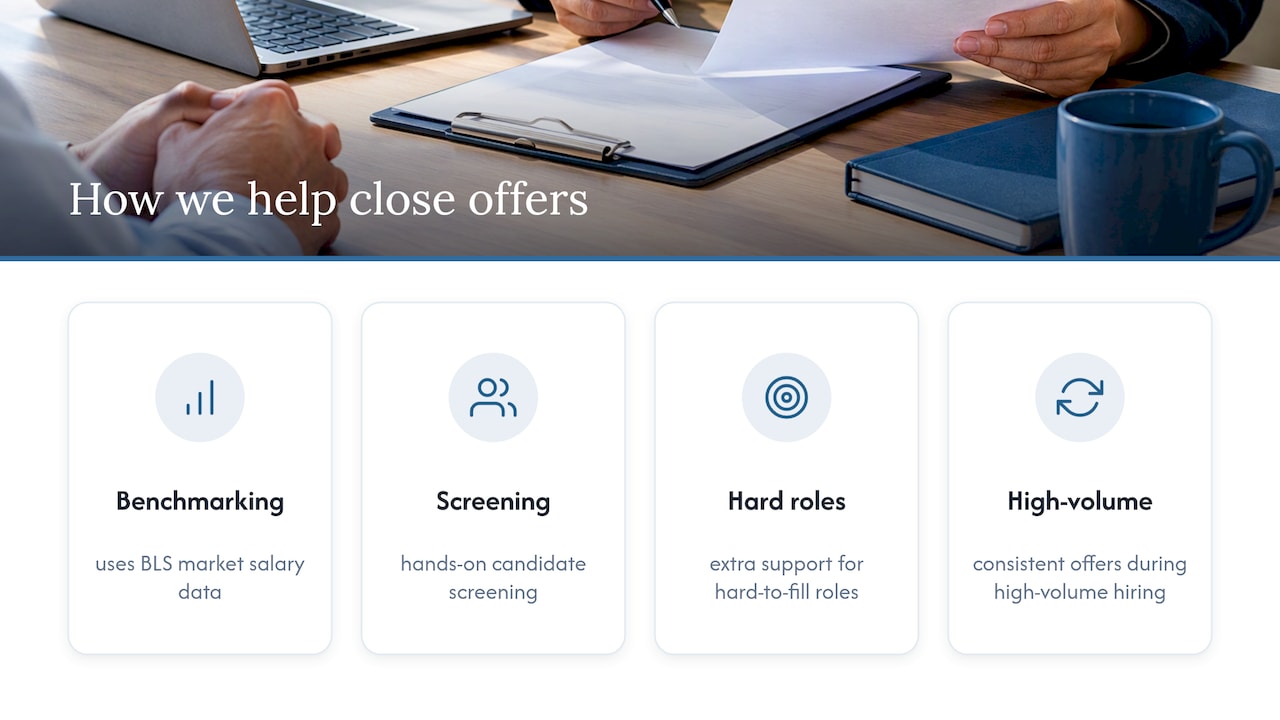
Closing a hire without overpaying or underpaying takes more than a spreadsheet, and that’s where Direct Hire support earns its keep. Recruiters pair benchmarking data with hands-on screening to help align offers with market expectations. Recruitment support can be especially helpful when a role is hard to fill, or when high-volume hiring requires consistent offers. Recruitment services can handle benchmarking and candidate fit to help your team focus on closing the deal.
FAQ
How do we decide the starting salary within our approved range?
Base the decision on documented, job-related factors such as experience, seniority, and specialized skill, applied the same way for every candidate in the role. The EEOC recommends keeping a record of that rationale so you can explain any difference between two hires later.
Can we still ask candidates what they currently earn?
Many states, cities, and counties now restrict or ban asking about prior salary, so check local rules before building your offer around it. Where it’s allowed, prior pay should inform, not determine, a number set primarily from market benchmarks.
What should we offer instead of a higher base salary?
A signing bonus, relocation support, flexible scheduling, or a phased raise tied to a performance milestone can close a gap without changing your permanent pay band. These levers work especially well when the candidate’s ask is driven by a one-time cost rather than an ongoing need.
How long should we keep salary negotiation records?
Keep offer letters, approval emails, and the benchmarking data behind each decision for as long as your EEOC recordkeeping obligations require, since these are the documents you’d need in a discrimination inquiry. The same file also supports future pay-equity audits across your team.
Where can we find reliable salary benchmarks for a specific role?
Our Salary Guide covers more than 450 job titles by industry, and public data like the BLS Employer Costs for Employee Compensation report offers a broader wage and benefits baseline. Using both together gives you a defensible range before you ever speak with a candidate.